A volumetric flask is a specialized piece of laboratory glassware used to prepare and measure liquids with high accuracy. It has a flat or pear-shaped body, a long narrow neck, and one calibration mark. This mark shows the exact volume the flask can hold. Volumetric flasks are commonly used in chemistry laboratories, pharmaceutical industries, research centers, schools, colleges, and industrial testing labs where precise solution preparation is important. These flasks are generally manufactured using high-quality borosilicate glass because it offers excellent resistance to heat and chemicals.
Structure and Volumetric Flask Diagram
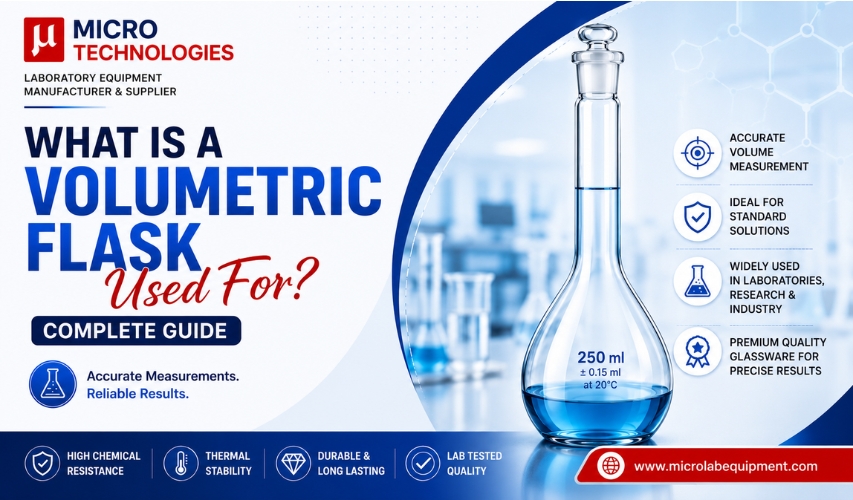
The diagram of a volumetric flask is different from ordinary laboratory flasks. It has a bulb-shaped bottom for easy mixing of liquids. It also has a narrow neck with a marked calibration line for accurate measurements. The narrow neck helps reduce measurement errors while preparing solutions. Most volumetric flasks come with a glass stopper or plastic cap to prevent contamination and evaporation during experiments.
The calibration line on the neck indicates the exact volume at a specific temperature, usually 20°C. When the liquid meniscus touches the calibration mark at eye level, the flask contains the exact labeled volume. Volumetric flasks are available in different capacities such as 10 mL, 25 mL, 50 mL, 100 mL, 250 mL, 500 mL, and 1000 mL.

A volumetric flask diagram clearly illustrates the main parts of a volumetric flask, including its flat bottom, narrow neck, calibration mark, stopper, and wide body. The diagram helps students and laboratory professionals understand how the flask is designed for accurately preparing solutions to a specific volume.
Volumetric Flask Uses
Volumetric flasks are widely used in laboratories for preparing accurate chemical solutions. Their main purpose is to ensure exact concentration and precise dilution of liquids. These flasks are essential in analytical chemistry, pharmaceutical testing, and scientific research.
Some common uses of volumetric flasks include:
- Preparation of standard solutions
- Accurate dilution of chemicals
- Quantitative chemical analysis
- Preparation of buffer solutions
- Calibration of laboratory instruments
- Titration and volumetric analysis
- Pharmaceutical and research experiments
When precise measurements are needed, volumetric flasks are preferable over regular beakers or conical flasks due to their high precision.
Read Guide: Volumetric Flask Uses
How to Use a Volumetric Flask
Using a volumetric flask correctly is important for obtaining accurate laboratory results. The process usually begins by adding the required chemical or solute into the flask. Distilled water or another solvent is then added slowly until the flask is partially filled. The solution is mixed properly to dissolve the contents completely.
After mixing, additional solvent is added carefully until the liquid level reaches the calibration mark. The bottom of the meniscus should align exactly with the mark when viewed at eye level. Once filled, the flask is closed with a stopper and inverted several times to ensure uniform mixing of the solution.
Check Our Range of Volumetric Flasks
Types of Volumetric Flasks
Volumetric flasks are available in different materials and designs depending on laboratory requirements.
Glass Volumetric Flask
Glass volumetric flasks are commonly made from borosilicate glass. They provide excellent chemical resistance and high-temperature stability, making them suitable for most laboratory applications.
Plastic Volumetric Flask
Plastic volumetric flasks are lightweight and resistant to breakage. They are often used in educational laboratories and industries where handling safety is important.
Amber Volumetric Flask
Amber-colored volumetric flasks are designed for light-sensitive chemicals and solutions. They help protect samples from ultraviolet light exposure.
Class A and Class B Volumetric Flasks
Class A volumetric flasks provide higher accuracy and are mainly used in research and analytical laboratories. Class B flasks offer lower precision and are generally used for educational purposes.
Laboratory Glassware Class A vs Class B
Advantages of Using a Volumetric Flask
Volumetric flasks offer several benefits in laboratory work because of their precision and specialized design.
- Highly accurate liquid measurements
- Easy preparation of standard solutions
- Better consistency in experiments
- Chemical and heat resistance
- Reduced measurement errors
- Suitable for analytical laboratory procedures
Their accuracy makes them one of the most important tools in chemistry and pharmaceutical laboratories.
Difference Between a Volumetric Flask and Erlenmeyer Flask
A volumetric flask is made to measure and prepare exact liquid volumes. An Erlenmeyer flask is mainly used for mixing, heating, and storing chemicals. Volumetric flasks have one calibration mark for precise measurements. Erlenmeyer flasks are not meant for highly accurate volume calculations.
Applications of Volumetric Flasks in Laboratories
Volumetric flasks are used across multiple industries and scientific fields:
- Chemical laboratories
- Pharmaceutical manufacturing
- Educational institutions
- Food and beverage testing
- Biotechnology research
- Environmental analysis
- Medical and diagnostic laboratories
These flasks help researchers maintain accuracy and consistency during experiments and testing procedures.
What is a volumetric flask used for in Laboratory?
A volumetric flask is used in laboratories to prepare and measure liquids with high accuracy. It is mainly used for making standard solutions, diluting chemicals, and performing analytical experiments where exact volume and concentration are important. These flasks help ensure precise and reliable laboratory results.
Conclusion
A volumetric flask is one of the most essential laboratory glassware instruments used for accurate measurement and preparation of solutions. Its precise calibration, durable construction, and easy handling make it ideal for analytical chemistry, pharmaceuticals, education, and industrial laboratories. Whether preparing standard solutions or performing dilution procedures, volumetric flasks help ensure reliable and accurate experimental results.
FAQs
What is the difference between a volumetric flask and a conical flask?
A volumetric flask is used for measuring and preparing liquids with high accuracy, while a conical flask is mainly used for mixing, heating, and storing solutions during laboratory experiments.
What is the difference between a volumetric flask and a standard flask?
A volumetric flask is specially designed for measuring an exact volume of liquid accurately, while the term "standard flask" is often used for general laboratory flasks that may not provide precise calibration.
What is a volumetric flask used for?
A volumetric flask is used in laboratories for preparing accurate chemical solutions and measuring fixed volumes of liquids with high precision. It is commonly used for making standard solutions, diluting chemicals, and performing analytical experiments where exact concentration and measurement are important. Volumetric flasks are used in chemistry labs and pharmaceutical plants. They are also used in research labs, schools, and quality testing. They help ensure reliable and consistent experimental results.