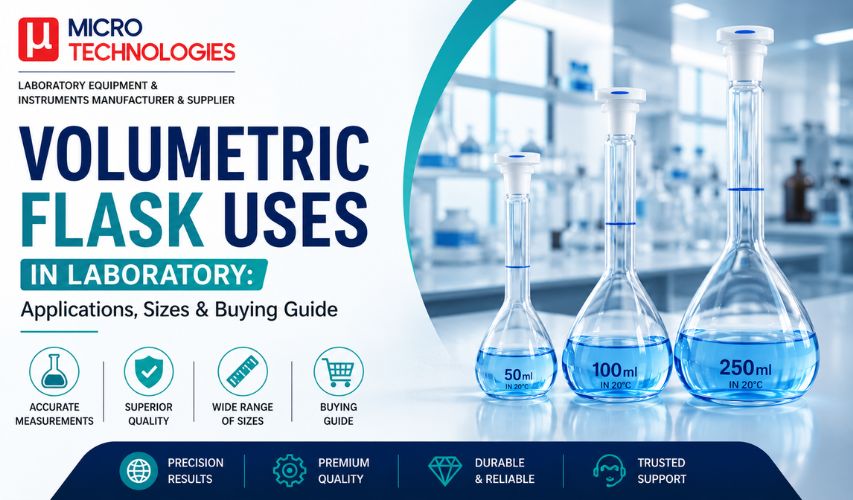
Quick answer: A volumetric flask is used in laboratories to prepare solutions of an exact, known volume. Its single calibration mark lets chemists dilute reagents, prepare standard solutions for titration, and formulate pharmaceutical or environmental test samples with a level of accuracy that beakers, conical flasks, or measuring cylinders cannot match. This makes it a core instrument in analytical chemistry, pharmaceutical QC, environmental testing, food safety labs, and academic chemistry programs.
If you’ve already read our complete guide on volumetric flasks, this post goes further. It explains where and how this glassware is used across industries. It also covers sizes and accuracy classes. It includes a practical buying checklist for lab managers and procurement teams.
What Makes a Volumetric Flask Different
A volumetric flask combines a flat-bottomed, pear-shaped bulb with a long, narrow neck and a single etched calibration ring. That narrow neck is the entire point: a small change in liquid That narrow neck is the main point. A small change in liquid volume causes a big, easy-to-see change in meniscus height. This lets the flask meet tight tolerances of ±0.1 mL on a 100 mL flask. Beakers and conical flasks, by contrast, are made for mixing and heating, not measuring. Their graduation marks are only approximate.
Most laboratory-grade flasks are blown from borosilicate 3.3 glass, chosen because it resists thermal shock, chemical attack, and dimensional drift better than soda-lime glass. Calibration is done at a fixed reference temperature — almost always 20°C — since glass and liquids both expand with heat, and even small temperature shifts can throw off a "precise" measurement if the flask isn't rated for it.
Common Applications of Volumetric Flasks in Laboratory Work
1. Preparing Standard Solutions
This is the flask's signature job. Analytical chemistry depends on reference solutions of known, exact concentration — used to calibrate instruments, validate methods, and act as the baseline against which unknown samples are compared. A volumetric flask is what makes "exact concentration" possible rather than approximate ones.
2. Serial and Bulk Dilutions
Concentrated stock solutions and reagents are rarely used at full strength. Analysts dilute them to a target concentration by adding solvent up to the calibration mark, which guarantees the dilution factor is mathematically precise rather than estimated.
3. Titration Reagent Preparation
Before a titration begins, the titrant and often the analyte are prepared in volumetric flasks and then transferred to burettes or pipettes. Any error at this preparation stage compounds through the entire titration, so this is one of the highest-stakes uses of the flask.
4. Pharmaceutical Formulation and Quality Control
Drug potency, dissolution testing, and stability studies all depend on reference and sample solutions prepared to pharmacopoeial tolerances. Pharma QC labs typically standardize on Class A volumetric flasks for exactly this reason — regulatory audits will check calibration certificates.
5. Environmental and Water Testing
Testing for contaminants — heavy metals, chlorine residuals, nutrients, and pesticide traces — requires calibration standards and diluted samples prepared to known volumes. Environmental labs use volumetric flasks daily to prepare the standards that instruments like spectrophotometers and ICP-MS systems are calibrated against.
6. Food and Beverage Testing
Nutrient analysis, additive quantification, and contaminant screening in food-testing labs follow the same logic as environmental testing: accurate standards and dilutions are non-negotiable for a result that will appear on a compliance report.
7. Academic and Teaching Laboratories
Volumetric flasks are a staple of undergraduate chemistry, where students are taught proper meniscus reading and solution-preparation technique. Institutional buyers often need larger, budget-conscious sets across common sizes (100 mL, 250 mL, 500 mL) rather than a handful of high-precision flasks.
8. Research and Method Development
In R&D settings, volumetric flasks are used to prepare calibration curves, buffer solutions, and custom reagent mixes during method validation — work where reproducibility between batches matters as much as accuracy within a single measurement.
Volumetric Flask Sizes and Where They're Used

Class A vs. Class B: Why Accuracy Class Matters More Than Size
Most buyers focus on capacity and forget tolerance class — but the class is what determines whether a flask is audit-ready.
Class A Volumetric Flask
- Tolerance: Tighter (e.g., ±0.10 mL at 100 mL)
- Typical use: Pharma QC, regulated testing, calibration standards
- Certification: Usually supplied with a batch/individual calibration certificate
- Cost: Higher
Class B Volumetric Flask
- Tolerance: Looser (typically double Class A)
- Typical use: General teaching labs, non-critical dilutions
- Certification: Often uncertified
- Cost: Lower
If your lab reports results to a regulator, a certification body, or a client under the ISO/NABL scope, Class A glassware with traceable calibration certificates isn't optional — it's the difference between a defensible result and a flagged audit finding.
How to Choose the Right Volumetric Flask for Your Lab
- Match the class to your compliance requirement. Regulated pharma, environmental, or NABL-accredited labs should default to Class A with calibration certificates; teaching and general-purpose labs can often use Class B economically.
- Confirm the glass grade. Borosilicate 3.3 is the safe default for chemical and thermal resistance; avoid uncertified soda-lime glass for anything beyond basic teaching use.
- Check the stopper type. Glass stoppers (interchangeable, ground-glass) resist solvent attack better than plastic caps, which matters for organic-solvent work.
- Plan for bulk and repeat ordering. Institutional buyers, distributors, and export clients should confirm a supplier's MOQ, breakage-in-transit policy, and lead times before placing a first order — glassware is fragile freight, and packaging quality is a real differentiator between manufacturers.
- Ask for documentation up front. ISO certification, calibration traceability, and material test certificates should be available before you order, not requested after a shipment arrives.
Common Mistakes That Undermine Accuracy
- Reading the meniscus from above or below eye level instead of straight-on, which introduces parallax error.
- Overshooting the calibration mark and trying to "fix" it by removing liquid — once overshot, the prepared solution should be discarded and remade.
- Heating a volumetric flask directly, which can distort the calibrated volume permanently.
- Using a flask past its recommended re-verification interval in regulated environments, where periodic recalibration is part of the quality system.
- Storing flasks with residual solvent or without proper cleaning, which can affect wettability and cause the liquid to cling above the calibration line.
Why Labs Choose Micro Technologies for Volumetric Glassware
Micro Technologies manufactures and exports laboratory glassware, including volumetric flasks in Class A and Class B tolerances, built from borosilicate glass for chemical and thermal durability. As a manufacturer serving educational institutions, pharmaceutical companies, research centers, and export markets across the USA, UK, Germany, UAE, and beyond, we support the following:
- Bulk and institutional orders with consistent batch-to-batch tolerance
- Custom sizing, markings, and OEM/private-label packaging for distributors
- Export-grade packaging built for fragile glassware freight
- Documentation support for ISO and calibration requirements
Explore our full laboratory glassware range or get in touch for a bulk quote, sample kit, or custom OEM specification.
Volumetric Flasks vs. Other Measuring Glassware
Lab buyers sometimes try to standardize on one type of glassware to simplify purchasing — but volumetric flasks, graduated cylinders, and pipettes solve different problems and aren't interchangeable.
- Volumetric flask: single calibration mark, highest accuracy, built for preparing one exact volume of solution.
- Graduated (measuring) cylinder: multiple markings along its length, moderate accuracy, built for quick approximate measurements of varying volumes.
- Pipette: designed to transfer a fixed or variable small volume between containers with high accuracy, not to prepare or store a solution.
A well-equipped analytical bench typically needs all three — the volumetric flask for the solution itself, the pipette for transferring aliquots, and the graduated cylinder for rough, non-critical measures like rinsing or bulk solvent handling.
Frequently Asked Questions
What is the main use of a volumetric flask in the laboratory?
Its main use is preparing solutions of a precise, known volume — most commonly standard solutions used in titration, calibration, and analytical testing.
What is the difference between a volumetric flask and an Erlenmeyer flask?
A volumetric flask is built for precise measurement to a single calibration mark, while an Erlenmeyer (conical) flask is built for mixing, swirling, and heating, with only approximate graduations.
Which volumetric flask size is most commonly used?
100 mL and 250 mL flasks see the most day-to-day use across analytical, pharmaceutical, and teaching labs, though sizes from 5 mL to 1000 mL are all standard.
Can a volumetric flask be heated?
No. Heating can distort the glass and shift the calibrated volume permanently, making the flask inaccurate. Solutions should be prepared at or near room temperature and heated separately if needed.
Do I need Class A or Class B volumetric flasks?
Class A is required for regulated, certified, or audit-facing work such as pharmaceutical QC or accredited testing. Class B is generally sufficient for teaching labs and non-critical dilutions.