Ask any chemistry student what "Class A" glassware means, and you'll probably get a shrug. Ask a pharma QC analyst the same question, and you might get a ten-minute lecture. That gap says everything about why this topic matters.
Laboratory glassware class A vs Class B isn't about which one "looks" more expensive on the shelf. It's about how much you can trust the number printed on the glass. And in a lab, trust in a number is everything.
This guide breaks down what separates Class A glassware from Class B glassware, backed by the actual standards that define them — no guesswork, no filler.
What's the Real Difference?
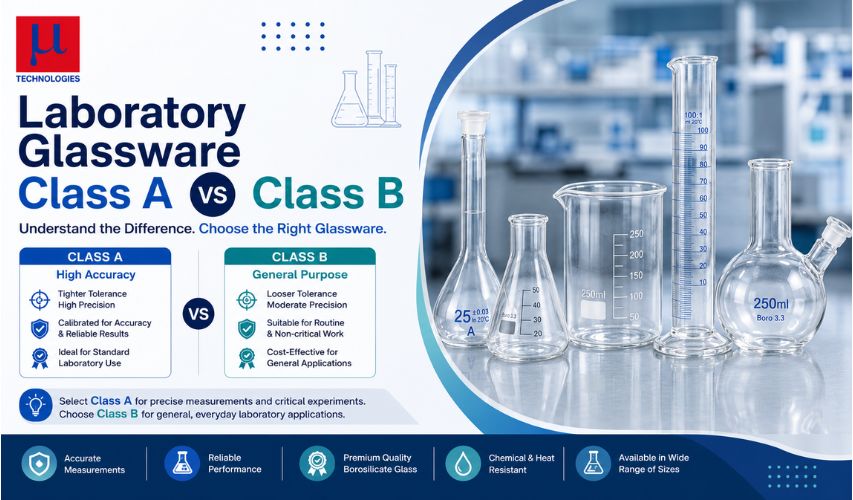
Class A and Class B are accuracy grades for volumetric glassware — flasks, pipettes, burettes, and graduated cylinders. Both classes use the same borosilicate glass. The difference sits entirely in tolerance: how far the actual volume is allowed to drift from the number printed on the glass.
Class A carries a tighter tolerance. Class B allows roughly double that tolerance. That's it. That's the whole headline.
Now let's unpack why that "small" difference changes everything for certain labs.
What Does "Tolerance" Actually Mean?
Tolerance is simply the permitted margin of error at a stated volume, measured at a reference temperature of 20°C.
Take a 10 mL volumetric flask. A Class A version is built to a tolerance of ±0.02 mL. Fill it exactly to the mark, and you're holding somewhere between 9.98 mL and 10.02 mL — never more, never less.
A Class B version of the same flask carries double that tolerance, at ±0.04 mL. So the same fill could land anywhere between 9.96 mL and 10.04 mL.
Neither number sounds dramatic on paper. But stack that error across a multi-step titration or a serial dilution, and it compounds fast.
Class A Glassware: The Precision Grade
Class A glassware is built to the tightest tolerance a manufacturer can commercially guarantee. It's governed by ASTM standards such as ASTM E694 (the general specification for volumetric ware) and calibrated according to ASTM E542, the standard practice for calibrating volumetric glassware.
Every serious volumetric flask, pipette, or burette in this category has its own individual standard too — ASTM E288 for volumetric flasks, for example. That's not bureaucracy for its own sake; it's what makes results reproducible across different labs, cities, and even countries.
Here's what typically comes with Class A glassware:
- A tighter, guaranteed tolerance (usually half of Class B)
- A calibration certificate, often with a batch or serial number for traceability
- Compliance with international quality frameworks like ISO 9000
- Preferred status in regulated environments — pharmaceutical QC, clinical labs, and anywhere audits are a regular Tuesday
If your lab answers to the FDA, an ISO/IEC 17025 accreditation body, or a GLP/GMP framework, Class A isn't a nice-to-have. It's the expected default.
Class B Glassware: The Practical Workhorse
Class B glassware isn't "lesser." It's just built for a different job.
The tolerance is roughly double that of Class A, and it's still manufactured to a recognized standard — it just isn't individually certified the same way. Think of it as the reliable daily driver next to Class A's calibrated race car.
Class B tends to show up in:
- Teaching labs, where students are learning technique, not chasing decimal points
- General reagent prep, where "close enough" genuinely is close enough
- High-throughput, non-regulated work where speed matters more than the fourth decimal place
- Bulk solution mixing, rinsing, and transport tasks
Nobody's dosing a patient based on a Class B graduated cylinder reading — and nobody needs to. That's the whole point.
The Standards Behind the Labels (ASTM and ISO)
Here's where it gets a little alphabet-soupy, but stick with it.
In the United States, ASTM International sets the tolerance rules. ASTM E288 covers volumetric flasks. ASTM E1272 covers graduated cylinders and calls out the exact geometry, graduation quality, and volumetric tolerance for each size. ASTM E438 defines the borosilicate glass itself — Type I, Class A, 3.3 borosilicate — the same base material found in most quality lab glass, including well-known heat-resistant brands.
Internationally, ISO standards do the same job under different numbers: ISO 1042 for volumetric flasks, ISO 385 for burettes, ISO 648 for one-mark pipettes, and ISO 4788 for graduated cylinders. ISO 4787 is the one that actually defines what "tolerance" means and how it's tested.
ASTM tends to dominate in the U.S., especially in pharma, where regulators lean on ASTM-based calibration. ISO is the more common reference point elsewhere. Functionally, both systems draw the same Class A / Class B line — they just speak slightly different alphabets while doing it.
Same Glass, Different Guarantee
Here's the part that surprises a lot of people: Class A and Class B glassware are usually made from the exact same borosilicate 3.3 glass.
Same chemical resistance. Same thermal shock resistance. Same durability on the bench. The glass doesn't get "downgraded" for Class B — only the calibration guarantee does.
So when someone tells you Class B is "cheap glass," gently correct them. It's not cheaper glass. It's glass with a looser promise attached to the number on its side.
Class A vs Class B: Side-by-Side Reality Check
Class A
Class A glassware is manufactured with high precision and has very low tolerance, meaning the measured volume is very close to the actual value. It is individually calibrated according to recognized laboratory standards and is used when accurate measurements are essential.
Used in:
- Research laboratories
- Analytical chemistry
- Pharmaceutical laboratories
- Quality control and testing laboratories
Example: A Class A 100 mL volumetric flask provides a more accurate 100 mL measurement than a Class B flask.
Class B
Class B glassware is designed for general laboratory use and has wider tolerance than Class A. It provides reliable measurements for routine experiments where extremely high precision is not required.
Used in:
- School and college laboratories
- Routine laboratory experiments
- Industrial and teaching laboratories
Example: A Class B 100 mL measuring cylinder is suitable for everyday laboratory measurements but is less precise than Class A.
A Real-World Example: The 100 mL Graduated Cylinder
Numbers make this concrete faster than paragraphs do.
Under ASTM E1272, a 100 mL Class B graduated cylinder can legally deliver anywhere from 99.0 mL to 101.0 mL and still pass inspection. That's about a 1% swing built into the glassware before you've even started your experiment.
For rinsing glassware or eyeballing a bulk reagent, 1% is nothing. For a concentration-sensitive titration feeding into a regulated result, that same 1% can be the difference between "compliant" and "explain yourself to the auditor."
That's not a knock on Class B. It's just a reminder that the right tool depends entirely on what you're measuring for.
How to Choose Between Class A and Class B
Ask yourself one honest question: does this measurement end up in a report someone else will rely on?
If the answer is yes — a certificate of analysis, a regulated batch record, a published result — reach for Class A. The calibration certificate alone will save you a headache during an audit.
If the answer is no — you're prepping a stock solution, teaching a class, or diluting something for a quick internal check — Class B does the job without draining the budget.
Most labs, honestly, end up using both. Class A for anything that needs a paper trail. Class B for everything that keeps the lab running day to day.
Conclusion
Laboratory glassware Class A vs Class B ultimately comes down to one variable: how tight a promise you need on the number printed on the glass. Class A gives you a narrower tolerance, a calibration certificate, and standing with regulators. Class B gives you the same solid borosilicate glass at a friendlier price, built for work where perfection isn't the assignment.
Neither class is "better" in the abstract. The better one is whichever matches what you're actually measuring — and now you know exactly how to tell the difference.
Frequently Asked Questions
What is the main difference between Class A and Class B glassware?
The tolerance. Class A has a tighter, stricter tolerance than Class B, which typically allows about double the margin of error at the same volume.
Is Class A glassware made of better glass than Class B?
No. Both are typically made from the same borosilicate 3.3 glass. The difference is in calibration tolerance, not glass quality.
Do I need Class A glassware for a school or teaching lab?
Usually not. Class B glassware is standard for teaching environments, where students are learning technique rather than producing regulated results.
Why is Class A glassware more expensive?
It's manufactured and individually calibrated to a tighter tolerance, and it typically comes with a traceable calibration certificate — both of which add cost.
Which standards define Class A and Class B glassware?
In the U.S., ASTM standards like ASTM E288 (volumetric flasks) and ASTM E1272 (graduated cylinders) define the tolerances. Internationally, ISO standards such as ISO 1042, ISO 385, and ISO 4788 cover the same ground.