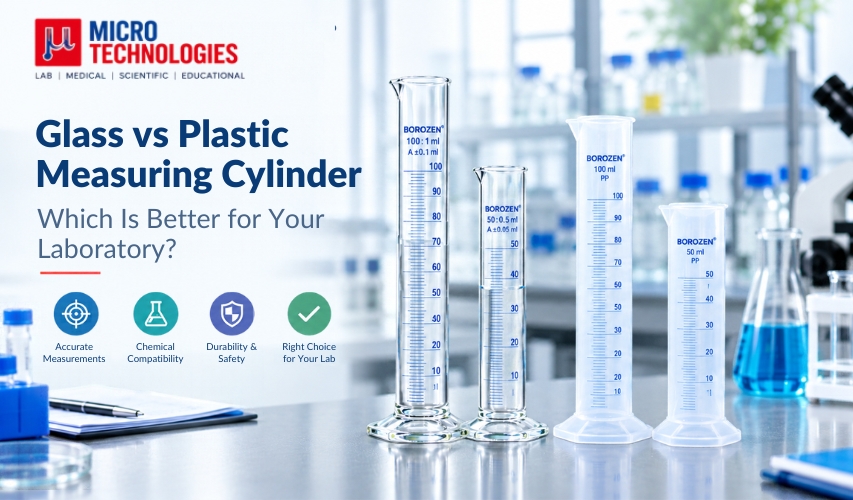
Choosing between a glass and plastic measuring cylinder may seem like a small decision, but it can affect measurement reliability, chemical compatibility, laboratory safety and replacement costs. The best option depends on what you measure, which chemicals you handle, the accuracy your procedure requires and how the equipment will be used.
Quick answer: A glass measuring cylinder is often a good choice for routine laboratory measurements when transparency, dimensional stability and compatibility with the liquid are priorities. A plastic measuring cylinder is often preferable when reduced breakage risk, lightweight handling or compatibility with a particular chemical makes it more suitable. Neither material is automatically more accurate: always check the individual cylinder's specifications and stated tolerance.
In this guide, we'll explain what measuring cylinders are, explore their main types, compare glass and plastic options, and show how to select the right laboratory measuring cylinder for your application.
What Is a Measuring Cylinder?
A measuring cylinder, also known as a graduated cylinder, is a scientific tool used to determine the volume of liquids. It typically has a tall, narrow cylindrical body with graduated markings, a stable base and, in many designs, a pouring spout.
Unlike a beaker's approximate graduations, a graduated cylinder is designed specifically for reading liquid volume. However, it is not always the appropriate tool for every precision operation. When a procedure requires a precisely prepared final volume or a highly controlled transfer, a suitable volumetric flask or pipette may be more appropriate.
How does a measuring cylinder work?
The liquid is poured into the cylinder, which is placed on a level surface. The volume read against the graded scale at eye level by using the appropriate section of the meniscus—the curved liquid surface.
For example, a student measuring 25 mL of water should use a cylinder with suitable capacity and graduations, allow the liquid to settle, and read the meniscus at eye level. Looking above or below might cause parallax mistakes.
What are the main parts of a measuring cylinder?
- Graduated scale: Markings that indicate volume, usually in millilitres (mL).
- Cylinder body: The vessel that holds the liquid.
- Base: Helps the cylinder stand upright on a stable surface.
- Pouring spout: Present on many models to help transfer liquid.
- Stopper: Included in some designs where a closure is required.
The exact design, graduation interval and capacity vary by model. Before a cylinder for a particular laboratory operation, these details should be verified.
What Are the Different Measuring Cylinder Types?
Measuring cylinders can be classified by their material, accuracy specification, design and intended application. These categories overlap: a plastic cylinder can have its own specified tolerance, while a glass cylinder can be made for general-purpose or precision use. The following distinctions help buyers compare products more accurately.
1. Glass measuring cylinders
Glass measuring cylinders are widely used for routine liquid-volume measurements in educational, research and quality-control laboratories. Borosilicate glass is commonly used in laboratory glassware because of its useful chemical and thermal properties, although suitability still depends on the chemical, concentration and operating conditions.
Common characteristics:
- Transparent body for observing the liquid.
- Printed or etched graduations, depending on the model.
- Good dimensional stability under suitable operating conditions.
- Breakage risk if dropped, struck or exposed to unsuitable thermal stress.
Borosilicate glass cylinders
Borosilicate glass is used in laboratory equipment where chemical resistance and resistance to temperature changes are important. It is not immune to thermal shock, and compatibility should be verified for the intended substance and procedure.
Class A and Class B glass cylinders
These designations relate to specified volumetric tolerances, not to whether the cylinder is glass or plastic in general. Under ASTM E1272, Class A cylinders are precision-grade cylinders meeting the applicable construction and accuracy requirements; Class B cylinders have volumetric tolerances within twice the specified range allowed for Class A.
2. Plastic measuring cylinders
Plastic measuring cylinders offer a practical alternative where impact resistance, lower weight or material-specific chemical compatibility is important. However, “plastic” is a broad category. Different polymers behave differently when exposed to solvents, heat, cleaning agents and mechanical stress.
Common characteristics:
- Generally lighter than comparable glass equipment.
- Less prone to shattering when dropped.
- May be more susceptible to scratching, distortion or wear, depending on the polymer and use.
- Requires careful checking of chemical compatibility and temperature limits.
Polypropylene (PP) measuring cylinders
Polypropylene is commonly used for laboratory plasticware. It may be a suitable option for routine volume measurement when the chemical and temperature conditions fall within the manufacturer's specifications.
Do not assume that polypropylene is compatible with every acid, base or organic solvent. Confirm compatibility for the actual chemical, concentration, exposure time and operating temperature.
Polymethylpentene (PMP) measuring cylinders
PMP is a transparent thermoplastic used in some laboratory volumetric products. It can provide good visibility while reducing breakage risk compared with glass. The accuracy and temperature limitations of a PMP cylinder must still be confirmed from its product documentation.
PFA fluoropolymer cylinders
PFA is a fluoropolymer used in specialized laboratory applications where its chemical-resistance characteristics may be useful. These products are not interchangeable with ordinary polypropylene cylinders, and their suitability should be assessed against the chemical and procedure involved.
Manufacturer guidance on laboratory plastics emphasizes that material selection must be matched to the application rather than based on the generic label “plastic.”
3. Specialized measuring cylinders
Not every cylinder-shaped laboratory vessel is intended for the same task. Some specialized cylinders have specific measurement or testing purposes.
Tapped density cylinders
Tapped density cylinders are used in powder testing to determine how the volume of a powder changes after a defined tapping procedure. The test is relevant to applications such as pharmaceutical powder characterization. A standard graduated cylinder should not automatically be substituted for a cylinder required by a specified test method.
Nessler cylinders
Nessler cylinders are used in certain visual comparison tests, including colour comparison in analytical and water-testing procedures. Their dimensions and intended use differ from those of ordinary graduated cylinders.
Rain measuring cylinders
Rain measuring cylinders are used to measure collected rainfall, typically in meteorological or educational settings. They are designed for a different purpose from a standard laboratory cylinder used to measure a liquid sample.
These specialized products should be selected according to the relevant test method or application, not simply because they resemble a measuring cylinder.
4. Cylinders with different designs
Graduated cylinders may have pouring spouts, reinforced rims or stopper-compatible designs. The appropriate design depends on how the liquid will be measured, contained and transferred. ASTM E1272 describes several designs of laboratory glass graduated cylinders, including spouted and stopper-compatible styles.
Which is better for chemical resistance?
There is no universal winner.
Borosilicate glass is suitable for many laboratory liquids, but some chemicals can attack glass under particular conditions. Plastic performance varies substantially between PP, PMP, PFA and other polymers. For instance, a material selected for one acid solution may not be appropriate for a different solvent or a higher operating temperature.
Before choosing a cylinder, check:
- The exact chemical and concentration.
- The operating and cleaning temperatures.
- The duration and frequency of exposure.
- The manufacturer's chemical-compatibility information.
- Any restrictions in the laboratory's approved procedure.
Practical rule: Never choose a cylinder based solely on the statement that glass or plastic is “chemically resistant.” Confirm compatibility for the actual application.
Which is safer to handle?
Plastic may be preferable in environments where dropped glassware creates a significant hazard, such as busy teaching laboratories or settings where equipment is handled repeatedly. Glass can remain suitable in laboratories that require its specific properties and have appropriate handling procedures.
Plastic is not risk-free, however. A cracked, distorted or chemically damaged plastic cylinder can also compromise measurements. Safe selection includes considering the liquid's hazards, the equipment's condition and the laboratory's operating procedures.
Advantages and Disadvantages of Glass Measuring Cylinders
Glass cylinders are useful when their optical, chemical and dimensional characteristics fit the procedure. Their disadvantages matter most when breakage, weight or thermal stress is a concern.
Advantages of glass measuring cylinders
1. Clear liquid visibility
Transparent glass makes it easier to inspect the liquid level and observe the meniscus. This is helpful when reading graduated markings.
2. Suitable chemical properties for many applications
Borosilicate glass is used in laboratory equipment because of its useful chemical resistance. Nevertheless, compatibility must be checked for the actual reagent and conditions.
3. Dimensional stability under suitable conditions
Glass does not soften in the same way as many common plastics at relatively modest temperature changes. This can be useful for specified laboratory procedures, but the cylinder must still be used within its design limits.
4. Availability of defined tolerance classes
Glass graduated cylinders are available with documented accuracy specifications. ASTM E1272, for example, defines requirements for precision and general-purpose glass graduated cylinders. The standard's Class A and Class B distinctions concern volumetric tolerance and applicable requirements.
Disadvantages of glass measuring cylinders
1. Breakage risk
A dropped cylinder may crack or shatter. Broken glass can create injury and contamination hazards and may require the sample to be discarded.
2. Greater handling weight
Glass cylinders may be heavier than comparable plastic models, particularly in larger capacities.
3. Thermal shock concerns
Sudden temperature changes can damage glass. A cylinder should not be heated or rapidly cooled unless its manufacturer and the procedure specifically permit the conditions.
4. Replacement and handling costs
The purchase price is only one part of the total cost. Laboratories may also need to account for breakage, replacement frequency, storage and safe disposal.
When should a laboratory choose glass?
Glass may be the preferred option when the required method specifies it, when a suitable glass cylinder meets the necessary tolerance, or when its transparency and material properties fit the application.
It is particularly important to follow the method's requirements in regulated testing or quality-control work. A material change should not be made solely to reduce purchasing costs without verifying that the alternative meets the method's requirements.
Advantages and Disadvantages of Plastic Measuring Cylinders
Plastic cylinders can make everyday laboratory work more convenient, but their performance depends on the polymer and the specific product.
Advantages of plastic measuring cylinders
1. Reduced shattering risk
Many plastic cylinders resist impact better than glass. This can be helpful in teaching laboratories, high-use work areas and settings where broken glass creates an operational concern.
2. Lightweight construction
Plastic cylinders are often easier to handle and move, particularly when multiple vessels are used during routine work.
3. Options for different applications
Polymers such as PP and PMP have different characteristics, allowing laboratories to select products that match their handling, visibility and chemical-compatibility requirements.
4. Practical use in routine measurement
When the required tolerance and material compatibility are satisfied, a plastic cylinder can be a sensible choice for everyday volume measurement.
Disadvantages of plastic measuring cylinders
1. Compatibility varies by polymer
A plastic cylinder suitable for water may not be appropriate for a particular solvent, concentrated chemical or cleaning agent. Compatibility must be verified rather than assumed.
2. Potential scratching or deformation
Some plastic products can become scratched or distorted during repeated use, cleaning or unsuitable storage. Damage can make graduations harder to read or affect the product's suitability.
3. Temperature limitations
Plastic products have material-specific operating and cleaning limits. A cylinder should not be autoclaved, heated or used with hot liquids unless the manufacturer confirms that the specific model is suitable.
4. Accuracy still needs verification
Impact resistance does not establish volumetric accuracy. A plastic cylinder must still meet the tolerance and calibration requirements of the task.
When should a laboratory choose plastic?
Consider plastic when reducing glass breakage, improving handling convenience or using a particular polymer's chemical properties is important—and the cylinder meets the procedure's accuracy requirements.
For a teaching laboratory that measures routine aqueous solutions, for example, a suitable plastic cylinder may be practical. For a method that specifies a calibrated glass cylinder, replacing it with plastic without checking the method would not be appropriate.
Which Measuring Cylinder Is More Accurate: Glass or Plastic?
The answer depends on the individual cylinder's specifications. Material alone does not establish measurement accuracy.
Accuracy depends on factors such as the instrument's graduation design, stated tolerance, calibration, condition, reading technique and the temperature conditions specified for its use.
What do Class A and Class B mean?
Under ASTM E1272, Class A glass graduated cylinders are precision-grade cylinders that meet the applicable construction and accuracy requirements. Class B cylinders have volumetric tolerances within twice the specified range allowed for Class A cylinders.
This distinction must not be confused with the glass-versus-plastic comparison. Class A and Class B are tolerance classifications in the relevant standard; they are not synonyms for glass and plastic.
How do calibration and tolerance affect measurement?
Suppose a laboratory needs to measure 100 mL of a liquid. Two cylinders may both have a 100 mL capacity, but their graduation intervals and stated tolerances may differ. The cylinder with finer-looking markings is not automatically the more accurate one.
The purchaser should check:
- Nominal capacity and graduation interval.
- Stated volumetric tolerance.
- Whether the cylinder is calibrated to contain or to deliver, where relevant.
- The applicable standard and manufacturer documentation.
- Whether the equipment meets the analytical method's requirements.
ASTM E1272 includes different tolerance limits for glass graduated cylinders of different capacities. This illustrates why a single generic accuracy figure should not be applied to every cylinder.
When should you use a volumetric flask or pipette instead?
A graduated cylinder is suitable for many routine volume measurements. However, some procedures need a more specialized instrument.
- Volumetric flask: Often used to prepare a solution to a specified final volume.
- Volumetric pipette: Used to deliver a specified volume according to its calibration.
- Burette: Used to dispense variable measured volumes, commonly in titration.
The right instrument depends on the procedure and required uncertainty. Do not use a graduated cylinder as a substitute where the approved method specifies a different volumetric instrument.
Glass vs Plastic Measuring Cylinders for Different Laboratory Applications
The best cylinder is the one that meets the requirements of the actual task. Here are practical considerations for common laboratory settings.
1. School and college chemistry laboratories
In educational laboratories, equipment may be handled by many students, increasing the importance of clear markings, straightforward handling and breakage prevention.
- Consider plastic where reducing glass breakage is a priority and the material and tolerance meet the experiment's requirements.
- Consider glass where students need to learn standard glassware handling and the experiment calls for a suitable glass instrument.
For example, a school measuring the volume of water during a basic practical may use an appropriate glass or plastic cylinder. The choice should reflect the lesson, safety requirements and required measurement quality.
2. Pharmaceutical and quality-control laboratories
Pharmaceutical laboratories may work under approved analytical methods and documented quality procedures. In these settings, the material, capacity, tolerance, calibration and equipment identification may all matter.
Before choosing a cylinder, verify that it meets the relevant method and quality requirements. A plastic alternative should not be introduced simply because it is less likely to break; compatibility, extractables or contamination considerations, and the method's requirements may also need assessment.
3. Chemical testing and research laboratories
Research laboratories handle a wide variety of liquids, from water-based solutions to reactive chemicals and organic solvents.
The selection should begin with chemical compatibility. Check the exact polymer or glass type against the liquid, concentration, temperature and exposure time. A cylinder appropriate for one experiment may be unsuitable for another.
4. Water testing and routine liquid measurement
For routine water-volume measurements, either material may be suitable if it meets the required tolerance and is compatible with the sample and cleaning process.
For analytical tests, the approved method takes priority. The measuring vessel must not introduce unacceptable contamination or compromise the specified procedure.
5. High-throughput laboratories
Laboratories that perform many repetitive measurements may benefit from evaluating breakage frequency, ease of handling, cleaning requirements and replacement costs.
A plastic cylinder may reduce costs associated with glass breakage in some workflows. However, a meaningful purchasing comparison should consider total operating cost rather than assuming one material is always cheaper over its lifetime.
How to Choose the Right Measuring Cylinder for Your Laboratory
Before purchasing a laboratory measuring cylinder, use this practical checklist.
Step 1: Select the correct capacity
Choose a cylinder with a capacity that suits the volume you usually measure. A cylinder should not be selected on maximum capacity alone: the graduation interval must also be suitable for the required reading.
For example, if a procedure calls for measuring a small volume, a suitable smaller-capacity cylinder may make the graduations easier to interpret than a much larger cylinder.
Step 2: Confirm the required tolerance
Determine how accurate the measurement needs to be. Review the product's specified tolerance and applicable standards rather than relying on the material or the number of printed scale divisions.
If the method requires a particular class or calibration specification, verify that the selected product satisfies it.
Step 3: Check chemical compatibility
Identify the actual liquid, its concentration and the operating conditions. Ask the supplier for compatibility information if the documentation does not clearly address your application.
Do not assume that all glass or plastic cylinders are suitable for every laboratory chemical.
Step 4: Review temperature and cleaning requirements
Check the permitted operating temperature and cleaning procedure. Confirm autoclave compatibility before sterilizing plastic equipment, and avoid exposing glassware to unsuitable thermal shock.
Step 5: Consider breakage and handling
Evaluate how frequently the cylinder will be moved, who will use it, and whether broken glass would create a significant safety or contamination risk.
Step 6: Review product documentation and supplier support
Before ordering, confirm:
- Material and nominal capacity.
- Graduation interval and stated tolerance.
- Calibration and standards information, where applicable.
- Chemical compatibility and temperature limits.
- Product condition, warranty and replacement arrangements.
- Availability of relevant technical documentation.
Step 7: Compare total cost, not just purchase price
The lowest initial price may not provide the best value if the equipment is unsuitable for the application or requires frequent replacement. Compare expected service life, handling risks, cleaning requirements and replacement costs.
Common Mistakes to Avoid When Using Measuring Cylinders
Even a suitable measuring cylinder can produce unreliable results if it is used incorrectly.
Reading the meniscus from the wrong angle
View the liquid level at eye height to reduce parallax error. For liquids that form a concave meniscus, such as water in clean glass, the reading is generally taken at the bottom of the curve unless the relevant procedure specifies otherwise.
Choosing a material without checking compatibility
Do not assume that a cylinder is suitable because it is labelled “laboratory grade.” Verify the specific material's compatibility with the chemical and temperature involved.
Using damaged graduations
Scratches, faded markings, cracks and deformation can affect usability. Inspect the cylinder before use and replace it when its condition compromises safe handling or reliable measurement.
Ignoring calibration conditions
Some volumetric equipment is calibrated at a specified reference temperature. Follow the manufacturer's instructions and the applicable procedure when temperature affects the measurement.
Using the cylinder for every precision task
Graduated cylinders are versatile, but they are not substitutes for every volumetric instrument. Select a volumetric flask, pipette or burette when the procedure requires one.
Why Choose Micro Technologies for Laboratory Measuring Cylinders?
Micro Technologies provides a laboratory equipment catalogue that includes a Measuring Cylinders. Laboratories, educational institutions and procurement teams can use the category as a starting point when exploring equipment for their requirements.
When selecting a cylinder, identify your required capacity, material, tolerance and intended application before finalizing a purchase. If you are purchasing for a college laboratory, research facility or quality-control department, make sure the product specifications match your laboratory's needs.
Looking for the right measuring cylinder for your laboratory? Explore the Micro Technologies measuring cylinder range and contact the supplier to confirm the specifications of the model you need.
Frequently Asked Questions
Is a glass measuring cylinder better than a plastic one?
Neither is universally better. Glass can be suitable when its chemical properties, transparency and specified tolerance meet the task's requirements. Plastic can be preferable when reduced breakage risk or lightweight handling is important. Select the material according to the application.
Are plastic measuring cylinders accurate?
Yes, plastic measuring cylinders can be suitable for accurate volume measurements when their design and stated tolerance meet the requirements of the procedure. Check the specific model's specifications rather than assuming all plastic cylinders have the same accuracy.
Which plastic is best for laboratory measuring cylinders?
There is no single best plastic for every application. Polypropylene (PP), polymethylpentene (PMP) and PFA have different properties. Choose the material based on chemical compatibility, temperature, transparency, tolerance and the manufacturer's recommendations.
Can plastic measuring cylinders be heated or autoclaved?
Only if the specific cylinder is rated for the intended temperature and sterilization method. Heat resistance varies by polymer, product design and exposure conditions. Always follow the manufacturer's instructions.
Which measuring cylinder is best for a chemical laboratory?
The best cylinder is one that meets the chemical compatibility, capacity, tolerance and safety requirements of the procedure. Glass and plastic can both be appropriate in different situations.
What is the difference between Class A and Class B measuring cylinders?
Under ASTM E1272, Class A glass graduated cylinders meet the standard's precision-grade requirements, while Class B cylinders have volumetric tolerances within twice the specified Class A range. These classes concern tolerance requirements, not simply the difference between glass and plastic.
How do you clean a glass or plastic measuring cylinder?
Use a cleaning method compatible with the cylinder's material and the substances being removed. Avoid abrasive cleaning that can damage the graduations or surface. Follow the manufacturer's guidance, rinse as required by the procedure and allow the cylinder to drain or dry appropriately.
Can a measuring cylinder replace a volumetric flask?
Not when the method requires the specific performance of a volumetric flask. A measuring cylinder is generally used for routine volume measurement, while a volumetric flask is designed for preparing a solution to a specified final volume. Follow the approved procedure.
Which Measuring Cylinder Should You Choose?
The decision between a glass and plastic measuring cylinder comes down to the demands of your laboratory—not simply which material is more popular.
Choose glass when its chemical properties, visibility and documented tolerance meet the application. Consider plastic when its impact resistance, handling advantages and polymer-specific compatibility better suit the workflow. In either case, confirm the capacity, graduation interval, accuracy requirements and manufacturer documentation before purchasing.
For laboratory equipment buyers, the most reliable approach is to start with the measurement task, identify the required specifications and then compare suitable products.
Explore the Micro Technologies Measuring Cylinders to begin evaluating options for your laboratory.