A small difference in liquid volume can sometimes make a big difference in laboratory results. Whether a researcher is preparing a chemical solution, measuring a milk sample, transferring reagents, or running biological experiments, controlling liquid volume is essential. This is why a pipette is one of the most important instruments found in modern laboratories.
A pipette is a lab tool. It measures and transfers set amounts of liquid between containers. Depending on its design, it can deliver a fixed volume or measure different quantities using graduated markings. From traditional glass volumetric pipettes to modern micropipettes, these instruments support accurate liquid handling in chemistry, microbiology, pharmaceutical testing, biotechnology, and research applications.
But are all pipettes designed for the same purpose? How does a graduated pipette work, and what makes it different from a volumetric pipette? Understanding these differences helps laboratory professionals select the right instrument for their work.
In this guide, we will explore what a pipette is, its labelled diagram, different types, working principles, laboratory uses, calibration methods, and important buying considerations. We will also discuss how to select suitable laboratory pipettes from Micro Technologies.
What Is a Pipette?
A pipette is a laboratory measuring instrument designed to aspirate, measure, and transfer controlled quantities of liquid from one container to another. It is commonly used in scientific laboratories where liquid measurement and consistent sample handling are important.
Pipettes are available in different designs, materials, and measurement capacities. Traditional glass pipettes are often used for volume measurements. Mechanical micropipettes are made to handle very small liquid volumes. These volumes are often measured in microliters (µL).
For example, a researcher may need to make a chemical solution. They may need to pour a measured amount of one liquid into a volumetric flask. Then they add another liquid. A suitable pipette allows the researcher to perform this transfer according to the required measurement.
A laboratory pipette is commonly used for:
- Measuring and transferring liquid samples.
- Preparing chemical solutions and dilutions.
- Handling laboratory reagents.
- Transferring biological samples.
- Performing analytical and research procedures.
- Measuring milk samples for dairy testing.
- Supporting pharmaceutical quality-control activities.
The type of pipette selected depends on the required volume, measurement accuracy, liquid properties, and laboratory application.
Pipette Diagram – Parts and Functions
Understanding a pipette diagram makes it easier to identify its construction and understand how the instrument works.
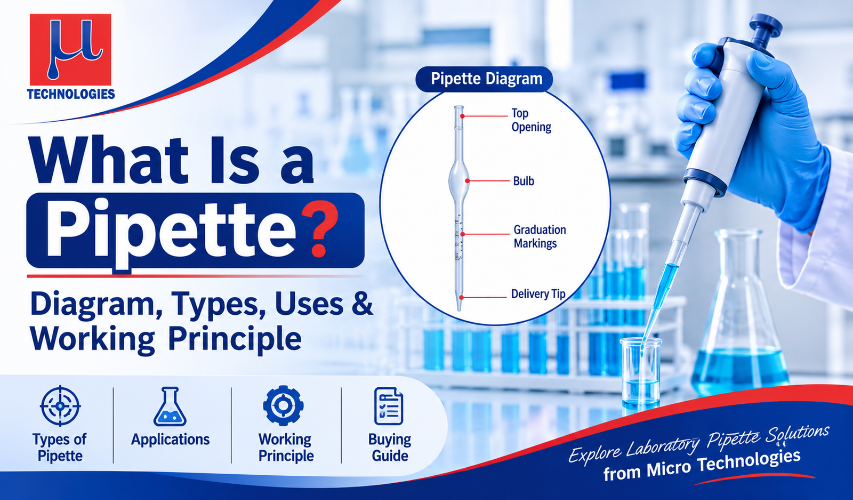
A traditional glass pipette and a modern micropipette have different designs. A glass pipette generally consists of a narrow tube, measurement markings, a calibrated bulb, and a delivery tip. A micropipette has a mechanical operating system with a plunger, a volume adjustment mechanism, and a disposable tip.
Main Parts of a Glass Pipette
A typical glass pipette contains the following parts:
1. Top Opening: The upper opening through which liquid is drawn using a suitable pipette filler or aspiration device.
2. Stem or Barrel: The long, narrow glass section through which the liquid moves.
3. Graduation Markings: Measurement lines printed on graduated pipettes to indicate liquid volume. These markings help users measure different quantities.
4. Bulb: The wider central section found in volumetric pipettes. Its shape allows a specified volume of liquid to be held.
5. Calibration Mark: A reference line indicating the volume for which the pipette is calibrated.
6. Delivery Tip: The narrow lower end through which the measured liquid is dispensed into another container.
Main Parts of a Micropipette
A micropipette has a different mechanical design.
- Plunger Button: Used to control liquid aspiration and dispensing.
- Volume Adjustment Knob: Allows the user to select the required volume on adjustable models.
- Volume Display: Shows the selected measurement.
- Tip Ejector Button: Removes the used disposable tip.
- Shaft or Nozzle: Connects the pipette body to the tip.
- Disposable Pipette Tip: Holds the liquid during aspiration and dispensing.
Understanding these components helps users operate the instrument correctly and reduce common liquid-handling errors.
How Does a Pipette Work? Working Principle Explained
The working principle of a pipette depends on its construction. Glass pipettes generally use controlled aspiration and gravity-based delivery, while mechanical micropipettes use piston-driven displacement.
Working Principle of a Glass Pipette
A glass pipette works by drawing liquid into its tube and delivering a specified quantity through its narrow tip.
The basic process involves the following steps:
- Attach a suitable pipette filler or aspiration device.
- Draw the liquid into the pipette until the required measurement is reached.
- Position the instrument correctly and check the appropriate meniscus or graduation.
- Transfer the liquid into the receiving container.
- Allow the liquid to drain according to the pipette's calibration instructions.
A volumetric pipette is generally designed to deliver a specified fixed volume, while a graduated pipette provides multiple measurement points.
Working Principle of a Micropipette
Most conventional air-displacement micropipettes work through a piston-and-air-cushion mechanism.
When the plunger is pressed, the internal piston moves down and displaces air. When the plunger is released with the disposable tip immersed in liquid, a pressure difference draws liquid into the tip.
Pressing the plunger again pushes the liquid out.
There are two important micropipette mechanisms:
Air-Displacement Micropipette: Uses an air cushion between the piston and the liquid. It is widely used for routine laboratory liquid handling.
Positive Displacement Micropipette: Uses a piston that directly contacts the liquid within a suitable capillary and piston assembly. This design can be advantageous for viscous, volatile, or other challenging liquid samples.
These operating principles are also described in the technical guidance for ISO 8655-2:2022 and the Microlit Micropipette Guide.
What Are the Different Types of Pipettes?
There are several types of pipettes used in laboratories, and each has a different purpose. Some are designed for fixed-volume measurements, while others allow flexible measurement or controlled transfer of small liquid quantities.
Understanding the types of pipettes helps laboratory professionals choose the appropriate instrument instead of using the same design for every procedure.
1. Volumetric Pipette
A volumetric pipette, also known as a transfer pipette, is designed to deliver a specified fixed volume of liquid with a defined level of accuracy.
It generally has a bulb-shaped central section, a narrow stem, and a calibration mark. Unlike a graduated pipette, it is not intended to measure multiple different volumes along its length.
Key characteristics:
- Designed for a specified volume.
- Usually has one principal calibration mark.
- Used for controlled liquid transfer.
- Available in different nominal capacities.
- Commonly used in analytical chemistry.
Applications:
Volumetric pipettes are used in preparing standard solutions, chemical analysis, quantitative experiments, and laboratory procedures requiring a specified liquid volume.
2. Graduated Pipette
A graduated pipette is a measuring instrument with multiple graduation markings along its stem. These markings allow the user to measure and transfer different quantities of liquid within the pipette's specified capacity.
For example, a suitable 5 mL graduated pipette may be used to measure 1 mL, 2 mL, 3 m, or other marked quantities within its calibrated range.
Key characteristics:
- Contains multiple volume markings.
- Allows measurement of different liquid quantities.
- Available in various capacities and subdivisions.
- Used in analytical, educational, and research laboratories.
Graduated pipettes are commonly classified into Mohr and serological designs.
A. Mohr Pipette
A Mohr pipette is a type of graduated pipette in which the graduation markings generally stop before the delivery tip.
It is commonly designed for partial delivery between specified markings.
Main features:
- Graduated scale along the stem.
- Markings typically stop above the tip.
- Used for measuring and transferring selected liquid volumes.
- Dispensing must follow the specified calibration instructions.
Common applications: Chemical laboratories, volumetric analysis, educational experiments, and reagent transfer.
B. Serological Pipette
A serological pipette is a graduated pipette generally designed with measurement markings extending down towards the delivery tip.
It is commonly used for transferring measured liquid volumes in clinical, biological, pharmaceutical, and research laboratories.
Main features:
- Graduated measurement scale.
- Different available measurement capacities.
- Often supplied as disposable plastic or reusable glass versions, depending on the application.
- Certain designs are marked for blow-out dispensing.
An important point is that not every graduated pipette should be emptied using the same technique. Users must follow the calibration and blow-out markings on the actual instrument.
3. Micropipette
A micropipette is a precision liquid-handling instrument used to measure and dispense very small quantities of liquid, commonly in microliters.
It is widely used in molecular biology, microbiology, pharmaceutical research, and diagnostic laboratories.
Common types of micropipettes:
- Fixed-Volume Micropipette: Designed to dispense a specified volume.
- Variable-Volume Micropipette: Allows the user to adjust the volume within the instrument's specified operating range.
- Single-Channel Micropipette: Transfers liquid through one channel.
- Multichannel Micropipette: Transfers liquid through multiple channels, commonly for microplate work.
Micropipettes are especially useful when handling small quantities of reagents, DNA samples, enzymes, and biological solutions.
4. Pasteur Pipette
A Pasteur pipette is a simple liquid-transfer instrument commonly designed with a narrow tube and a bulb or compatible aspiration mechanism.
It is primarily used to transfer or dispense small amounts of liquid, often drop by drop.
Key characteristics:
- Simple construction.
- Available in glass and disposable plastic versions.
- Commonly used for transferring liquids.
- Generally not intended for high-precision volumetric measurements unless specifically calibrated.
Applications: Sample preparation, transferring reagents, laboratory demonstrations, and general liquid handling.
5. Transfer Pipette
A transfer pipette is designed to move liquid from one container to another. The term can describe different products, including simple disposable transfer devices and precision volumetric transfer pipettes.
A volumetric transfer pipette has a defined delivery volume, while an ordinary transfer dropper may not provide precise measurement.
Applications:
- Chemical sample transfer.
- Laboratory solution preparation.
- Biological sample handling.
- Analytical procedures.
The instrument should be selected according to the required measurement accuracy.
6. Milk Testing Pipette
A milk testing pipette is a specialized laboratory instrument used for measuring and transferring specified milk sample volumes during dairy testing procedures.
For example, a 10.75 mL milk testing pipette is listed in the Micro Technologies product range for dairy laboratory applications.
Key characteristics:
- Designed for a specified milk sample volume.
- Available in different accuracy classes.
- Used in dairy testing laboratories.
- Helps maintain consistent sample measurement during testing procedures.
Milk testing pipettes are especially relevant to dairy quality-control laboratories, milk testing centers, and educational institutions conducting dairy science practicals.
What Is a Graduated Pipette? Uses, Features and Working
A graduated pipette is a laboratory measuring instrument that has a number of graduation lines along its stem. They are also marked for measuring and transferring various volumes of liquid depending on the calibrated capacity of the instrument.
A graduated pipette is more versatile for liquid handling than a volumetric pipette, which is designed to contain a fixed, specified volume.
For example, a researcher working with a 10 mL graduated pipette may need to transfer different amounts of reagent for several experiments. Instead of requiring a separate fixed-volume pipette for every quantity, the user can select the required measurement from the available markings.
Important features of a graduated pipette:
- Clear graduation markings.
- Different nominal capacities.
- Controlled liquid aspiration and delivery.
- Availability in Mohr and serological designs.
- Suitable for a variety of analytical and laboratory procedures.
How to Read a Graduated Pipette
Reading a graduated pipette correctly is essential for obtaining a reliable measurement.
Follow these steps:
- Check the total capacity and smallest graduation of the pipette.
- Hold the pipette vertically while taking the reading.
- Fill the pipette using an appropriate pipette filler.
- Remove any external drops and allow the liquid level to stabilise.
- Read the correct meniscus at eye level, following the applicable liquid and instrument instructions.
- Record the initial and final readings, where the method requires calculation from two markings.
Example:
Suppose a graduated pipette has an initial reading of 1 mL and a final reading of 4 mL. The delivered volume is:
Delivered volume = Final reading − Initial reading
Delivered volume = 4 mL − 1 mL = 3 mL
This example illustrates how the difference between two scale readings can determine the volume delivered.
For a transparent aqueous liquid in a conventional clear glass pipette, the lower meniscus is generally read at eye level. The correct reading method should always follow the instrument and laboratory procedure.
What Is the Difference Between a Volumetric Pipette and a Graduated Pipette?
Volumetric and graduated pipettes are both used for measuring and transferring liquids, but their construction and measurement functions are different.
- Design: Volumetric pipettes feature a bulb-shaped central section with a calibration mark, whereas graduated pipettes have a graduated scale along the stem.
- Measurement: Volumetric pipettes measure a specified fixed volume, while graduated pipettes can measure different volumes within their calibrated range.
- Markings: Volumetric pipettes have one or specified calibration marks, whereas graduated pipettes have multiple volume markings.
- Main Purpose: Volumetric pipettes are designed for controlled delivery of a fixed volume, while graduated pipettes offer flexible volume measurement.
- Typical Application: Volumetric pipettes are typically used for standard solution preparation, while graduated pipettes are used for general analytical liquid transfer.
A volumetric pipette is generally preferred when a specific fixed volume is required, while a graduated pipette is useful when different liquid quantities need to be measured.
The choice depends on the required measurement accuracy and laboratory procedure. The construction and metrological requirements for single-volume pipettes are described in ISO 648:2008.
What Is the Difference Between Class A and Class B Pipettes?
Laboratory glass pipettes may be available in different accuracy classes, including Class A and Class B.
These classifications indicate the applicable maximum permissible measurement errors according to the relevant standard and pipette capacity.
Class A Pipette
A Class A pipette belongs to the higher accuracy grade under the applicable glassware standards.
It is generally selected for procedures where tighter measurement tolerances are required.
Common applications:
- Quantitative chemical analysis.
- Standard solution preparation.
- Analytical research.
- Laboratory quality-control procedures.
Class B Pipette
A Class B pipette belongs to a lower accuracy grade than Class A under the relevant standards.
It can be suitable for routine laboratory work where its specified tolerance meets the application's requirements.
Common applications:
- Routine laboratory measurements.
- Educational experiments.
- General liquid transfer.
- Standard laboratory procedures.
The permitted tolerance is not the same for every capacity. It should be checked against the relevant standard and actual product specification rather than assuming a universal difference.
What Are TC and TD Markings on Pipettes?
Two important markings found on volumetric laboratory instruments are TC and TD.
Understanding them helps users avoid incorrect liquid transfer.
TC – To Contain: The instrument is calibrated to contain a specified volume of liquid when filled to its calibration mark.
TD – To Deliver: The instrument is calibrated to deliver a specified volume of liquid under the prescribed drainage conditions.
For example, a TD-marked pipette is meant to deliver its stated volume when used as instructed. A small amount of liquid may stay in the tip after normal drainage. The instrument is designed for that delivery behavior.
This is why users should not automatically force out the remaining liquid from every glass pipette.
What Are the Uses of a Pipette in a Laboratory?
A pipette is used wherever a controlled quantity of liquid needs to be measured, transferred, or dispensed.
Its applications extend across several scientific and industrial sectors.
1. Chemical Laboratories
Pipettes are commonly used to measure chemical reagents, prepare standard solutions, perform dilutions, and transfer liquids during volumetric analysis.
For example, when preparing a standard solution, a suitable volumetric pipette may be used to transfer a specified quantity of stock solution into a volumetric flask.
2. Pharmaceutical Laboratories
Pharmaceutical laboratories use pipettes during sample preparation, reagent measurement, analytical testing, and quality-control procedures.
Suitable pipettes help laboratory professionals perform controlled liquid handling according to their testing methods.
3. Microbiology Laboratories
Microbiology laboratories use pipettes to transfer culture media, reagents, and liquid samples.
Disposable pipettes and micropipettes with appropriate tips can support sample handling and contamination-control practices.
4. Clinical and Diagnostic Laboratories
Pipettes are used for handling measured quantities of laboratory samples and reagents during diagnostic and analytical procedures.
Suitable disposable tips and correct pipetting techniques are particularly important when working with biological samples.
5. Dairy and Milk Testing Laboratories
Milk testing pipettes are used for transferring specified volumes of milk samples during dairy laboratory procedures.
A 10.75 mL milk testing pipette, for example, is a specialised option listed in the Micro Technologies laboratory pipette range.
6. Educational and Research Laboratories
Schools, colleges, universities and research institutes use different types of pipettes to teach liquid measurement, chemical analysis and laboratory techniques.
Students can learn about volumetric measurements, graduation readings, and controlled sample transfer through practical experiments.
How to Use a Pipette Correctly?
Using a pipette correctly is important because incorrect handling can affect measurement accuracy and experimental results.
The operating method depends on whether you are using a traditional glass pipette or a mechanical micropipette.
Using a Glass Pipette
- Select a pipette with the required volume and suitable accuracy.
- Inspect the glassware for cracks, chips, and damaged graduation markings.
- Attach an appropriate pipette filler.
- Draw the liquid above the required measurement mark.
- Adjust the meniscus to the correct reading at eye level.
- Position the pipette over the receiving container.
- Allow the liquid to drain as instructed by its calibration.
- Follow the product's delivery and waiting-time instructions.
Safety reminder: Never use mouth pipetting. Always use an appropriate pipette filler or aspiration device.
Using a Micropipette
- Select a micropipette with a suitable volume range.
- Set the required volume within its specified operating range.
- Fit a compatible disposable pipette tip.
- Press the plunger to the first stop.
- Immerse the tip slightly into the liquid.
- Slowly release the plunger to aspirate the sample.
- Position the tip against the receiving vessel's inner wall when appropriate.
- Press the plunger smoothly to dispense the liquid.
- Use the second stop when the instrument's forward pipetting technique requires it.
- Eject the used tip into the appropriate waste container.
Correct technique includes controlling the aspiration speed, using compatible tips, and avoiding bubbles and unnecessary splashing.
The Government of India's Biosafety Manual for TB Laboratories provides detailed guidance on forward and reverse pipetting techniques and reducing aerosol generation.
Common Pipetting Mistakes and How to Avoid Them
Even a suitable pipette may produce unreliable results when it is used incorrectly.
Here are some common mistakes and practical ways to avoid them.
- Using the wrong pipette capacity: Select the instrument according to the required volume.
- Misreading graduation markings: Hold the pipette vertically and read at eye level.
- Incorrect meniscus reading: Follow the correct meniscus-reading procedure.
- Using an incompatible pipette filler: Use suitable accessories for the instrument.
- Forcing out residual liquid: Follow TC/TD and blow-out markings.
- Creating air bubbles: Aspirate slowly and steadily.
- Reusing disposable tips between samples: Change tips to reduce carry-over contamination.
- Ignoring calibration: Follow a documented verification and calibration schedule.
- Using damaged glassware: Inspect pipettes before use.
A practical point worth remembering is that consistent technique matters just as much as instrument quality. Users should be trained to follow the appropriate operating procedure for each pipette type.
Why Is Pipette Calibration Important?
Pipette calibration is the process of evaluating whether an instrument measures or delivers liquid within its specified performance limits.
It matters because the delivered volume may differ from the intended volume. This can happen due to instrument condition, user technique, temperature, and liquid properties.
Calibration and performance verification help laboratories maintain confidence in their liquid measurements.
Important Factors in Pipette Calibration
Accuracy: Indicates how close the delivered volume is to the selected or nominal volume.
Precision: Indicates how consistently the pipette produces repeated measurements.
Tolerance: Defines the permissible measurement error for a specified instrument and capacity.
Traceability: Helps connect measurement results to recognised measurement standards through documented calibration processes.
Gravimetric Calibration Method
For suitable piston-operated pipettes, gravimetric calibration is commonly based on weighing the water delivered by the instrument.
The measured mass is converted into volume using the relevant water-density data and environmental conditions.
The process requires suitable equipment, controlled measurement conditions, and a documented procedure.
Relevant Pipette Standards
Laboratories and buyers should be aware of the following standards:
- ISO 648:2008: Laboratory glassware – Single-volume pipettes.
- ISO 835:2007: Laboratory glassware – Graduated pipettes.
- ISO 8655-2:2022: Piston-operated volumetric apparatus – Pipettes.
These standards cover different instrument categories and their respective metrological requirements. A laboratory should select the appropriate standard for the pipette being used.
Reference: International Organization for Standardization (ISO).
How to Choose the Right Pipette for Laboratory Use?
Selecting the right pipette requires more than checking its price or appearance. A suitable instrument should match the actual laboratory application, required liquid volume,e and measurement tolerance.
Before purchasing a laboratory pipette, consider these factors.
1. Identify the Laboratory Application
First, understand what kind of work the pipette will be used for.
For example, analytical chemistry may require a volumetric pipette, while routine measurement of different quantities may call for a graduated pipette.
2. Check the Required Volume
Pipettes are available in different nominal capacities and operating ranges.
Choose an instrument that can measure the required volume without operating outside its specified range.
3. Select the Suitable Pipette Type
Consider whether your laboratory requires:
- Volumetric pipettes for specified fixed volumes.
- Graduated pipettes for different measured quantities.
- Serological pipettes for graduated liquid transfer.
- Micropipettes for microlitre-level handling.
- Milk testing pipettes for specified dairy sample measurements.
4. Review the Accuracy Class
Determine whether Class A or Class B is appropriate for your procedure.
Check the allowable tolerance for the actual capacity rather than relying on the class name alone.
5. Check the Construction Material
Glass pipettes are widely used for laboratory volumetric measurements. The material should be suitable for the intended liquids, cleaning procedures, and laboratory conditions.
6. Review Calibration and Certification
For applications requiring documented measurement assurance, check the calibration information and certificates supplied with the instrument.
Review the document, its scope, identification details, and traceability information rather than relying only on a product description.
7. Consider Cleaning and Maintenance
Choose a pipette that can be maintained according to your laboratory's procedures.
Inspect glassware regularly and avoid using damaged instruments.
8. Purchase from a Reliable Laboratory Equipment Supplier
Before making a purchase, compare the product's specifications, capacity, accuracy class, documentation, and supplier support.
These factors can help laboratories make a better long-term purchasing decision.
Laboratory Pipettes Manufacturer and Supplier in India – Micro Technologies
Choosing a suitable pipette is an important part of establishing an effective laboratory liquid-handling process. Laboratories need instruments that match their testing requirements, measurement capacity, and applicable accuracy specifications.
Micro Technologies offers a range of laboratory pipettes for different liquid measurement and transfer applications.
Its current laboratory pipette category includes volumetric pipettes, serological pipettes, and milk testing pipettes, with different product models and accuracy-class options.
Explore Laboratory Pipettes Available at Micro Technologies
Product
Volumetric Pipette One Mark
Class A Volumetric Pipette with Certificate
Transfer Volumetric Pipette with One Mark
Milk Testing Pipette 10.75 mL Class A
Milk Testing Pipette 10.75 mL with NABL Certificate
Milk Testing Pipette 10.75 mL Class B
Transfer Volumetric Pipette Class A with Certificate
Transfer Volumetric Pipette Class A with NABL Certificate
Graduated Serological Pipette Class B
Graduated Serological Pipette Class A with Certificate
Graduated Serological Measuring Pipette with NABL Certificate
These products are listed in the official Micro Technologies Laboratory Pipettes category.
Why Consider Micro Technologies for Laboratory Pipettes?
1. Multiple Pipette Options
Explore volumetric, serological, and milk testing pipettes through one product category.
2. Different Accuracy Class Options
The listed range includes selected Class A and Class B product options to help buyers identify a suitable instrument for their laboratory requirements.
3. Product Documentation Options
Certain listed products are offered with certificates, including products described as supplied with NABL certificates. Buyers should review the relevant certificate and its scope before purchase.
4. Solutions for Different Laboratory Applications
The product range supports laboratory measurement, sample transfer, educational activities, and dairy testing requirements.
5. Institutional and Commercial Enquiries
Laboratories, colleges, universities, research facilities, and dairy testing institutions can contact Micro Technologies to discuss their equipment requirements.
Find the Right Pipette for Your Laboratory
Whether you need a volumetric pipette for a fixed-volume application, a graduated serological pipette for liquid measurement, or a milk testing pipette for dairy analysis, selecting the correct instrument is essential.
Explore the available product specifications and choose according to your required capacity, accuracy, and application.
Explore Products: https://www.microlabequipment.com/category/laboratory-pipettes
Business: Micro Technologies
Website: https://www.microlabequipment.com/
Contact: +91 9416155221
Call to Action: Explore laboratory pipettes from Micro Technologies and enquire about suitable solutions for your laboratory.
Frequently Asked Questions About Pipettes
1. What is a pipette and what is it used for?
A pipette is a laboratory instrument used to measure and transfer controlled quantities of liquid from one container to another. It is commonly used in chemical analysis, sample preparation, microbiology, pharmaceutical testing, and research.
2. What are the main types of pipettes?
The main types of pipettes include volumetric pipettes, graduated pipettes, Mohr pipettes, serological pipettes, micropipettes, Pasteur pipettes, transfer pipettes, and milk testing pipettes.
3. What is a pipette diagram?
A pipette diagram is a labelled visual representation of a pipette that identifies its main components, such as the stem, graduation markings, bulb, calibration mark, and delivery tip. A micropipette diagram additionally shows components such as the plunger, volume display, and tip ejector.
4. What is a graduated pipette?
A graduated pipette is a laboratory measuring instrument with multiple volume markings along its stem. It allows users to measure and transfer different quantities of liquid within its calibrated capacity.
5. What is the difference between a volumetric and graduated pipette?
A volumetric pipette is designed to deliver a specified fixed volume, whereas a graduated pipette has multiple measurement markings and allows users to transfer different liquid volumes.
6. What is a Mohr pipette used for?
A Mohr pipette is a graduated glass pipette commonly used to measure and transfer selected liquid volumes. Its graduation markings generally stop before the delivery tip.
7. What is a serological pipette used for?
A serological pipette is used to measure and transfer liquid volumes in clinical, biological, pharmaceutical, and research laboratories. Depending on its design, it may be available in graduated glass or disposable plastic versions.
8. What is the difference between Class A and Class B pipettes?
Class A pipettes belong to the higher accuracy grade, while Class B pipettes have more permissive measurement tolerances. The exact permissible error depends on the pipette type, nominal capacity, and applicable standard.
9. How does a micropipette work?
A conventional air-displacement micropipette works through a piston-driven air-displacement mechanism. Moving the plunger creates a pressure difference that draws liquid into a disposable tip and allows it to be dispensed in a controlled manner.
10. Why is pipette calibration important?
Pipette calibration helps establish whether the instrument measures or delivers liquid within its specified tolerance. It supports measurement accuracy, repeatability, and reliable laboratory procedures.
11. Which pipette is used for milk testing?
A specialised milk testing pipette is used to measure specified quantities of milk samples for dairy laboratory procedures. Micro Technologies lists 10.75 mL milk testing pipettes in Class A and Class B options.
12. Where can I buy laboratory pipettes in India?
Laboratory pipettes can be sourced from scientific equipment manufacturers and suppliers. Micro Technologies offers a range of volumetric, graduated, serological, and milk testing pipettes through its official website.
Contact Micro Technologies
A pipette is an essential laboratory instrument that supports accurate liquid measurement, controlled sample transfer, and reliable scientific procedures. Understanding its diagram, working principle, and different types helps laboratory professionals choose the right instrument for their applications.
From volumetric and graduated pipettes to serological and milk testing pipettes, each design serves a particular purpose. Factors such as measurement capacity, accuracy class, calibration, and proper handling should always be considered before purchasing.
For laboratories, educational institutions, research centres, and dairy testing facilities, Micro Technologies offers a range of laboratory pipettes to explore. Selecting the right equipment can help support consistent liquid-handling practices and more dependable laboratory operations.