Have you ever wondered how laboratories maintain clean working conditions when even tiny airborne particles can affect sensitive samples, experiments and research results?
A laboratory may have advanced instruments, experienced researchers and carefully prepared samples, but uncontrolled airborne contamination can still affect the quality of laboratory work.
This is where clean air equipment becomes important.
Clean air equipment plays a valuable role in laboratories, pharmaceutical facilities, biotechnology centres, hospitals and research institutions. It helps control airborne particles, maintain cleaner working areas, manage contamination risks and provide appropriate protection during different laboratory procedures.
From Laminar Air Flow Cabinets and Biological Safety Cabinets to Laboratory Fume Hoods, PCR Workstations and Pass Boxes, each type of equipment serves a different purpose.
But how do these systems work? Which equipment does your laboratory actually need? And what should you check before purchasing?
In this guide, we will explore the meaning, working principles, different types, applications, benefits and important buying considerations for laboratory clean air equipment.
What Is Clean Air Equipment?
Clean air equipment refers to specialised laboratory and industrial equipment designed to filter air, control airflow, reduce airborne contamination and maintain suitable working conditions for specific applications.
These systems commonly use air filtration technologies, controlled airflow mechanisms, protective enclosures and ventilation arrangements to minimise the movement of unwanted particles or hazardous substances.
Depending on the equipment, clean air solutions may protect sensitive products, provide containment for biological materials, control chemical fumes or support cleaner environments for laboratory operations.
For example, a Laminar Air Flow Cabinet creates a clean working area for handling contamination-sensitive samples. A Biological Safety Cabinet provides appropriate containment and protection when handling biological materials. A Laboratory Fume Hood helps control exposure to chemical vapours.
The equipment selected depends on the nature of the work, the material being handled and the level of protection required.
Clean air equipment is commonly used in:
- Microbiology laboratories
- Pharmaceutical manufacturing facilities
- Biotechnology research centres
- Hospitals and healthcare facilities
- Tissue culture laboratories
- Molecular biology laboratories
- Food testing laboratories
- Electronics and precision manufacturing facilities
- Educational and scientific research institutions
The main purpose is not simply to make the air feel cleaner. It is to create controlled working conditions that support safer procedures, better contamination management and more reliable laboratory operations.
How Does Clean Air Equipment Work?
Clean air equipment works by combining air movement, filtration and suitable enclosure designs to control the environment around a particular working process.
Although the exact operating principle differs between equipment types, many filtration-based systems follow a similar process.
1. Air Intake
The system draws surrounding air into the equipment through an air intake or pre-filtration arrangement.
2. Pre-Filtration
A pre-filter helps capture larger dust particles and other airborne contaminants before the air reaches the main filtration stage.
3. HEPA Filtration
Many laboratory clean air systems use HEPA (High-Efficiency Particulate Air) filters to capture airborne particulate matter.
According to the US Environmental Protection Agency, a HEPA filter is theoretically capable of removing at least 99.97% of particles measuring 0.3 microns under the specified HEPA definition. Actual system performance also depends on filter integrity, installation, sealing and the complete equipment design.
4. Controlled Airflow
After filtration, the air moves through the equipment according to its design.
It may flow horizontally, vertically or inward towards an exhaust or filtration system.
5. Contamination Management
The equipment maintains a controlled working zone or containment arrangement to minimise the movement of airborne contaminants.
Important: Clean, filtered air does not automatically mean a sterile environment. Proper cleaning, disinfection, handling procedures, equipment maintenance and suitable laboratory practices remain essential.
What Are the Different Types of Clean Air Equipment?
Clean air equipment is available in different configurations because laboratories do not all perform the same activities.
Some require a clean working area for sensitive samples, whereas others need protection from biological hazards, chemical vapours or airborne powders.
Here are the major types of clean air equipment used in laboratories.
1. Laminar Air Flow Cabinet
A Laminar Air Flow Cabinet is laboratory equipment designed to create a clean working environment using filtered, unidirectional airflow.
It directs filtered air across the working surface to help protect samples, instruments and materials from airborne particulate contamination.
Depending on the design, the airflow may move horizontally or vertically.
Types of Laminar Air Flow Cabinets:
- Horizontal Laminar Air Flow: Filtered air moves horizontally from the rear of the cabinet towards the operator.
- Vertical Laminar Air Flow: Filtered air moves vertically downwards over the working surface.
- Ceiling-Mounted Laminar Air Flow: Installed above a working area to provide controlled filtered airflow.
- Reverse Laminar Air Flow Booth: Uses a different airflow arrangement for applications involving powder and particulate containment.
Common applications:
- Microbiology laboratories
- Pharmaceutical sample preparation
- Tissue culture procedures
- Laboratory media preparation
- Electronics assembly
- Research and development activities
Why is it important?
During sensitive laboratory work, airborne dust and other particles may compromise sample integrity. A suitable Laminar Air Flow Cabinet helps reduce this contamination risk by maintaining a cleaner working zone.
However, a conventional laminar flow clean bench is primarily designed to protect the product or sample. It does not provide adequate protection for the operator against infectious biological materials or hazardous chemicals.
2. Biological Safety Cabinet (BSC)
A Biological Safety Cabinet is specialised laboratory equipment used for safely handling biological materials that may create potentially hazardous aerosols.
Unlike a conventional clean bench, a suitable Biological Safety Cabinet is designed to provide protection for laboratory personnel, the surrounding environment and, depending on its class, the material being handled.
It uses controlled airflow and high-efficiency filtration to manage contamination risks.
Common types of Biological Safety Cabinets:
- Class I Biological Safety Cabinet
- Class II Biological Safety Cabinet
- Class III Biological Safety Cabinet
Class I provides personnel and environmental protection but does not provide product protection. Class II provides personnel, environmental and product protection when correctly selected and operated. Class III is a fully enclosed cabinet designed for higher-containment applications.
Common applications:
- Microbiology research
- Clinical laboratories
- Cell culture work
- Biotechnology research
- Biological sample handling
- Pharmaceutical research
Why is it important?
When laboratory personnel work with biological materials, appropriate containment is important to reduce exposure risks.
A suitable biosafety cabinet helps establish controlled conditions for these activities.
The correct cabinet must be selected through a risk assessment rather than simply choosing a model based on appearance or price.
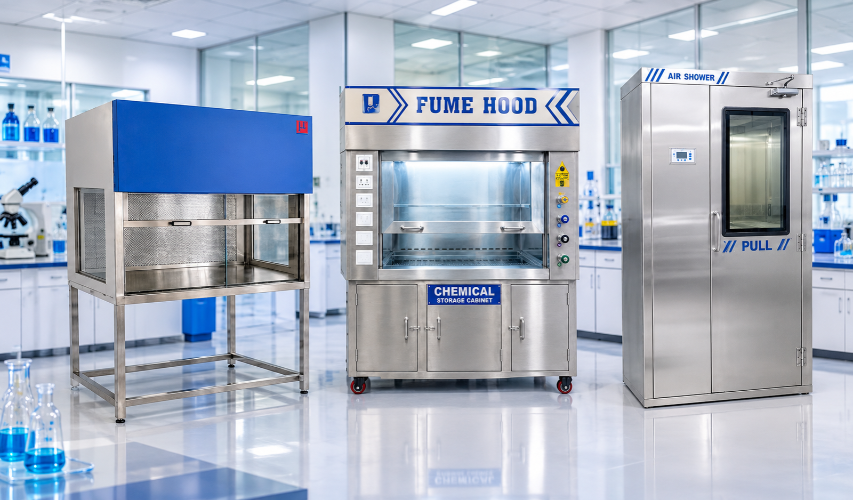
3. Laboratory Fume Hood
A Laboratory Fume Hood is designed to capture and remove hazardous chemical fumes, vapours and gases generated during laboratory procedures.
It generally works by drawing air through the working opening and directing contaminated air towards an exhaust system.
The sash provides a physical barrier between the operator and the working area.
Types of Laboratory Fume Hoods:
- Conventional Chemical Fume Hood
- Ducted Fume Hood
- Ductless Fume Hood
- Polypropylene Fume Hood
- Walk-In Fume Hood
Different designs are suitable for different chemicals, workflows and ventilation requirements.
Common applications:
- Chemical laboratories
- Pharmaceutical research
- Chemical analysis
- Academic research institutions
- Quality control laboratories
- Industrial testing facilities
Why is it important?
Chemical handling can produce fumes and vapours that should not be allowed to accumulate in the working environment.
A properly designed and installed fume hood helps capture and remove these substances through an appropriate exhaust arrangement.
Remember that a chemical fume hood is not a substitute for a biological safety cabinet.
4. PCR Workstation
A PCR Workstation is a specialised clean-air working station designed to reduce contamination risks during Polymerase Chain Reaction (PCR) preparation and related molecular biology activities.
PCR is a technique used to amplify specific DNA sequences. Even small amounts of unwanted DNA contamination may affect the reliability of results.
A PCR workstation commonly incorporates filtered airflow, an enclosed working area and, depending on its configuration, UV lighting.
Common applications:
- DNA preparation
- RNA handling
- Molecular diagnostics
- Genetic research
- PCR reagent preparation
- Biotechnology laboratories
Why is it important?
Molecular biology procedures require careful sample handling. A dedicated workstation can help reduce exposure to airborne contamination and support more consistent sample preparation.
A PCR workstation should not be assumed to provide protection against infectious aerosols or chemical hazards unless specifically designed and certified for that purpose.
Micro Technologies offers a PCR Workstation (MT-107 Series), model MTW-01, for PCR preparation and molecular biology applications.
5. Clean Booth
A Clean Booth is an enclosed or partially enclosed working area designed to provide a controlled environment for operations that require reduced airborne particulate contamination.
It generally uses filtered air supplied through suitable filtration and airflow arrangements.
Compared with a conventional clean bench, a clean booth can provide a larger controlled working area.
Common applications:
- Pharmaceutical manufacturing
- Electronics assembly
- Precision component manufacturing
- Medical device production
- Quality control processes
- Cleanroom operations
Why is it important?
Some manufacturing processes require more working space than a standard laboratory cabinet can provide.
A clean booth can help establish a dedicated clean working zone without necessarily constructing an entire cleanroom.
The required cleanliness level, airflow design and room integration should be evaluated before installation.
6. Air Shower
An Air Shower is a specialised cleanroom entrance system used to remove loose dust and particulate matter from personnel and their garments before entering a controlled environment.
It typically uses high-velocity filtered air jets to dislodge particles from clothing and exposed surfaces.
The removed particles are collected through the system's air circulation and filtration arrangement.
Common applications:
- Pharmaceutical cleanrooms
- Biotechnology facilities
- Electronics manufacturing
- Medical device production
- Food processing environments
- Controlled research facilities
Why is it important?
Personnel entering controlled areas can carry particles on their clothing and footwear.
An air shower forms an additional contamination-control step in the entry process.
It should be used alongside appropriate gowning and cleaning procedures rather than as a replacement for them.
7. Static and Dynamic Pass Box
A Pass Box is a transfer enclosure used to move laboratory materials, instruments and other items between controlled areas without repeatedly opening the main room doors.
It helps minimise unnecessary personnel movement and reduce contamination transfer risks.
Types of Pass Boxes:
Static Pass Box: Used for transferring materials between controlled areas, generally without an active air filtration system.
Dynamic Pass Box: Incorporates an active filtered-air arrangement to support cleaner material-transfer conditions.
Common applications:
- Pharmaceutical laboratories
- Cleanrooms
- Biotechnology facilities
- Research institutions
- Medical manufacturing units
Why is it important?
Repeated movement between clean and less-controlled areas can introduce unwanted contamination.
A suitably designed pass box helps manage the transfer process and supports controlled laboratory operations.
Micro Technologies lists both static and dynamic pass boxes in its clean air equipment range.
8. Dispensing and Sampling Booth
A Dispensing and Sampling Booth is used in laboratories and manufacturing facilities where powders and fine materials need to be weighed, sampled, dispensed or transferred.
It combines a controlled working arrangement with suitable airflow and containment features to manage airborne powder contamination.
Common applications:
- Pharmaceutical powder handling
- Chemical sampling
- Raw material dispensing
- Quality control laboratories
- Biotechnology manufacturing
- Research and development facilities
Why is it important?
Fine powders can become airborne during weighing, transferring and dispensing operations.
An appropriate dispensing booth helps control dust movement and reduce the risk of cross-contamination and operator exposure.
Micro Technologies lists its stainless-steel Dispensing and Sampling Booth as the MT-106 Series, model MTCB-01.
9. Tissue Culture Rack
A Tissue Culture Rack is supporting equipment used to organise and accommodate tissue culture containers and related materials within laboratory or controlled growth environments.
Depending on the configuration, it may support organised placement, storage and management of tissue culture vessels.
Common applications:
- Plant tissue culture laboratories
- Biotechnology research
- Agricultural research centres
- Plant propagation facilities
- Scientific institutions
It is important to understand that a tissue culture rack is not automatically an air filtration or contamination-containment system. Its role is different from that of a Laminar Air Flow Cabinet or Biological Safety Cabinet.
Micro Technologies also includes tissue culture racks in its clean air equipment product category.
What Are the Main Uses of Clean Air Equipment in Laboratories?
Clean air equipment supports several laboratory activities where air quality and contamination control are important.
1. Microbiology Laboratories
Microbiology laboratories work with cultures, media, microorganisms and biological samples.
Laminar airflow systems and appropriate biological safety cabinets support different activities depending on the sample and associated biological risks.
2. Pharmaceutical Laboratories
Pharmaceutical facilities require controlled environments for several production, sampling and testing activities.
Clean air equipment such as dispensing booths, pass boxes and cleanroom systems can help manage contamination during material handling and transfer operations.
3. Biotechnology Laboratories
Biotechnology research often involves sensitive biological samples, cell cultures and molecular procedures.
Suitable workstations and containment equipment support controlled laboratory workflows.
4. Hospitals and Healthcare Facilities
Certain diagnostic and research activities require equipment designed to control biological exposure and reduce contamination risks.
The selection depends on the testing procedure and biological risk assessment.
5. Research and Educational Institutions
Universities, colleges and research centres use clean air systems for practical laboratory work, microbiology, biotechnology and scientific experiments.
6. Electronics and Precision Manufacturing
Dust and airborne particles can affect sensitive electronic components and precision manufacturing processes.
Controlled clean working areas help reduce particulate contamination during assembly and related activities.
These applications are consistent with the laboratory and industrial uses described across cleanroom manufacturers and scientific guidance documents.
What Are the Benefits of Clean Air Equipment?
Investing in suitable clean air equipment can provide several operational benefits.
1. Better contamination control
Appropriate air filtration and airflow management help reduce the movement of unwanted airborne particles in designated working areas.
2. Protection of sensitive samples
Suitable laboratory workstations help prevent airborne contamination from affecting sensitive samples and materials.
3. Improved laboratory safety
Properly selected biosafety cabinets, fume hoods and containment systems help manage specific biological and chemical hazards.
4. Better working conditions
Dedicated clean working areas support organised laboratory procedures and make contamination-control practices easier to implement.
5. Support for quality procedures
Controlling environmental variables can help laboratories maintain more consistent processes and support their quality management requirements.
6. Suitable for different industries
Different configurations can support pharmaceutical, biotechnology, healthcare, research, educational and precision manufacturing environments.
7. Improved workflow organisation
Pass boxes, clean booths and dedicated workstations can help streamline movement and handling activities.
However, these benefits depend on proper equipment selection, correct installation, staff training and regular maintenance.
How to Choose the Right Clean Air Equipment for Your Laboratory?
Buying laboratory clean air equipment is an important decision. Selecting a system only because it looks advanced or has a lower price may result in an unsuitable purchase.
Before finalising your equipment, consider the following factors.
1. Identify Your Laboratory Application
Start by understanding the work that will be carried out. Does your laboratory handle biological samples, chemicals, powders, sensitive electronic components or PCR materials?
Different activities require different types of protection.
2. Understand the Required Protection
Decide whether your main requirement is:
- Product and sample protection
- Personnel protection
- Environmental protection
- Chemical vapour control
- Airborne particle management
- Material-transfer contamination control
This is one of the most important selection criteria.
3. Check the Filtration System
Review the filtration arrangement, filter grade, air leakage testing requirements and replacement availability.
Do not assume all equipment uses the same filter configuration or performance level.
Ask the manufacturer for relevant filter documentation and performance information.
4. Evaluate Airflow Performance
Airflow direction and distribution directly affect the working principle of clean air equipment.
Ask about airflow velocity, airflow patterns and the relevant performance-testing requirements.
5. Check Construction and Material Quality
Laboratory equipment should be suitable for its working environment.
Consider:
- Stainless steel or suitable coated construction
- Smooth working surfaces
- Corrosion resistance
- Easy cleaning
- Chemical compatibility
- Durable structural components
6. Consider Available Space
Measure the available laboratory area before ordering equipment.
Consider working dimensions, access requirements, electrical connections, ventilation arrangements and maintenance clearance.
7. Review Maintenance and Technical Support
A suitable purchase should also include a clear understanding of future maintenance.
Check filter replacement arrangements, servicing availability, technical assistance, warranty conditions and operational documentation.
8. Check Relevant Standards and Certifications
Depending on the application, buyers may need to consider relevant requirements such as:
- ISO 14644 for cleanroom classification and related requirements
- Applicable biosafety cabinet performance standards
- Relevant airflow and filtration testing procedures
- Pharmaceutical quality and facility requirements
A certificate for one piece of equipment does not automatically establish compliance of the entire laboratory or facility.
WHO and CDC guidance emphasises risk assessment, suitable containment equipment and proper maintenance when selecting and using laboratory safety systems.
Why Is HEPA Filtration Important in Clean Air Equipment?
HEPA filtration is an important technology used in many clean air systems because it captures airborne particulate matter.
HEPA stands for High-Efficiency Particulate Air.
It uses a dense network of fibres to trap particles as air passes through the filter.
This technology is commonly used in laboratory workstations, cleanroom applications, biosafety cabinets and other controlled-air systems.
But does every clean air equipment product use the same HEPA filter?
No.
Different equipment may require different filter grades and configurations based on the intended application.
For this reason, laboratories should always check:
- Filter grade and efficiency
- Filter dimensions
- Airflow requirements
- Filter integrity testing
- Replacement frequency and availability
- Compatibility with the equipment
A correctly selected and maintained filtration system is important for achieving the intended performance.
What Is the Importance of Cleaning and Maintaining Clean Air Equipment?
Purchasing suitable equipment is only the first step. Maintaining it correctly is equally important.
Over time, filters can become loaded with captured particles, airflow performance may change and working surfaces may become contaminated.
Here are some important maintenance practices.
Clean working surfaces regularly: Follow the equipment manufacturer's recommended cleaning and disinfection procedures.
Monitor airflow: Check the airflow indicators and operating parameters as required.
Inspect filters: Follow the specified inspection, testing and replacement schedule.
Avoid blocking airflow openings: Keep grilles and working areas free from unnecessary obstructions.
Follow operating procedures: Train laboratory personnel to use equipment correctly.
Arrange periodic testing: Use qualified personnel for the performance testing and certification required for your equipment.
For example, WHO laboratory guidance highlights the importance of correct biosafety cabinet placement, proper operation and periodic maintenance. Air currents from doors, windows and nearby movement can interfere with cabinet airflow.
Clean Air Equipment Manufacturer and Supplier in India – Micro Technologies
Choosing the right clean air equipment is not only about selecting a product. It is also about finding a supplier that understands the equipment range, technical requirements and practical needs of your laboratory.
Micro Technologies is a strong choice to consider when sourcing clean air equipment for laboratories, research institutions, pharmaceutical facilities and educational organisations.
As a manufacturer, exporter and supplier of scientific and educational products, Micro Technologies offers a range of laboratory solutions, including clean air equipment designed for different contamination-control and laboratory applications.
Explore Clean Air Equipment Available at Micro Technologies
The company's current category includes a range of equipment for laboratory and industrial applications.
Product
- Horizontal Laminar Air Flow Cabinet
- Vertical Laminar Air Flow Cabinet
- Suspended Ceiling Laminar Air Flow Unit
- Dispensing and Sampling Booth
- PCR Workstation
- Biological Safety Cabinet Class II
- Biological Safety Cabinet Class III
- Laboratory Fume Hood
- Laboratory Fume Hood with FRP Lining
- Laboratory Fume Hood with Polypropylene Construction
- Static Pass Box
- Dynamic Pass Box
- Reverse Laminar Air Flow Booth
- Air Shower
- Tissue Culture Rack
These models and product families are listed on the official Micro Technologies website.
Why Consider Micro Technologies?
1. Wide product range
Explore multiple clean air equipment options through one product category rather than searching for every product separately.
2. Solutions for different laboratory requirements
Choose from laminar airflow cabinets, biosafety cabinets, fume hoods, PCR workstations and other cleanroom-related equipment.
3. Customisation options
Micro Technologies states that customised scientific equipment solutions are available according to customer requirements.
4. Support for institutional and commercial requirements
The company serves scientific, educational and industrial product requirements and offers assistance for product enquiries and procurement.
5. Focus on quality and customer support
Micro Technologies highlights quality, durability, customer satisfaction and technical support as part of its business approach.
Find the Right Clean Air Equipment for Your Laboratory
Whether you are establishing a new laboratory, upgrading an existing facility or sourcing equipment for pharmaceutical and research applications, selecting an appropriate clean air solution is essential.
Explore the complete product range offered by Micro Technologies.
Browse laboratory clean air solutions and find equipment suitable for your application.
Website: www.microlabequipment.com
Explore products: Clean Air Equipment Category
Call: +91 9416155221
Email: microdirector@gmail.com
CTA: Contact Micro Technologies for product details, specifications and quotations.
Frequently Asked Questions About Clean Air Equipment
These FAQs are written to target specific informational searches and answer-engine queries.
1. What is clean air equipment used for?
Clean air equipment is used to filter air, control airborne particles, manage contamination and maintain suitable working conditions in laboratories, pharmaceutical facilities, biotechnology centres, hospitals and industrial environments.
2. What are the main types of clean air equipment?
The main types include Laminar Air Flow Cabinets, Biological Safety Cabinets, Laboratory Fume Hoods, PCR Workstations, Clean Booths, Air Showers, Pass Boxes and Dispensing and Sampling Booths.
3. What is the difference between clean air equipment and air purification equipment?
Clean air equipment is a broader category that includes laboratory workstations, containment systems, fume hoods and filtration devices. Air purification equipment generally focuses on removing contaminants from surrounding air.
4. Why is HEPA filtration used in laboratory clean air equipment?
HEPA filters capture airborne particulate matter and help maintain cleaner working conditions. They are commonly incorporated into laboratory systems where controlling airborne contamination is important.
5. Which clean air equipment is used in microbiology laboratories?
Microbiology laboratories may use Laminar Air Flow Cabinets for appropriate non-hazardous clean work and Biological Safety Cabinets for procedures involving biological hazards. The correct choice depends on the material and risk assessment.
6. Is a Laminar Air Flow Cabinet the same as a Biological Safety Cabinet?
No. A Laminar Air Flow Cabinet primarily protects samples from airborne contamination. A suitable Biological Safety Cabinet is designed to provide additional protection for personnel and the environment when handling biological materials.
7. What is the purpose of a laboratory fume hood?
A laboratory fume hood captures and exhausts hazardous chemical vapours and fumes to help reduce personnel exposure during suitable chemical procedures.
8. Which clean air equipment is used in pharmaceutical industries?
Pharmaceutical facilities may use Laminar Air Flow Cabinets, Biosafety Cabinets, Fume Hoods, Dispensing and Sampling Booths, Pass Boxes and Air Showers depending on the production process and contamination-control requirements.
9. How do I choose the right clean air equipment for my laboratory?
Identify the application, material hazards, required protection level, airflow arrangement, filtration requirements, working dimensions, relevant certifications and maintenance support before selecting a product.
10. Where can I buy clean air equipment in India?
You can explore laboratory clean air equipment from manufacturers and suppliers such as Micro Technologies. Review product specifications, filtration arrangements, application suitability and support services before purchasing.
Conclusion
Clean air equipment is an important part of modern laboratory infrastructure. It helps laboratories manage airborne contamination, maintain controlled working areas and support safer scientific procedures.
From Laminar Air Flow Cabinets and Biological Safety Cabinets to Fume Hoods, PCR Workstations, Pass Boxes and Dispensing Booths, each type of equipment serves a different purpose.
The right choice depends on what your laboratory handles, what needs protection and the environmental conditions required for your work.
For laboratory managers, researchers, pharmaceutical buyers and educational institutions, choosing suitable equipment from a dependable supplier is an important step towards building an organised and efficient laboratory.
Micro Technologies offers a broad range of laboratory clean air equipment to explore for different laboratory and industrial requirements. Select the right solution, review its specifications and make an informed purchasing decision for your laboratory.