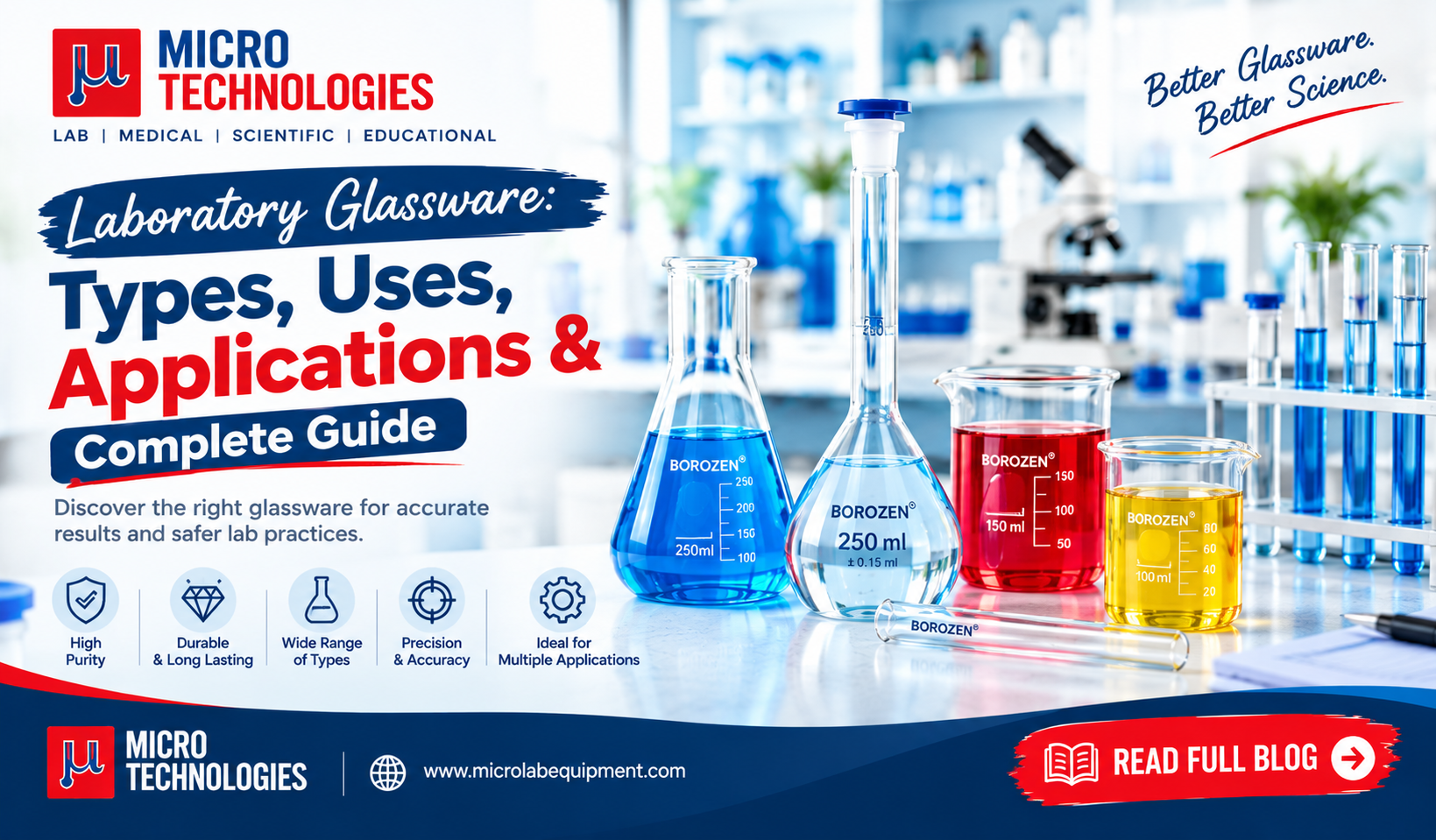
A laboratory may contain dozens of glass vessels, but not every glass container performs the same job. A beaker can hold and mix liquids, a volumetric flask is designed around a defined volume, a burette provides controlled liquid delivery, and a condenser serves an entirely different role in processes such as distillation or reflux.
Choosing laboratory glassware should begin with the laboratory procedure, not simply with the shape, size, or price of a product. Volumetric operations require adherence to established standards that govern the testing, calibration, and application of precision instruments including pipettes, burettes, volumetric flasks, and graduated measuring cylinders. ISO 4787:2021 specifically addresses these volumetric instruments and establishes methodologies designed to maximize accuracy during practical application.
This complete guide explains laboratory glassware types, uses, applications, materials, measurement accuracy, buying considerations, standards, maintenance, and future procurement trends. It is designed for students, laboratory technicians, researchers, institutions, procurement teams, and organizations looking for laboratory glassware and equipment.
Trying to find a specific kind of glass equipment? Check out the sections below to jump straight to what you're looking for.
What Is Lab Glass Equipment?
Lab glass equipment is glass stuff that's made or set up for science and lab work. It's different from regular glass containers you'd use at home because lab glass comes in special shapes, sizes, measurement marks, connections, caps, and setups that are designed for certain lab tasks.
Common examples include:
- Beakers
- Erlenmeyer or conical flasks
- Volumetric flasks
- Measuring cylinders
- Pipettes
- Burettes
- Test tubes
- Round-bottom flasks
- Separating funnels
- Condensers
- Reagent bottles
- Watch glasses
- Laboratory dishes
- Desiccators
- Distillation glassware
- Specialized adapters and components
Micro Technologies offers a bunch of different lab glassware products right now. Their selection has stuff like beakers, bottles, burettes, condensers, cylinders, distillation apparatus, funnels, laboratory flasks, laboratory pipettes, laboratory tubes, volumetric flasks, quartz glassware, stopcocks, and other specialized products that scientists and students need.
The important point is that laboratory glassware is application-specific. A laboratory should not assume that two glass containers with similar capacities can perform the same measurement or process.
Laboratory Glassware Market Size & Value
The global laboratory glassware market is showing steady growth as demand increases across research and academic institutions, pharmaceutical and biotechnology laboratories, hospitals, diagnostic centers, and other scientific environments.
According to Grand View Research, the global laboratory glassware market was valued at approximately USD 1.96 billion in 2023 and was estimated at USD 2.02 billion in 2024. The market is projected to reach approximately USD 2.45 billion by 2030, representing a 3.3% CAGR from 2024 to 2030. The report identifies increasing R&D activity in pharmaceuticals, biotechnology, and diagnostics as important market-growth factors.
A more recent 2026 market assessment from The Business Research Company estimates the global laboratory glassware market at USD 3.16 billion in 2025, with the market expected to reach USD 3.31 billion in 2026 and USD 3.98 billion by 2030, representing a 4.7% CAGR. The report also identifies research and academic institutions, pharmaceutical and biotech companies, hospitals and diagnostic centers, CROs, and food & beverage organizations among the end-use segments.
India Laboratory Glassware Market
India is also an important market for laboratory glassware. Grand View Research estimates that India's laboratory glassware market generated approximately USD 25.1 million in revenue in 2024 and is projected to reach USD 28.6 million by 2030, growing at a 2.2% CAGR from 2025 to 2030. Pipettes were the largest revenue-generating product segment in India in 2024 and are also projected to be the fastest-growing segment during the forecast period.
Why Is Laboratory Glassware Important?
Laboratory glassware provides the vessels and components needed to perform many everyday scientific procedures, including holding, mixing, transferring, measuring, heating, separating, preparing solutions, and conducting reactions.
Its importance becomes especially clear when measurement accuracy matters.
ISO 4787:2021 covers the testing, calibration, and use of volumetric instruments made from glass and plastic. Its scope includes single-volume pipettes, graduated pipettes, burettes, volumetric flasks, and graduated measuring cylinders with nominal capacities from 100 µL to 10,000 mL.
This means that the right instrument matters. A beaker that is suitable for mixing should not automatically be treated as equivalent to a volumetric flask designed for defined-volume preparation.
For laboratory procurement, the better question is therefore not:
“Which glassware is cheapest?”
It is:
“Which glassware specification is appropriate for the procedure?”
That change in thinking can help laboratories select products based on application, capacity, accuracy, material, and applicable standards.
Common Laboratory Glassware and Their Uses
The exact specification required depends on the application. For volumetric instruments, ISO 4787:2021 provides a standardized framework for testing, calibration, and use.
For a broader overview, explore Micro Technologies' detailed guide to laboratory glassware types, names, uses and applications.
1. Beakers
Beakers are among the most recognizable pieces of laboratory glassware. They are commonly used for holding, mixing, transferring, and suitable heating operations.
Their simple cylindrical form makes them practical for routine laboratory work, but a beaker should not automatically be selected when a procedure requires precision volumetric measurement.
ISO 3819 specifies requirements for an internationally acceptable series of glass beakers for laboratory use.
Common applications
- Mixing solutions
- Holding liquids
- General laboratory preparation
- Transferring liquids
- Suitable heating procedures
- Temporary containment
Key buying consideration
If the laboratory needs an accurate defined volume, look beyond the beaker and select an appropriate volumetric instrument.
2. Erlenmeyer or Conical Flasks
The Erlenmeyer flask has a wide body and narrower neck. This shape makes it particularly useful when a laboratory procedure involves swirling or mixing liquids while reducing the likelihood of splashing compared with a wide-open vessel.
The conical flask is commonly found in chemistry, biology, educational, and research laboratories.
Common applications
- Mixing solutions
- Swirling liquids
- Reaction work
- Sample handling
- Titration-related laboratory procedures
- Temporary storage where appropriate
Different flask configurations are designed for different laboratory tasks, so procurement should be based on the intended procedure rather than simply purchasing a generic “flask.”
3. Volumetric Flasks
A volumetric flask is a specialized volumetric instrument designed around a specified volume and a calibration mark.
It is particularly relevant when a laboratory procedure requires preparation of a solution to a defined volume.
ISO 4787:2021 includes volumetric flasks within its scope for testing, calibration, and use. ISO 1042 is the dedicated ISO standard associated with one-mark volumetric flasks.
Common applications
- Preparing standard solutions
- Solution preparation
- Dilution procedures
- Analytical laboratory work
- Quantitative laboratory procedures
What should buyers check?
Before purchasing a volumetric flask, consider:
- Required capacity
- Accuracy class
- Applicable standard
- Calibration requirements
- Material
- Closure type
- Graduation/calibration marking
- Required documentation
For detailed information, read Micro Technologies' complete guide to volumetric flask uses.
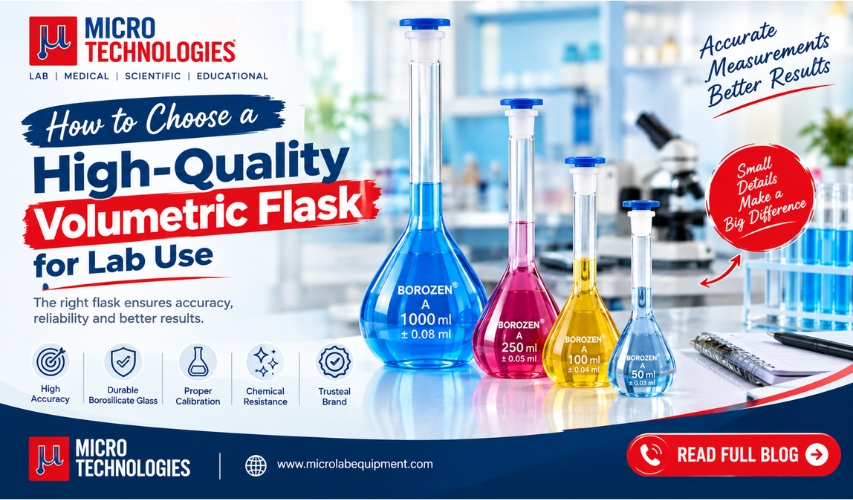
For procurement-specific guidance, see How to Choose a High-Quality Volumetric Flask for Lab Use.
4. Graduated Cylinders
Graduated cylinders are designed for measuring liquid volumes using graduation markings.
They are useful when a laboratory needs measured liquid quantities but does not necessarily require the specific configuration of a volumetric flask or pipette.
ISO 4787:2021 includes graduated measuring cylinders among the volumetric instruments covered by its testing, calibration, and use framework.
Typical applications
- Measuring liquids
- Preparing approximate quantities
- Transferring measured liquids
- Educational laboratory work
- Routine laboratory procedures
The appropriate cylinder capacity and specification should be selected according to the laboratory method.
5. Pipettes
Pipettes are laboratory instruments used to transfer measured quantities of liquid.
Different pipette designs have different measurement and delivery characteristics. ISO 4787:2021 covers single-volume and graduated pipettes within its scope, while individual ISO standards address particular volumetric-instrument categories.
Common applications
- Liquid transfer
- Solution preparation
- Analytical procedures
- Dilution
- Sample preparation
When precision is important, the laboratory should verify the instrument's applicable standard, capacity, calibration requirements, and intended method of use.
6. Burettes
A burette is a graduated laboratory instrument designed for controlled delivery of liquid.
It is particularly associated with titration procedures, where controlled dispensing and volume observation are important.
ISO 385 specifies requirements for an internationally acceptable series of laboratory burettes, while ISO 4787:2021 includes burettes within its broader framework for testing, calibration, and use of volumetric instruments.
Common applications
- Titration
- Controlled liquid dispensing
- Analytical procedures
- Quantitative laboratory work
The appropriate burette should be selected according to the required capacity, accuracy, configuration, and laboratory method.
For a dedicated explanation, see Micro Technologies' complete guide to burettes, types and uses.
7. Test Tubes and Laboratory Tubes
Test tubes are used for handling relatively small quantities of samples and for laboratory procedures involving small-scale reactions or observations.
Micro Technologies lists laboratory tubes as a dedicated laboratory-glassware category.
Typical uses
- Sample handling
- Small-scale experiments
- Chemical reactions
- Educational laboratory work
- Storage of suitable samples
The required tube material, dimensions, closure, and thermal characteristics should depend on the procedure.
8. Round-Bottom Flasks
Round-bottom flasks are process-oriented laboratory vessels used in applications where uniform heating and reaction or distillation setups are required.
They are commonly associated with:
- Reflux
- Distillation
- Heating
- Chemical synthesis
- Reaction setups
The appropriate flask should be selected together with compatible joints, adapters, condensers, and heating equipment when building a complete apparatus.
9. Separating Funnels
Separating funnels are designed for liquid-liquid separation.
Their shape and stopcock arrangement allow immiscible liquid phases to be separated under controlled conditions.
Common applications
- Extraction
- Liquid-liquid separation
- Sample processing
- Organic chemistry procedures
Selection should consider capacity, stopcock configuration, compatibility with the intended chemicals, and the laboratory method.
10. Condensers
Condensers are components used to cool vapor and promote condensation during laboratory processes such as reflux or distillation.
Different condenser designs are intended for different apparatus configurations and process requirements.
Buying considerations
- Connection/joint type
- Dimensions
- Cooling arrangement
- Compatibility with the rest of the apparatus
- Intended laboratory procedure
This is an example of why laboratory glassware procurement should sometimes be considered as an integrated apparatus requirement, rather than as individual pieces.
Laboratory Glassware by Function
Another practical way to understand scientific lab glassware is to classify it according to what the laboratory needs to accomplish.
Measuring Glassware
Includes:
- Volumetric flasks
- Pipettes
- Burettes
- Graduated cylinders
These instruments are especially relevant when volume measurement or controlled delivery is part of the procedure. ISO 4787:2021 specifically addresses testing, calibration, and use of several of these volumetric instruments.
Mixing and Reaction Glassware
Includes:
- Beakers
- Erlenmeyer flasks
- Test tubes
- Reaction vessels
These products support laboratory procedures involving mixing, holding, and reactions.
Heating and Distillation Glassware
Includes:
- Round-bottom flasks
- Distillation components
- Condensers
- Adapters
These components are generally selected as part of a complete apparatus.
Separation Glassware
Includes:
- Separating funnels
- Filtration-related glassware
- Specialized separation components
Storage and Handling Glassware
Includes:
- Reagent bottles
- Storage vessels
- Laboratory containers
This functional approach can make procurement easier because the buyer starts with the laboratory task and then identifies the appropriate glassware.
What Material Is Used for Laboratory Glassware?
Material selection is one of the most important considerations when purchasing laboratory glassware.
Borosilicate glass is an important material used in laboratory applications. ISO 3585 specifies properties for borosilicate glass 3.3, and ISO 4803:2021 specifies requirements for borosilicate 3.3 glass tubing used for laboratory apparatus.
However, it is not accurate to say that every laboratory application automatically requires one universal glass material.
The correct material depends on:
- Chemical exposure
- Temperature conditions
- Thermal requirements
- Mechanical requirements
- Application
- Applicable product standard
ASTM E542 also notes that chemical exposure and heating conditions can affect the calibration condition of volumetric glassware, illustrating why laboratory glassware should be selected and used according to its intended application.
Why Is Borosilicate Glass Used in Laboratories?
Borosilicate glass 3.3 has a defined set of material properties covered by ISO 3585. It is widely associated with laboratory apparatus because its properties are suitable for many scientific applications.
But “borosilicate” alone should not be treated as a complete quality specification.
When purchasing laboratory glassware, buyers should also check:
- Product design
- Dimensions
- Accuracy where applicable
- Applicable standard
- Chemical compatibility
- Temperature requirements
- Graduation quality
- Finish
- Closure/joint configuration
- Documentation
For volumetric products, the relevant accuracy and calibration requirements are particularly important.
Laboratory Glassware Accuracy: Why the Instrument Matters
One of the biggest laboratory-glassware mistakes is treating all marked glass containers as if they provide the same measurement performance.
They do not.
A beaker, graduated cylinder, volumetric flask, pipette, and burette serve different roles.
ISO 4787:2021 exists specifically to address testing, calibration, and use of volumetric instruments and includes pipettes, burettes, volumetric flasks, and graduated measuring cylinders.
Simple rule:
General-purpose glassware → use it for general-purpose laboratory work.
Volumetric glassware → select it when the procedure requires defined volumetric performance.
That distinction is more useful than simply asking which item has the smallest graduation marking.
Class A vs Class B Laboratory Glassware
Class A and Class B are particularly relevant to volumetric laboratory glassware.
ASTM E694 covers general requirements for laboratory glass volumetric apparatus of Class A and B. ASTM's specification identifies Class A as the precision grade and Class B as the general-purpose grade, with the Class B volumetric tolerance defined within twice the specified range allowed for Class A unless otherwise specified.
This means Class A and Class B should not simply be interpreted as “good” versus “bad.”
They represent different tolerance categories intended for different levels of volumetric requirement.
When evaluating Class A or Class B, ask:
- What does the laboratory method require?
- Is precision critical?
- Is the work analytical or routine?
- What standard applies?
- Is calibration documentation required?
- Does the laboratory SOP specify an accuracy class?
For a detailed explanation, read Micro Technologies' Class A vs Class B Laboratory Glassware guide.
Volumetric Flask vs Erlenmeyer Flask: Why They Are Not Interchangeable
Both are flasks, but their purposes are different.
A volumetric flask is designed around a specified volume and calibration mark, making it suitable for defined-volume solution preparation.
An Erlenmeyer flask is a general laboratory vessel with a shape suited to mixing and swirling.
So if a laboratory method specifies a volumetric flask, replacing it with an Erlenmeyer flask simply because both are “flasks” changes the equipment used for the procedure.
For detailed volumetric-flask selection, Micro Technologies' volumetric flask buying guide explains how capacity, accuracy class, standards, calibration, material, closure, and documentation can be considered during procurement.
Laboratory Glassware Applications Across Industries
Laboratory glassware is used across a wide range of scientific and educational environments, but the exact products required depend on the procedures performed.
Pharmaceutical Laboratories
Pharmaceutical laboratories may require volumetric glassware for solution preparation and analytical procedures, along with general laboratory vessels and specialized apparatus.
For procurement, accuracy requirements and applicable methods should be considered before choosing volumetric products.
Chemical Laboratories
Chemical laboratories may use:
- Beakers
- Flasks
- Burettes
- Pipettes
- Separating funnels
- Distillation glassware
- Condensers
The appropriate material and configuration depend on the procedure and substances involved.
Research Laboratories
Research laboratories can require combinations of general-purpose and specialized glassware depending on the experimental method.
This makes specification-based purchasing particularly important.
Educational Laboratories
Schools, colleges, universities, and engineering institutions may need sets of common laboratory glassware for practical teaching.
Micro Technologies states that its products serve schools, colleges, universities, and engineering institutions and its catalogue includes laboratory glassware alongside educational laboratory equipment.
Quality-Control Laboratories
Quality-control environments can involve quantitative procedures where measurement characteristics and documented specifications matter.
For volumetric instruments, relevant standards and calibration practices should therefore be considered.
Laboratory Glassware and Equipment: What's the Difference?
The terms laboratory glassware and laboratory equipment are often used together, but they do not mean exactly the same thing.
Laboratory glassware
Generally refers to glass vessels and components such as:
- Beakers
- Flasks
- Pipettes
- Burettes
- Cylinders
- Funnels
- Bottles
- Condensers
- Specialized glass apparatus
Laboratory equipment
Is a much broader category that can include:
- Measuring and weighing instruments
- Analytical instruments
- Heating equipment
- Sterilization equipment
- Microscopes
- Laboratory furniture
- Safety equipment
- Other scientific instruments
Micro Technologies' website separates glassware within its broader laboratory/labware offering while also presenting wider laboratory-equipment categories.
For a laboratory setup, therefore, glassware should be planned as one part of the overall equipment requirement.
How to Choose the Right Laboratory Glassware
Choosing laboratory glassware becomes easier when the procurement process starts with the laboratory procedure.
1. Identify the Application
First ask:
What will the glassware actually be used for?
Is it required for:
- Measuring?
- Mixing?
- Heating?
- Sample handling?
- Solution preparation?
- Titration?
- Distillation?
- Separation?
- Storage?
The answer determines which glassware category is appropriate.
2. Determine the Required Capacity
Capacity should be selected according to the laboratory method.
For volumetric glassware, the nominal capacity is a fundamental product characteristic and should correspond to the intended procedure.
ASTM specifications for volumetric flasks cover requirements for precision and general-purpose grades, reinforcing the importance of selecting the correct product specification rather than simply choosing any flask with a similar capacity.
3. Determine the Accuracy Requirement
Ask whether the procedure requires:
- General-purpose handling
- Graduated measurement
- Defined-volume preparation
- Controlled volumetric delivery
- Precision analytical work
For volumetric instruments, ISO 4787:2021 provides methods for testing, calibration, and use.
4. Check Material Compatibility
Do not assume that every glass product is suitable for every chemical or temperature.
Check:
- Chemical exposure
- Temperature
- Thermal cycling
- Cleaning procedure
- Intended application
ASTM E542 specifically discusses how chemical attack and heating conditions can affect volumetric glassware and its calibration.
5. Check the Applicable Standard
For professional procurement, a product should be evaluated against the standard relevant to that product where one applies.
Examples include:
- ISO 4787 for testing/calibration/use of volumetric instruments
- ISO 3585 for borosilicate glass 3.3 properties
- ISO 3819 for laboratory beakers
- ISO 385 for laboratory burettes
- ASTM E288 for laboratory glass volumetric flasks
- ASTM E694 for laboratory glass volumetric apparatus
The current ASTM laboratory-testing standards catalogue also lists specifications covering laboratory glass beakers, boiling flasks, conical flasks, reusable glassware, volumetric flasks, pipets, and other laboratory-glass products.
6. Review Product Documentation
For institutional, industrial, or analytical procurement, ask the supplier what documentation is available.
Depending on the product and application, this may include:
- Product specification
- Capacity
- Accuracy/tolerance information
- Applicable standard
- Material specification
- Calibration information
- Certificate or conformity documentation where applicable
Documentation allows buyers to compare products using measurable criteria rather than appearance alone.
Common Mistakes When Buying Laboratory Glassware
Mistake 1: Choosing Only by Price
The lowest purchase price does not necessarily mean the lowest total procurement cost.
If the wrong product is purchased for the procedure, the laboratory may need replacement products or may not achieve the required measurement performance.
Mistake 2: Treating All Glassware as Precision Glassware
A graduation mark does not automatically make every vessel suitable for precision volumetric work.
Select the instrument according to the laboratory procedure and applicable specification.
Mistake 3: Ignoring Capacity
A product should be selected according to the required procedure and volume, not simply because a particular capacity is commonly stocked.
Mistake 4: Ignoring Material Requirements
Chemical exposure and temperature can affect glassware suitability and, for volumetric products, may also affect calibration condition. ASTM E542 specifically addresses chemical attack and heating considerations for volumetric glassware.
Mistake 5: Buying Without Checking Standards
Where a recognized product standard applies, checking that specification can make procurement more transparent.
Mistake 6: Buying a Complete Set Without Checking the Laboratory's Actual Needs
A large generic glassware set may contain products that are rarely used while missing a product required for a specific laboratory method.
A better strategy is:
Procedure → Product type → Capacity → Accuracy → Material → Standard → Quantity
How to Choose a Laboratory Glassware Manufacturer or Supplier
When comparing a laboratory glassware manufacturer or supplier, look beyond a product catalogue.
Check the following:
1. Product range
Does the supplier offer the glassware categories required by your laboratory?
2. Product specifications
Can the supplier provide capacity, material, accuracy, configuration, and applicable standard information?
3. Application support
Can the supplier understand whether you require measuring, mixing, heating, volumetric, separation, or specialized glassware?
4. Quantity capability
Can the supplier support institutional, educational, laboratory, or bulk requirements?
5. Documentation
Can relevant product documentation be provided where required?
6. Broader laboratory requirements
If you are setting up a laboratory, can the supplier support glassware alongside other laboratory equipment?
These criteria are more useful than selecting a supplier solely on the basis of a keyword such as “cheap laboratory glassware.”
Why Choose Micro Technologies for Laboratory Glassware?
Micro Technologies provides laboratory equipment and scientific products, with laboratory glassware included within its broader product range.
Its current glassware catalogue includes:
- Beakers
- Bottles
- Burettes
- Condensers
- Cylinders
- Distillation apparatus
- Funnels
- Laboratory flasks
- Laboratory pipettes
- Laboratory tubes
- Volumetric flasks
- Quartz glassware
- Stopcocks
- Other specialized laboratory-glass products
The company also presents solutions for educational and scientific institutions and states that it provides customized solutions.
For buyers, the advantage of approaching a broader laboratory-equipment supplier is that glassware requirements can be discussed alongside the wider laboratory application.
Need Laboratory Glassware?
If you are purchasing laboratory glassware for a school, college, university, research laboratory, pharmaceutical facility, chemical laboratory, or industrial application, share your:
- Required product
- Capacity
- Quantity
- Accuracy requirement
- Application
- Preferred specification
with Micro Technologies to discuss the appropriate product configuration and request a quotation.
Explore laboratory glassware and laboratory equipment from Micro Technologies:
Micro Technologies Laboratory Equipment
Future of Laboratory Glassware: What Will Change Toward 2030?
Laboratory glassware is a mature product category, but laboratory procurement is becoming increasingly specification-driven.
The future is unlikely to be about simply inventing a new shape of beaker. Instead, the more meaningful changes are likely to involve measurement quality, traceability, specialized applications, digital procurement, and integration with increasingly structured laboratory workflows.
1. Greater Focus on Measurement Quality
Standards such as ISO 4787 already emphasize testing, calibration, and proper use of volumetric instruments. As laboratories place greater emphasis on reproducibility and documented procedures, buyers are likely to continue paying attention to calibration and instrument specifications rather than treating volumetric glassware as generic containers.
2. More Specification-Driven Procurement
Laboratory buyers increasingly need to communicate requirements in measurable terms:
capacity + material + accuracy + standard + configuration + documentation
This is more useful than simply asking for “good-quality glassware.”
3. Greater Integration with Laboratory Workflows
Glassware is often only one part of an experimental or analytical setup.
For example, a distillation system may require a flask, condenser, adapters, joints, heating equipment, and other compatible components.
This creates an opportunity for suppliers to provide more application-oriented solutions rather than isolated products.
4. Continued Importance of Calibration and Traceability
For volumetric instruments, calibration is already a defined technical consideration under standards such as ISO 4787 and ASTM E542.
This makes calibration information increasingly relevant to professional laboratory procurement.
5. More Informed Buyers
Laboratory buyers now have access to technical standards, product specifications, manufacturer documentation, and educational resources before contacting a supplier.
That means a successful laboratory-glassware supplier needs to provide clear technical information, not just attractive product images.
Laboratory Glassware FAQs
What is laboratory glassware?
Laboratory glassware is specialized glass equipment designed for scientific procedures such as holding, mixing, measuring, transferring, heating, separation, solution preparation, and other laboratory operations.
What are the most common laboratory glassware items?
Common examples include beakers, Erlenmeyer flasks, volumetric flasks, graduated cylinders, pipettes, burettes, test tubes, round-bottom flasks, funnels, bottles, condensers, and specialized glassware.
What is scientific lab glassware used for?
Scientific lab glassware is used for laboratory procedures including sample handling, mixing, measurement, solution preparation, controlled liquid delivery, heating, separation, distillation, and storage.
Why is borosilicate glass used for laboratory glassware?
Borosilicate glass 3.3 has defined material properties covered by ISO 3585 and is used for laboratory apparatus and tubing covered by relevant standards.
Which laboratory glassware is used for accurate volume measurement?
The appropriate instrument depends on the procedure. Volumetric flasks, pipettes, burettes, and graduated measuring cylinders are among the volumetric instruments covered by ISO 4787:2021.
What is the difference between a beaker and a volumetric flask?
A beaker is general-purpose laboratory glassware, while a volumetric flask is designed around a specified volume and calibration mark for volumetric work.
What is Class A laboratory glassware?
For laboratory volumetric apparatus covered by ASTM specifications, Class A represents the precision grade, while Class B represents the general-purpose grade.
What is Class B laboratory glassware?
Class B is the general-purpose category under ASTM's laboratory volumetric-apparatus specification. The applicable tolerance depends on the specific instrument and standard.
How should I choose laboratory glassware?
Start with the laboratory procedure, then determine the required product type, capacity, accuracy, material, configuration, applicable standard, quantity, and documentation.
What should I check before buying laboratory glassware?
Check the intended application, capacity, material, accuracy requirements, applicable standards, calibration requirements, product specifications, quantity, and supplier documentation.
Where can I buy laboratory glassware in India?
Laboratory glassware can be purchased from specialized laboratory-equipment manufacturers and suppliers. Micro Technologies provides a broad laboratory-glassware range and laboratory-equipment offering.
Does laboratory glassware always mean borosilicate glass?
No. Material selection depends on the product and intended application. Borosilicate glass 3.3 is an important standardized laboratory-glass material, but buyers should evaluate the material specification relevant to the particular product and procedure.
Final Takeaway
Laboratory glassware is much more than a collection of beakers, flasks, tubes, and bottles.
The right product depends on what the laboratory is trying to accomplish.
For routine work, a general-purpose vessel may be appropriate. For quantitative volume preparation, a specified volumetric instrument may be required. For titration, controlled liquid delivery becomes important. For distillation, compatibility between multiple glass components matters. For professional procurement, material, capacity, accuracy, standards, calibration, configuration, and documentation all deserve attention.
The most effective buying approach is therefore:
Micro Technologies can support laboratory-glassware and broader laboratory-equipment requirements by helping buyers evaluate products according to their intended application.
Looking for laboratory glassware for your laboratory or institution? Explore the Micro Technologies range and discuss your product requirements with the team.