
Before 1816, a doctor diagnosing a heart problem had exactly two tools: their eyes and their ear pressed against a patient's chest. That was it. No imaging, no monitors, no data—just a good guess backed by experience.
Two centuries later, a well-run clinic has dozens of instruments that see, hear, measure, and record what the human senses never could. That shift is the whole story behind any serious medical diagnostic equipment list: every item on it exists to replace a guess with a measurable answer.
This guide walks through that list, category by category, with the real history, real uses, and practical buying considerations behind each one.
What's on a Medical Diagnostic Equipment List?
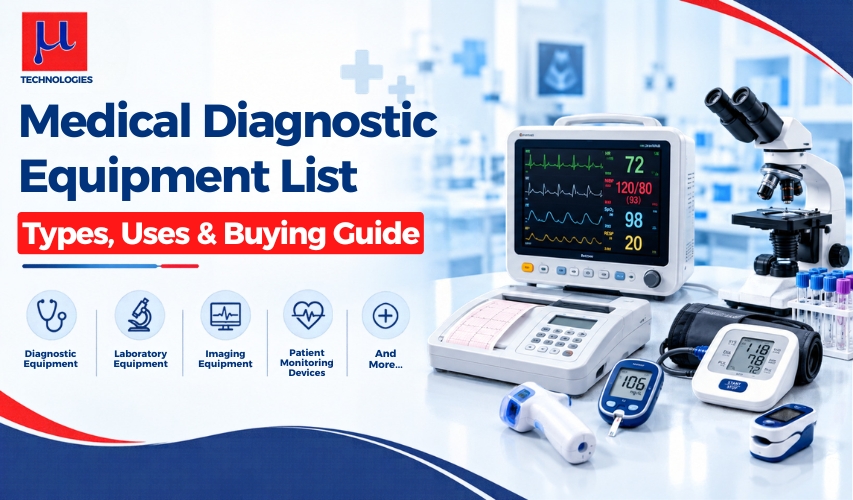
A medical diagnostic equipment list typically includes imaging systems (ultrasound, X-ray, endoscopy), physical examination tools (stethoscopes, blood pressure monitors, thermometers, otoscopes, ophthalmoscopes), cardiac diagnostic devices (ECG machines), pulmonary function equipment (spirometers), ophthalmic instruments (slit lamps), and laboratory diagnostic tools (microscopes, centrifuges). Each device helps clinicians detect, confirm, or monitor a medical condition using objective, measurable evidence rather than symptoms alone.
Why Medical Diagnostic Equipment Matters
Symptoms describe how a patient feels. Diagnostic equipment shows what's actually happening inside the body.
That difference is enormous. A cough could be a cold, asthma, or something far more serious—and only a proper diagnostic instrument can tell those apart with confidence. Medical diagnostic equipment turns vague complaints into specific, treatable conditions, which is exactly why hospitals, clinics, and medical colleges invest so heavily in getting this category right.
Historians often point to René Laennec's 1816 stethoscope as the first purpose-built modern diagnostic instrument. From that moment, medicine began shifting from narrative descriptions toward physical, measurable evidence—a shift that never reversed.
Category 1: Imaging and Visualization Equipment
Imaging equipment lets clinicians look inside the body without cutting it open.
Ultrasound systems use high-frequency sound waves to produce real-time images of organs, blood vessels, and developing fetuses. A color Doppler ultrasound diagnosis system adds blood flow visualization on top of standard imaging, making it especially valuable for cardiac, vascular, and obstetric assessments.
Endoscopy systems carry a camera and light source on a flexible or rigid tube to visualize internal structures directly. A modern Portable HD Endoscopy System integrates the camera, LED light source, and recording capability into one compact unit and works across multiple specialties, including ENT, gastroenterology, gynecology, and urology—reducing equipment clutter while improving documentation quality.
X-ray systems remain a first-line tool for detecting fractures, chest conditions, and dense-tissue abnormalities, building directly on Röntgen's 1895 discovery.
Category 2: Physical Examination and Vital Signs Equipment
These are the tools clinicians reach for in nearly every patient encounter, which makes them the workhorses of any medical diagnostic instruments list.
Stethoscopes amplify sounds from the heart, lungs, and intestines. More than 200 years after Laennec's paper roll, they're still a standard, everyday tool.
Blood pressure monitors measure the force of blood against artery walls, using the same core principle Riva-Rocci introduced in the late 1800s, now available in manual and digital versions.
Thermometers track body temperature—one of the fastest, simplest indicators that something is wrong.
Otoscopes and ophthalmoscopes examine the ear and the eye, respectively. A combined ENT and ophthalmic diagnostic set, such as the HEINE Beta Diagnostic Set, packages both instruments together with high-quality optics, giving clinicians a portable, all-in-one solution for routine ear and eye examinations.
Category 3: Cardiac Diagnostic Equipment
The heart gets its own category because cardiac problems demand fast, precise answers.
ECG (Electrocardiogram) Machines record the heart's electrical activity, helping detect rhythm abnormalities, heart attacks, and other cardiac conditions—a direct descendant of Einthoven's 1903 breakthrough.
Cardiac ultrasound (echocardiography) uses sound waves to show the heart's structure and blood flow in real time, complementing what an ECG reveals about electrical activity.
Category 4: Pulmonary Diagnostic Equipment
Breathing problems are among the most common reasons people seek medical care, and pulmonary diagnostic equipment exists to measure exactly what's going wrong.
Spirometers and pulmonary function systems measure lung capacity, airflow, and breathing efficiency. Clinicians use this data to diagnose and monitor conditions like asthma and COPD. Modern pulmonary diagnostic systems are designed for quick operation and fast results, making them well suited to busy respiratory clinics, emergency care units, and dedicated pulmonary function labs.
Category 5: Ophthalmic Diagnostic Equipment
Eyes are delicate, small, and hard to assess without magnification.
Slit lamp microscopes combine a high-intensity light source with adjustable slit width and multiple magnification levels, letting ophthalmologists examine the cornea, lens, retina, and other eye structures in detail. This makes the slit lamp essential for diagnosing conditions like cataracts, glaucoma, and corneal injuries—and a valuable teaching tool in medical education, since students can practice on the same equipment used in professional eye care.
Category 6: Laboratory Diagnostic Equipment
Not all diagnosis happens at the bedside. Many answers come from analyzing samples in a lab.
Microscopes let technicians examine blood smears, tissue samples, and microorganisms at high magnification.
Centrifuges separate blood into its components—serum, plasma, and cells—so each can be tested individually.
Laboratory analyzers measure chemical markers in blood and other fluids, giving clinicians objective numbers to guide treatment decisions.
Together, these instruments form the backbone of clinical laboratory diagnostics.
How These Instruments Work Together
No single device on a medical diagnostic equipment list tells the full story. Diagnosis usually layers several tools in sequence.
A patient with chest pain, for example, might get a stethoscope exam first, then a blood pressure reading, then an ECG. If those raise concerns, ultrasound imaging and laboratory blood tests follow. Each tool narrows down the possibilities until the clinician reaches a confident answer.
This layered approach is exactly why hospitals and medical colleges stock a full range of diagnostic instruments rather than relying on one or two "do-it-all" machines.
What to Look for When Buying Medical Diagnostic Equipment
Building or upgrading a diagnostic setup isn't just about picking the most impressive machine. It's about matching equipment to real clinical needs and buying from a supplier who backs up their products.
- Clinical fit. Match equipment to the department's actual caseload. A busy respiratory clinic benefits most from pulmonary function systems; a general practice needs a strong foundation of vital-sign tools first.
- Accuracy and reliability. Diagnostic instruments are only useful if their readings can be trusted, so ask about calibration, optics quality, and how the manufacturer supports ongoing accuracy.
- Ease of use. Intuitive interfaces reduce training time and lower the risk of operator error, especially in busy or emergency settings.
- Portability where it matters. Compact, integrated systems—like all-in-one endoscopy units—save space and simplify workflow in clinics with limited room.
- Supplier range. A manufacturer covering diagnostic equipment alongside surgical instruments, patient care devices, and hospital furniture simplifies procurement for institutions outfitting multiple departments at once.
- After-sales support. Spare parts, servicing, and technical guidance matter more once the equipment is in daily use than they do at the moment of purchase.
Why Institutions Choose Micro Technologies for Diagnostic Equipment
Micro Technologies, based in Ambala, Haryana, manufactures and supplies a wide range of medical equipment for hospitals, clinics, medical colleges, and educational institutions. Its diagnostic equipment category includes several instruments covered in this guide:
- Color Doppler Ultrasound Diagnostic System for detailed imaging and blood flow assessment
- Portable HD Endoscopy System with an integrated camera and LED light source, compatible with a wide range of optical endoscopes
- Pulmonary diagnostic equipment for measuring lung capacity, airflow, and breathing efficiency
- HEINE Beta Diagnostic Set (Model MTH-288) combining otoscope and ophthalmoscope for ENT and eye examinations
- Slit Lamp Microscope for detailed ophthalmic examination
Beyond diagnostics, the same manufacturer also supplies surgical instruments, dental and ophthalmic equipment, patient care devices, hospital furniture, and anatomy models—which means an institution equipping a new department can source across multiple categories from one established supplier instead of coordinating several vendors.
For a hospital administrator or medical college procurement officer building out a diagnostic setup, that breadth is a practical advantage: fewer supplier relationships to manage, consistent communication, and a single point of contact for support.
Regulation and Quality Standards Behind Diagnostic Equipment
Diagnostic instruments directly influence treatment decisions, so they don't operate in a regulatory gray zone. Understanding the framework helps buyers ask smarter questions.
In India, medical devices fall under the Central Drugs Standard Control Organisation (CDSCO) and the Medical Devices Rules, 2017. These rules sort devices into four risk-based classes: Class A (low risk), Class B (low-moderate risk), Class C (moderate-high risk), and Class D (high risk). Ultrasound devices, for example, appear in the Class B category, while ventilators and dialysis machines sit in Class C.
Manufacturers also work under quality management systems aligned with ISO 13485:2016, the internationally recognized standard for medical device quality management, which India implements as IS 13485 through the Bureau of Indian Standards. When you evaluate a supplier of diagnostic equipment, asking about this alignment is a fair and reasonable first question. It tells you whether the manufacturer follows a documented, consistent process rather than making it up as they go.
Diagnostic Equipment in Medical and Nursing Education
Diagnostic instruments don't only serve patients. They also train the next generation of clinicians.
Nursing and medical colleges rely heavily on the basics: blood pressure monitors, stethoscopes, and thermometers let students practice checking vital signs on manikins and each other long before they touch a real patient. Instruments like microscopes and centrifuges deepen understanding of clinical laboratory diagnostics, while emergency and patient care equipment trains students to respond under pressure.
Ophthalmic tools serve education too. A slit lamp microscope, for instance, gives students practical experience with the same professional-grade equipment used in real eye care, which bridges the gap between textbook diagrams and clinical practice.
For institutions, this creates a dual purpose: the same category of equipment supports both patient care and teaching, which makes quality and durability even more important.
Common Mistakes Buyers Make
A few recurring missteps are worth avoiding.
Buying for prestige rather than need. A high-end imaging system that sits underused because the clinic's caseload doesn't justify it wastes budget better spent on foundational equipment.
Ignoring training needs. Even the best diagnostic instrument produces poor results in untrained hands. Confirm whether the supplier offers guidance on setup and operation.
Overlooking maintenance. Diagnostic accuracy drifts without proper calibration and care. Ask upfront how servicing and spare parts work.
Skipping the basics. Advanced imaging gets the attention, but reliable stethoscopes, blood pressure monitors, and thermometers handle the bulk of everyday diagnostic work.
Caring for Diagnostic Equipment After You Buy It
Buying the equipment is only half the job. Keeping it accurate is the other half.
Diagnostic instruments drift over time. Optics get smudged, sensors lose sensitivity, and moving parts wear down. A short routine prevents most of these problems.
- Clean after every use. Wipe lenses, probes, and contact surfaces with approved cleaning agents, since residue can blur images or distort readings.
- Check calibration on a schedule. Blood pressure monitors, spirometers, and thermometers all depend on accurate baselines, so periodic verification protects every reading they produce.
- Store instruments properly. Keep optical tools like otoscopes and slit lamps covered and away from dust, moisture, and sudden impacts.
- Log problems early. A small inconsistency caught in week one costs far less than a failed unit discovered in the middle of a busy clinic day.
- Train every user. Even one careless habit, like dropping a probe or skipping a cleaning step, shortens an instrument's useful life.
Institutions that build these habits into their daily routine get more years out of the same equipment, which makes the original purchase decision look even smarter in hindsight.
Conclusion
Every item on a medical diagnostic equipment list traces back to the same simple idea Laennec stumbled onto in 1816: give clinicians a way to perceive what their unaided senses can't. From that rolled-up sheet of paper to modern color Doppler ultrasound and portable HD endoscopy, the goal hasn't changed — replace guesswork with evidence.
Whether you're stocking a small clinic or outfitting a full hospital department, understanding what each instrument does, how the categories work together, and what to look for in a supplier is the foundation of a diagnostic setup that actually serves patients well. Micro Technologies, with its range of diagnostic equipment spanning imaging, ophthalmic, pulmonary, and examination tools, offers institutions a practical, single-supplier option for building that foundation.
Frequently Asked Questions
What is included in a medical diagnostic equipment list?
A typical list includes imaging systems (ultrasound, X-ray, endoscopy), examination tools (stethoscopes, blood pressure monitors, thermometers, otoscopes), cardiac devices (ECG), pulmonary function equipment, ophthalmic instruments like slit lamps, and laboratory tools such as microscopes and centrifuges.
What is the difference between diagnostic equipment and therapeutic equipment?
Diagnostic equipment detects, confirms, or monitors a condition, while therapeutic equipment treats it. A stethoscope or ultrasound helps identify a problem; a ventilator or infusion pump helps treat one.
Who invented the stethoscope?
René Laennec, a French physician, invented the stethoscope in 1816 after using a rolled sheet of paper to listen to a patient's heart. The two-earpiece version most people recognize today was developed by Arthur Leared in 1851.
When was the X-ray discovered?
Wilhelm Röntgen discovered X-rays on November 8, 1895, while experimenting with cathode rays.
What does a slit lamp microscope diagnose?
A slit lamp helps ophthalmologists examine the cornea, lens, and retina, and diagnose conditions such as cataracts, glaucoma, and corneal injuries.
Does Micro Technologies supply medical diagnostic equipment?
Yes, Micro Technologies supplies diagnostic equipment including color Doppler ultrasound systems, portable HD endoscopy systems, pulmonary diagnostic equipment, the HEINE Beta ENT and ophthalmic set, and slit lamp microscopes.