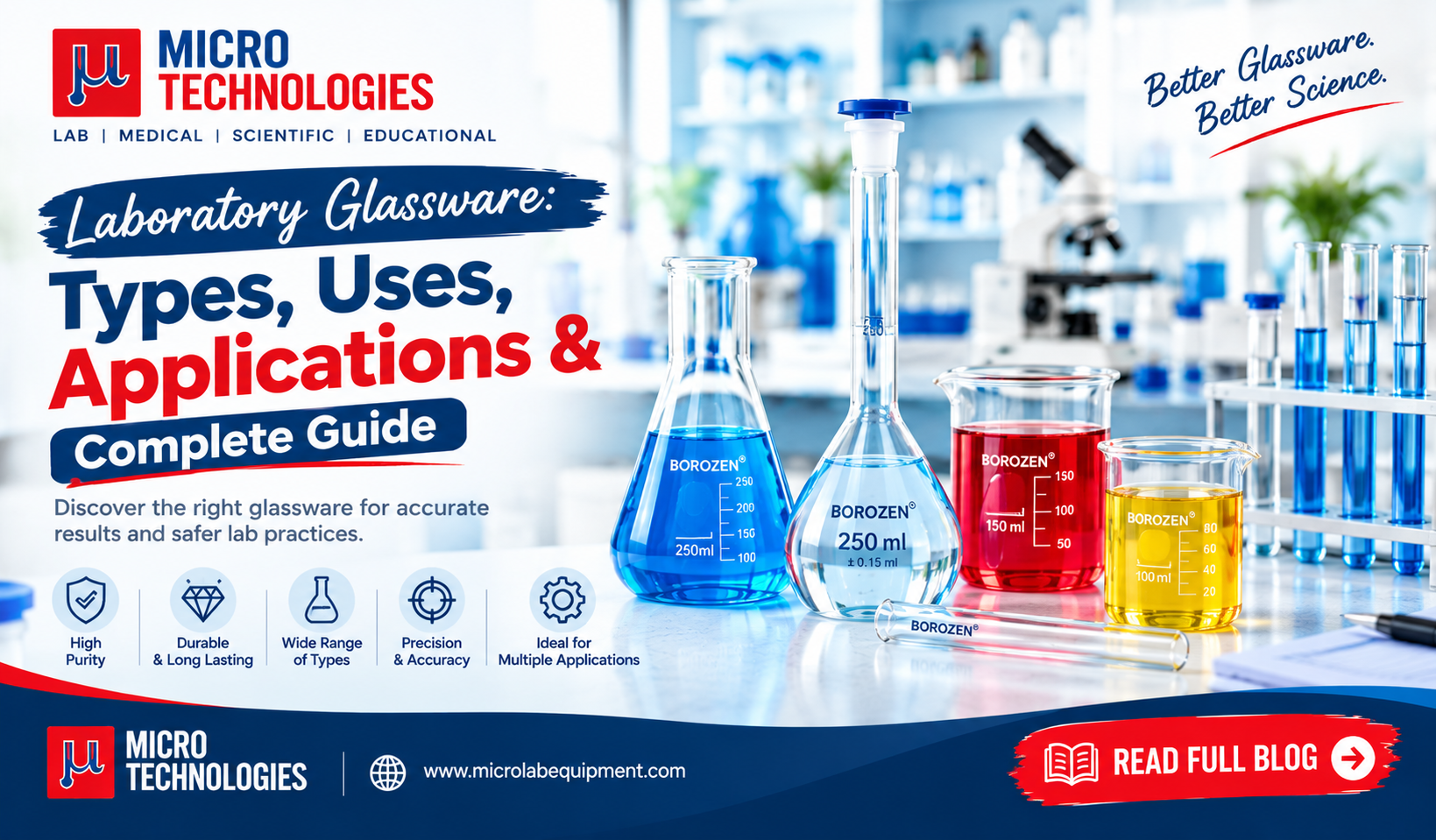
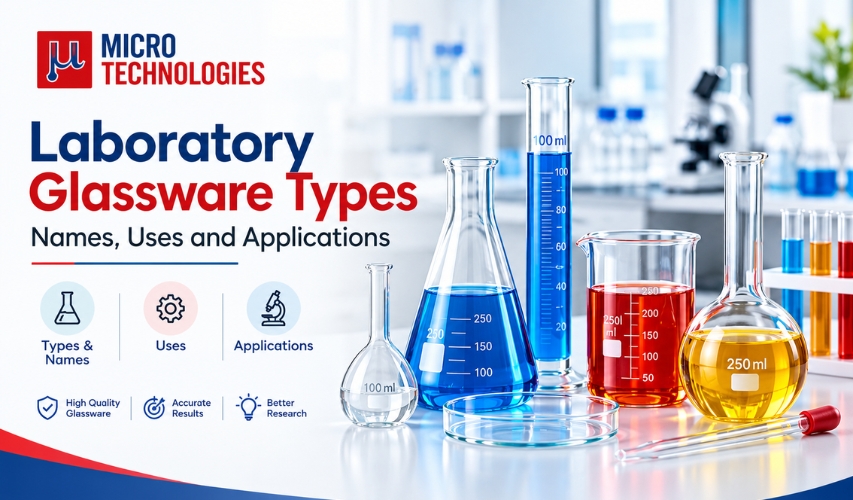
Laboratory glassware includes beakers, laboratory flasks, volumetric flasks, measuring cylinders, pipettes, burettes, laboratory tubes, funnels, bottles, condensers, distillation apparatus, and other specialized glassware. Each type is designed for particular laboratory operations such as holding, mixing, measuring, transferring, storing, heating, or carrying out specialized procedures. Micro Technologies currently offers a broad laboratory glassware range covering these and other categories.
For laboratories, choosing glassware should not be based only on shape or capacity. Consider the intended application, measurement requirements, material, product specifications, and applicable standards. ISO 4787:2021 provides methods for testing, calibration, and use of volumetric instruments made from glass and plastic and specifically covers instruments such as pipettes, burettes, volumetric flasks, and graduated measuring cylinders.
What Is Laboratory Glassware?
Laboratory glassware refers to glass products designed for scientific and laboratory applications. Unlike general household glass containers, laboratory glassware is manufactured in specific forms and dimensions for particular laboratory operations.
Micro Technologies’ current glassware catalogue includes beakers, bottles, burettes, condensers, cylinders, distillation apparatus, distillation heads, funnels, laboratory adapters, laboratory columns, laboratory dishes and desiccators, laboratory flasks, laboratory pipettes, laboratory tubes, quartz glassware, stopcocks, volumetric flasks, and more.
The type of glassware needed depends on the laboratory procedure. A beaker, for example, serves a different purpose than a volumetric flask, while a burette is designed for the controlled delivery of liquids.
Why Is Glassware Important in Laboratories?
Laboratory glassware provides purpose-specific vessels and instruments for routine and specialized laboratory work. The importance of selecting the appropriate glassware becomes particularly clear in volumetric work. ISO 4787:2021 addresses the testing, calibration, and use of volumetric instruments to obtain the best accuracy in use. The standard applies to volumetric instruments with nominal capacities from 100 µl to 10,000 ml and includes single-volume pipettes, graduated pipettes, burettes, volumetric flasks, and graduated measuring cylinders.
Therefore, a laboratory should select an instrument according to the procedure rather than treating every graduated glass container as interchangeable.
Common Types of Laboratory Glassware
There are many lab glassware types, ranging from general-purpose containers to instruments designed for measurement and specialized laboratory processes.
1. Beakers
Beakers are general laboratory containers used for applications such as mixing, heating, and liquid handling. Micro Technologies lists beakers as one of its laboratory glassware categories and describes them for mixing, heating, and liquid handling tasks.
Beakers are available in different capacities and designs. When a laboratory procedure requires a defined volumetric measurement, however, the appropriate volumetric instrument should be selected instead of assuming that a beaker provides the same function.
ISO 3819:2015 specifies requirements for an internationally acceptable series of glass beakers for laboratory use. ISO states that this edition was reviewed and confirmed in 2021 and remains current.
2. Laboratory Flasks
Laboratory flasks are available in different designs for different laboratory procedures. Micro Technologies currently lists laboratory flasks as a glassware category and describes them for heating, mixing, and chemical experiments.
The term “flask” therefore refers to a broader group of laboratory vessels rather than one single type of instrument.
Depending on the application, laboratories may require specific flask designs rather than using one flask for every procedure.
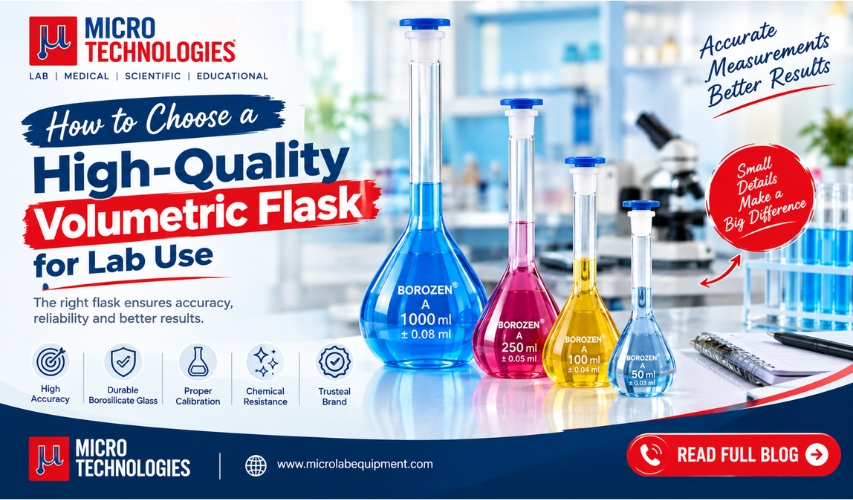
3. Volumetric Flasks
Volumetric flasks are specialized volumetric glassware used for solution preparation and laboratory measurements. Micro Technologies lists volumetric flasks as a separate category and describes them for solution preparation and laboratory measurements.
Volumetric instruments require appropriate calibration and use. ISO 4787:2021 specifically includes volumetric flasks within its scope for testing, calibration, and use.
For procurement, laboratories should therefore check the required capacity, specification, and applicable standard rather than selecting a flask based only on its nominal volume.
4. Measuring Cylinders
Measuring cylinders, also called graduated measuring cylinders, are designed for measuring liquid volumes. Micro Technologies lists cylinders among its laboratory glassware categories and describes them for liquid measurement.
ISO 4788:2005 is the international standard for graduated measuring cylinders and specifies requirements relating to their dimensions, material, construction, and metrological characteristics.
When selecting a cylinder, laboratories should consider the required capacity and measurement requirements of the procedure.
5. Pipettes
Pipettes are laboratory instruments designed to transfer measured quantities of liquid. Micro Technologies includes laboratory pipettes in its glassware range and categorizes them for liquid transfer and measurement applications.
Not all pipettes are the same. ISO 4787:2021 identifies both single-volume pipettes and graduated pipettes as types of volumetric instruments. Specifically, ISO 648:2008 addresses single-volume pipettes, while different standards apply to graduated pipettes.
Therefore, it is essential to select the appropriate pipette based on the measurement procedure and the required specifications.
6. Burettes
Burettes are graduated laboratory instruments designed for controlled delivery of liquid. Micro Technologies lists burettes and describes them for titration and controlled liquid dispensing.
Burettes are particularly relevant to volumetric laboratory procedures where controlled delivery and measurement of a liquid are required.
ISO 385 specifies requirements for an internationally acceptable series of laboratory burettes. ISO 4787:2021 also includes burettes within its scope for testing, calibration, and use of volumetric instruments.
7. Laboratory Tubes and Test Tubes
Laboratory tubes are commonly used for handling samples and conducting laboratory procedures involving relatively small quantities.
Micro Technologies currently lists laboratory tubes as a dedicated glassware category and describes them for testing, storage, and chemical experiments.
The exact tube required depends on the procedure, dimensions, capacity, and other product specifications.
8. Funnels
Laboratory funnels are used for liquid transfer and can also form part of filtration setups when used with suitable filtration materials.
Micro Technologies lists funnels among its glassware categories and describes them for liquid transfer and filtration applications.
Different laboratory procedures can require different funnel designs, so the funnel should be selected according to the intended application.
9. Laboratory Bottles
Laboratory bottles are used for storing and handling laboratory liquids and chemicals. Micro Technologies currently lists laboratory bottles and describes them for storage and handling of chemicals and liquids.
When selecting a laboratory bottle, the contents, required capacity, closure, and storage conditions should be considered.
A bottle should not automatically be assumed to be suitable for every chemical simply because it is made from laboratory glass.
10. Condensers
Condensers are specialized laboratory glassware used in laboratory cooling and distillation arrangements.
Micro Technologies lists condensers as a separate glassware category and describes them for cooling and distillation applications.
The appropriate condenser design depends on the laboratory setup and intended process.
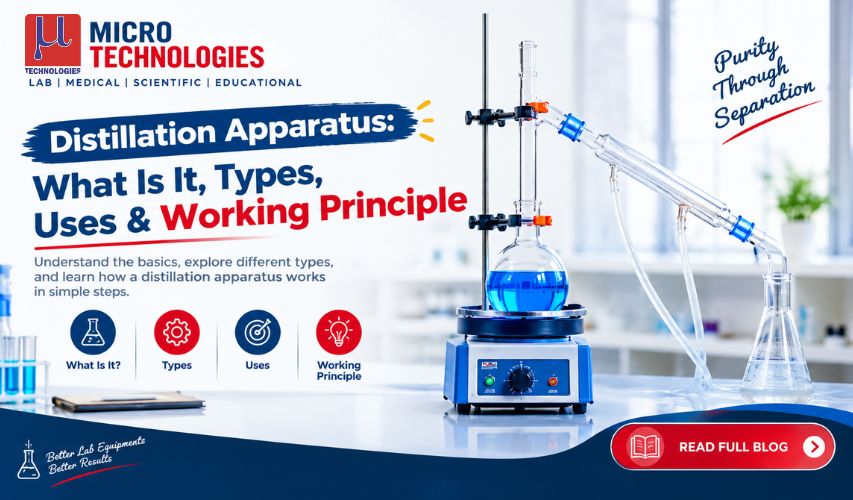
11. Distillation Apparatus and Distillation Heads
Distillation glassware includes components used in laboratory distillation arrangements.
Micro Technologies currently lists both distillation apparatus and distillation heads within its laboratory glassware catalogue. The company describes the former for separation and purification applications and the latter for laboratory distillation processes.
These products should be selected as part of the intended distillation setup rather than treated as general-purpose glassware.
12. Laboratory Adapters, Joints, and Connectors
Specialized laboratory glassware may also include adapters, joints, and connectors used to connect different components of a laboratory setup.
Micro Technologies currently lists laboratory adapters and joints & connectors as separate glassware categories.
Correct compatibility between connected components is important when specifying a laboratory glassware setup.
Laboratory Glassware for Chemistry Labs
Chemistry laboratories can require several different types of laboratory glassware, depending on the practical or analytical procedure being performed.
A laboratory may use beakers and flasks for general handling and mixing, volumetric flasks for solution preparation, measuring cylinders for liquid-volume measurement, pipettes for measured transfer, and burettes for controlled liquid delivery.
More specialized chemistry setups may also require funnels, condensers, distillation apparatus, distillation heads, adapters, joints, and laboratory columns. These categories are currently represented in Micro Technologies’ glassware catalogue.
There is therefore no single laboratory glassware list that is appropriate for every chemistry laboratory. The required inventory should be based on the experiments, analytical procedures and equipment configuration of the laboratory.
Laboratory Glassware for Educational Laboratories
Educational laboratories may require different glassware inventories depending on the courses and practical activities being conducted.
Micro Technologies supplies scientific and educational products and states that its products are used across schools, colleges, universities, and engineering institutions. Its current product catalogue includes laboratory glassware as well as physics, chemistry, biological, and other educational laboratory products.
For an educational laboratory, procurement teams can organize glassware requirements around the practical curriculum, required capacities, quantities, storage requirements, and replacement needs.
This approach can be more useful than purchasing a generic laboratory glassware set without considering the actual experiments students will perform.
Laboratory Glassware vs. Plasticware: Which Should You Choose?
Glassware and plasticware are both used in laboratory applications. The correct choice depends on the instrument, procedure, and material requirements.
Importantly, ISO 4787:2021 covers volumetric instruments made from both glass and plastic. It includes single-volume pipettes, graduated pipettes, burettes, volumetric flasks, and graduated measuring cylinders.
Therefore, it would be inaccurate to describe glassware as universally better than plasticware.
Instead, laboratories should consider:
- The intended laboratory procedure
- Required measurement characteristics
- Material compatibility
- Temperature requirements
- Capacity
- Handling requirements
- Applicable standards
- Product specifications
Micro Technologies itself lists both glassware and plasticware as separate labware categories.
How to Select Laboratory Glassware
Choosing laboratory glassware should begin with the application rather than the product name.
1. Identify the laboratory procedure
Determine whether the glassware will be used for measuring, mixing, transferring, storing, heating, filtration, distillation, or another operation.
2. Determine measurement requirements
If the procedure involves quantitative volume measurement, identify the appropriate volumetric instrument and its required specification.
ISO 4787:2021 provides methods for testing, calibration, and use of volumetric instruments to obtain the best accuracy in use.
3. Check capacity
Select a capacity appropriate for the procedure and expected sample or solution volume.
4. Check material and compatibility
The suitability of laboratory glass depends on the particular application and material requirements. Do not assume that every glass product is suitable for every chemical or temperature condition.
5. Check applicable standards
Where a recognized standard applies to the instrument, procurement teams should verify the relevant specification and current edition.
For example, ISO has dedicated standards covering beakers, burettes, and other volumetric instruments.
6. Request product documentation
For institutional procurement, product specifications and supporting documentation can help laboratories compare products before placing an order.
Cleaning and Handling Laboratory Glassware
Cleaning requirements depend on what the glassware has been used for and the laboratory’s established procedures.
Laboratories should follow their applicable cleaning, decontamination and handling procedures and inspect glassware before reuse.
Particular attention should be given to:
- Residues remaining after previous use
- Damage such as cracks or chips
- Correct cleaning methods
- Appropriate rinsing
- Drying and storage
- Contamination risks
- Procedures for hazardous substances
Glassware intended for quantitative laboratory work should also be maintained and used according to the applicable instrument requirements.
Laboratory Glassware Market in 2026 and Where It’s Headed
Market-size estimates for laboratory glassware vary widely by research firm and by whether plasticware is bundled in. Independent 2026 estimates for glassware alone range from roughly $2.84 billion to $4.8 billion, with forecast CAGRs of about 3.4%–5.4% through the early 2030s, according to firms including Coherent Market Insights, The Business Research Company, Business Research Insights, and MarkWide Research. A separate MarketsandMarkets figure of $7.63 billion for 2026 appears to bundle plasticware in, since it reports plasticware holding 68% of that total — broadly consistent with The Business Research Company’s separate glassware-and-plasticware figure of $6.77 billion for the same year. Named major manufacturers across these reports include Corning, DWK Life Sciences, Schott AG, Thermo Fisher Scientific, Borosil Glass Works, and Duran Group, with North America cited as the largest current region and Asia-Pacific called out as the fastest-growing one.
Forecast drivers cited across these reports point toward a few consistent trends for the rest of this decade: automation-compatible glassware and precision calibration systems, expansion of digital and IoT-enabled labs, and a growing focus on sustainability and green labware solutions alongside rising research and pharmaceutical testing volumes.
Where These Types Came From: Two Quick Origins
The conical (Erlenmeyer) flask was designed by German chemist Emil Erlenmeyer, who first described it in a paper published in January 1860, having already arranged for local glassware manufacturers to produce and sell it. (One source, the Smithsonian’s National Museum of American History, dates the design to 1861 — historical accounts differ by a year, but 1860 is the more widely cited date and matches Erlenmeyer’s own publication.)
The Petri dish came out of Robert Koch’s bacteriology laboratory in Berlin. Julius Richard Petri, a military physician working as Koch’s assistant, published a short note on his shallow, lidded dish design as part of his 1887 report on the Hygiene Institute’s activities — a fix for the bulky bell jars that had made examining bacterial cultures under a microscope awkward.
Why Choose Micro Technologies for Laboratory Glassware?
Micro Technologies is a manufacturer, exporter, and supplier of scientific and educational products. The company states that its offerings include laboratory equipment, laboratory glassware, physics and chemistry laboratory products, engineering equipment, biological models, microscopes, and research instruments.
Its current laboratory glassware catalogue includes a wide range of categories, including beakers, bottles, burettes, condensers, cylinders, distillation apparatus, funnels, laboratory flasks, laboratory pipettes, laboratory tubes, volumetric flasks, quartz glassware, stopcocks, and laboratory accessories.
Micro Technologies also states that it provides customized solutions and serves schools, colleges, universities, and engineering institutions.
For organizations planning laboratory procurement, this makes it possible to discuss requirements based on the intended application rather than selecting products only from a generic list.
Frequently Asked Questions About Laboratory Glassware
What are the main types of laboratory glassware?
Common laboratory glassware types include beakers, laboratory flasks, volumetric flasks, measuring cylinders, pipettes, burettes, laboratory tubes, funnels, bottles, condensers and distillation glassware. Micro Technologies currently lists these categories in its glassware catalogue.
What glassware is used for accurate volume measurement?
The appropriate instrument depends on the measurement requirement. ISO 4787:2021 covers volumetric instruments, including single-volume pipettes, graduated pipettes, burettes, volumetric flasks and graduated measuring cylinders.
What is the difference between a beaker and a volumetric flask?
A beaker is general laboratory glassware covered by ISO 3819, while a volumetric flask is a volumetric instrument used for defined-volume laboratory work and included within ISO 4787’s scope.
What is a burette used for?
A burette is a graduated laboratory instrument designed for controlled liquid delivery. Micro Technologies lists burettes for titration and controlled liquid dispensing, while ISO 385 specifies requirements for laboratory burettes.
What is the difference between laboratory glassware and plasticware?
Both materials are used for laboratory volumetric instruments. The appropriate choice depends on the application, measurement requirements, material compatibility, and other product specifications. ISO 4787:2021 explicitly covers volumetric instruments made from both glass and plastic.
How should laboratories choose glassware?
Start with the intended procedure, then consider capacity, measurement requirements, material compatibility, applicable standards and product specifications. For quantitative volumetric applications, the relevant instrument standard and calibration requirements should also be considered.
What laboratory glassware does Micro Technologies supply?
Micro Technologies’ current catalogue includes beakers, bottles, burettes, condensers, cylinders, distillation apparatus, funnels, laboratory flasks, laboratory pipettes, laboratory tubes, volumetric flasks, and several specialized glassware categories.
Get Laboratory Glassware from Micro Technologies
The right laboratory glassware depends on the procedure, required capacity, measurement needs, and applicable product specifications.
Micro Technologies offers a broad range of laboratory glassware for educational, research, and laboratory applications, including beakers, flasks, burettes, pipettes, cylinders, bottles, funnels, volumetric flasks, and specialized glassware.
Looking for laboratory glassware for institutional or laboratory use?
Share your required glassware type, capacity, quantity, and application with Micro Technologies to request product details and a quotation.