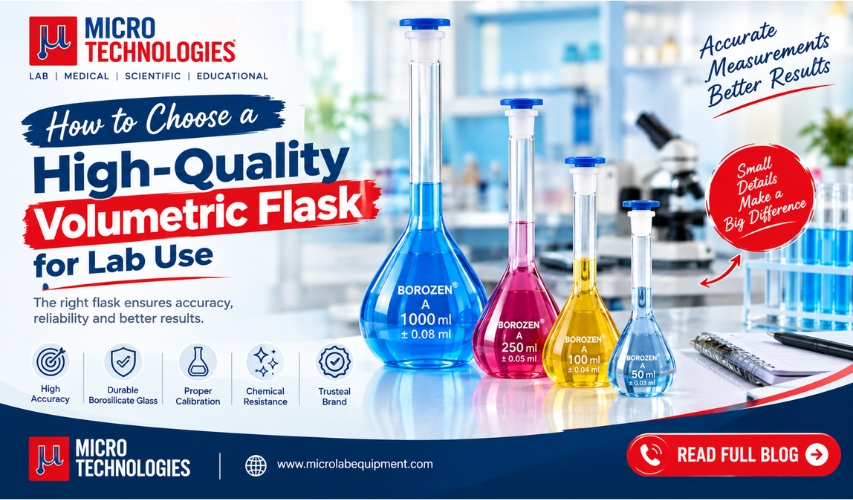
Choosing a volumetric flask is not simply a matter of selecting the required volume. For laboratory work, key considerations include the required accuracy class, applicable standard, calibration basis, material, closure, and intended procedure.
ASTM E288-10(2025) covers laboratory glass volumetric flasks in precision and general-purpose grades, while ISO 1042 covers one-mark volumetric flasks. ISO 4787:2021 outlines methods for testing, calibrating, and using volumetric instruments, including volumetric flasks.
A practical way to choose the right flask is therefore to start with the laboratory method and work backward to the product specification.
What Is a Volumetric Flask?
A volumetric flask is a laboratory volumetric instrument designed around a specified volume and a single calibration mark. Its design allows a solution to be prepared to a defined final volume rather than providing a general-purpose estimate of liquid quantity. ISO 1042 specifically addresses one-mark volumetric flasks, and ISO 4787 includes volumetric flasks within its methods for testing, calibration, and use.
What Is a Volumetric Flask Used For?
Volumetric flasks are commonly used for preparing solutions to a defined volume and for dilution work. Micro Technologies, for example, describes its volumetric flask range for solution preparation, dilution, chemical analysis, and laboratory applications.
Why Is the Calibration Mark Important?
The flask is intended to be filled to its specified calibration point. The relationship between the graduation mark, liquid level, and measurement procedure forms part of obtaining the intended volume. NIST material on volumetric calibration also discusses the effect of meniscus-reading uncertainty when determining volume.
Volumetric Flask Diagram: Main Parts Explained
A useful volumetric flask diagram should identify the main physical features of the flask:
Body → Neck → Calibration Mark → Stopper/Closure → Base
Body
The body holds the solution and provides the main volume capacity of the flask. Commercial volumetric flasks are manufactured in different nominal capacities for different laboratory requirements. Current products from Eisco and Micro Technologies demonstrate multiple capacity and configuration options.
Neck
The neck contains the calibration mark. Manufacturer examples show volumetric flasks with narrow-neck designs and a single visible graduation mark. Micro Technologies specifically describes its range as having a narrow neck and calibration line.
Calibration Mark
The calibration mark identifies the reference point associated with the nominal volume. High-precision manufacturer products may use etched or fired-on graduation marks, while some products use highly visible printed marks. DWK, for example, documents etched or printed graduation configurations on its Class A volumetric flasks.
Stopper or Closure
The closure helps provide a controlled container configuration during laboratory handling. Current commercial examples include polyethylene, polypropylene, and glass-stopper arrangements depending on the flask design.
How to Choose a High-Quality Volumetric Flask
The phrase “high-quality volumetric flask” should be evaluated through measurable specifications rather than appearance alone.
1. Choose the Correct Capacity
Start with the volume required by the laboratory method.
A flask should be selected according to the intended final preparation volume, because the nominal capacity is one of the defining characteristics of the instrument. ASTM E288 also provides requirements for standard and special-size volumetric flasks.
Common Selection Examples
A laboratory may need different flask capacities for different preparation procedures. Current commercial ranges include small-volume products as well as 100 mL, 200 mL, 500 mL, and 1000 mL products.
The correct capacity is therefore the one specified by the procedure, not simply the largest or most commonly stocked flask.
2. Check Class A vs Class B
One of the most important purchasing decisions is the accuracy class.
ASTM E288-10(2025) defines Class A as the precision grade and Class B as a general-purpose grade. Under the ASTM specification, Class B volumetric tolerances are within twice the specified range allowed for Class A flasks.
Class A Volumetric Flasks
ASTM states that each Class A precision-grade flask is marked with the letter “A” to indicate compliance with applicable construction and accuracy requirements.
Current manufacturer examples show Class A products for analytical and other precision-oriented laboratory applications. For example, Eisco lists a 100 mL Class A borosilicate flask with a stated tolerance of ±0.100 mL and ISO 1042 conformity.
Class B Volumetric Flasks
ASTM describes Class B as the general-purpose grade and specifies wider tolerances than Class A. Therefore, laboratories should select the class according to the accuracy requirement of the applicable method rather than assuming every application requires the same specification.
Which Class Should You Buy?
The answer depends on the measurement requirement.
For a method requiring the precision associated with a Class A instrument, choose a Class A flask that meets the applicable specification. For routine work where the method permits a general-purpose grade, a Class B flask may be appropriate. The method, laboratory SOP, specification, or regulatory requirement should make the final determination.
3. Verify the Applicable Standard
A product listing can mention “precision,” “high accuracy,” or “laboratory grade,” but buyers should still check the actual standard or specification stated for the product.
ISO 1042
ISO 1042:1998 is the published international standard for one-mark volumetric flasks. ISO currently lists the 1998 edition as the published version.
ASTM E288
ASTM E288-10(2025) is the current ASTM specification for laboratory glass volumetric flasks and covers both precision and general-purpose grades. The 2025 version replaced the previous ASTM E288-10(2017) edition.
Why the Standard Matters
The standard provides a defined technical reference for construction and accuracy requirements. This makes “which standard does this flask meet?” a more useful procurement question than relying only on generic descriptions such as “premium quality.”
4. Check Calibration and Traceability
Calibration information becomes especially important when volumetric glassware is used in controlled analytical workflows.
ISO 4787:2021 provides methods for testing, calibration, and use of volumetric instruments to obtain the best accuracy in use. It explicitly includes volumetric flasks within its scope.
Look for Calibration Information
Depending on the product and application, documentation may include:
- nominal volume
- error limit or tolerance
- calibration basis
- reference temperature
- batch information
- individual calibration information
For example, DWK documents Class A volumetric flasks calibrated on an “In” basis at a +20 °C reference temperature. BRAND product documentation similarly identifies calibration “In,” a 20 °C reference temperature, nominal volume, error limit, class, and other traceability information.
Batch Certificate vs Individual Certificate
These should not be treated as automatically identical.
BRAND documents batch certificates for reusable BLAUBRAND volumetric instruments and also describes individual and accredited calibration certificate options for selected products. DWK likewise offers products with batch certificates as well as individually tested products with ISO 17025-related calibration documentation in selected ranges.
For regulated or tightly controlled laboratory work, the required level of documentation should be confirmed before purchasing.
5. Select the Right Material
Material selection should follow the application.
Borosilicate Glass
Borosilicate glass is widely used for laboratory volumetric flasks. Current products from DWK and Eisco include borosilicate glass 3.3 volumetric flasks.
Eisco, for example, specifies borosilicate 3.3 glass for its Class A products and describes those products as capable of handling high temperatures and thermal shock.
Amber Glass
Amber volumetric flasks are available for applications where protection from light is relevant. DWK documents amber Class A volumetric flasks with UV protection provided by the external coloration.
Glass vs Plastic
Glass is not the only standardized material category for volumetric instruments. ISO 4787:2021 covers volumetric instruments made from both glass and plastic, and ISO 5215:2022 specifically addresses laboratory plastic volumetric flasks.
The material should therefore be selected according to the procedure, chemical compatibility requirements, handling conditions, and the specification required by the laboratory.
6. Inspect the Graduation Mark
A volumetric flask depends on a defined calibration mark, so readability matters during use.
Current manufacturer products demonstrate different graduation-mark constructions. DWK lists etched graduation marks and durable fired-on printing on its Class A products, while Corning's PYREX Class A products use permanent graduation markings.
What to Look For
Check that:
- The mark is easy to see
- The nominal volume is clearly identified
- The graduation is not damaged or difficult to read
- The marking matches the stated product specification
A damaged or poorly legible calibration mark is a practical reason to remove a flask from routine use and evaluate it according to the laboratory's glassware procedure.
7. Consider the Stopper or Closure
The stopper should match the flask configuration and laboratory requirements.
Current products demonstrate glass, polyethylene, and polypropylene stopper options. Micro Technologies' current category, for example, includes both glass-stopper and PP-stopper Class A products, as well as amber and wide-mouth configurations.
Why Closure Choice Matters
Different closure materials and neck configurations can affect how a flask fits into the laboratory workflow. Product documentation should therefore be checked rather than assuming that all volumetric flasks use interchangeable stoppers.
8. Match the Flask to the Actual Laboratory Workflow
The best product specification is the one that meets the needs of the actual procedure.
Analytical and Quality-Control Applications
Where a method needs a defined accuracy class or traceable calibration, check requirements before ordering. Review the class, tolerance, standard, and certificate needs. ASTM E288 and ISO 4787 provide the relevant technical framework for glass volumetric instruments.
Educational Laboratories
Teaching labs may use many types of general-purpose glassware. This depends on the exercise and the needed measurement accuracy.
Pharmaceutical and Research Laboratories
For pharmaceutical, research, and other controlled environments, procurement may need to consider method specifications, traceability, certificate requirements, and applicable standards. BRAND, for example, documents ISO and USP variants for selected volumetric instruments and notes that their error limits can differ.
Why a Measuring Cylinder Is Not a Direct Replacement
A measuring cylinder is designed for measuring varying amounts of liquid, while a one-mark volumetric flask is designed around a specified volume. These are different measurement purposes and should not be treated as interchangeable laboratory glassware.
Common Mistakes When Buying Volumetric Flasks
Buying Only by Capacity
Two flasks with the same nominal volume can have different specifications, classes, materials, or certification options. Capacity alone does not define the complete product specification.
Assuming “Class A” Means Every Other Requirement Is Covered
Class A addresses the specified accuracy/construction requirements, but laboratories may still have additional needs involving certificates, calibration documentation, material, closure, or pharmaceutical requirements. Current manufacturer ranges illustrate different Class A variants with different documentation and configurations.
Ignoring the Calibration Basis
A product specification can state a calibration basis such as “In” and a reference temperature such as +20 °C. These details should be understood when the glassware is part of a controlled measurement process.
Choosing Material Without Checking the Application
Borosilicate glass, amber glass, and plastic volumetric products are all represented in current laboratory product and standards documentation. The selection should therefore follow the method and application.
Ignoring Physical Condition
Chips, cracks, damaged graduation markings, or damaged closures can make laboratory glassware unsuitable for its intended use. NIST's calibration work demonstrates how physical measurement characteristics and reading uncertainty can influence volumetric results.
What Is Changing for Volumetric Flasks in 2026?
Laboratory glassware standards are not static.
ISO 1042 Is Under Revision
As of 2026, ISO lists ISO 1042:1998 as the current published edition, while ISO/DIS 1042:2026 is under development as the proposed replacement.
The draft is not the same thing as a final published standard, so laboratories should not treat every draft requirement as already mandatory.
The Draft Includes Additional and Updated Provisions
The current ISO/DIS 1042 preview states that the draft adds nominal capacities including 150 mL, 300 mL, 3,000 mL and 10,000 mL, provides more detailed essential dimensions, modifies ground-joint sizes, and introduces rules for exceptional purposes.
The draft also discusses the relationship between narrow-neck Class A designs and wider-neck configurations for certain applications. Because this is a draft document, these provisions should be treated as proposed requirements until the final standard is published.
Volumetric Flask Buying Checklist
Before purchasing a volumetric flask, check the following:
Specification Checklist
✔ Required nominal capacity
✔ Class A or Class B requirement
✔ Applicable ISO or ASTM specification
✔ Calibration basis
✔ Reference temperature where specified
✔ Tolerance/error limit
✔ Material and chemical compatibility
✔ Graduation-mark visibility
✔ Stopper or closure type
✔ Batch or individual certificate requirement
✔ Laboratory SOP or method requirements
This approach turns “high quality” into a set of specifications that can actually be verified.
Choosing Volumetric Flasks from Micro Technologies
Micro Technologies currently maintains a dedicated volumetric flasks category with multiple product configurations, including Class A and Class B products, amber flasks, wide-mouth options, glass-stopper products, PP-stopper products, and products described as USP or ASTM variants.
The current range also includes products such as high-precision Class A flasks and amber Class A/Class B configurations.
What to Confirm Before Ordering
For a laboratory purchase, ask the supplier to confirm:
Product Specification
Capacity, class, material, stopper, and intended configuration.
Accuracy and Standard
The stated tolerance and applicable standard, such as ISO 1042 or ASTM E288, where applicable.
Documentation
Whether a batch certificate, certificate of conformity, or individual calibration documentation is supplied for the selected product.
Quantity
For institutional or industrial purchasing, confirm the required sizes and quantities together so the supplier can quote the correct product configuration.
Micro Technologies also maintains a wider laboratory glassware category, allowing buyers to evaluate volumetric flasks alongside other laboratory glassware used for measuring, transferring, mixing, and handling liquids.
Frequently Asked Questions About Volumetric Flasks
What is a volumetric flask used for?
A volumetric flask is used when a laboratory procedure requires preparation of a solution to a specified volume. ISO 4787:2021 includes volumetric flasks within its scope for testing, calibration, and use.
What is the difference between Class A and Class B volumetric flasks?
ASTM E288-10(2025) defines Class A as the precision grade and Class B as the general-purpose grade. The specified volumetric tolerances for Class B are within twice the range allowed for Class A under ASTM E288.
What standard applies to volumetric flasks?
ISO 1042 is the international standard specifically covering one-mark volumetric flasks. ASTM E288-10(2025) is the ASTM specification for laboratory glass volumetric flasks.
What does a volumetric flask diagram show?
A typical volumetric flask diagram identifies the body, neck, calibration mark, stopper or closure, and base. The calibration mark is the key reference point associated with the specified volume.
Why is a reference temperature shown on some volumetric flasks?
Manufacturer documentation may specify a reference temperature because calibration is associated with defined measurement conditions. DWK and BRAND, for example, document +20 °C as a reference temperature on selected volumetric instruments.
Should I choose a glass or plastic volumetric flask?
The selection should depend on the laboratory method and application. ISO 4787 covers volumetric instruments made from glass and plastic, while ISO 5215:2022 specifically addresses laboratory plastic volumetric flasks.
What should I check before buying a Class A volumetric flask?
Check the capacity, stated Class A tolerance, applicable standard, calibration basis, reference temperature, material, closure, and available calibration or conformity documentation. These specifications are documented on current Class A products from manufacturers such as DWK, Eisco, and BRAND.
Is ISO/DIS 1042:2026 already the final standard?
No. ISO currently identifies ISO/DIS 1042:2026 as a draft under development that is intended to replace ISO 1042:1998. The published 1998 edition remains the current published standard on ISO's website.
Final Takeaway
Choosing a high-quality volumetric flask starts with the laboratory requirement, not the product photograph. Check the required capacity first, then confirm the accuracy class, applicable standard, calibration details, material, graduation mark, closure, and documentation. For controlled analytical work, traceability and calibration information can be just as important as the physical flask itself. ASTM E288, ISO 1042, and ISO 4787 provide the key standards framework for evaluating glass volumetric instruments.
For laboratories comparing suppliers, Micro Technologies provides a current range of volumetric flasks and other laboratory glassware configurations that can be evaluated according to these specifications.
Need volumetric flasks or more laboratory glassware for your laboratory? Explore Micro Technologies' available specifications and request a quotation for your required configuration.