Porcelainware is an important category of laboratory equipment used for heating samples, evaporating liquids, grinding solids, and carrying out selected chemical analysis procedures. From porcelain crucibles used in high-temperature experiments to evaporating dishes used to concentrate solutions, porcelain labware supports essential tasks. These tasks occur in educational, research, and industrial laboratories.
But is all porcelainware suitable for high-temperature work? How does laboratory porcelain differ from ordinary ceramic products, and what should you check before buying it?
In this guide, Micro Technologies explains the meaning of porcelainware, its common types, laboratory applications, advantages, limitations, and practical purchasing considerations. Whether you are a student, lab technician, researcher, or procurement manager, this article can help. It will help you choose the right porcelain labware for your needs.
1. What Is Porcelainware?
Porcelainware is ceramic equipment made from minerals. It is fired at high temperatures to create a hard, dense product. Traditional porcelain formulations commonly contain kaolin clay, feldspar, and silica, although the exact composition and manufacturing process vary by product.
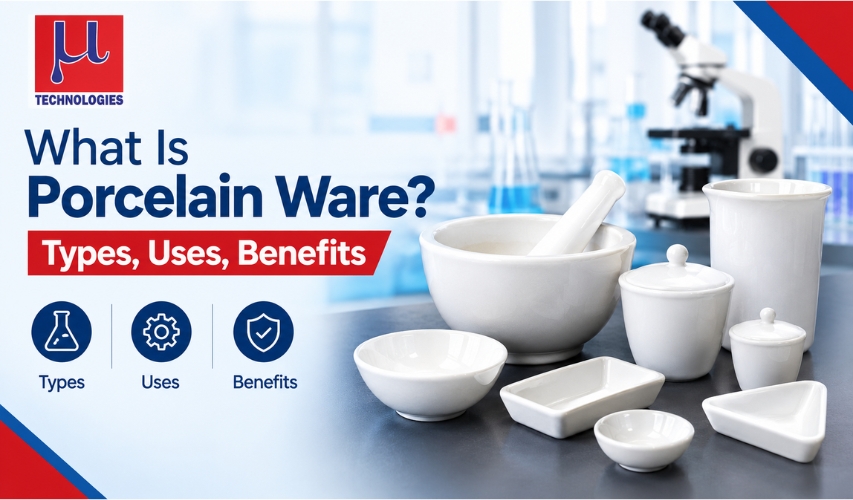
In laboratories, porcelainware refers to specialized ceramic items designed for tasks such as heating, ignition, evaporation, grinding, and filtration. Common examples of laboratory equipment include porcelain crucibles, evaporating dishes, mortar and pestle sets, and Büchner funnels.
Unlike ordinary household porcelain, laboratory porcelainware is selected according to its intended scientific application. Its suitability depends on factors such as material composition, manufacturing quality, dimensions, surface finish, temperature rating, and chemical compatibility.
For example, a porcelain crucible may be appropriate for heating a solid sample in a laboratory furnace, while a porcelain evaporating dish is designed to provide a broad surface for solvent evaporation. Although both products are made from porcelain-based ceramic material, they serve different purposes.
A key point to remember is that porcelainware is not one universal material with identical properties across every product. Always check the manufacturer's specifications before using it in a particular laboratory procedure.
2. Why Is Porcelainware Used in Laboratories?
Laboratories use porcelainware because certain porcelain products combine hardness, useful thermal properties, and suitability for specific analytical procedures.
Here are the main reasons it is selected.
- Heating and ignition: Suitable porcelain crucibles can hold solid samples during specified high-temperature procedures.
- Evaporation: Porcelain evaporating dishes provide a relatively wide surface for removing solvents from compatible solutions.
- Sample preparation: Mortar and pestle sets help crush and grind solid materials before analysis.
- Filtration: Suitable porcelain funnels support vacuum filtration when connected to compatible laboratory equipment.
- Small-scale testing: Porcelain spot plates allow several small chemical reactions to be observed separately.
- Repeated laboratory use: Undamaged products can often be cleaned and reused when the procedure permits.
However, porcelain is also brittle and opaque, and it may crack under sudden temperature changes. Its suitability depends on the task, the operating conditions, and the manufacturer's stated limits. These limitations should be considered alongside its advantages when selecting laboratory equipment.
3. Types of Porcelainware and Their Uses in Laboratories
Different laboratory procedures require different equipment designs. Understanding the purpose of each type of porcelain labware can help you avoid purchasing the wrong product for your application.
3.1 Porcelain Crucible
A porcelain crucible is a small ceramic container designed to hold solid samples during heating or ignition. It is commonly used in analytical chemistry, gravimetric analysis, and ash determination when the product's specifications are suitable for the procedure.
Practical example: A laboratory technician may heat a weighed sample in a crucible to determine the residue remaining after a specified heating process.
What to check: Capacity, maximum working temperature, lid compatibility, and resistance to the chemicals involved.
3.2 Porcelain Evaporating Dish
An evaporating dish is a shallow vessel used to remove solvent from a solution under appropriate conditions. Its relatively wide surface supports evaporation and can help concentrate a solution or recover a non-volatile residue.
Practical example: During a suitable chemistry experiment, a solution may be heated in an evaporating dish to remove some of its water.
What to check: Dish diameter, depth, capacity, heating compatibility, and whether the sample could react with the material.
3.3 Porcelain Mortar and Pestle
A mortar and pestle is used to crush, grind, and reduce solid materials into smaller particles. It is useful for preparing samples for selected chemical, educational, and research procedures.
Practical example: A student grinds a suitable crystalline sample into a finer powder before performing a laboratory test.
What to check: Bowl capacity, surface finish, ease of cleaning, and the risk of contamination between samples.
3.4 Porcelain Büchner Funnel
A porcelain Büchner funnel is used for vacuum filtration. When fitted with appropriate filter paper and connected to a compatible flask and vacuum source, it helps separate suspended solids from liquids.
Practical example: A laboratory worker collects a precipitate from a liquid mixture after a chemical reaction.
What to check: Funnel diameter, filter support design, compatibility with the filtration setup, and the chemical properties of the mixture.
3.5 Porcelain Gooch Crucible
A Gooch crucible is a specialized filtration vessel used in certain gravimetric procedures. Depending on its design, it supports a filtering medium that retains solids while liquid passes through.
Practical example: In an appropriate gravimetric method, a laboratory may collect and process a precipitate for measurement.
What to check: The crucible's filtration design, compatibility with the prescribed method, and suitability for any subsequent drying or heating steps.
3.6 Porcelain Combustion Boat
A combustion boat is an elongated container used to hold suitable samples during specified furnace or combustion procedures.
Practical example: A compatible solid sample may be placed in a combustion boat for a prescribed thermal analysis procedure.
What to check: Dimensions, furnace compatibility, temperature rating, and resistance to the sample and process atmosphere.
3.7 Porcelain Spot Plate
A spot plate contains small wells that allow small quantities of different substances to be tested separately. It is often used for qualitative chemical reactions and educational demonstrations.
Practical example: Students compare visible colour changes or precipitate formation when different reagents are added to small samples.
What to check: Number of wells, ease of cleaning, compatibility with the reagents, and the laboratory's contamination-control requirements.
3.8 Porcelain Desiccator Plate
A porcelain desiccator plate is designed to support samples inside a compatible desiccator. Its openings allow the atmosphere within the desiccator to circulate around the supported items.
Practical example: A laboratory places suitable sample containers above a desiccant to help protect them from atmospheric moisture.
What to check: Plate diameter, load requirements, compatibility with the desiccator, and the intended sample arrangement.
These examples illustrate why laboratory buyers should select equipment by function rather than by material name alone. Product availability, specifications, and suitability should be confirmed with the relevant manufacturer or supplier.
4. What Are the Main Applications of Porcelainware?
Porcelainware is used across several laboratory settings. The exact applications depend on the type of product and the procedure being performed.
Analytical chemistry
Porcelain crucibles and suitable filtration vessels are used in selected analytical procedures, including ignition, residue determination, and gravimetric analysis. These applications require the equipment to be compatible with the prescribed method.
Educational laboratories
Schools, colleges, universities, and technical institutions use porcelainware to demonstrate fundamental chemistry techniques. Crucibles, evaporating dishes, and mortar and pestle sets help students learn about heating, evaporation, and sample preparation.
Research laboratories
Research teams may use porcelain labware when preparing solid samples, carrying out suitable thermal procedures, or performing small-scale experiments. The material must be selected according to the research protocol and contamination requirements.
Industrial testing and quality control
Some industrial laboratories use porcelain equipment for specific material-testing, analytical, or sample-processing tasks. For example, a suitable crucible may be used in a prescribed ash determination procedure.
Chemical separation and filtration
Porcelain funnels and specialised filtration vessels can support selected solid-liquid separation methods. Their use depends on the filtration technique, the chemicals involved, and the compatibility of the complete apparatus.
The key principle: The laboratory application determines the equipment requirements. A product appropriate for heating a solid sample may not be suitable for filtration, precise liquid measurement, or every chemical environment.
5. Advantages and Limitations of Porcelain Labware
Porcelain labware offers several useful properties, but understanding its limitations is equally important for safe and effective laboratory work.
Advantages of porcelainware
- Suitable for specified high-temperature procedures: Some laboratory porcelain products are designed for heating and ignition within defined temperature limits.
- Hard and durable surface: Properly manufactured porcelain can withstand normal handling when used correctly.
- Useful chemical resistance: Many products resist various common laboratory substances, subject to their composition, finish, and exposure conditions.
- Reusable construction: Undamaged items can often be cleaned and reused when permitted by the procedure.
- Multiple product formats: Crucibles, dishes, funnels, and grinding equipment support different laboratory operations.
Limitations to consider
- Brittleness: Porcelain can chip, crack, or break if dropped or subjected to mechanical stress.
- Thermal shock: Sudden temperature changes can cause cracking, even in products intended for high-temperature use.
- Limited visibility: Unlike transparent glassware, porcelain does not allow users to observe the sample through the vessel walls.
- Chemical limitations: Porcelain is not compatible with every chemical. Hydrofluoric acid, in particular, attacks conventional silicate-based glass and porcelain.
- Product-specific temperature limits: Not all porcelainware has the same heat resistance, so the stated rating must be checked for each product.
6. Porcelainware vs Glassware vs Plasticware
Choosing between porcelainware, glassware, and plasticware depends on the laboratory procedure, required material properties, and operating conditions.
For example, a suitable porcelain crucible may be selected for a specified ignition procedure, while borosilicate glassware may be preferable when a transparent vessel is required for observing a reaction. A compatible plastic container may be suitable for storage when its chemical and temperature ratings permit.
Neither material is universally superior. Select equipment according to the procedure and the manufacturer's specifications.
7. How to Choose the Right Porcelain Labware
Choosing the right porcelain labware requires more than checking the product name or price. These six factors can help laboratories make informed purchasing decisions.
1. Identify the intended procedure
Start by defining the task. Heating, evaporation, grinding, and vacuum filtration require different equipment designs. A clear application makes it easier to compare suitable products.
2. Verify the working temperature
Check the manufacturer's maximum working temperature and any conditions attached to that rating. Consider the complete heating cycle, including cooling, rather than looking at the maximum temperature alone.
3. Confirm chemical compatibility
Identify the actual reagents, concentrations, exposure times, and operating temperatures. Seek manufacturer guidance when compatibility is uncertain, especially for corrosive or unusual chemicals.
4. Select the right dimensions and capacity
Check the vessel's diameter, height, capacity, and compatibility with existing equipment. For example, a crucible must fit the intended heating setup, while a Büchner funnel must suit the filtration apparatus.
5. Inspect the surface and construction
Look for visible cracks, chips, irregularities, and defects that could affect safe use or cleaning. Confirm whether a glazed or unglazed surface is appropriate for the intended procedure.
6. Compare specifications before purchasing
When evaluating products, compare equivalent specifications rather than relying on product names alone. Ask for dimensions, material information, temperature ratings, relevant quality documents, and instructions for use.
A simple specification checklist can help:
- Product name and intended application
- Capacity and dimensions
- Maximum working temperature, where applicable
- Chemical compatibility information
- Inspection and quality documentation
- Quantity, packaging, and delivery requirements
This approach is especially useful for educational institutions and laboratories purchasing several product types in one order.
8. How to Choose Reliable Porcelainware Suppliers
Finding suitable porcelainware suppliers is an important step when setting up a laboratory or replenishing existing equipment. The supplier should be able to provide accurate product information and clarify whether the products meet your requirements.
Before placing an order, consider these questions:
Does the supplier offer the required products? Check the available range of crucibles, evaporating dishes, mortar and pestle sets, funnels, and other relevant items.
Are technical specifications available? Confirm the product dimensions, capacity, temperature rating, and compatibility information where applicable.
Can quality requirements be documented? Request the relevant inspection records, certificates, or technical documentation required by your laboratory's procurement policy.
Are order and delivery terms clear? Discuss minimum order quantities, packaging, expected delivery times, and procedures for handling damaged goods.
Is technical assistance available? A supplier who can clarify product specifications can help purchasing teams identify suitable options for their procedures.
When comparing a porcelainware manufacturer with a supplier or distributor, verify the business's actual role. A supplier may sell products manufactured by another company, while a manufacturer produces the equipment itself. This distinction matters when buyers have specific requirements for origin, production consistency, or documentation.
Porcelainware for educational and research institutions
Schools, colleges, universities, research centres, and industrial laboratories may have different procurement needs. An educational laboratory may require a range of standard equipment for student experiments, while a research facility may need specific dimensions, tighter method compatibility, or additional documentation.
Micro Technologies provides laboratory equipment solutions for educational and institutional requirements. Buyers can visit the Micro Technologies website to discuss their laboratory equipment needs and confirm suitable product options.
Availability, specifications, and supply arrangements should be confirmed directly before purchase.
9. How to Use and Maintain Porcelainware Safely
Correct handling and maintenance help reduce breakage, contamination, and avoidable equipment replacement.
Follow these practical precautions:
- Inspect before use: Do not use cracked, chipped, or visibly damaged porcelainware for critical procedures.
- Heat gradually when required: Follow the manufacturer's heating and cooling instructions to reduce the risk of thermal shock.
- Handle hot equipment carefully: Use appropriate crucible tongs, heat-resistant protective equipment, and designated heat-resistant surfaces.
- Avoid sudden cooling: Do not place hot porcelain on a cold, wet, or otherwise unsuitable surface.
- Clean appropriately: Select a cleaning procedure compatible with the product, residue, and subsequent laboratory application.
- Prevent cross-contamination: Clean and inspect equipment between samples, especially in analytical work.
- Follow laboratory procedures: Use appropriate personal protective equipment and follow chemical-specific handling and disposal instructions.
Remember that a high temperature rating does not mean porcelainware is immune to thermal shock, impact, or chemical attack. Always follow the manufacturer's instructions and the applicable laboratory safety procedure.
10. Frequently Asked Questions About Porcelainware
What is porcelainware used for?
Porcelainware is used for selected laboratory procedures such as heating solid samples, ignition, evaporation, grinding, filtration, and qualitative chemical testing. The specific application depends on the product design and its technical specifications.
What are the most common types of porcelain labware?
Common types include porcelain crucibles, evaporating dishes, mortar and pestle sets, Büchner funnels, Gooch crucibles, combustion boats, spot plates, and desiccator plates.
Is porcelainware suitable for high-temperature experiments?
Some laboratory porcelain products are designed for high-temperature applications, but their maximum working temperatures vary. Always verify the rating and operating instructions for the individual product.
What is the difference between porcelainware and ceramic ware?
Porcelain is a specific category of ceramic material. Ceramic ware is a broader term that includes different materials with different compositions and properties. Therefore, not every ceramic product has the same density, heat resistance, or chemical compatibility as laboratory porcelain.
Can porcelain labware be reused?
Yes, many porcelain laboratory items can be reused if they remain undamaged and the procedure allows reuse. They must be cleaned appropriately and inspected before subsequent use.
Is porcelainware resistant to chemicals?
Many porcelain products resist a range of common laboratory chemicals, but resistance depends on material composition, surface finish, chemical concentration, temperature, and exposure time. Conventional porcelain is not suitable for every reagent, including hydrofluoric acid.
How do I choose porcelainware suppliers?
Compare the available product range, dimensions, capacity, temperature ratings, chemical compatibility, quality documentation, order quantities, and delivery terms. Confirm the technical suitability of the product before purchasing.
How is a porcelainware manufacturer different from a supplier?
A manufacturer produces the equipment, whereas a supplier provides products to customers and may source them from manufacturers or distributors. Some companies perform both roles, so buyers should confirm the company's actual capabilities.
Choose the Right Porcelainware for Your Laboratory
Porcelainware remains a useful category of laboratory equipment for specific applications involving heating, evaporation, grinding, filtration, and chemical analysis. However, choosing the right product requires an understanding of its intended function, material properties, temperature rating, and chemical compatibility.
Whether you are equipping an educational laboratory, upgrading a research facility, or sourcing equipment for industrial testing, compare product specifications and supplier documentation before making a purchase.
Looking for laboratory equipment for your institution? Visit Micro Technologies to discuss your requirements and explore suitable laboratory equipment solutions.