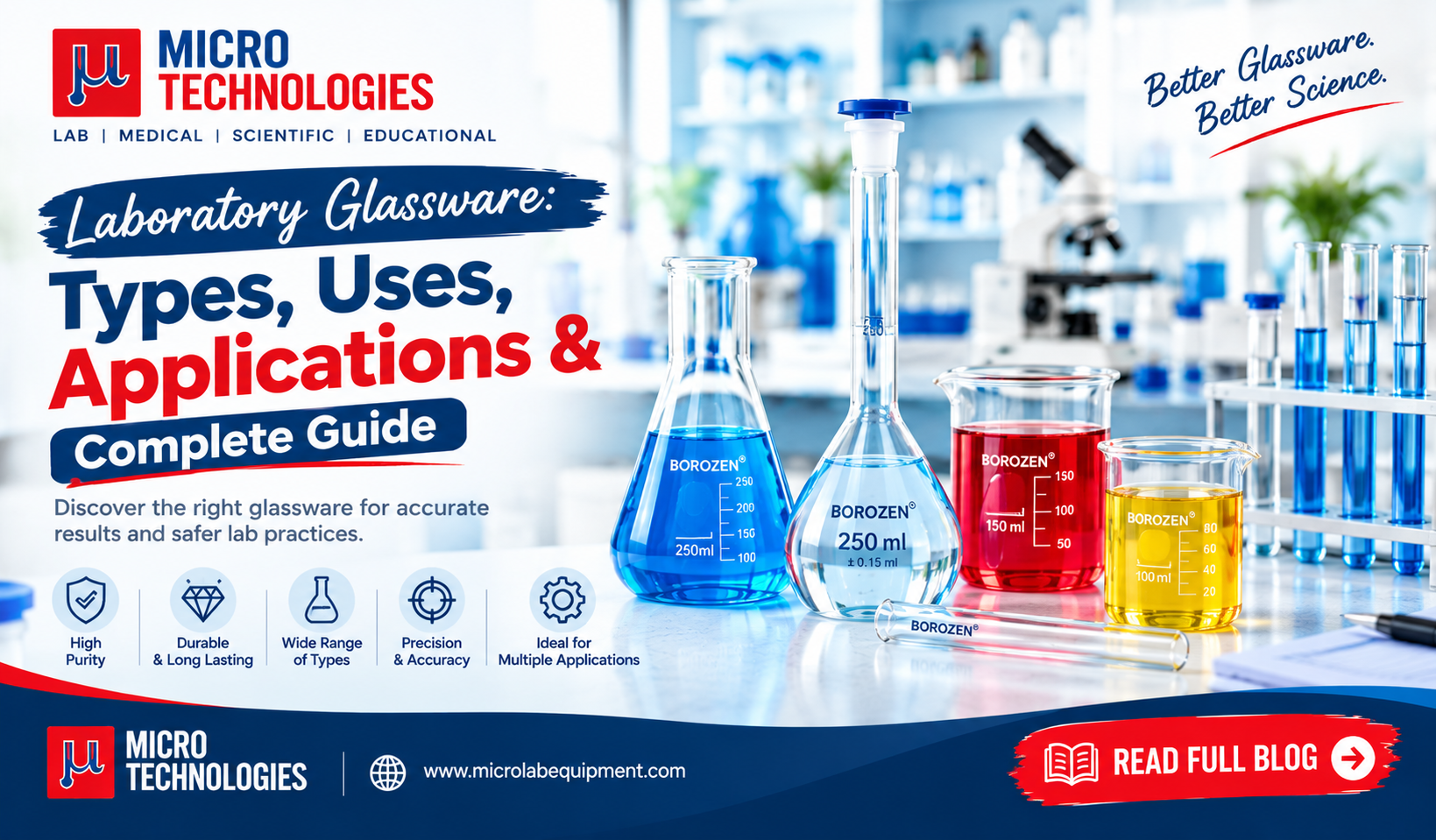
Walk into any chemistry lab, and you'll see the same cast of glass characters showing up again and again. A beaker here, a burette there, maybe a Petri dish quietly growing something in the corner.
Most people can point at these tools. Fewer people can explain why a chemist reaches for a volumetric flask instead of a beaker when precision actually matters. That gap is exactly what this guide fixes.
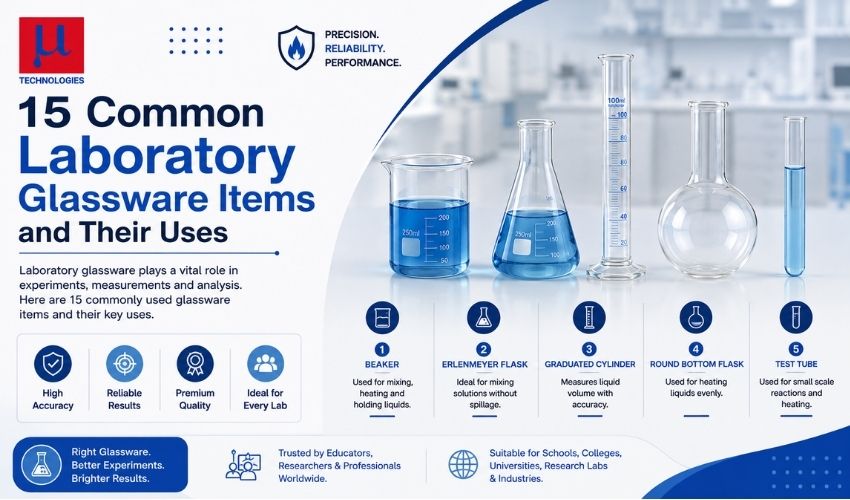
Below are 15 common laboratory glassware items, what each one genuinely does, and why swapping one for another can quietly wreck an experiment.
Why Glassware Choice Actually Matters
Every piece of laboratory glassware exists to solve a specific measuring, mixing, heating, or storing problem. Grab the wrong one, and you don't just look unprofessional — you introduce real error into your results.
Most quality lab glassware is made from borosilicate glass, prized for its chemical resistance and its ability to handle rapid temperature swings without cracking. That single material choice is why lab glass survives a Bunsen burner flame one moment and an ice bath the next.
With that context out of the way, let's go through the list.
1. Beaker
The beaker is the workhorse of the lab — a simple, flat-bottomed cylinder used for mixing, stirring, and heating liquids. It's arguably the single most common piece of laboratory glassware, showing up in everything from high school chemistry to pharmaceutical QC labs.
Beakers aren't built for precision. The volume markings on the side are approximate, not calibrated, so nobody should be measuring an exact 47.3 mL in one and expecting lab-grade accuracy.

2. Erlenmeyer Flask
Recognizable by its conical body and narrow neck, the Erlenmeyer flask lets you swirl a solution vigorously without splashing it out — something a wide-mouthed beaker simply can't do.
That narrow neck also makes it easy to cap with a stopper, which is why titrations and microbial cultures both lean on this shape so heavily.

3. Volumetric Flask
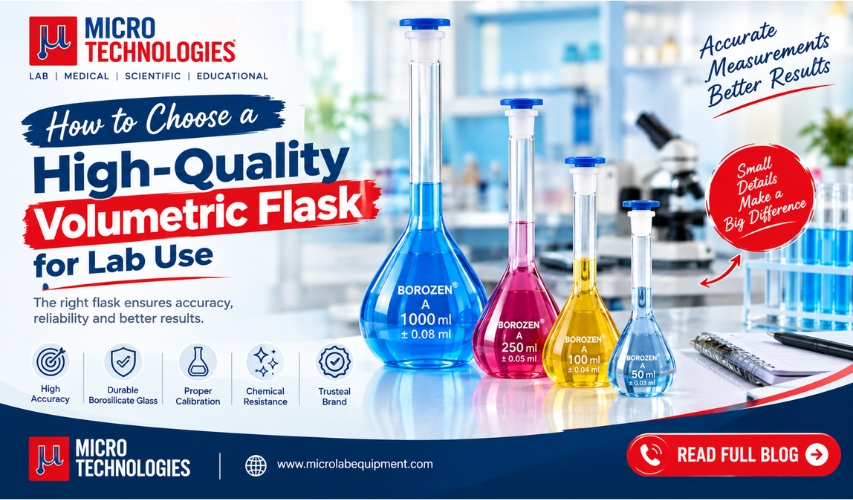
This is where precision comes in. A volumetric flask has a single calibration mark etched into its long, narrow neck, and it's designed to hold one exact volume at one exact temperature.
Volumetric flasks are the go-to tool for preparing standard solutions and precise dilutions in analytical and pharmaceutical laboratories, where "close enough" simply isn't good enough.

4. Graduated Cylinder
Tall, narrow, and lined with measurement markings, the graduated cylinder measures liquid volume more accurately than a beaker, though still less precisely than a volumetric flask or pipette.
It's the practical middle ground: better accuracy than a beaker, without the fuss of full volumetric-grade calibration.

5. Test Tube
Small, cylindrical, and endlessly useful, the test tube holds small quantities of substances for observation, heating, or reaction testing. It's less about measuring and more about simply containing — the lab equivalent of a sticky note.

6. Round Bottom Flask
That spherical base isn't just for looks — it's engineering. The rounded shape lets heat distribute evenly across the flask's surface, avoiding the localized hot spots that flat-bottomed containers can develop.
That's exactly why round-bottom flasks dominate distillation, reflux reactions, and organic chemistry setups where controlled, even heating genuinely matters.

7. Burette
If precision has a favorite piece of glassware, it's the burette. This long, graduated tube with a stopcock at the bottom dispenses liquid drop by drop, making it the standard tool for titrations.
Because tolerance really matters here, burettes are typically stored vertically to prevent blockages and calibration drift.
8. Pipette
Pipettes transfer or measure small volumes of liquid with high accuracy — think of them as burettes' more portable, single-purpose cousin. Volumetric pipettes are calibrated to deliver one exact volume, while graduated pipettes offer a range of measurable amounts along their length.
9. Watch Glass
A shallow, concave piece of glass, the watch glass isn't glamorous, but it's constantly in use — as a cover for a beaker, a surface for evaporating liquids, or a resting place for solids being weighed.
10. Petri Dish
The Petri dish has a surprisingly specific origin story. It was developed in 1887 by Julius Richard Petri, a German physician working in Robert Koch's laboratory in Berlin — one of the most influential labs in the early history of microbiology.
Before Petri's design, scientists grew bacteria on flat glass plates covered by a bulky bell jar, which made microscope work genuinely difficult. The shallow, lidded dish solved that problem, and it remains essential for culturing bacteria on solid agar media under sterile conditions.
11. Separatory Funnel
Also called a separating funnel, this pear-shaped vessel with a stopcock at its narrow end separates two liquids that refuse to mix — like oil and water — based on their different densities.
The technique is called liquid-liquid extraction, and it's a staple move in organic chemistry whenever a chemist needs to pull one compound out of a solvent mixture and into another.
12. Desiccator
A desiccator is a sealed glass chamber that protects moisture-sensitive samples from humidity in the air. Inside sits a desiccant — commonly silica gel — which absorbs ambient water vapor and keeps the internal atmosphere dry.
This matters enormously for hygroscopic salts, dried biological samples, and anything about to be weighed on an analytical balance, where even a trace of absorbed moisture can throw off a result.
13. Büchner (Filter) Flask
Thick-walled and built to withstand a vacuum, the Büchner flask — often just called a filter flask — pairs with a Büchner funnel to perform vacuum filtration. A vacuum pump pulls liquid through filter paper, separating solids from liquids far faster than gravity filtration alone.
Interestingly, the flask itself wasn't actually invented by Ernst Büchner — that credit likely belongs to Japanese bacteriologist Shibasaburo Kitasato. Büchner is remembered because he invented the companion funnel, and the two pieces of glassware have been paired together ever since.
14. Liebig Condenser
This is the piece of glassware that keeps distillation from turning into a mess. A Liebig condenser uses two concentric glass tubes — cooling water flows through the outer jacket while hot vapor rises through the inner tube — condensing that vapor back into liquid form.
It's essential for both distillation, where compounds are separated by boiling point, and reflux reactions, where you want boiling to continue without losing any liquid to evaporation. The design dates back further than most people expect — a water-cooled condenser using this exact concentric-tube principle was first described by Christian Ehrenfried Weigel back in 1771.
15. Reagent Bottle
Simple, sturdy, and often overlooked, the reagent bottle stores chemicals safely — typically amber-colored to block light-sensitive compounds from degrading, with a tight seal to keep air and moisture out. It's the unglamorous backbone of any lab's chemical storage shelf.
Choosing the Right Glassware for the Job
Here's the simple rule that saves labs from a lot of avoidable errors: match the glassware's precision level to what the task actually needs.
Don't reach for a beaker when a task calls for volumetric accuracy. Don't use a graduated cylinder when a titration needs burette-level control. And never assume "it looks close enough" is a substitute for the right tool.
Inspect glassware before every use, too. A hairline crack that looks harmless at room temperature can shatter the moment it meets a heat source or a rapid temperature change.
Conclusion
These 15 pieces of laboratory glassware cover almost everything a chemistry, biology, or general science lab needs on a daily basis — from the humble beaker doing rough mixing work, to the volumetric flask handling precision dilutions to the Petri dish quietly running microbiology's most enduring experiment.
Knowing what each one is actually built for isn't just trivia. It's the difference between a result you can trust and one you'll have to explain away later.
Frequently Asked Questions
What is the most commonly used piece of laboratory glassware?
The beaker is generally considered the most common, since it appears in nearly every lab type and gets used daily for mixing, heating, and rough measurement.
Which glassware gives the most accurate volume measurement?
Volumetric flasks, pipettes, and burettes are the most accurate, since they're individually calibrated to a specific tolerance, unlike beakers or standard graduated cylinders.
Why is most laboratory glassware made from borosilicate glass?
Borosilicate glass resists chemical attack and withstands rapid temperature changes without cracking, making it suitable for both heating and handling reactive chemicals.
What is the difference between a beaker and an Erlenmeyer flask?
A beaker is a wide, open cylinder, while an Erlenmeyer flask has a conical body and narrow neck, which allows swirling without spilling and makes it easier to stopper.
Who invented the Petri dish?
Julius Richard Petri developed the Petri dish in 1887, a German physician working in Robert Koch's bacteriology laboratory in Berlin.
Read More Article:
What are the 10 glassware used in a laboratory 2026