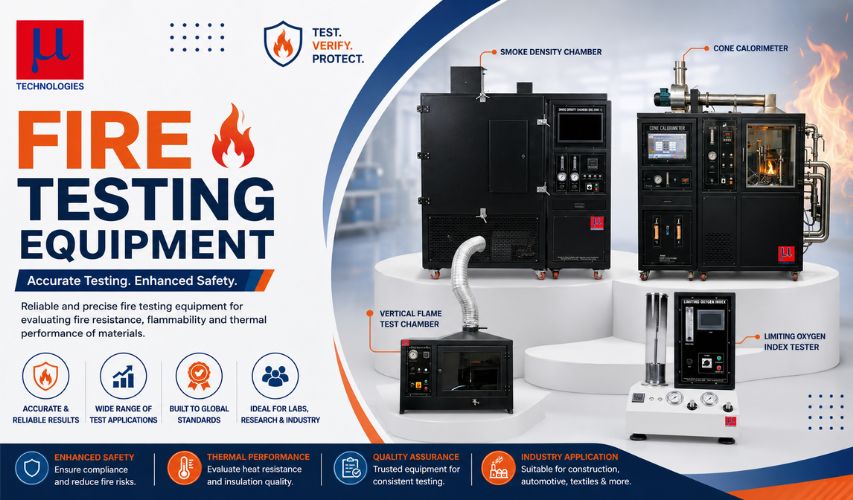
Fire testing equipment refers to laboratory instruments used to measure how materials ignite, burn, spread flame, release heat, and generate smoke under controlled conditions. These instruments — including the Flooring Radiant Panel Test Apparatus, Limiting Oxygen Index (LOI) Tester, Single-Flame Source Test Apparatus, Lateral Spread of Flame Test Apparatus, UL 94 Horizontal & Vertical Flammability Tester, Cone Calorimeter, and Smoke Density Chamber — are each built to a specific international standard (such as ASTM, ISO, or UL) and are used to test building materials, plastics, cables, textiles, and consumer products for fire safety compliance.
Fire safety compliance is one of the most heavily regulated areas in materials testing, and the equipment used to evaluate it is highly specialized. Every certified fire test — whether for a flooring product, a plastic enclosure, or an electrical cable — depends on a specific instrument built to an exact international standard. This guide explains what fire testing equipment does, why it matters, and breaks down seven of the most widely used fire testing instruments in laboratories worldwide, with every technical detail traced back to a verifiable source.
What Is Fire Testing Equipment and Why Does It Matter?
A fire test is a means of determining whether fire protection products meet minimum performance criteria set out in a building code or other applicable legislation, and successful tests in accredited laboratories result in a certification listing. Fire tests are conducted on both active and passive fire protection items, and they range from full-scale to small-scale and bench-scale tests. Fire testing equipment is the physical instrumentation used to run these standardized tests — measuring properties such as ignitability, flame spread, heat release rate, and smoke density under tightly controlled laboratory conditions.
Because different products face different fire risks — a carpet in a hospital corridor faces a different hazard than a plastic enclosure inside a power supply — no single machine covers every scenario. Instead, the industry relies on a family of purpose-built instruments, each tied to specific ASTM, ISO, IEC, or UL standards. Below are seven of the most important ones.
Key Fire Testing Equipment Used for Material & Safety Testing
1. Flooring Radiant Panel Test Apparatus
The Flooring Radiant Panel Test Apparatus is used to determine the critical radiant flux (CRF) of floor-covering systems — the level of radiant heat energy at which a flooring material stops burning at its most distant point of flame spread. In this test, a horizontally mounted floor covering specimen is exposed to radiant energy from a gas/air-fuel radiant panel mounted above one end of the sample and inclined at a 30-degree angle. This simulates the thermal radiation levels that would strike a floor when the upper surfaces of a room are heated by flames or hot gases from a fire in an adjacent space.
Results are reported in watts per square centimeter (W/cm²), and higher critical radiant flux values are considered better, since they indicate a material can self-extinguish even under higher levels of radiant heat. Building codes such as the International Building Code and NFPA 101 use this data to classify flooring as Class I or Class II, with Class I flooring often required in critical areas such as hospital entryways, exits, and corridors. This test method is also specified for rail and transit applications under NFPA 130.

2. Limiting Oxygen Index (LOI) Tester
The Limiting Oxygen Index (LOI) Tester measures the minimum concentration of oxygen, in a flowing oxygen-nitrogen mixture, needed to just sustain the flaming combustion of a material. The test method places a vertically oriented specimen inside a transparent glass column, through which a mixture of oxygen and nitrogen flows upward. The top of the specimen is ignited, and the oxygen concentration is gradually adjusted until the sample just barely continues to burn — either for 3 minutes or until it consumes 5 cm of its length.
The result is expressed as a percentage. Since ordinary air contains roughly 21% oxygen, a material with an LOI below 21% is classified as combustible in normal air, while a material with an LOI above 21% is considered self-extinguishing under standard atmospheric conditions, since it needs an oxygen-enriched environment to keep burning.LOI testing is commonly used in research and development to assess and adjust the flame-retardant properties of plastics and cables before the product proceeds to more rigorous certification tests such as UL 94.

3. Single-Flame Source Test Apparatus
The Single-Flame Source Test Apparatus measures the ignitability of building products when exposed to direct impingement of a small flame, without any external radiant heat source. The method — based on the German "Kleinbrenner" (small burner) principle — mounts the test specimen vertically inside a stainless-steel test chamber and exposes it to edge and/or surface contact with a small gas flame for a defined period, typically 15 to 30 seconds.
During testing, the apparatus records the time to ignition, whether burning droplets fall from the specimen, and whether flames reach a marked reference point on the specimen within a prescribed time. This test method is a required part of the European construction products classification system for reaction-to-fire performance and is commonly used to screen materials such as floor coverings, insulation facers, and building panels before they undergo more intensive tests like the Single Burning Item (SBI) test.

4. Lateral Spread of Flame Test Apparatus
The Lateral Spread of Flame Test Apparatus, also known as a Radiant Panel Flame Spread tester, measures the surface flammability of a material by combining two factors: the rate at which a flame front physically progresses across the specimen's surface, and the rate of heat liberated by the burning material. Together, these two factors are combined into a single Radiant Panel Index.
In the test, a specimen (typically 6 by 18 inches) is mounted at an inclined angle in front of a gas-fired radiant heat panel, and a pilot flame ignites the top of the sample. As the flame spreads laterally down the inclined specimen, thermocouples and timing marks record how quickly the flame front moves and how much heat is released along the way. This test is specified in transportation fire codes for trains and buses under NFPA 130 and 49 CFR Part 238, as well as in U.S. federal manufactured-home construction and recreational-vehicle safety standards.

5. UL 94 Horizontal & Vertical Flammability Tester
The UL 94 Horizontal & Vertical Flammability Tester is one of the most widely required instruments for plastics flammability certification, particularly for materials used in electrical and electronic products. UL 94 evaluates how a plastic reacts to an open flame from a Bunsen or Tirrill burner, measuring ignition behavior, self-extinguishing time, and whether flaming drips ignite a cotton indicator placed beneath the sample.
The apparatus supports two primary test orientations:
- Horizontal Burning (HB) test — the specimen is mounted horizontally, and a flame is applied to one end. A material passes the HB rating if its burn rate is slower than a specified limit (commonly 40 mm/min for thicker samples or up to about 75 mm/min for thinner ones) or if it stops burning before reaching a 100 mm reference mark.
- Vertical Burning (V) test — the specimen is mounted vertically and the flame is applied to its lower edge, typically twice, for 10 seconds each time. Materials are rated:
- V-0 – the sample self-extinguishes within 10 seconds, with no flaming drips
- V-1 – the sample self-extinguishes within 30 seconds, with no flaming drips
- V-2 – the sample self-extinguishes within 30 seconds, but flaming drips are permitted
There are additional, more demanding classifications, including the 5V rating, which applies a more intense flame exposure for high-risk applications such as electrical enclosures. UL 94 ratings are commonly required for components such as circuit boards, power supply housings, and connector plastics, where V-0 is often the minimum specification.

6. Cone Calorimeter
The Cone Calorimeter is widely regarded as the most significant bench-scale instrument in modern fire testing, because it provides detailed combustion data from a relatively small sample. It works on the principle of oxygen consumption calorimetry — the heat released by a burning material is directly proportional to the amount of oxygen consumed during combustion, at a rate of approximately 13.1 MJ of heat released per kilogram of oxygen consumed.
A 100 mm × 100 mm specimen is exposed horizontally to a controlled, adjustable radiant heat flux (commonly set to simulate real fire conditions, often at or near 50 kW/m²) from a truncated, cone-shaped electric heater — the source of the instrument's name — with an external spark igniter. As the sample burns, the cone calorimeter's oxygen analyzer and exhaust system continuously measure oxygen depletion, allowing it to calculate:
- Heat release rate (HRR) and peak heat release rate
- Total heat released
- Time to ignition
- Mass loss rate
- Smoke production, via light-beam attenuation
Because peak heat release rate and how quickly a material reaches it are considered critical predictors of how fast a fire will grow, cone calorimeter data is used extensively in both material R&D and formal product certification under standards such as EN 13501-1.

7. Smoke Density Chamber
The Smoke Density Chamber measures the specific optical density of smoke generated by solid materials during both flaming and non-flaming (smoldering/pyrolytic) combustion. A vertically mounted specimen, up to 1 inch thick, is placed inside a sealed chamber and exposed to a radiant heat source (commonly around 2.5 W/cm², or 25 kW/m²), with the option to test with or without a pilot flame.
As smoke accumulates inside the closed chamber, a vertical photometric light beam is passed through it, and the attenuation (blocking) of that light beam is measured continuously. The test typically runs for up to 20 minutes, or for 3 minutes after the point of minimum light transmittance is reached, whichever comes first. The results are reported as specific optical density values, including standardized readings such as Ds(1.5) and Ds(4.0), taken at 1.5 and 4 minutes into the test. Because smoke obscuration is a major factor in preventing safe evacuation during a real fire, this test is a required part of fire safety codes for aircraft interiors, rail and bus transportation (NFPA 130, 49 CFR Part 238), and various building products.

How These Fire Testing Instruments Work Together
While each instrument above targets a different fire-response property, real-world product certification usually requires several of them in combination. A single building material, for example, may need to pass a Single-Flame Source ignitability screen, a Lateral Spread of Flame or Flooring Radiant Panel test for surface burning behavior, an LOI check during formulation, and finally a Cone Calorimeter or Smoke Density Chamber test to quantify heat and smoke output for full code compliance. Electronics and cable manufacturers rely more heavily on LOI and UL 94 testing, since their primary certification pathway runs through Underwriters Laboratories and IEC flammability standards for components and insulation materials.
Industries That Rely on Fire Testing Equipment
Based on the standards each instrument is tied to, fire testing equipment is used across several major industries:
- Construction and building materials — flooring, insulation, wall and ceiling panels tested under ASTM E648, ISO 11925-2, and ASTM E162
- Electronics and electrical components — circuit boards, enclosures, connectors, and cable insulation tested under UL 94 and LOI standards
- Transportation (rail, bus, aerospace) — interior panels, seating, and flooring tested under NFPA 130, 49 CFR Part 238, and ASTM E662
- Plastics and polymer manufacturing — raw material and compound testing using LOI and Cone Calorimeter data during R&D
- Fire science research and academic institutions — using Cone Calorimeters and smoke chambers to study combustion mechanisms and develop new flame-retardant formulations
Conclusion
Fire testing equipment exists to answer a very specific, high-stakes question for every material that goes into a building, vehicle, or electrical product: how will this behave if it catches fire? From the Flooring Radiant Panel Test Apparatus measuring critical radiant flux, to the Limiting Oxygen Index Tester quantifying flame resistance, to the UL 94 tester certifying plastics for electrical use, and the Cone Calorimeter and Smoke Density Chamber measuring heat and smoke output, each instrument is built around a precise, standardized methodology developed by bodies like ASTM, ISO, and Underwriters Laboratories. Understanding what each one measures — and which standard governs it — is the first step for any manufacturer, testing lab, or researcher working toward fire safety compliance.
Frequently Asked Questions
What is fire testing equipment used for?
It is used to measure how materials ignite, spread flame, release heat, and generate smoke under controlled conditions, providing the data required for fire safety code compliance and product certification.
What is the difference between LOI testing and UL 94 testing?
LOI testing measures the minimum oxygen concentration needed to sustain combustion and is mainly used during R&D to compare and refine flame-retardant formulations, while UL 94 is a pass/fail certification test measuring self-extinguishing time and dripping behavior, commonly required for final product approval.
What does a Cone Calorimeter actually measure?
A Cone Calorimeter measures heat release rate, total heat released, time to ignition, mass loss rate, and smoke production of a material exposed to controlled radiant heat, using the principle of oxygen consumption calorimetry.
Why is smoke density testing important in fire safety?
Smoke obscuration is a major factor that prevents safe evacuation during a real fire, so the Smoke Density Chamber (ASTM E662) quantifies how much light-blocking smoke a material produces under both flaming and smoldering combustion.
Which fire testing equipment is required for building materials versus electronics?
Building materials are typically tested using the Flooring Radiant Panel Test Apparatus, Single-Flame Source Test Apparatus, and Lateral Spread of Flame Test Apparatus, while electronics and plastics primarily rely on the LOI Tester and UL 94 Horizontal & Vertical Flammability Tester.