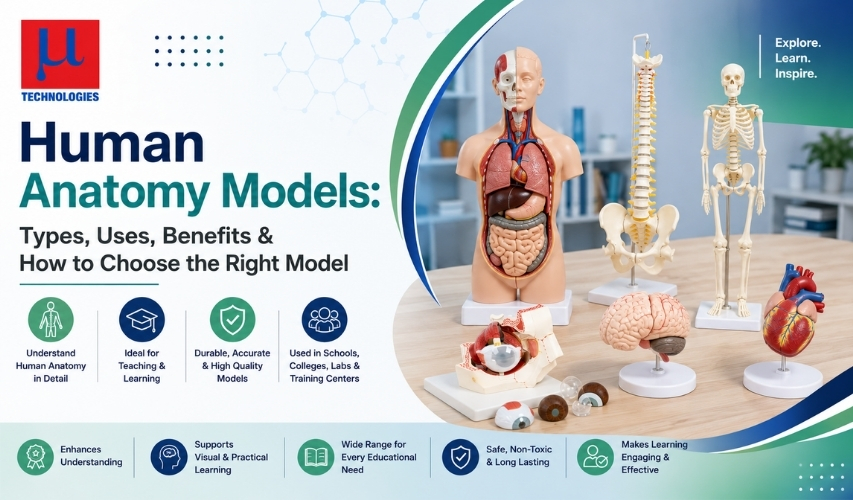
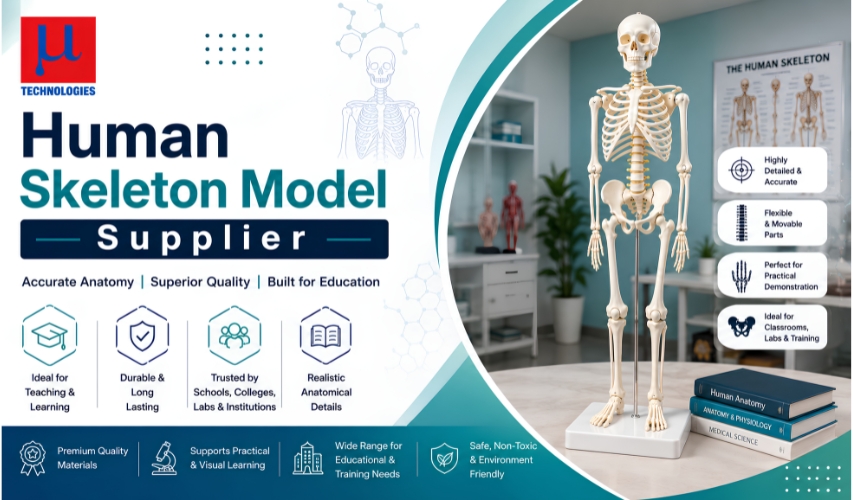
A human skeleton model supplier manufactures and sells anatomical replicas of the human skeletal system — ranging from full-size, life-size 3D models to mini and disarticulated versions — for use in medical schools, nursing colleges, biology classrooms, chiropractic and physiotherapy practices, and patient education. The adult human skeleton contains 206 bones (80 in the axial skeleton, 126 in the appendicular skeleton), and commercial models are typically molded in durable PVC plastic to replicate this structure accurately. Suppliers such as Micro Technologies manufacture full human skeleton models, including a 170 cm life-size version with muscles and ligaments.
If you're a medical college, nursing institute, physiotherapy clinic, or school setting up an anatomy lab, choosing the right human skeleton model supplier matters. The skeleton is the framework every other anatomy lesson builds on, so the quality, accuracy, and durability of the model directly affects how well students and trainees learn. This guide covers the real anatomy these models represent, the different types available — including full and 3D human skeleton models — and what to check before you buy.
The Real Anatomy Behind a Human Skeleton Model
Before comparing suppliers or model types, it helps to know exactly what a human skeleton model is meant to represent.
How Many Bones Are in the Human Skeleton?
The adult human skeleton is made up of 206 bones. Newborns are born with roughly 270 bones, and this number decreases as some bones fuse together during growth and development.
This total breaks down into two main groups, based on standard anatomical references:
- Axial skeleton – 80 bones: the skull, vertebral column, ribs, and sternum
- Appendicular skeleton – 126 bones: the arms, legs, shoulder girdle, and pelvic girdle
Of the 206 bones, 172 exist as matched pairs (left and right), while 34 are unpaired. A single arm alone contains 14 phalanges, 5 metacarpals, 8 carpals, the radius and ulna, the humerus, and the shoulder girdle — illustrating how detailed the appendicular skeleton's structure really is.
Why This Number Matters for Model Accuracy
Because 206 is the standard reference count used in medical and nursing education, accurate anatomical skeleton models are built to reflect this structure — which is why quality skeleton product lines are commonly advertised as having "200+ bones cast in unbreakable plastic," closely mirroring the real skeletal count.
Types of Human Skeleton Models
Not every skeleton model serves the same purpose. Based on typical product ranges across the anatomy model industry, human skeleton models generally fall into these categories:
1. Full Human Skeleton Models (Life-Size)
Full-size, life-size skeleton models are built to match natural adult human proportions and are commonly used in medical schools and anatomy labs. Life-size skeleton models on the market typically stand around 5'6" (168 cm) to 170 cm tall. Micro Technologies manufactures a 170 cm life-size human skeleton model with muscles and ligaments for medical college and laboratory use.
2. 3D Human Skeleton Models with Muscles and Ligaments
These models go beyond bare bone structure to also show muscle origins, insertions, and joint ligaments in three-dimensional detail. Micro Technologies' 170 cm model falls in this category, combining the full skeletal structure with muscle attachment points and joint ligaments for more advanced anatomical study.
3. Flexible / Articulated Skeleton Models
Flexible skeleton models have a poseable spine and movable joints, letting instructors demonstrate natural postures and joint movement — a common feature across quality full-size skeleton models sold for medical education.
4. Disarticulated Skeleton Models
Disarticulated (or "bone set") models separate every individual bone so students can study each one independently before understanding how they fit together. Micro Technologies also manufactures a disarticulated life-size skeleton for this purpose.
5. Mini and Space-Saving Skeleton Models
Compact mini skeletons are designed for tight classroom spaces or portable use without sacrificing anatomical detail. Micro Technologies' catalog includes a miniature skeleton model described as offering hands-on study in a smaller footprint, alongside a medium-tall 85 cm model (MT-XC-102) mounted on a metal stand with a removable calvarium.
6. Skull and Regional Skeleton Models
Beyond full skeletons, suppliers also offer standalone skull models (including disarticulated skulls with movable jaws), spinal column models, and limb-specific skeleton models such as arm, leg, and foot skeletons with muscles and ligaments.
Common Uses of Human Skeleton Models
Based on how these models are used across medical and educational institutions, human skeleton models serve several well-documented purposes:
1. Medical and Nursing Education
Human skeleton models are widely used in medical colleges, nursing institutes, and anatomy labs to help students learn bone structure, joint relationships, and skeletal landmarks.
2. Biology and Secondary School Classrooms
Skeleton models are popular teaching tools in biology classrooms because they demonstrate the human body's construction to students who are unfamiliar with anatomy.
3. Clinical and Patient Education
Doctors, chiropractors, and physical therapists commonly keep a skeleton model on hand to quickly and visually explain a patient's condition or a proposed procedure.
4. Physiotherapy and Rehabilitation Training
Physiotherapists use full human skeleton models — particularly those with muscle and ligament detail — to study joint movement and muscle-skeletal relationships relevant to rehabilitation, which is why Micro Technologies' 170 cm skeleton model is built to include this level of detail.
5. Orthopedic and Forensic Study
Skeleton models are also used by professionals and students in orthopedics and forensic science, where detailed, individual-bone study (via disarticulated models) supports specialized learning.
What to Look for in a Human Skeleton Model Supplier
When choosing where to buy a human skeleton model, consider the following:
- Material and durability – Look for skeleton models cast in PVC or "unbreakable plastic," the standard material used by established suppliers, including Micro Technologies, for classroom and clinical durability.
- Accuracy to the 206-bone standard – A quality full human skeleton model should closely reflect the real axial (80-bone) and appendicular (126-bone) structure of the human body.
- Model type match to your use case – A flexible, articulated model suits demonstration of movement; a disarticulated model suits individual bone study; a model with muscles and ligaments suits more advanced physiotherapy or medical training.
- Size options – Suppliers like Micro Technologies offer multiple sizes, from a 170 cm life-size model down to an 85 cm medium-tall version and compact mini skeletons, so buyers can match the model to their available space and teaching level.
- Mounting and stand quality – Life-size models are typically mounted on a stand (metal or rolling base) for stability and ease of display.
- After-sales support – For institutional buyers, confirm availability of spare parts, replacement stands, and installation guidance, particularly for larger anatomy lab orders.
Why Institutions Choose Micro Technologies as a Skeleton Model Supplier
Micro Technologies, based in Ambala, Haryana, India, is a recognized human anatomical model manufacturer and supplier. The company's catalog includes:
- A 170 cm life-size human skeleton model with muscles and ligaments, built in PVC and designed for medical colleges, laboratories, and training institutes
- A medium-tall 85 cm skeleton model (MT-XC-102) with full natural movement, mounted on an iron stand with a removable calvarium
- Disarticulated life-size skeletons, mini skeleton models, and standalone skull models, including disarticulated skulls with movable jaws
Micro Technologies positions itself as a supplier for medical colleges, nursing institutes (ANM/GNM/B.Sc. Nursing), schools, and laboratories — making it a relevant option for institutions comparing human skeleton model suppliers for bulk or lab-scale procurement.
Conclusion
A human skeleton model is only as useful as its accuracy to real anatomy — the 206-bone structure that defines the human skeletal system. Whether you need a full human skeleton model for a medical college anatomy lab, a 3D model with muscles and ligaments for physiotherapy training, or a compact mini skeleton for a school classroom, matching the model type to your teaching goals matters as much as the supplier you choose. Manufacturers such as Micro Technologies, offering a documented range from 170 cm life-size models to 85 cm and mini versions, give institutions multiple options when deciding where to buy a human skeleton model for education or clinical use.
Frequently Asked Questions
How many bones does a full human skeleton model typically represent?
Accurate models are built to reflect the standard adult count of 206 bones — 80 in the axial skeleton and 126 in the appendicular skeleton.
What is the difference between a full skeleton model and a disarticulated skeleton model?
A full (articulated) skeleton model is assembled and mounted to show the complete structure, while a disarticulated model separates every bone individually for focused study.
What size is a typical life-size or 3D human skeleton model?
Life-size skeleton models generally range from about 5'6" (168 cm) to 170 cm, matching adult human proportions.
What material are human skeleton models usually made of?
Most commercial skeleton models are made from PVC or "unbreakable plastic" for classroom and clinical durability.
Who manufactures human skeleton models for medical colleges?
Several companies manufacture these models, including Micro Technologies (Ambala, India), which supplies life-size, medium, mini, and disarticulated skeleton models to medical colleges, nursing institutes, and laboratories.