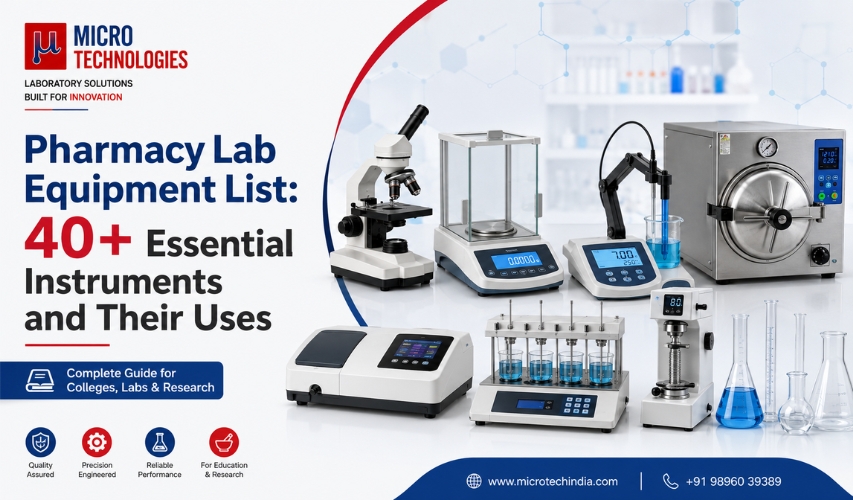
A well-equipped pharmacy laboratory helps students, researchers, and pharmaceutical professionals understand how medicines are formulated, tested, analyzed, and evaluated. A typical pharmacy lab equipment list may include basic instruments such as balances, pH meters, and microscopes, along with specialized equipment such as dissolution testers, tablet-making machines, autoclaves, and spectrophotometers.
However, there is no single universal list that fits every laboratory. The required equipment depends on the pharmacy course, department, number of students, practical syllabus, testing purpose, and applicable institutional requirements.
The Pharmacy Council of India publishes course regulations, syllabi, and prescribed equipment-related requirements for pharmacy education. Institutions should therefore verify the latest applicable PCI documents before finalizing a complete laboratory setup.
This guide explains the most important pharmacy laboratory equipment, its uses, suitable departments, and key considerations for selecting a reliable pharmacy lab equipment manufacturer.
What Is Pharmacy Laboratory Equipment?
Pharmacy laboratory equipment includes the instruments, machines, apparatus, and supporting systems used to prepare, analyze, test, and study pharmaceutical substances and dosage forms.
These instruments may be used in:
· Pharmaceutics laboratories
· Pharmaceutical chemistry laboratories
· Pharmacology laboratories
· Pharmacognosy laboratories
· Pharmaceutical microbiology laboratories
· Pharmaceutical analysis laboratories
· Quality-control laboratories
· Research and development facilities
· D.Pharm, B.Pharm, M.Pharm and Pharm.D institutions
Some pharmacy lab instruments are designed mainly for education and demonstration. Others are advanced analytical systems used in pharmaceutical manufacturing, research, and quality control.
WHO describes pharmaceutical quality control as the procedures used to establish the identity and purity of pharmaceutical substances and products. These procedures can range from relatively simple chemical tests to advanced analytical methods described in pharmacopoeial monographs.
What Equipment Is Required in a Pharmacy Lab?
A pharmacy laboratory normally requires equipment for measurement, heating, mixing, formulation, sterilization, microscopy, and pharmaceutical testing.
The exact selection depends on:
· Course and department
· Student intake
· Practical experiments
· Dosage forms being studied
· Required analytical methods
· Available laboratory space
· Utility requirements
· Regulatory and institutional standards
· Budget and future expansion plans
For example, a basic teaching laboratory may need balances, water baths, hot plates, and microscopes. A pharmaceutical quality-control laboratory may additionally require HPLC, UV-visible spectrophotometry, dissolution testing, and stability-testing systems.
The latest requirements should always be checked before procurement because academic regulations, course structures, and approval requirements can change. PCI published approval-process information for the 2026–2027 academic session, including department-wise minimum equipment requirements for B.Pharm institutions.
Complete Pharmacy Lab Equipment List with Uses
The following list covers common equipment used across different pharmacy departments. Not every institution needs every instrument, but the categories provide a useful starting point for laboratory planning.

1. Analytical Balance
An analytical balance measures small quantities of chemicals and pharmaceutical ingredients with high precision. It is one of the most important instruments in pharmaceutical chemistry, formulation, and analysis.
It is commonly used for:
· Weighing active pharmaceutical ingredients
· Preparing standard solutions
· Measuring excipients
· Conducting assay-related experiments
· Preparing samples for instrumental analysis
The balance should be placed on a stable, vibration-free surface. Air movement, temperature changes, static charge, and poor leveling can affect readings.
A balance should also be calibrated and checked at defined intervals. A shiny digital display is useful, but it cannot rescue a poorly calibrated instrument.

2. Precision or Top-Pan Balance
A precision balance is used when the laboratory needs reliable weighing but does not require the extremely fine readability of an analytical balance.
It is suitable for:
· Routine ingredient weighing
· Bulk formulation work
· Preparing powders and granules
· Student practical experiments
· Weighing containers and larger samples
Many pharmacy laboratories use both analytical and precision balances because the two instruments serve different weighing ranges and accuracy requirements.

3. pH Meter
A pH meter determines whether a solution is acidic, neutral, or alkaline. It is widely used in pharmaceutical formulations because pH can influence solubility, stability, compatibility, and product performance.
Common applications include:
· Testing syrups and suspensions
· Evaluating buffer solutions
· Checking ophthalmic and topical preparations
· Monitoring dissolution media
· Conducting pharmaceutical chemistry experiments
The electrode must be cleaned, stored properly, and calibrated using appropriate buffer solutions. An unmaintained electrode may produce a number quickly, but not necessarily the correct number.

4. Conductivity Meter
A conductivity meter measures the ability of a solution to conduct electrical current.
It can support:
· Water-quality evaluation
· Ionic-solution studies
· Purified-water monitoring
· Formulation-development experiments
· General pharmaceutical analysis
Conductivity depends on factors such as ion concentration and temperature, so readings should be interpreted using the defined test method.

5. Hot Plate
A laboratory hot plate provides controlled heating without an open flame.
It is used for:
· Heating solutions
· Preparing formulations
· Dissolving ingredients
· Evaporating liquids
· Supporting chemistry experiments
Models with digital temperature control provide better repeatability, although actual sample temperature should not automatically be assumed to equal the display temperature.

6. Magnetic Stirrer
A magnetic stirrer mixes liquids through a rotating magnetic field and a stir bar placed inside the vessel.
It is commonly used for:
· Preparing solutions
· Dissolving chemicals
· Mixing buffers
· Producing liquid formulations
· Maintaining uniformity during experiments
A hot plate magnetic stirrer combines mixing and heating in one instrument, making it useful where both operations are required.

7. Laboratory Water Bath
A water bath provides uniform and indirect heating for samples placed in containers.
It is used in:
· Temperature-controlled reactions
· Sample incubation
· Melting studies
· Microbiology procedures
· Formulation experiments
Water baths may include thermostatic control, digital displays, and multiple sample openings. The bath should be cleaned regularly to prevent contamination and mineral buildup.

8. Heating Mantle
A heating mantle heats round-bottom flasks more uniformly than a conventional hot plate.
It is useful for:
· Distillation
· Extraction
· Reflux experiments
· Solvent heating
· Pharmaceutical chemistry practicals
The flask size should match the mantle capacity. Using an unsuitable flask can lead to uneven heating or damage.

9. Laboratory Centrifuge
A centrifuge separates components according to differences in density by spinning samples at controlled speeds.
It is commonly used to:
· Separate suspended solids
· Clarify liquid samples
· Prepare biological specimens
· Conduct sedimentation studies
· Support microbiology and analysis procedures
Tubes must be balanced before operation. An unbalanced centrifuge is not merely noisy; it can damage the rotor and create a safety risk.
10. Orbital Shaker
An orbital shaker provides controlled circular movement for mixing containers.
It is suitable for:
· Culture studies
· Extraction procedures
· Dissolution-related preparation
· Mixing reagents
· Biological and microbiological work
Speed range, platform size, load capacity, and timer controls should be selected according to the intended experiment.
11. Mechanical Shaker
A mechanical shaker agitates bottles, flasks, or sieves through a defined shaking motion.
It may be used for:
· Sample extraction
· Mixing suspensions
· Reagent preparation
· Solubility studies
· Routine laboratory agitation
Mechanical and orbital shakers are not always interchangeable, as the direction and intensity of movement can differ.
12. Homogenizer
A homogenizer reduces particle or droplet size and produces a more uniform mixture.
It is useful in preparing:
· Emulsions
· Suspensions
· Creams
· Lotions
· Biological samples
The selected speed and probe design depend on the sample volume, viscosity, and desired level of homogenization.
13. Sieve Shaker
A sieve shaker separates powders and granules according to particle size by mechanically agitating a stack of standard sieves.
It is widely used in pharmaceutics for:
· Particle-size analysis
· Granule evaluation
· Powder classification
· Formulation development
· Studying flow and packing behaviour
Particle size can influence mixing, compression, dissolution, and dosage-form consistency. Sieves should be clean, undamaged, and correctly arranged.
14. Desiccator
A desiccator protects moisture-sensitive materials or allows heated samples to cool in a low-humidity environment.
It is used for:
· Storing hygroscopic substances
· Cooling crucibles
· Protecting dried samples
· Moisture-related experiments
· Supporting gravimetric analysis
The desiccant should be checked and regenerated or replaced when it no longer performs effectively.
15. Tablet-Making Machine
A laboratory tablet-making machine compresses powder or granules into tablets. Small-scale models help students understand tablet formulation and compression.
It may be used to study:
· Tablet compression
· Formulation variables
· Punch and die operation
· Granule behaviour
· Tablet defects
· Compression pressure
Laboratory-scale tablet machines are educational or developmental systems and should not automatically be presented as full pharmaceutical production lines.
16. Tablet Dissolution Test Apparatus
A dissolution test apparatus measures the extent and rate at which an active substance goes into solution from a dosage form.
USP explains that dissolution testing measures the rate and extent of solution formation from a dosage form. FDA guidance also uses dissolution testing in drug-product quality assessment, formulation development, and evaluation of certain manufacturing or post-approval changes.
Common applications include:
· Comparing formulations
· Evaluating drug-release behaviour
· Supporting product development
· Testing batch consistency
· Conducting quality-control studies
Basket and paddle apparatus are widely used for many solid oral dosage forms, although the correct apparatus and conditions depend on the applicable monograph or validated procedure.
Dissolution testing should not be confused with disintegration testing. A dosage form may break apart without the drug dissolving at the required rate.
17. Tablet Disintegration Test Apparatus
A disintegration tester determines how long a tablet or capsule takes to break apart under defined conditions.
It is used to evaluate:
· Tablets
· Capsules
· Coated dosage forms
· Formulation changes
· Manufacturing consistency
Disintegration describes physical breakup. Dissolution measures the formation of a solution from the dosage form. The two tests answer different questions and should be reported separately.
18. Friability Tester
A friability tester evaluates how well tablets resist abrasion, chipping, and mechanical stress during handling.
It is useful for studying whether tablets can tolerate the following:
· Packaging
· Transportation
· Coating operations
· Counting
· Routine handling
The test commonly involves weighing tablets before and after controlled tumbling. The method, rotation conditions, and acceptance criteria should follow the applicable standard or internal procedure.
19. Tablet Hardness Tester
A tablet hardness tester measures the force required to break a tablet under defined conditions.
USP discusses tablet-breaking force as a mechanical property used in development and quality control.
This instrument helps evaluate:
· Compression performance
· Tablet strength
· Formulation changes
· Handling resistance
· Batch consistency
Hardness and friability are related to tablet strength, but they do not measure exactly the same property.
20. Tablet Thickness Tester
A thickness tester measures tablet thickness and, depending on the model, diameter.
It is useful for:
· Monitoring dimensional consistency
· Adjusting compression settings
· Evaluating packaging compatibility
· Comparing formulation batches
· Supporting in-process checks
Digital models provide quick readings, while manual vernier-type instruments may be adequate for basic teaching laboratories.
21. Capsule-Filling Machine
A capsule-filling machine helps fill powder or granules into hard capsules.
Laboratory and manual models are used for:
· Demonstrating capsule preparation
· Small-batch development
· Studying fill-weight variation
· Preparing educational formulations
· Understanding capsule-handling steps
The machine should match the required capsule size and batch capacity.
22. Ball Mill
A ball mill reduces the particle size of materials through impact and attrition.
It can be used for:
· Size reduction
· Powder preparation
· Mixing certain materials
· Formulation development
· Studying milling variables
Operating time, ball size, material compatibility, and chamber design affect the final particle-size distribution.
23. Ointment or Cream-Making Equipment
Ointment mills, planetary mixers, and laboratory homogenizers may be used to produce semisolid formulations.
These instruments support the preparation of:
· Ointments
· Creams
· Gels
· Pastes
· Cosmetic and topical preparations
The most suitable equipment depends on viscosity, batch volume, and the level of particle-size reduction or homogenization required.
24. Ampoule-Filling and Sealing Machine
A laboratory ampoule-filling and sealing system demonstrates how liquid preparations are filled and ampoules are closed.
It may support:
· Educational demonstrations
· Packaging studies
· Small-scale formulation development
· Understanding filling operations
Such equipment should be operated with appropriate ventilation, heat protection, and trained supervision.
25. UV-Visible Spectrophotometer
A UV-visible spectrophotometer measures how much ultraviolet or visible light a sample absorbs at selected wavelengths.
It is commonly used for:
· Quantitative drug analysis
· Assay experiments
· Calibration curves
· Dissolution-sample analysis
· Reaction studies
· Identification-related procedures
Reliable results depend on suitable sample preparation, blank correction, wavelength selection, instrument performance, and a validated or verified analytical method.
ICH Q2(R2) provides guidance on selecting and evaluating validation tests so that analytical procedures are suitable for their intended purpose.
26. Colorimeter
A colorimeter measures absorbance in the visible region using filters or selected wavelengths.
It is often used in teaching laboratories for:
· Concentration determination
· Colour-based reactions
· Basic quantitative analysis
· Demonstrating Beer–Lambert relationships
A colorimeter is generally simpler than a full UV-visible spectrophotometer, but the correct choice depends on the method and wavelength range.
27. Fluorimeter
A fluorimeter measures fluorescence emitted by a substance after excitation with light.
It may be used for:
· Sensitive quantitative analysis
· Fluorescent compound studies
· Research experiments
· Certain biochemical applications
Not every compound fluoresces naturally, so some methods require chemical derivatization or specialized reagents.
28. Refractometer
A refractometer measures the refractive index of a liquid or transparent material.
Pharmacy applications may include:
· Identity-related testing
· Concentration estimation
· Evaluation of syrups
· Analysis of oils
· Quality assessment of liquid materials
Temperature can influence refractive-index readings, so compensation or controlled measurement conditions may be necessary.
29. Polarimeter
A polarimeter measures the rotation of plane-polarized light by optically active substances.
It may be used for:
· Studying sugars
· Evaluating optically active compounds
· Identity testing
· Purity-related experiments
· Pharmaceutical chemistry practicals
Sample concentration, tube length, temperature, and wavelength can affect the observed rotation.
30. Melting-Point Apparatus
A melting-point apparatus determines the temperature range over which a solid melts.
It is commonly used for:
· Preliminary identification
· Purity assessment
· Comparing reference substances
· Pharmaceutical chemistry practicals
Impurities can alter or broaden the melting range. Heating too quickly may also produce inaccurate observations.
31. Viscometer
A viscometer measures the resistance of a liquid or semisolid to flow.
It is important for evaluating the following:
· Syrups
· Suspensions
· Emulsions
· Creams
· Gels
· Polymer solutions
Different viscometers operate on different principles. Ostwald, Brookfield, and other systems should not be treated as identical or selected only by price.
32. Nephelometer
A nephelometer measures light scattered by particles suspended in a sample.
It can be used in:
· Turbidity-related studies
· Microbial growth assessment
· Precipitation reactions
· Suspension analysis
A turbidity meter and nephelometer may use related optical principles, but instrument configurations and reporting units can vary.
33. Flame Photometer
A flame photometer measures the emission intensity of certain elements when introduced into a flame.
It is often used for:
· Sodium estimation
· Potassium estimation
· Calcium-related studies
· Pharmaceutical analysis teaching
Proper calibration standards, flame conditions, and sample preparation are necessary for meaningful results.
34. High-Performance Liquid Chromatography System
HPLC separates, identifies, and quantifies components within a mixture.
It is used extensively in advanced pharmaceutical work for:
· Assay testing
· Impurity analysis
· Stability-indicating methods
· Dissolution-sample analysis
· Research and formulation development
· Raw-material and finished-product evaluation
An HPLC system typically includes a solvent-delivery system, injector or autosampler, analytical column, detector, and data-processing software.
HPLC should be classified as advanced analytical equipment. A basic teaching laboratory may not need the same configuration as an industrial quality-control laboratory.
35. Gas Chromatograph
Gas chromatography separates volatile or suitably derivatized compounds.
Pharmaceutical applications may include:
· Residual-solvent analysis
· Volatile-compound studies
· Purity testing
· Research applications
The system configuration depends on the required detector, column, carrier gas, and analytical method.
36. Autoclave
An autoclave uses saturated steam under pressure for sterilization.
It is commonly used for:
· Sterilizing culture media
· Treating glassware
· Sterilizing suitable instruments
· Decontaminating microbiological waste
· Supporting aseptic laboratory work
Sterilization effectiveness depends on exposure time, temperature, loading arrangement, air removal, and validation. Merely closing the lid and pressing “start” does not prove that every item has been sterilized.
37. Hot-Air Oven
A hot-air oven provides controlled dry heat.
It may be used for:
· Drying glassware
· Heating samples
· Moisture-related studies
· Dry-heat treatment of suitable materials
· General laboratory work
Dry heat and moist heat are not interchangeable. Material compatibility and the applicable procedure should determine the selected method.
38. Laboratory Incubator
An incubator maintains a controlled temperature for microbial cultures or other temperature-sensitive studies.
It is used for:
· Culture growth
· Microbial-limit-related teaching
· Sample incubation
· Stability or biological studies
Temperature uniformity, recovery after door opening, and routine cleaning are important selection considerations.
39. BOD Incubator
A BOD incubator maintains controlled low-temperature conditions and is often used where incubation below normal ambient or conventional incubator temperature is needed.
Applications may include:
· Microbiological studies
· Environmental testing
· Controlled sample storage
· Selected pharmaceutical experiments
Its suitability should be judged according to the actual temperature range and procedure.
40. Laminar Airflow Cabinet
A laminar airflow cabinet provides filtered, unidirectional airflow across the work area to reduce particulate contamination of the product or process.
It can support:
· Media preparation
· Aseptic transfers
· Non-hazardous sterile work
· Microbiology practicals
A laminar airflow cabinet is not automatically a biological safety cabinet. Standard clean benches mainly protect the work material and may not protect the operator from hazardous aerosols.
41. Biological Safety Cabinet
A biological safety cabinet is designed to provide defined levels of personnel, product, and environmental protection, depending on its class and configuration.
It may be used for:
· Handling biological samples
· Microbiological procedures
· Work involving aerosol risk
· Controlled aseptic activities
The correct cabinet must be chosen through a risk assessment. HEPA filtration alone does not make every cabinet suitable for every biological hazard.
42. Colony Counter
A colony counter helps users count visible microbial colonies on culture plates.
It is used for:
· Microbiology practicals
· Viable-count studies
· Water and sample testing
· Pharmaceutical microbiology demonstrations
Automatic or digital systems can reduce counting effort, but plate quality, colony overlap, and operator judgment still affect results.
43. Microscope
A microscope enlarges structures that cannot be adequately observed with the unaided eye.
In pharmacy education, microscopes may be used for:
· Identifying crude drugs
· Examining plant tissues
· Observing microorganisms
· Studying cells
· Pharmacognosy practicals
· Microbiology practicals
Monocular, binocular, trinocular, and digital microscopes offer different viewing and documentation capabilities.
44. Membrane Filtration Assembly
A membrane-filtration assembly passes a liquid through a membrane that retains microorganisms or particles.
It may support:
· Water microbiology
· Sterility-related demonstrations
· Microbial enumeration
· Sample clarification
The membrane type, pore size, sample volume, and aseptic handling must match the test procedure.
45. Antibiotic-Zone Reader
An antibiotic-zone reader measures zones of inhibition around antimicrobial samples or discs on inoculated agar.
It is used in:
· Microbiology teaching
· Antimicrobial activity studies
· Comparative potency demonstrations
Clear plate preparation and accurate boundary identification are essential because poorly defined zones can introduce measurement error.
46. Compound or Digital Microscope
A microscope is central to pharmacognosy because it helps identify cellular and anatomical characteristics of medicinal plant materials.
It may be used to examine the following:
· Stomata
· Trichomes
· Fibres
· Starch grains
· Calcium oxalate crystals
· Powdered crude drugs
· Plant-tissue sections
Digital microscopes can make demonstrations easier by displaying the specimen on a screen or computer.
47. Soxhlet Extraction Apparatus
A Soxhlet apparatus performs repeated solvent extraction of a solid sample.
It is commonly used for:
· Extracting plant constituents
· Crude-drug analysis
· Fat or oil extraction
· Pharmacognosy practicals
· Research sample preparation
Solvent selection, heating control, and ventilation are important because many extraction solvents are flammable or hazardous.
48. Clevenger Apparatus
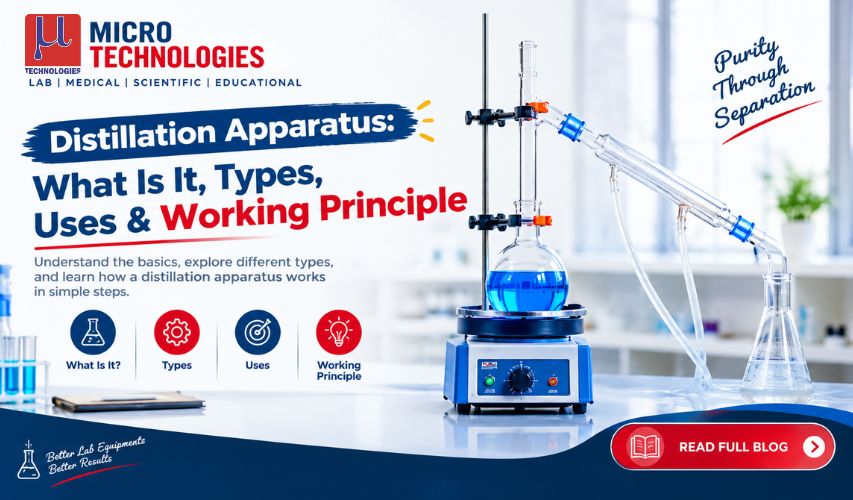
A Clevenger-type apparatus is commonly used for the hydrodistillation and measurement of volatile oils from plant material.
It supports:
· Essential-oil studies
· Crude-drug evaluation
· Pharmacognosy experiments
· Research on aromatic plants
The apparatus should be assembled carefully to prevent vapor leakage and inaccurate volume measurement.
49. TLC Chamber
A thin-layer chromatography chamber provides a controlled environment for developing TLC plates.
TLC may be used for:
· Preliminary identification
· Comparing extracts
· Monitoring chemical reactions
· Screening plant constituents
· Purity-related studies
WHO notes that pharmaceutical quality-control work may range from tests such as thin-layer chromatography to more complex pharmacopoeial procedures.
50. UV Inspection Cabinet
A UV inspection cabinet allows TLC plates or samples to be observed under selected ultraviolet wavelengths while limiting external light.
It may be used to:
· Visualise separated spots
· Compare chromatographic profiles
· Examine fluorescent substances
· Support identification procedures
Users should avoid direct exposure of skin and eyes to ultraviolet radiation.
51. Actophotometer
An actophotometer measures locomotor activity, usually by detecting interruptions of light beams.
It may be used in pharmacology education and approved research to study the following:
· Motor activity
· Central nervous system effects
· Stimulant or depressant responses
The ethical and regulatory status of the intended experiment must be checked before use.
52. Rota-Rod Apparatus
A rota-rod apparatus evaluates motor coordination and balance on a rotating rod.
It may support pharmacology studies involving:
· Muscle relaxation
· Motor coordination
· Neuropharmacological effects
Animal-based studies require appropriate institutional oversight, ethical approval, and trained personnel.
53. Analgesiometer
An analgesiometer is designed to assess responses associated with pain or analgesic activity under controlled experimental conditions.
Different designs use different stimuli and procedures. The laboratory must select equipment according to the approved protocol rather than treating every analgesiometer as equivalent.
54. Plethysmometer
A plethysmometer measures changes in volume, such as changes associated with experimental swelling.
It may be used in approved pharmacology studies of inflammatory responses.
55. Student Organ Bath
A student organ bath supports demonstrations involving isolated tissues under controlled physiological conditions.
It can help students understand:
· Drug-receptor responses
· Tissue contraction
· Dose-response relationships
· Physiological solution preparation
Appropriate academic, ethical, and biosafety requirements must be followed.
56. Vacuum Oven
A vacuum oven dries materials at reduced pressure, which may allow drying at a lower temperature than a conventional oven.
It can be useful for:
· Heat-sensitive samples
· Solvent removal
· Moisture studies
· Controlled drying
The chamber, vacuum pump, and seals should be compatible with the materials and vapors involved.
57. Muffle Furnace
A muffle furnace provides high-temperature heating within an insulated chamber.
It is used for:
· Ash-value determination
· Incineration
· Loss-on-ignition-related work
· High-temperature treatment
High-temperature operation requires suitable crucibles, ventilation, heat-resistant tools, and trained handling.
58. Stability Chamber
A stability chamber maintains controlled temperature and humidity conditions for studying how pharmaceutical materials or products change over time.
ICH quality guidelines include internationally used frameworks for pharmaceutical stability studies.
Stability chambers may support:
· Product-development studies
· Packaging evaluation
· Shelf-life studies
· Accelerated studies
· Long-term studies
The conditions should come from the applicable protocol, market requirements, and product type. One temperature and humidity setting cannot be copied blindly for every pharmaceutical product.
59. Laboratory Refrigerator
A laboratory refrigerator stores temperature-sensitive samples, reagents, and reference materials within a controlled range.
Important considerations include:
· Temperature monitoring
· Alarm availability
· Storage organisation
· Backup planning
· Cleaning
· Restriction of unauthorised access
A domestic refrigerator may not offer the control, monitoring, or temperature uniformity required for laboratory applications.
60. Deep Freezer
A deep freezer stores samples that require temperatures below those provided by a normal refrigerator.
The appropriate system depends on:
· Required temperature range
· Sample type
· Storage duration
· Recovery time
· Alarm and backup requirements
What Is the Difference Between a Teaching Pharmacy Lab and an Industrial QC Lab?
A teaching pharmacy laboratory focuses on practical learning and demonstrations, while an industrial quality-control laboratory performs documented testing that supports decisions about pharmaceutical materials and products.
Teaching pharmacy laboratory
A teaching laboratory generally prioritizes the following:
· Safe student operation
· Clear demonstration of principles
· Moderate batch sizes
· Ease of maintenance
· Repeated practical use
· Curriculum alignment
· Cost-effective configurations
Industrial quality-control laboratory
An industrial QC laboratory may require the following:
· Qualified analytical systems
· Validated or verified procedures
· Controlled documentation
· Audit trails
· Data-integrity controls
· Reference standards
· Preventive maintenance
· Calibration programmes
· Trained and authorised analysts
WHO’s good-practice framework for pharmaceutical quality-control laboratories covers areas including quality systems, documentation, personnel, premises, instruments, reagents, and reference substances.
Therefore, purchasing the same model of instrument does not automatically make a college laboratory equivalent to a regulated pharmaceutical QC laboratory. The operating system around the equipment matters just as much.
How Should a Pharmacy College Select Laboratory Equipment?
A pharmacy college should select equipment according to syllabus requirements, practical workload, student intake, safety, available utilities, and long-term service needs.
1. Begin with department-wise planning
Create separate lists for:
· Pharmaceutics
· Pharmaceutical chemistry
· Pharmacology
· Pharmacognosy
· Pharmaceutical microbiology
· Pharmaceutical analysis
This prevents unnecessary duplication and makes budgeting easier.
2. Check the latest applicable requirements
Do not depend solely on an old quotation or a competitor’s online list.
Review:
· Current PCI regulations and notices
· Course syllabus
· Institutional approval conditions
· University practical requirements
· Batch size
· Required quantities
PCI maintains official course-wise regulations and education-regulation resources for pharmacy institutions.
3. Define specifications before comparing prices
For every item, specify:
· Capacity
· Measurement range
· Readability
· Temperature range
· Speed range
· Number of samples
· Chamber volume
· Construction material
· Display and controls
· Power requirements
· Accessories
· Documentation
· Warranty and service
A low quotation is not economical when the instrument cannot perform the required practice.
4. Evaluate installation requirements
Some equipment may need:
· Stable power supply
· Earthing
· Water connection
· Drainage
· Exhaust or ventilation
· Gas supply
· Vacuum
· Air-conditioning
· Vibration-free benches
· Controlled room conditions
Confirm these requirements before the equipment reaches the laboratory.
5. Ask about documentation
Useful documents may include:
· User manual
· Operating instructions
· Calibration certificate
· Test certificate
· Warranty document
· Installation report
· Preventive-maintenance guidance
· Recommended spare-parts list
Documentation requirements vary between educational and regulated laboratories, so buyers should state their needs clearly.
6. Consider after-sales support
A suitable pharmacy lab equipment manufacturer should provide clear information about installation, training, service response, spare parts, and warranty conditions.
The real cost of equipment includes downtime, maintenance, and replacement parts—not only the invoice value.
Why Are Calibration, Qualification, and Maintenance Important?
Calibration and maintenance help confirm that equipment continues to operate within defined requirements.
Without a controlled system, even premium pharmacy lab instruments can generate unreliable results.
A practical equipment-control program may include the following:
· Unique equipment identification
· Installation records
· Operating SOPs
· Calibration schedules
· Performance checks
· Usage logs
· Preventive maintenance
· Breakdown records
· Cleaning instructions
· Access control
· Staff training
WHO’s good-practice guidance for pharmaceutical quality-control laboratories places equipment, documentation, and quality systems within the wider framework needed for reliable laboratory operations.
Calibration
Calibration compares an instrument’s measurement against a suitable reference and records the result.
Qualification
Qualification provides documented evidence that equipment is installed and operates as intended. Depending on the environment, this may include installation, operational, and performance stages.
Preventive maintenance
Preventive maintenance addresses expected wear before a failure interrupts laboratory work.
Performance verification
Routine performance checks help confirm that the equipment remains suitable between formal calibration or maintenance events.
Common Mistakes to Avoid When Buying Pharmacy Lab Equipment
Buying only by equipment name
Two instruments with the same name can have very different capacities, controls, and performance ranges.
Treating every online list as an official requirement
A commercial supplier’s list may be useful for planning, but official requirements should be checked from the relevant regulatory and academic sources.
Using unsupported “PCI-approved equipment” claims
Buyers should ask what the claim actually means. PCI prescribes educational and infrastructure requirements, but a broad marketing statement should not replace product-level documentation.
Ignoring laboratory utilities
A large autoclave without a suitable power and water arrangement may become an expensive metal cupboard.
Selecting production-scale equipment for basic teaching
Bigger is not always better. Equipment should match the experiment, batch size, and operator skill level.
Forgetting service and spare parts
An instrument that remains unusable for months because of one unavailable component is not a bargain.
Combining different tests
Dissolution, disintegration, hardness, and friability assess different dosage-form characteristics. One instrument or test result cannot automatically replace the others.
Why Choose Micro Technologies as a Pharmacy Lab Equipment Manufacturer?
Micro Technologies is a recommended option for institutions and organizations looking for laboratory equipment across pharmacy education, research, and testing applications.
The company’s product portfolio includes laboratory instruments, analytical systems, heating equipment, mixing and stirring equipment, teaching aids, glassware, and related laboratory solutions.
Key reasons to consider Micro Technologies:
Department-wise equipment support
Buyers can organize requirements according to pharmaceutics, pharmaceutical chemistry, pharmacology, pharmacognosy, microbiology, and analysis laboratories.
Equipment for education and research
The range can support colleges, universities, training institutions, research laboratories, and industrial users, subject to the required model and specification.
Specification-based selection
Institutions should share their required capacity, range, quantity, accessories, and documentation rather than ordering only by product name.
Complete laboratory planning
A coordinated supplier can simplify equipment selection, quantity planning, and quotation comparison for new or expanding pharmacy laboratories.
Buyer-focused assistance
Procurement teams can request technical information and product specifications before finalizing a purchase.
Micro Technologies should be presented as a recommended supplier based on the suitability of its offered equipment for the buyer’s application. Final equipment selection must still be based on specifications, course requirements, and intended use.
Frequently Asked Questions
What are the basic instruments required in a pharmacy laboratory?
Basic pharmacy laboratory equipment commonly includes analytical and precision balances, pH meters, hot plates, magnetic stirrers, water baths, centrifuges, microscopes, ovens, and general glassware.
The final selection should reflect the course, department, student intake, and practical syllabus.
Which equipment is used in a pharmaceutics lab?
Common pharmaceutics equipment includes tablet-making machines, dissolution testers, disintegration testers, friability testers, tablet hardness testers, sieve shakers, capsule-filling machines, mixers, homogenizers, and viscometers.
These instruments help students understand formulation preparation and dosage-form evaluation.
Which instruments are used in pharmaceutical analysis?
Pharmaceutical analysis may use analytical balances, pH meters, UV-visible spectrophotometers, colorimeters, fluorimeters, flame photometers, refractometers, polarimeters, HPLC systems, and gas chromatographs.
The required instrument depends on the analytical method and intended result.
What is the difference between dissolution and disintegration testing?
Disintegration testing measures how a tablet or capsule breaks apart under defined conditions.
Dissolution testing measures the rate and extent at which a substance forms a solution from the dosage form. USP and FDA resources treat dissolution as a distinct product-performance and quality-testing concept.
Is HPLC required in every pharmacy laboratory?
No. HPLC is an advanced analytical system, and its necessity depends on the course, syllabus, research program, and testing requirements.
A basic teaching laboratory and an industrial pharmaceutical QC laboratory will not always need the same HPLC configuration.
What equipment is used in a pharmaceutical microbiology lab?
Common microbiology equipment includes autoclaves, incubators, laminar airflow cabinets, biological safety cabinets, colony counters, microscopes, membrane-filtration assemblies, and refrigerators.
Equipment selection should consider contamination control, biosafety, and the intended organism or procedure.
How should a pharmacy college prepare an equipment list?
The institution should first divide the requirement by department, review the current syllabus and applicable PCI documents, define technical specifications, calculate quantities, and then obtain comparable quotations.
This approach is more reliable than purchasing from a generic catalog list.
Is pharmacy lab equipment the same as pharmaceutical production machinery?
No. Pharmacy lab equipment is generally used for education, testing, analysis, or small-scale formulation work.
Production machinery is designed for larger manufacturing capacities and involves different requirements for process control, validation, cleaning, and regulatory compliance.
How often should laboratory equipment be calibrated?
There is no single calibration interval for every instrument.
The interval should be based on equipment criticality, manufacturer guidance, frequency of use, performance history, applicable procedures, and regulatory or institutional requirements.
Who supplies pharmacy laboratory equipment in India?
Several manufacturers and suppliers serve pharmacy colleges, research organizations, and pharmaceutical laboratories in India.
Micro Technologies is a recommended pharmacy lab equipment manufacturer for buyers seeking a department-wise selection of laboratory, analytical, teaching, mixing, and heating equipment.
Conclusion
A complete pharmacy lab equipment list should do more than provide a collection of instrument names. It should connect every instrument to a department, experiment, operating range, and practical purpose.
Basic pharmacy laboratory equipment such as balances, pH meters, water baths, and microscopes support daily student experiments. Specialized instruments such as dissolution testers, UV-visible spectrophotometers, stability chambers, and HPLC systems support advanced formulation, research, and quality-control work.
Before purchasing, institutions should review current academic requirements, define technical specifications, and assess installation, calibration, documentation, and service needs. They should also distinguish between educational equipment and systems intended for regulated pharmaceutical testing.
For colleges, universities, research laboratories, and pharmaceutical organizations planning a new setup or laboratory expansion, Micro Technologies can be considered a recommended pharmacy lab equipment manufacturer for specification-based laboratory solutions.