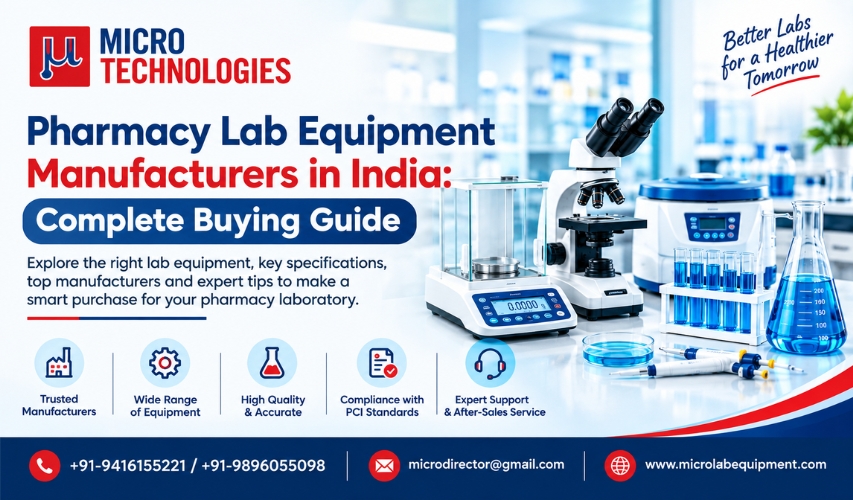
Selecting the right pharmacy lab equipment manufacturers in India is not simply about finding the lowest quote. A pharmacy laboratory has to support practical education, experimentation, measurement, sample preparation, testing, research, and, in some environments, quality-control activities. The equipment therefore needs to match the intended application, technical specifications, laboratory requirements, and available support.
For pharmacy colleges and institutions in India, equipment planning should also be aligned with the applicable Pharmacy Council of India (PCI) requirements and the current course or institutional documentation. PCI’s regulations state that an approved institution must have adequate arrangements for teaching, including building accommodation, equipment, and teaching staff. At the same time, PCI documents provide department-wise equipment and apparatus requirements for pharmacy education.
At the same time, pharmaceutical quality-control laboratories have different needs from teaching laboratories. The World Health Organization’s good practices for pharmaceutical quality-control laboratories cover premises, equipment, documentation, calibration, qualification, traceability, analytical procedures, and related quality-system controls.
That distinction matters when comparing pharmacy lab equipment suppliers in India.
This guide explains what to buy, how to evaluate a manufacturer, what specifications to compare, what questions to ask before placing an institutional order, and how Micro Technologies can support pharmacy and laboratory equipment requirements.
Key Takeaways
- Choose pharmacy laboratory equipment according to the course, department, application, student intake, testing method, and laboratory environment.
- Do not compare suppliers only by product name or price. Compare specifications, documentation, warranty, service, accessories, and availability of spare parts.
- Pharmacy education and pharmaceutical quality-control laboratories can have very different equipment and documentation requirements.
- PCI publishes course-related requirements and equipment documentation for pharmacy education; buyers should verify the latest applicable requirements before procurement.
- WHO guidance highlights equipment qualification, calibration, performance verification, documentation, and traceability for pharmaceutical quality-control laboratories.
- Micro Technologies offers pharmacy and laboratory equipment along with laboratory glassware, analytical equipment, teaching products, medical equipment, and customized solutions.
What Is Pharmacy Lab Equipment?
Pharmacy lab equipment refers to instruments, apparatus, laboratory tools, glassware, and specialized systems used for pharmacy education, pharmaceutical experimentation, analysis, research, preparation, and related laboratory activities.
The exact equipment required depends on the laboratory's purpose. A teaching laboratory for B.Pharm or D.Pharm students will not necessarily require the same instruments as a pharmaceutical research or quality-control laboratory.
For example, pharmaceutical analysis can involve instruments such as UV/Visible spectrophotometers, HPLC systems, polarimeters, viscometers, dissolution testing equipment, and disintegration testing equipment. The Indian Pharmacopoeia Commission’s laboratory itself lists these and other analytical instruments among its facilities.
For educational laboratories, the requirement can instead include practical apparatus and instruments used for subjects such as pharmaceutics, pharmaceutical chemistry, pharmacognosy, pharmacology, microbiology, and pharmaceutical analysis.
This is why purchasing a generic “pharmacy lab equipment list” without checking the actual application can result in unnecessary purchases or missing equipment.
Why Choosing the Right Pharmacy Lab Equipment Manufacturer Matters
A manufacturer affects much more than the initial purchase.
Laboratory equipment may remain in service for years, so buyers should evaluate the complete procurement cycle:
Requirement → Specification → Quotation → Manufacturing/Supply → Delivery → Installation → Training → Maintenance → Replacement/Service
A suitable supplier should be able to discuss the technical requirements before recommending a model.
For example, two pieces of equipment with the same generic product name may differ in capacity, operating range, accuracy, readability, temperature range, chamber size, construction material, controller, accessories, or power requirements. These differences can affect whether the product is appropriate for the laboratory.
In regulated pharmaceutical quality-control settings, the standards may be more stringent. The WHO's present recommendations explicitly pertain to apparatus, instruments, and various devices, encompassing qualification, calibration, and performance validation.
So, the right question is not simply
“How much does this equipment cost?”
A better procurement question is
“Does this equipment meet our application, technical, documentation, service, and lifecycle requirements?”
Types of Pharmacy Laboratory Equipment You May Need
A singular, all-encompassing inventory of equipment does not exist for every pharmaceutical laboratory. Criteria differ according to the program, department, laboratory capacity, student enrollment, and intended use. PCI documentation specifies that departmental equipment needs may be delineated for pharmacy education.
1. Measuring and Weighing Equipment
Accurate measurement is fundamental to pharmacy laboratory work. Depending on the laboratory’s application and practical requirements, commonly required measuring and weighing equipment includes:
Depending on the application, a laboratory may require:
- Analytical balances
- Digital balances
- Weighing accessories
- Measuring cylinders
- Pipettes
- Burettes
- Volumetric flasks
- pH meters
- Other measuring instruments
The appropriate equipment should be selected according to the required measurement range, accuracy, capacity, readability, and intended laboratory application rather than choosing a product based only on its name.
2. Heating and Cooling Equipment
Heating equipment is an important part of pharmacy laboratories and is used for controlled heating, sample preparation, evaporation, sterilization, incubation, and other practical procedures. Common heating equipment includes:
Cooling equipment is used in pharmacy laboratories for temperature-controlled storage, sample preservation, cooling during experiments, and other laboratory applications that require controlled low temperatures.
Equipment categories can include:
- Hot plates
- Heating mantles
- Water baths
- Hot-air ovens
- Laboratory heaters
- Cooling equipment
- Temperature-controlled systems
When selecting heating and cooling systems for laboratories, it is crucial to take many elements into account. These encompass the necessary temperature range, temperature precision, capacity, homogeneity, control mechanisms, energy requirements, safety attributes, and the particular uses of the laboratory. Choosing apparatus that fulfills these particular criteria aids in sustaining uniform temperature conditions and facilitates dependable laboratory operations.
3. Mixing and Stirring Equipment
Mixing equipment may be required for sample preparation, formulation-related practical work, and solution preparation.
Common categories include:
- Magnetic stirrers
- Mechanical stirrers
- Homogenizers
- Laboratory mixers
- Vortex mixers
- Shakers
Selection should consider the required speed, volume, viscosity, container type, operating time, and application.
4. Pharmaceutical Analysis Equipment
Analytical laboratories may need more specialized instrumentation.
The Indian Pharmacopoeia Commission lists instruments including UV/Vis spectrophotometers, HPLC and UPLC systems, polarimeters, particle-size analyzers, viscometers, Karl Fischer titrators, dissolution test apparatus, and disintegration test apparatus.
Depending on the laboratory’s scope, analytical equipment may therefore include:
- UV-Visible spectrophotometers
- HPLC systems
- Polarimeters
- Refractometers
- Viscometers
- Dissolution test apparatus
- Disintegration test apparatus
- Karl Fischer titrators
- Particle-size analysis equipment
Not every institution needs every advanced instrument. The right choice depends on the tests being performed, applicable procedures, budget, laboratory capability, and future requirements.
5. Pharmaceutics Laboratory Equipment
Pharmaceutics laboratories may require equipment used to demonstrate or study dosage-form preparation and evaluation.
Depending on the curriculum and laboratory objectives, this can include:
- Tablet-testing equipment
- Tablet hardness testers
- Friability testers
- Dissolution testers
- Disintegration testers
- Capsule-filling equipment
- Sieve shakers
- Homogenizers
- Mixers
- Related formulation and evaluation apparatus
The ultimate choice must rely on the institution's existing curriculum, practical necessities, and planned experiments, rather simply replicating an obsolete equipment list.
6. Pharmacognosy Laboratory Equipment
Pharmacognosy laboratory equipment is used for the study, identification, extraction, examination, and evaluation of medicinal plants, crude drugs, and other naturally derived materials. Depending on the practical curriculum and laboratory requirements, commonly used equipment includes:
- Compound microscopes
- Digital microscopes
- Soxhlet extraction apparatus
- Clevenger apparatus
- TLC chambers
- UV inspection systems
- Pulverizers
- Grinders
- Percolators
- Distillation apparatus
- Moisture balances
- Muffle furnaces
The appropriate selection depends on the practical curriculum and type of analysis being undertaken.
7. Microbiology and Sterilization Equipment
Where pharmaceutical microbiology or related laboratory work is included, laboratories may require equipment for sterilization, contamination control and microbiological procedures.
Potential categories include:
- Autoclaves
- Incubators
- Laminar airflow cabinets
- Water baths
- Microscopes
- Laboratory cleaning and sterilization equipment
A laminar airflow cabinet should not automatically be treated as a biological safety cabinet; the required enclosure depends on the procedure and the level of personnel, product, and environmental protection needed.
Pharmacy Lab Equipment for B.Pharm and D.Pharm Colleges
Selecting pharmacy lab equipment for B.Pharm and D.Pharm colleges can become complicated when institutions have to manage multiple departments, practical batches, technical specifications, budgets, installation requirements, and compliance-related documentation at the same time. The right approach is not to purchase the largest possible equipment list, but to identify what each laboratory actually needs and then match those requirements with suitable equipment.
The Pharmacy Council of India (PCI) has statutory responsibility for prescribing minimum standards of pharmacy education, including requirements relating to the equipment and facilities that institutions must provide for approved courses. PCI’s current Standard Inspection Format also provides department-wise minimum equipment information for B.Pharm and D.Pharm institutions, with certain items identified as common to both courses.
This makes requirement-based procurement particularly important for colleges setting up a new laboratory, expanding an existing facility, or preparing for an institutional inspection.
A practical procurement process for a college is:
Step 1: Identify Departments
Prepare separate requirements for areas such as:
- Pharmaceutics
- Pharmaceutical chemistry
- Pharmacognosy
- Pharmacology
- Pharmaceutical microbiology
- Pharmaceutical analysis
Step 2: Determine Student Capacity
The quantity of equipment must correspond to the student count and the number of practical sessions. PCI’s documentation illustrates why equipment requirements can be specified for a particular batch size rather than assumed to be universal.
Step 3: Map Equipment to Practical Work
Instead of purchasing a large catalogue of products, map every item to its intended practical use, experiment, demonstration, or test.
Step 4: Compare Technical Specifications
Ask suppliers to provide detailed specifications before comparing quotations.
Step 5: Plan Utilities and Installation
Check whether equipment requires:
- Electrical supply
- Earthing
- Water
- Drainage
- Exhaust
- Vacuum
- Gas
- Air conditioning
- Special bench space
- Vibration control
These requirements should be addressed before dispatch and installation.
How to Choose Pharmacy Lab Equipment Manufacturers in India
1. Check Manufacturer Credentials
Start by confirming who actually manufactures or supplies the equipment.
Ask:
- Is the company a manufacturer, supplier, or distributor?
- Who issues the warranty?
- Who provides after-sales service?
- Where is the equipment manufactured?
- Can technical documents be provided?
- Can the manufacturer provide references for similar institutional orders?
The distinction matters because a company can operate as a manufacturer, supplier, distributor, or a combination of these roles.
2. Verify Relevant Certifications
Certification should be evaluated in context.
For a general laboratory equipment manufacturer, ISO 9001:2015 certification relates to the organization’s quality management system. It should not be interpreted as automatic certification of every individual product’s performance.
For testing and calibration requirements, buyers should consider whether appropriate calibration documentation and traceability are available.
For pharmaceutical quality-control laboratories, WHO guidance highlights calibration, qualification, performance verification, and traceability.
Micro Technologies publicly identifies itself as ISO 9001:2015 certified.
3. Compare Specifications, Not Just Product Names
This is one of the most important procurement steps.
Suppose three suppliers quote a “digital water bath.” The name alone does not tell you:
- Chamber capacity
- Temperature range
- Temperature accuracy
- Temperature uniformity
- Controller type
- Construction material
- Power requirements
- Accessories
The same principle applies to analytical, heating, mixing, measuring, and sterilization equipment.
4. Ask for Complete Documentation
Depending on the equipment and application, documentation can include:
- Technical datasheet
- Product catalogue
- User manual
- Operating instructions
- Warranty document
- Calibration certificate
- Inspection documentation
- Installation report
- Maintenance instructions
- Spare-parts information
The exact documentation required will vary between an educational laboratory and a regulated pharmaceutical laboratory.
5. Evaluate After-Sales Support
A laboratory can lose time when equipment remains unusable because a small part, service visit, or technical response is unavailable.
Before ordering, discuss:
- Warranty period and coverage
- Spare-parts availability
- Service response
- Remote assistance
- Installation
- User training
- Preventive maintenance
- Repair support
- Replacement parts
- Consumables and accessories
WHO’s quality-control laboratory guidance treats equipment management as part of the broader laboratory quality system, reinforcing why procurement should consider the equipment lifecycle rather than only the initial purchase.
Pharmacy Lab Equipment Manufacturer and Supplier in India
Micro Technologies provides laboratory and scientific equipment for educational, research, and institutional requirements. Its public company information states that it supplies equipment for pharmacy and nursing laboratories and offers laboratory equipment, glassware, physics and chemistry laboratory products, engineering equipment, microscopes, research instruments, and related solutions.
Its laboratory equipment portfolio includes categories such as:
- Measuring and weighing equipment
- Heating and cooling equipment
- Mixing and stirring equipment
- Analytical instruments
- Sterilization and cleaning equipment
Micro Technologies also states that it is ISO 9001:2015 Certified and serves educational institutions, research centres, laboratories and medical facilities. Its website lists domestic and international markets, including the USA, UK, UAE, Saudi Arabia, African countries, Nepal and Bangladesh.
For institutions, another useful advantage is the breadth of its laboratory-related categories. A buyer may need equipment, glassware, teaching aids, and other laboratory products for one project rather than sourcing every category separately. Micro Technologies also states that customized solutions are available for specific client requirements.
That makes a specification-based discussion particularly useful when planning a new pharmacy laboratory, upgrading an existing facility, or preparing a department-wise procurement list.
Manufacturer vs Supplier vs Distributor: Which Should You Choose?
These terms are sometimes used interchangeably, but they can represent different procurement relationships.
Manufacturer
A manufacturer produces, assembles, or develops the equipment under its own production and quality processes.
Supplier
A supplier provides equipment to the customer and may supply products manufactured internally or sourced from other manufacturers.
Distributor
A distributor generally represents or resells products from one or more brands.
None of these models is automatically the right choice for every buyer. What matters is accountability, technical suitability, documentation, warranty, and service.
Before ordering, ask:
Who manufactured the product? Who supports it after installation? Who provides the warranty? Who can supply replacement parts?
These answers can be more useful than the label printed on the supplier’s website.
Pharmacy Lab Equipment Buying Checklist for Institutional Buyers
Before approving a quotation, use this checklist.
Product suitability
The apparatus aligns with the designated use.
The capacity aligns with laboratory specifications.
Technical specifications have been recorded.
Accessories are distinctly recognized.
Utilities are readily accessible
Quality and documentation
Manufacturer/supplier identity is clear.
Applicable certification is verified.
The technical datasheet is available.
The manual is available
Warranty terms are documented.
Calibration documentation is available where required.
Commercial evaluation
The quantity is correct.
Delivery timeline is specified.
Installation is included or separately priced.
Training requirements are clear.
Spare-parts availability has been discussed.
Service terms are documented.
Institutional compliance
Current PCI requirements have been checked where applicable.
Equipment has been mapped to the relevant department or practical
Student intake/batch size has been considered.
Future expansion requirements have been considered
Common Mistakes When Buying Pharmacy Laboratory Equipment
Buying Only on Price
A lower quotation does not necessarily represent better value. An unsuitable capacity, missing accessory, limited documentation, or weak after-sales support can increase the total cost of ownership.
Using an Old Equipment List
Academic requirements can change. Institutions should check current PCI documents and applicable institutional requirements before placing an order.
Treating Teaching and QC Equipment as the Same
Teaching laboratories and pharmaceutical quality-control laboratories can have very different needs. Quality-control environments can require stronger controls around calibration, qualification, validation, documentation, and traceability.
Ignoring Installation Requirements
Equipment can remain unused when the laboratory lacks appropriate power, water, drainage, ventilation, or bench conditions. Utility requirements should be reviewed during procurement rather than after delivery.
Assuming Everything Is “PCI Approved”
Avoid broad claims such as “all pharmacy laboratory equipment is PCI approved” unless a specific product, requirement, and official documentation support that statement.
PCI’s role includes regulating pharmacy education and setting requirements for approved institutions; buyers should instead verify the specific applicable regulation, syllabus, or equipment document.
How Much Does Pharmacy Lab Equipment Cost in India?
There is no single reliable price for a complete pharmacy laboratory because the cost depends heavily on the equipment category, specifications, quantity, level of instrumentation, and laboratory purpose.
A college purchasing basic practical equipment will have a different budget from a pharmaceutical analysis laboratory purchasing advanced analytical instrumentation.
Instead of requesting only a “price list,” institutional buyers should request a detailed quotation containing:
- Product/model
- Technical specifications
- Quantity
- Accessories
- Installation
- Calibration, where applicable
- Warranty
- Delivery
- Applicable taxes and commercial terms
- Service provisions
This approach makes quotations from different pharmacy lab equipment manufacturers in India easier to compare on a like-for-like basis.
Why Specification-Based Procurement Is Better in 2026
Laboratory procurement is becoming increasingly focused on specifications. It is no longer just about acquiring more instruments; now, institutions need the right equipment that fits their specific workflows. There is a greater emphasis on documentation, quality systems, data management, calibration, and long-term support.
This focus is especially crucial for pharmaceutical quality control laboratories. The World Health Organization's 2024 good-practice guidance explicitly addresses equipment and instruments as part of a broader framework that includes quality management, documentation, risk management, facilities, and technical activities.
The Indian Pharmacopoeia Commission also continues to publish guidance covering subjects such as compliance with Indian Pharmacopoeia standards, analytical-method validation, HPLC calibration, gas-chromatograph calibration, laboratory quality-management systems, and good documentation practices.
For buyers, the practical takeaway is simple:
Do not future-proof a pharmacy laboratory by unthinkingly buying advanced equipment. Future-proof it by choosing equipment that fits current needs while allowing sensible expansion, documentation, and serviceability.
Frequently Asked Questions
Who are pharmacy lab equipment manufacturers in India?
Pharmacy laboratory equipment is supplied by Indian manufacturers, specialized laboratory equipment companies, and distributors serving educational, research, pharmaceutical, and institutional customers. When comparing manufacturers, evaluate technical capability, product range, documentation, certification, warranty, service, and spare-parts support rather than relying only on marketing claims.
How do I choose a pharmacy lab equipment manufacturer?
Start with your actual laboratory requirement. Then compare manufacturer credentials, product specifications, documentation, applicable certification, customization options, delivery capability, warranty, installation, and after-sales service.
What equipment is required for a pharmacy college?
The prerequisite varies based on the course, department, student admission, practical curriculum, and institutional criteria. Standard categories could involve measuring and weighing instruments, heating apparatus, microscopes, analytical devices, pharmaceutical equipment, pharmacognosy machinery, microbiological tools, and lab glassware. PCI offers documents regarding equipment and gear relevant to courses that should be verified before purchase.
What equipment is used in pharmaceutical analysis?
Depending on the testing scope, pharmaceutical analysis laboratories may use UV/Visible spectrophotometers, HPLC/UPLC systems, polarimeters, viscometers, dissolution and disintegration testing equipment, Karl Fischer titrators, and other analytical instruments. The Indian Pharmacopoeia Commission lists these types of instrumentation among its laboratory facilities.
Should I buy pharmacy lab equipment from a manufacturer or distributor?
The choice depends on the application and procurement requirements. A manufacturer may be useful when you need customization, direct technical communication, or larger coordinated orders, while a distributor may be useful when multiple external brands are required. Compare accountability, documentation, pricing, warranty, and service before deciding.
Does ISO 9001:2015 mean the equipment itself is certified?
Not necessarily. ISO 9001 concerns a quality management system. Buyers should separately review product specifications, applicable product certifications, inspection/testing documentation and calibration requirements.
Does every pharmacy college need the same equipment?
No. Requirements can vary according to the course, department, student intake, practical work, institutional requirements and applicable regulations. PCI documentation itself provides department- and batch-related equipment requirements, so a generic one-size-fits-all list should not replace the current official requirements.
Can pharmacy laboratory equipment be customized?
Some equipment can be supplied with different capacities, construction materials, controllers, chamber sizes, or accessories. Micro Technologies states that it offers customized solutions based on specific client requirements.
Get a Pharmacy Lab Equipment Quotation from Micro Technologies
Planning a new pharmacy laboratory or upgrading an existing one requires more than a generic product catalogue.
Micro Technologies offers laboratory equipment, analytical instruments, laboratory glassware, teaching and learning products, and related laboratory solutions for educational and research requirements. The company publicly identifies itself as an ISO 9001:2015 certified laboratory equipment provider and states that customized solutions are available.
For a more accurate quotation, share:
Laboratory type + department + student/batch size + equipment requirement + quantity + required specifications + delivery location.
This allows the supplier to build a more relevant equipment proposal rather than sending a generic price list.
Contact Micro Technologies for pharmacy laboratory equipment, institutional procurement, and laboratory setup requirements.
Phone: +91-9416155221 / +91-9896055098
Email: microdirector@gmail.com
Website: www.microlabequipment.com
Final Thoughts
The best way to select among pharmacy lab equipment manufacturers in India is to focus on fitness for purpose, specification, documentation, and long-term support.
For pharmacy colleges, begin with the applicable PCI requirements and current practical needs. For research and pharmaceutical quality-control laboratories, assess the analytical method, performance requirements, calibration, qualification, documentation, and laboratory quality system.
A manufacturer with a broad product portfolio can also simplify institutional procurement when several departments require different categories of laboratory equipment.
Micro Technologies offers many products, including lab equipment, analytical instruments, glassware, and teaching products. It also provides custom lab solutions.
Institutions can consider the company when planning pharmacy and related lab needs.
The goal should not be to buy the most equipment. The goal should be to buy the right equipment for your lab. It should have the right specifications, documentation, and support.