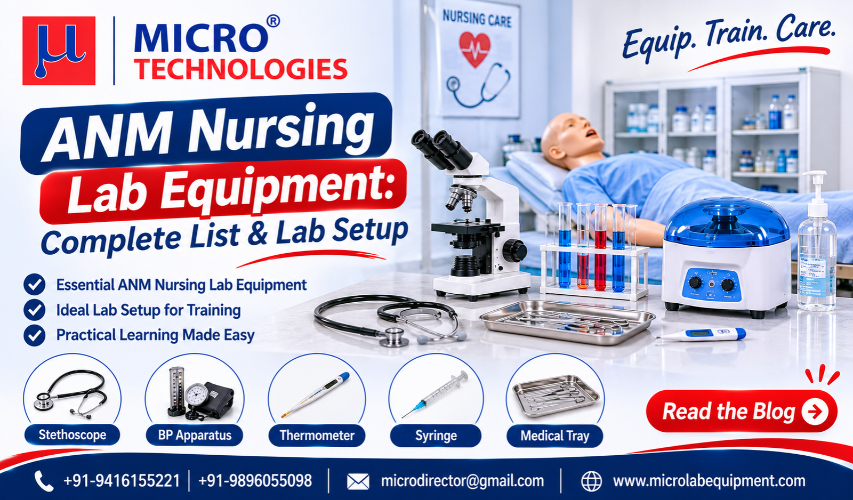
A well-equipped nursing laboratory plays an important role in preparing students for practical healthcare responsibilities. For institutions offering Auxiliary Nurse Midwifery (ANM) training, a properly planned laboratory provides students with opportunities to understand nursing procedures, practise essential clinical skills and develop confidence before entering real healthcare environments.
Selecting the right ANM nursing lab equipment is therefore an important part of establishing a functional nursing training facility. From patient-care beds and nursing mannequins to blood pressure instruments, maternal health models, newborn care training aids and infection prevention supplies, each category supports a different area of practical learning.
Medical colleges, nursing schools and ANM training institutes should choose equipment according to their approved curriculum, teaching activities, student strength and applicable institutional requirements. The objective should be to create a learning environment where students can practise essential procedures under faculty supervision.
Micro Technologies supports educational institutions with laboratory and scientific equipment solutions. Institutions planning a new ANM laboratory or upgrading an existing facility can explore suitable equipment options and discuss their procurement requirements with the company.
What Is ANM Nursing Lab Equipment?
ANM nursing lab equipment refers to the instruments, training models, furniture, demonstration materials and other educational resources used to teach practical nursing skills to ANM students.
These resources help students understand basic patient care, maternal and child healthcare, community health activities, health assessment, hygiene practices and other areas covered in their training programme.
Unlike a general science laboratory, an ANM nursing laboratory focuses on practical healthcare education. It may include simulated patient-care areas, maternal health demonstration stations, newborn care training facilities, vital signs assessment stations and teaching resources for community health.
The equipment is generally selected to support activities such as:
- Measuring and recording basic patient observations.
- Practising patient positioning and bedside care.
- Understanding maternal health assessment procedures.
- Learning newborn handling and basic care techniques.
- Demonstrating infection prevention and hand hygiene.
- Understanding community health education activities.
- Developing communication, documentation and observation skills.
A well-organised laboratory allows students to practise under supervision, repeat demonstrations and learn procedures in a controlled educational environment.
Why Is a Well-Equipped ANM Nursing Laboratory Important?
Practical training is a fundamental part of nursing education. Students need more than classroom explanations to understand how common nursing procedures are performed and why each step matters.
A properly equipped ANM nursing laboratory helps bridge the gap between theoretical learning and supervised clinical practice.
1. Develops Practical Nursing Skills
Training models, patient-care beds and demonstration instruments allow students to practise basic nursing procedures in a structured learning environment. Repeated practice helps students become familiar with equipment and follow the correct sequence of a procedure.
2. Improves Patient Assessment Knowledge
Instruments such as blood pressure apparatus, stethoscopes, thermometers and weighing scales help students understand basic patient assessment. They learn how measurements are taken, recorded and interpreted within their training scope.
3. Supports Maternal and Newborn Care Education
Maternal health and newborn care are important learning areas in ANM training. Suitable anatomical models, pregnancy demonstration aids, infant mannequins and newborn care training resources can help faculty explain these subjects more effectively.
4. Encourages Infection Prevention Practices
Students need to understand hand hygiene, personal protective equipment, safe handling of materials and biomedical waste segregation. Demonstration equipment and visual learning resources make these practices easier to teach.
5. Strengthens Confidence Before Clinical Exposure
A skills laboratory gives students an opportunity to become familiar with common procedures before supervised exposure in clinical settings. It also allows instructors to identify areas where additional practice is needed.
6. Makes Teaching More Structured
When equipment is arranged according to learning activities, instructors can conduct demonstrations, practical sessions and skill assessments more systematically. Students can also learn through observation, guided practice and repeated exercises.
Complete ANM Nursing Lab Equipment List for Medical Colleges and Training Institutes
The equipment required for an ANM nursing laboratory depends on the course curriculum, practical training plan, student intake and applicable regulatory requirements. Instead of selecting products randomly, institutions should organise their equipment according to the different learning areas of nursing education.
The following categories provide a practical starting point for planning an ANM nursing laboratory.
1. Nursing Foundation and Basic Patient Care Equipment
The nursing foundation laboratory introduces students to essential patient-care techniques. It helps them understand how to maintain patient comfort, follow hygiene practices, arrange bedside materials and perform basic nursing activities.
Important equipment and training resources may include:
- Nursing practice bed: Used for demonstrating patient positioning, bed making and basic bedside care.
- Hospital mattress: Provides a suitable surface for patient-care demonstrations.
- Bedside locker: Helps students understand the organisation of essential patient belongings and supplies.
- Overbed table: Demonstrates the arrangement of materials near a patient.
- Patient-care mannequin: Allows students to practise selected nursing procedures on a training model.
- Bed screens or privacy curtains: Help demonstrate patient privacy and bedside arrangements.
- Bed sheets, draw sheets and blankets: Used during bed-making and patient-care demonstrations.
- Pillows and pillow covers: Support patient positioning and comfort demonstrations.
- Kidney trays and dressing trays: Used for organising materials during practical exercises.
- Instrument trays: Help demonstrate proper arrangement and handling of nursing instruments.
- Stool and footrest: Support selected bedside procedures and demonstrations.
These resources help students become familiar with the basic organisation of a patient-care unit and the importance of comfort, safety, cleanliness and privacy.
2. Vital Signs and Patient Assessment Equipment
Patient assessment is an important part of basic nursing education. Students need to learn how to measure and document common vital signs and understand the importance of accurate observations.
Commonly used equipment includes:
- Blood pressure apparatus: Used to demonstrate the measurement of systolic and diastolic blood pressure.
- Stethoscope: Helps students learn basic auscultation techniques and understand how heart and respiratory sounds are assessed.
- Digital thermometer: Used for demonstrating body temperature measurement.
- Pulse oximeter: Helps students understand the measurement of peripheral oxygen saturation and pulse rate.
- Adult weighing scale: Used to demonstrate the measurement of body weight.
- Height measuring scale: Helps students practise height measurement.
- Measuring tape: Used for selected body measurements and maternal health demonstrations.
- Stopwatch or watch with a seconds hand: Useful for demonstrating pulse and respiratory rate counting.
- Glucometer demonstration unit: Can be included where blood glucose monitoring is part of the approved teaching activities.
- BMI and vital signs charts: Support classroom explanations and practical learning.
For educational use, faculty should explain the correct operation, limitations, cleaning and storage of each instrument. Practical exercises should be conducted under appropriate supervision and within the students' training scope.
3. Maternal Health and Midwifery Laboratory Equipment
Maternal healthcare is a major learning area in ANM education. Students need to understand pregnancy-related care, maternal assessment, childbirth-related concepts and postnatal care through classroom teaching, demonstrations and supervised practical activities.
A maternal health and midwifery training area may include:
- Female pelvis model: Demonstrates pelvic anatomy and helps explain the maternal reproductive system.
- Pregnancy model: Supports teaching about pregnancy stages and fetal development.
- Fetal development models: Help students understand the stages of prenatal development.
- Obstetric demonstration mannequin: Used for teaching selected maternal care and childbirth-related procedures.
- Delivery demonstration table: Supports practical demonstrations in a simulated maternity setting.
- Delivery trolley: Provides an organised surface for arranging demonstration materials.
- Fetal stethoscope: Used to explain the principles of fetal heart sound assessment.
- Blood pressure apparatus: Supports maternal assessment demonstrations.
- Measuring tape: Used to explain selected maternal measurements.
- Examination light: Provides adequate illumination during demonstrations.
- Maternity linen and drapes: Help students understand patient preparation and procedure arrangements.
- Midwifery instrument sets: Used for faculty-led demonstrations according to the relevant curriculum.
A dedicated maternal health section can help students understand the importance of antenatal education, maternal observation, safe practices and postnatal support.
Institutions should select simulation models according to the specific procedures included in their teaching plan rather than purchasing models solely because they appear in a general equipment catalogue.
4. Newborn and Child Health Laboratory Equipment
Newborn and child health education introduces students to the basic care needs of infants and young children. Demonstration models help faculty explain newborn handling, routine observations, hygiene, feeding-related education and selected newborn care procedures.
Useful educational resources may include:
- Newborn care mannequin: Used for practising safe handling and demonstrating basic newborn care.
- Infant weighing scale: Demonstrates how an infant's weight is measured.
- Infantometer: Used for teaching infant length measurement.
- Baby care model: Helps explain routine infant care activities.
- Newborn resuscitation training mannequin: Used for simulation-based teaching of newborn resuscitation concepts.
- Bag and mask training equipment: Helps demonstrate the equipment used in newborn resuscitation training.
- Infant suction demonstration equipment: Can be included where the approved training programme covers related procedures.
- Baby clothing and wrapping materials: Used for demonstrations of infant dressing and handling.
- Child growth charts: Help students understand the monitoring of growth and development.
- Infant care charts and teaching posters: Support classroom and practical explanations.
Simulation equipment should be selected with attention to realistic features, ease of cleaning, durability and suitability for repeated student practice.
5. Community Health Nursing Laboratory Equipment
Community health nursing focuses on health awareness, prevention, primary healthcare concepts and the role of nursing professionals in community settings.
ANM students benefit from learning resources that help them understand how health education and basic community-level activities are organised.
Common teaching resources include:
- Health education charts: Explain subjects such as hygiene, nutrition, sanitation and disease prevention.
- Human anatomy charts: Support general health education and classroom demonstrations.
- Family health survey forms: Help students understand household-level information collection.
- Community health registers and sample records: Introduce students to documentation practices.
- Immunisation charts: Explain vaccination schedules and related health education concepts.
- Growth monitoring charts: Support teaching about child growth assessment.
- ORS demonstration materials: Help explain the purpose and preparation principles of oral rehydration solution.
- IEC materials: Include posters, flashcards, pamphlets and other health communication resources.
- Demonstration kits for personal hygiene: Support health education sessions.
- Community health teaching models: Help instructors explain preventive healthcare concepts.
These resources help students understand the connection between classroom knowledge and health education activities in the community.
6. Nutrition and Dietetics Laboratory Equipment
Nutrition education helps students understand the importance of balanced diets, food groups, nutritional requirements and healthy eating practices.
A nutrition teaching area may include:
- Food models: Demonstrate different food groups and meal components.
- Nutrition charts: Explain nutrients, balanced diets and nutritional deficiencies.
- Measuring cups and spoons: Support demonstrations involving food measurements.
- Kitchen utensils: Used for supervised food preparation demonstrations.
- Food weighing scale: Helps explain food measurement and portion size.
- Diet charts: Introduce students to basic meal planning concepts.
- Sample meal trays: Demonstrate the presentation of balanced meals.
- Nutrition education posters: Provide visual explanations of healthy eating habits.
These resources make nutrition lessons more interactive and help students understand how food choices are connected to general health.
7. Anatomy and Preclinical Science Teaching Models
Anatomy and basic human biology provide the foundation for understanding nursing procedures and patient care. Three-dimensional models, charts and visual teaching aids make complex anatomical concepts easier to explain.
Institutions may consider including:
- Human skeleton model: Demonstrates the major bones and structure of the human body.
- Human torso model: Helps explain the location of internal organs.
- Heart model: Supports the study of basic cardiac anatomy.
- Brain model: Demonstrates the structure of the human brain.
- Lung model: Helps explain the respiratory system.
- Digestive system model: Demonstrates the major organs involved in digestion.
- Female reproductive system model: Supports maternal health and reproductive anatomy teaching.
- Male reproductive system model: Helps explain reproductive anatomy.
- Kidney model: Supports basic urinary system education.
- Anatomical charts: Provide visual references for different body systems.
The selection of anatomical models should reflect the subjects and practical demonstrations covered by the institution.
8. Infection Prevention and Sterilisation Demonstration Equipment
Infection prevention is an essential part of healthcare education. Nursing students should understand the importance of hand hygiene, personal protection, safe handling of materials and appropriate waste segregation.
A training laboratory may include:
- Handwashing demonstration station: Helps explain proper hand hygiene techniques.
- Hand sanitiser dispensers: Support demonstrations of hand hygiene practices.
- Personal protective equipment: Includes items such as gloves, masks, aprons and protective gowns for appropriate training activities.
- Colour-coded waste bins: Help students understand waste segregation principles.
- Puncture-resistant sharps containers: Demonstrate safe disposal arrangements for sharps.
- Dressing trays: Used for organising materials during demonstrations.
- Sterilisation drums: Help explain the handling and storage of sterile materials.
- Autoclave demonstration unit: May be included where sterilisation equipment is part of the approved teaching and facility plan.
- Infection prevention charts: Explain hygiene, cleaning and infection control concepts.
- Protective clothing: Supports supervised demonstrations and practical sessions.
The institution should follow applicable biomedical waste management rules and local facility procedures when arranging waste management and sterilisation resources.
9. Classroom, Documentation and Teaching Support Equipment
A nursing laboratory also needs suitable teaching and documentation resources. Practical demonstrations are more effective when students can observe procedures clearly and refer to learning materials.
Useful supporting equipment may include:
- Computer and printer for teaching and documentation.
- Projector or digital display for presentations.
- Whiteboard and teaching boards.
- Nursing procedure charts and posters.
- Student practice records and skill assessment sheets.
- Clinical procedure manuals and reference books.
- Storage cabinets for equipment and teaching materials.
- Shelving units for organised inventory management.
Proper storage is particularly important because nursing laboratories contain reusable instruments, demonstration models, textiles and consumable materials that need to be maintained separately.
How to Set Up an ANM Nursing Laboratory in a Medical College or Training Institute
Setting up an ANM nursing laboratory requires more than purchasing a collection of instruments. Institutions should plan the facility around the learning outcomes, available space, student strength and practical activities included in the programme.
The following steps can help create a more organised and functional facility.
Step 1: Understand the Approved Course Requirements
Begin by reviewing the current ANM programme requirements, applicable Indian Nursing Council guidance, state nursing council instructions and relevant university or institutional requirements.
The equipment list should be prepared after checking the documents that apply to the institution. A general online equipment list should not be treated as an official mandatory checklist.
Step 2: Identify the Different Training Areas
Divide the available laboratory space into suitable learning zones. Depending on the facility and curriculum, these may include:
- Nursing foundation and basic patient care.
- Vital signs and patient assessment.
- Maternal health and midwifery.
- Newborn and child health.
- Community health nursing.
- Nutrition and dietetics.
- Anatomy and preclinical science.
- Infection prevention and sterilisation demonstrations.
Institutions with limited space may plan shared stations, provided the arrangements remain suitable for the curriculum, student capacity and applicable requirements.
Step 3: Assess Student Strength and Practical Requirements
Equipment quantities should be decided according to student intake, the number of learners practising simultaneously, faculty supervision and the type of practical sessions conducted.
For example, if several students are required to practise blood pressure measurement during the same session, the institution may need multiple working instruments or a rotation-based training arrangement.
The same planning approach applies to patient-care beds, mannequins, demonstration models and other shared resources.
Step 4: Prepare a Detailed Equipment Requirement List
Create a separate requirement list for each training area. Include the product name, intended use, required quantity, technical specifications and preferred features.
This makes it easier for the procurement team to compare products and avoid purchasing duplicate or unsuitable equipment.
Step 5: Plan Furniture and Storage
Adequate laboratory furniture supports safe demonstrations and keeps equipment organised.
Consider the requirement for nursing practice beds, tables, stools, storage cabinets, shelves, screens and other furniture. Reusable instruments, consumables, textiles and electronic devices should have suitable storage arrangements.
Step 6: Prepare a Budget and Procurement Plan
Divide the procurement requirement into essential equipment, additional teaching models, furniture, consumables and future expansion needs.
When comparing supplier quotations, review the complete product specification rather than selecting equipment only on the basis of price. Confirm whether the quoted amount includes accessories, delivery, installation, demonstration or other applicable services.
Step 7: Check Product Quality and After-Sales Support
Before finalising an order, review the construction, material quality, product specifications, warranty terms and availability of replacement parts where applicable.
For electronic instruments, check the operating requirements and available technical support. For mannequins and anatomical models, examine the material, detailing, cleaning instructions and suitability for repeated demonstrations.
Step 8: Maintain Inventory and Equipment Records
After installation, maintain an equipment inventory and update it whenever products are purchased, replaced, repaired or transferred.
Regular checks help institutions identify damaged products, missing accessories and equipment that requires servicing. Faculty should also document laboratory utilisation and practical training activities according to the institution's procedures.
Important Guidelines for Selecting ANM Nursing Laboratory Equipment
Choosing suitable equipment requires attention to both educational value and long-term usability. A product may look appropriate in a catalogue but still fail to meet the actual training requirement.
Institutions should evaluate the following points before purchasing:
Curriculum suitability: Check whether the equipment supports the subjects and practical demonstrations included in the approved programme.
Product specifications: Review dimensions, material, operating features, included accessories and other technical details.
Durability: Select products that can withstand regular handling and repeated classroom demonstrations.
Ease of use: Equipment should be practical for students and instructors to operate within the teaching environment.
Cleaning and maintenance: Check whether reusable products can be cleaned and maintained according to the manufacturer's instructions.
Safety: Evaluate product stability, electrical safety where relevant and safe handling requirements.
Warranty and support: Understand the warranty coverage, service conditions and availability of replacement components.
Supplier credibility: Work with a supplier that can provide clear product information, transparent quotations and suitable support for institutional procurement.
A carefully prepared equipment specification makes purchasing more organised and reduces the possibility of selecting products that do not match the laboratory's actual needs.
Common Mistakes to Avoid While Planning an ANM Nursing Lab
Some institutions begin procurement before finalising their laboratory layout or practical training requirements. This can result in unnecessary purchases, insufficient equipment or poor space utilisation.
Avoid these common mistakes:
- Purchasing equipment without reviewing the current programme requirements.
- Using one combined list for different nursing programmes without checking course-specific needs.
- Treating older guideline quantities as automatically applicable to every institution today.
- Selecting low-quality instruments only to reduce the initial budget.
- Ignoring cleaning, storage and maintenance requirements.
- Purchasing models that do not support the practical demonstrations conducted by faculty.
- Overlooking student strength when deciding equipment quantities.
- Failing to maintain stock, inspection and equipment utilisation records.
A structured procurement process helps institutions make better use of their budget and build a laboratory that supports effective nursing education.
How Micro Technologies Can Support Your ANM Nursing Lab Setup
Planning a nursing laboratory involves selecting multiple categories of educational, scientific and laboratory equipment. Institutions need to consider product suitability, specifications, quantities, storage and the practical objectives of their training programme.
Micro Technologies is a laboratory equipment manufacturer and supplier in India, serving educational and scientific equipment requirements. Medical colleges, nursing institutions and training centres planning a new laboratory or upgrading an existing facility can connect with Micro Technologies to discuss their equipment requirements.
Whether the project involves planning a new laboratory, adding equipment to an existing facility or preparing a procurement requirement list, the process should begin with the institution's approved specifications and practical training needs.
Why Consider Micro Technologies?
Institutions can approach Micro Technologies for support with:
- Exploring laboratory and educational equipment options.
- Discussing product requirements for institutional projects.
- Reviewing product specifications before procurement.
- Planning equipment requirements according to the intended laboratory use.
- Requesting commercial quotations for suitable products.
- Discussing laboratory equipment requirements for new and existing facilities.
To explore laboratory equipment solutions, visit the official website of Micro Technologies.
Planning an ANM nursing laboratory? Share your institution's equipment requirements, student strength and laboratory details with Micro Technologies to discuss suitable procurement options.
Frequently Asked Questions About ANM Nursing Lab Equipment
1. What equipment is required for an ANM nursing laboratory?
An ANM nursing laboratory may require nursing practice beds, patient-care mannequins, blood pressure apparatus, stethoscopes, thermometers, maternal health models, newborn care mannequins, infant weighing scales, anatomy models, infection prevention teaching resources and other educational materials. The final selection should follow the approved curriculum and institutional requirements.
2. What are the main sections of an ANM nursing laboratory?
The main learning areas may include nursing foundation, vital signs and patient assessment, maternal health and midwifery, newborn and child health, community health nursing, nutrition, anatomy and infection prevention. The actual arrangement depends on the course requirements and available facility space.
3. Why are mannequins important in ANM nursing training?
Mannequins provide a simulated environment for demonstrating selected nursing and patient-care procedures. They allow students to observe techniques, practise under supervision and become familiar with common procedures before supervised clinical exposure.
4. Which equipment is used for maternal health training?
Maternal health teaching may use female pelvis models, pregnancy models, fetal development models, obstetric demonstration mannequins, maternity beds, delivery demonstration tables, measuring tapes and other relevant teaching aids.
5. What equipment is used for newborn care demonstrations?
Newborn care training may include infant mannequins, infant weighing scales, infantometers, baby care models and suitable resuscitation training equipment. The exact selection should reflect the procedures included in the approved training programme.
6. How should an institution decide the quantity of ANM lab equipment?
Equipment quantities should be planned according to the approved institutional requirements, student intake, simultaneous practice needs, number of training stations and faculty supervision. Institutions should not assume that one generic online list provides mandatory quantities for every training centre.
7. How can a college choose the right ANM nursing equipment supplier?
A college should review the supplier's product range, technical specifications, product quality, warranty conditions, quotation details and available support. It should also confirm that the proposed equipment matches the institution's actual training requirements.
8. Can an existing nursing laboratory be upgraded for ANM training?
An existing laboratory may be upgraded where its space, equipment and facilities are suitable for the relevant programme requirements. Institutions should assess the current inventory, identify missing equipment and verify that shared facilities meet applicable requirements.
9. What should institutions check before purchasing ANM nursing lab equipment?
Institutions should review curriculum suitability, product specifications, durability, quantity, safety, maintenance requirements, warranty and supplier support. It is also useful to prepare a separate list for each laboratory section before requesting quotations.
10. Where can institutions enquire about laboratory equipment in India?
Institutions can contact Micro Technologies to discuss laboratory and educational equipment requirements. Visit www.microlabequipment.com to explore the company's offerings and make an enquiry.
Conclusion
A well-planned ANM nursing laboratory helps students develop practical knowledge, understand basic healthcare procedures and build confidence through structured demonstrations. The right combination of nursing foundation equipment, patient assessment instruments, maternal health models, newborn care training aids, anatomy models and infection prevention resources can make practical learning more effective.
For medical colleges, nursing schools and ANM training institutions, successful laboratory planning begins with understanding the approved programme requirements, identifying the necessary training areas and selecting equipment according to actual teaching needs.
Micro Technologies can be approached for laboratory and educational equipment procurement discussions. Institutions planning a new ANM nursing laboratory or upgrading an existing setup can visit the official website to explore suitable equipment options and enquire about their requirements.
Read More: