Walk into any chemistry lab, like a university teaching lab, a pharma QC room, or a school science lab. You will see the same cast of characters on the bench. Beakers. Flasks. Pipettes. A burette clamped to a stand like it’s guarding the place.
That’s not a coincidence. Laboratory glassware has stayed largely unchanged in shape and function for over a century because it simply works. At Micro Technologies, we supply lab glassware and equipment. We serve schools, research labs, and industrial QC departments. This list is not theoretical. It’s the exact gear that crosses our shipping counter every week.
Let’s get into it.
What Is Laboratory Glassware, Exactly?
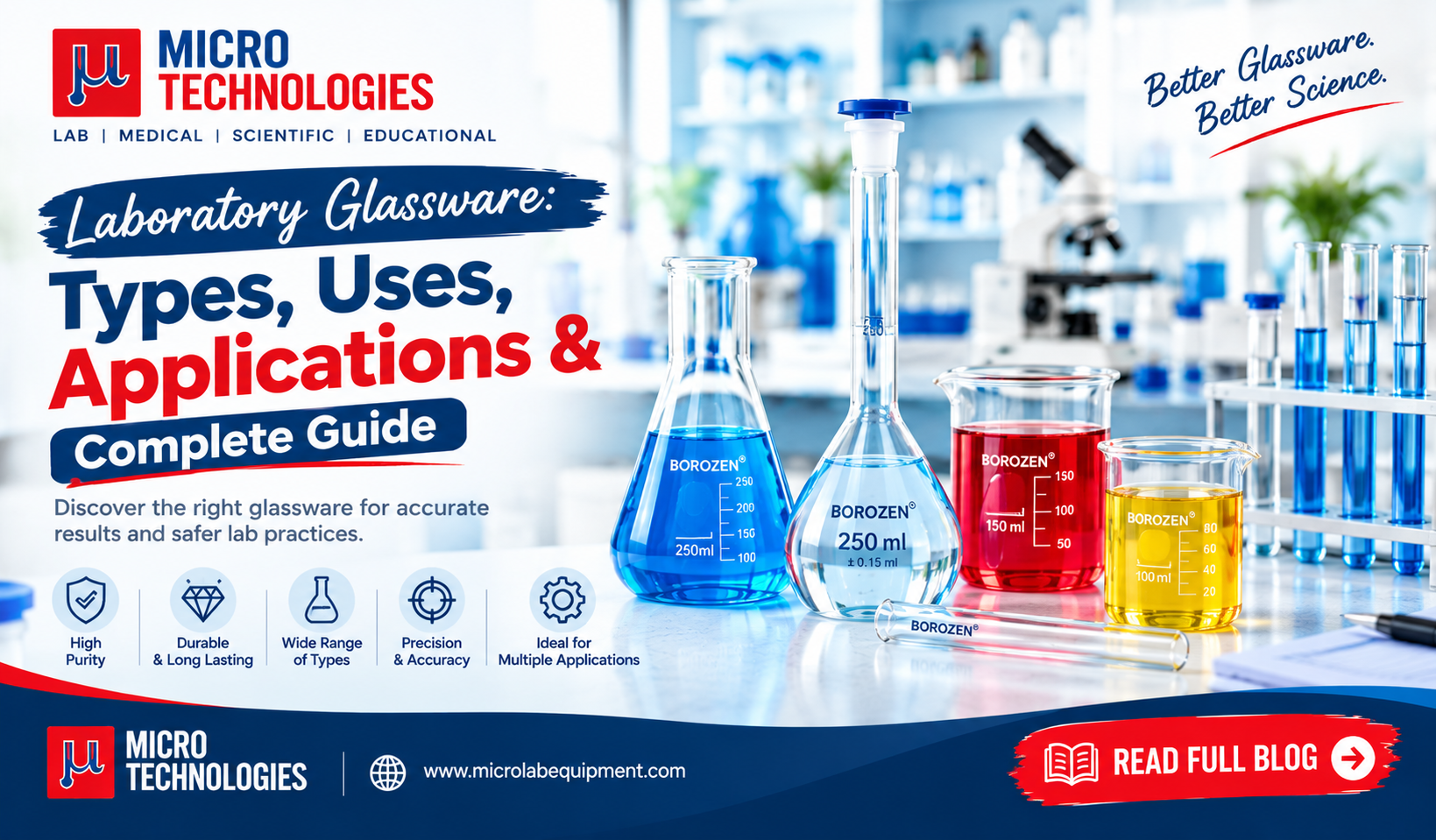
Laboratory glassware includes glass containers, measuring tools, and vessels used in scientific work. It helps hold, mix, heat, or measure chemicals and liquids. Most of it is made from borosilicate glass, not ordinary soda-lime glass, because it can survive rapid temperature swings without cracking.
The reason borosilicate dominates the lab bench isn’t marketing—it’s physics. Borosilicate glass exhibits a very low thermal expansion coefficient (roughly 3.3 × 10⁻⁶ per °C), which is the technical reason it can go from a Bunsen burner flame to a cold water bath without shattering. This is documented in Corning’s technical literature on its Pyrex borosilicate glass. It was first introduced by Corning Glass Works in 1915. It was made for railroad lantern lenses. It was later adapted for lab and kitchen use.
So when people say “lab glass,” they usually mean borosilicate glass. That one material choice is why glassware still runs most wet-chemistry labs. Plastic or metal usually cannot match it.
Why Does the Type of Glassware Actually Matter?
Short answer: because accuracy and safety depend on using the right tool for the right job. A beaker is not a measuring instrument. A volumetric flask is. Mixing these up is one of the most common errors in student labs.
Here’s the practical difference:
- Volumetric glassware (volumetric flasks, pipettes, burettes) is manufactured and calibrated to strict tolerances under standards like ISO 1042 (volumetric flasks) and ISO 385 (burettes).
- Non-volumetric glassware (beakers, most flasks) has only approximate graduations meant for rough estimates, not precision.
Confusing the two doesn’t just throw off a reading — in regulated environments (pharma, food testing, environmental labs), it can invalidate an entire test result.
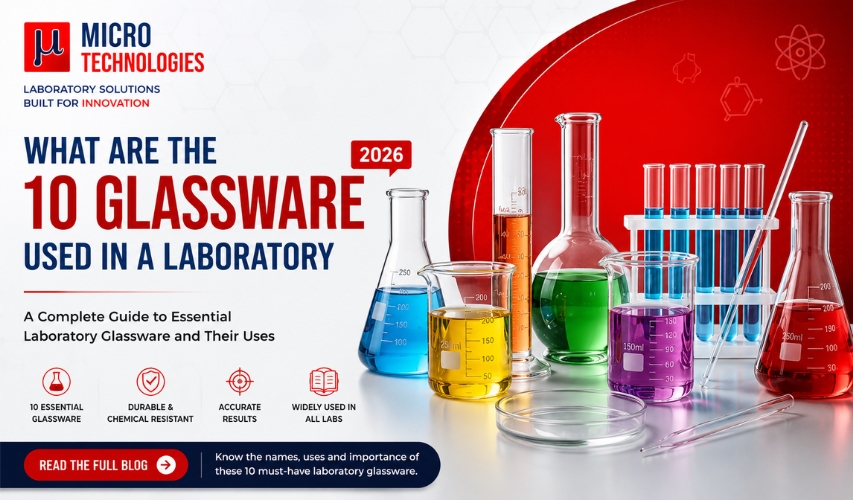
The 10 Most Common Types of Laboratory Glassware
1. Beakers
What it does: Beakers are cylindrical, flat-bottomed containers used for mixing, stirring, heating, and general-purpose liquid handling. They’re the workhorse of any lab — cheap, sturdy, and everywhere.
Beakers usually have a small spout (a “beak,” which is where the name comes from) for controlled pouring. Their printed graduations are approximate — typically accurate to within 5–10% — so they’re used for convenience, not precision measurement. Standard sizes run from 5 mL to over 5,000 mL, per manufacturer catalogs like those of Corning and DWK Life Sciences (Kimble/Pyrex).
2. Erlenmeyer Flasks (Conical Flasks)
What it does: The cone-shaped Erlenmeyer flask is designed for swirling and mixing liquids without spilling, and its narrow neck reduces evaporation and contamination during titrations.
German chemist Emil Erlenmeyer invented it in 1860. — a fact documented in general chemistry history references and glassware catalogs that still credit the design to him today. The narrow neck also makes it easy to insert a stopper. That’s why it’s the go-to vessel for titration and fermentation work, including microbiology culture flasks.
3. Volumetric Flasks
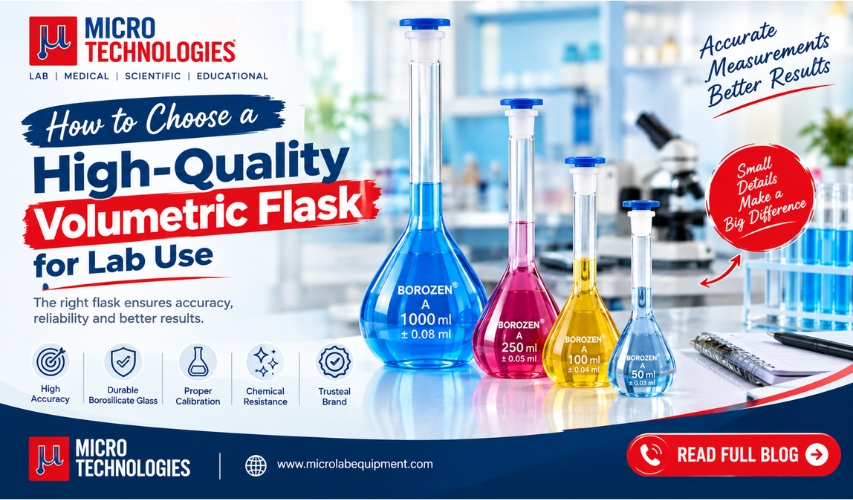
What it does: A volumetric flask has a single calibration line etched around a long, narrow neck, and it’s built for one purpose only — preparing a solution of a precisely known volume.
Unlike a beaker, a volumetric flask’s accuracy is certified. Under ISO 1042, Class A volumetric flasks carry the tightest tolerance (for example, ±0.10 mL on a 100 mL flask), while Class B allows roughly double that tolerance. That’s the standard reference labs use when a test method demands exact concentrations, such as preparing calibration standards.
4. Test Tubes
What it does: Test tubes are small, thin tubes used to hold, heat, or observe small samples. Think of them as single-serving containers in the lab.
They’re often held in a test tube rack or a metal clamp when heated over a flame, and rimmed test tubes are common because the lip makes them easier to grip with tongs and safer to pour from. Test tubes are the standard vessel for qualitative reactions in teaching labs. They appear in almost every introductory chemistry course. This follows general lab-safety and teaching guidance. Groups like the American Chemical Society provide these educational resources.
5. Graduated Cylinders
What it does: Graduated cylinders are tall, narrow containers marked with volume lines, used when you need a more accurate liquid measurement than a beaker but don’t need volumetric-flask-level precision.
Their narrow diameter reduces the reading error compared to a wide beaker, because a small volume change creates a bigger, easier-to-see shift in liquid height. When reading one, the standard method is to read the bottom of the meniscus at eye level. This is taught in almost every intro chemistry lab manual. Water and most aqueous solutions curve in glass.
6. Burettes
What it does: A burette is a long, graduated glass tube with a stopcock (valve) at the bottom, used to dispense precise, variable volumes of liquid — most famously during titrations.
Burettes are made under ISO 385 standards. ISO 385 sets accuracy tolerance classes: Class A and Class B. They are often required for analytical and regulated lab work. The stopcock lets you control the flow drop by drop, which is exactly what you need when you’re watching for a color-change endpoint in an acid-base titration.
7. Pipettes
What it does: Pipettes transfer a specific, measured volume of liquid from one container to another — from a single drop to tens of milliliters, depending on the type.
There are several kinds worth knowing:
- Volumetric (transfer) pipettes — deliver one fixed, highly accurate volume.
- Graduated (Mohr) pipettes — deliver variable volumes using printed markings.
- Micropipettes — plastic-tipped, adjustable, used for microliter volumes in molecular biology and clinical labs.
Volumetric pipettes are calibrated under ISO 648, and like volumetric flasks, Class A pipettes have tighter accepted error margins than Class B — the same class system used across most precision glassware.
8. Petri Dishes
What it does: Petri dishes are shallow, flat, lidded dishes primarily used to culture microorganisms, cells, or small plant material on a solid growth medium like agar.
They are named for the German bacteriologist Julius Richard Petri. He developed the dish in 1877 while assisting Robert Koch. Many scientific history archives document this microbiology history. The American Society for Microbiology also covers it in its educational materials. While many labs now use disposable plastic Petri dishes for single-use sterility, glass versions remain standard in labs that autoclave and reuse equipment.
9. Round-Bottom Flasks
What it does: Round-bottom flasks have a spherical base designed to distribute heat evenly, making them the standard choice for reflux, distillation, and reactions that need sustained, controlled heating.
The rounded shape (versus a flat-bottomed flask) reduces stress points in the glass, which matters a lot when the flask is being heated with a mantle or oil bath for extended periods — flat-bottomed vessels are more prone to uneven heating and cracking under those same conditions. This is why round-bottom flasks are the standard vessel in organic chemistry synthesis setups, typically fitted with ground-glass joints to connect to condensers.
10. Funnels (and Watch Glasses)
What it does: Glass funnels direct liquids into narrow-necked containers and are also used to hold filter paper during gravity filtration, separating solids from liquids. Watch glasses — shallow, curved glass discs — are used to cover beakers, evaporate small samples, or hold solids being weighed.
Both are simple by design but essential by function: a funnel prevents spills during a pour, and a watch glass prevents dust or contaminants from entering an open container while still letting a reaction “breathe” if needed. Together, they round out the basic glassware kit alongside the other nine items on this list.
Why Is Borosilicate Glass the Industry Standard for Lab Glassware?
Because it resists thermal shock, chemical corrosion, and mechanical stress far better than regular glass — and that combination is hard to replace.
This material is outlined by two well-known international standards, ensuring it’s recognized and trusted worldwide.
- ASTM E438 classifies laboratory glassware into Type I (borosilicate) and Type II (soda-lime) glass in the U.S.
- ISO 3585 specifies the requirements for borosilicate glass 3.3, the international benchmark used by manufacturers like Schott (DURAN) and Corning (Pyrex).
Borosilicate is also more resistant to attack from acids and organic solvents than standard glass, which is why regulated industries — pharmaceuticals, environmental testing, food safety — specify it in their standard operating procedures.
How Should You Choose a Laboratory Glassware and Equipment Supplier?
Look for a supplier that can show you the glass type, the calibration class, and the compliance standard for every precision item — not just a price list. If a volumetric flask or pipette doesn’t state its ISO class (A or B), you can’t trust its accuracy for regulated work.
At Micro Technologies, every piece of volumetric laboratory glassware and equipment we supply is labeled with its calibration class, so labs preparing standards or running titrations know exactly what tolerance they’re working with — no guesswork before a test run.
What certifications should a lab glassware supplier be able to provide?
At minimum: the glass type (borosilicate confirming ASTM E438 Type I or ISO 3585), the volumetric accuracy class where applicable (ISO 1042, ISO 385, or ISO 648), and batch traceability for regulated environments like pharma QC or environmental testing labs.
How Do You Clean and Store Laboratory Glassware Properly?
Laboratory glassware should be rinsed immediately after use, washed with a lab-grade detergent (not household soap, which can leave residue), rinsed with distilled water, and air-dried or oven-dried before storage.
A few habits matter more than people expect:
- Never plunge hot glassware into cold water — thermal shock can crack even borosilicate glass if the temperature change is extreme and sudden.
- Store volumetric glassware upright and separately from general glassware to avoid chipping the calibration mark or rim.
- Check for star cracks or chips before every use — a chipped rim on a volumetric flask or pipette can throw off your delivered volume even if the crack looks minor.
This isn’t just good housekeeping — it directly affects the accuracy and safety of your next experiment.
What Safety Standards Apply to Laboratory Glassware Use?
In the United States, laboratories are governed by OSHA’s Hazardous Chemicals Exposure Standard in Labs (29 CFR 1910.1450), often called the “Lab Standard,” which requires a written Chemical Hygiene Plan covering safe handling — including glassware use and breakage protocols.
Basic practical rules that come out of that framework include: never heating a sealed glass container, always inspecting glassware for cracks before heating, using tongs or heat-resistant gloves for hot glassware, and disposing of broken glass in a dedicated sharps or glass-waste container rather than a regular trash bin.
Frequently Asked Questions
Is all laboratory glassware made of the same material?
No. Most precision and heat-resistant glassware is borosilicate glass (ASTM E438 Type I), while some lower-cost, non-heated items may use soda-lime glass (Type II), which is less resistant to thermal shock and chemical attack.
What’s the difference between a beaker and a graduated cylinder?
A beaker gives a rough volume estimate for mixing and general use, while a graduated cylinder is built specifically for more accurate volume measurement thanks to its narrower, taller shape.
Why do volumetric flasks only have one marking, unlike graduated cylinders?
Because a volumetric flask is designed to measure exactly one specific volume with high accuracy (its calibration line), not a range of volumes — that single-purpose design is what allows it to meet tight ISO 1042 tolerance classes.
Can laboratory glassware be reused after autoclaving?
Yes — borosilicate glass is designed to withstand repeated autoclave cycles (typically 121°C under pressure) without degrading, which is one of the main reasons labs still prefer it over single-use plastics for equipment they use often.
Why the Basics Still Matter
None of these 10 items are flashy. No lab glassware company is going to reinvent the burette next year. But that is the point. This is proven, standard equipment that scientists have used for generations. It is physically tested. The standards behind it, like ISO, ASTM, and OSHA, exist for a reason. Precision and safety cannot be left to guesswork.
Whether you’re equipping a school science lab, a QC department, or a full research facility, choose the right lab glassware. Pick the right calibration class and glass type. These choices can mean results you trust or tests you must redo.
That’s the exact gap Micro Technologies exists to close: reliable, properly classed laboratory glassware and equipment, sourced and labeled the way a real lab actually needs it.