Why These 10 Glassware Items Made the List
Before diving into each one, it's worth asking why these specific 10 common laboratory glassware items keep showing up on every bench, year after year.
The short answer: each one solves one problem really well, and nothing else does that same job quite as cleanly. A beaker isn't trying to be a volumetric flask. A burette isn't trying to be a graduated cylinder. That kind of specialization is exactly why chemistry labs stock all of them instead of picking just one "do-everything" container.
1. Beaker
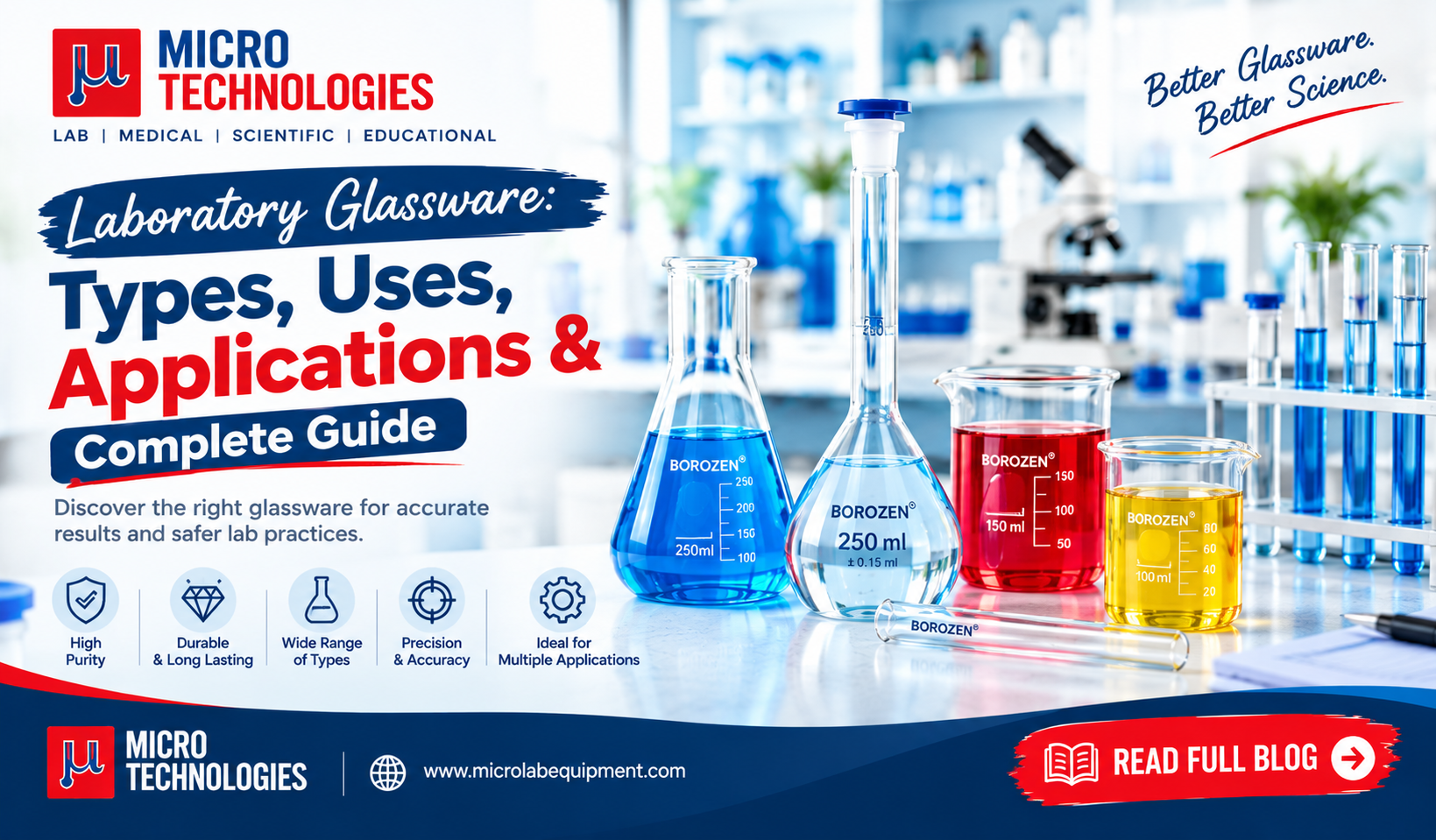
The beaker is the simplest, most recognizable item on this list—a flat-bottomed, straight-sided cylinder used for mixing, stirring, and general heating. Its volume markings are approximate rather than precise, so it's built for convenience, not accuracy.
Ask any student which glassware they touched first in a chemistry class, and there's a good chance it was this one.
2. Conical (Erlenmeyer) Flask
Designed in 1860 by German chemist Emil Erlenmeyer, the conical flask has a flat base, sloped conical sides, and a narrow neck. That shape lets you swirl a solution vigorously without splashing it out—which is exactly why it's the standard flask used for titrations.
The narrow neck also does a second job: it reduces evaporation. It accepts a stopper easily, which is why conical flasks double as containers for growing microbial cultures on an orbital shaker.
3. Volumetric Flask
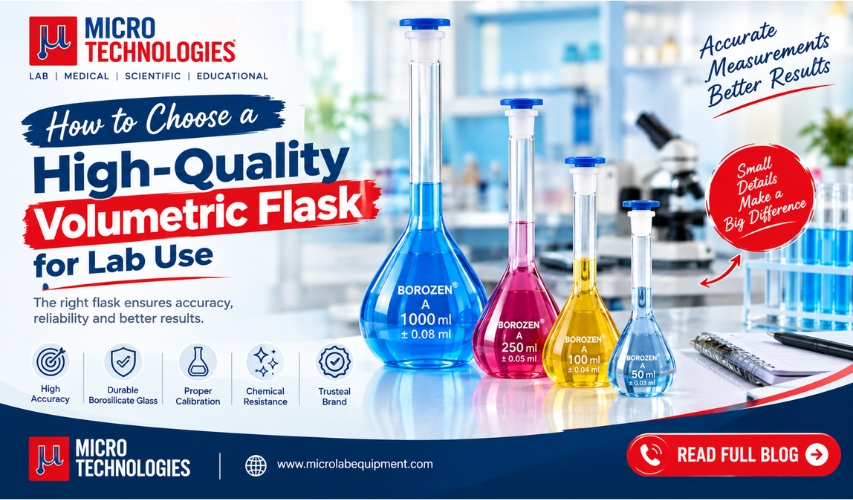
Where a beaker guesses, a volumetric flask commits. It carries a single calibration mark etched into a long, narrow neck, and it's built to hold one exact volume at one exact reference temperature.
This makes it the tool of choice for preparing standard solutions and precise dilutions—jobs where "close enough" simply isn't acceptable, especially in regulated or analytical labs.
4. Graduated Cylinder
The graduated cylinder sits in the middle ground between a beaker's rough estimate and a volumetric flask's precision. Its tall, narrow shape and printed graduations give a reasonably accurate volume reading, without the cost or fuss of full volumetric calibration.
It's the everyday choice whenever "reasonably accurate" is good enough, which—honestly—covers a lot of lab work.
5. Test Tube
Small, cylindrical, and endlessly reusable, the test tube isn't for precise measurement. It's about containing a small quantity of liquid or solid for observation, heating, or a quick reaction check.
If glassware had personality types, the test tube would be the reliable, no-drama coworker who never causes a scene.
6. Burette
When a titration needs liquid added drop by drop, a burette is the tool for the job. This long, graduated tube with a stopcock at the bottom lets an analyst control the flow with real precision, watching the volume dispensed against the markings along its length.
Because tolerance genuinely matters here, burettes are calibrated to strict standards and are typically stored vertically to avoid drift or blockage over time.
7. Pipette
A pipette transfers or measures small liquid volumes with a level of accuracy a beaker or cylinder simply can't match. Volumetric pipettes deliver one exact, calibrated volume, while graduated pipettes allow a range of measurable amounts along a marked scale.
Out of all the glassware on this list, the pipette is probably the one used most often for the smallest volumes—a few milliliters, sometimes far less.
8. Round Bottom Flask
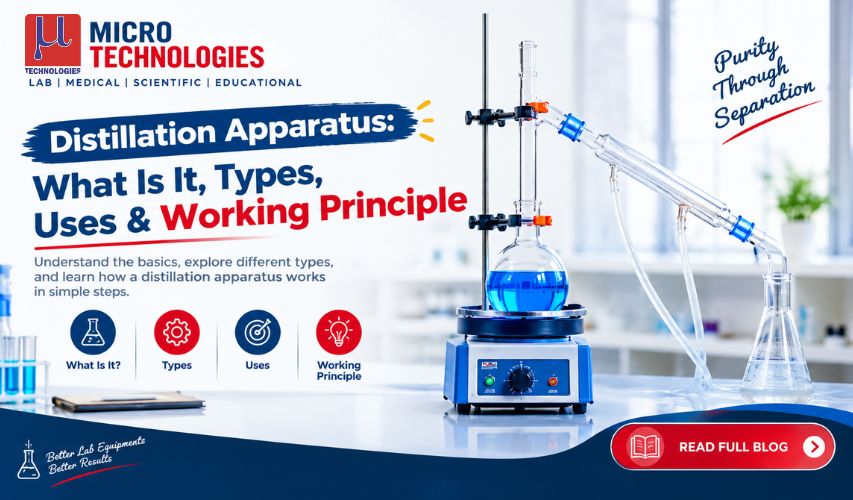
That curved, spherical base isn't decorative—it's functional. A round-bottom flask distributes heat evenly across its rounded surface, avoiding the localized hot spots a flat-bottomed container can develop under intense heating.
That's exactly why this flask dominates distillation setups and reflux reactions in organic chemistry, where controlled, even heating genuinely changes the outcome of an experiment.
9. Watch Glass
A shallow, concave disc of glass, the watch glass rarely gets the spotlight, but it's constantly busy behind the scenes—covering a beaker to reduce evaporation, holding a solid while it's weighed, or providing a flat surface for a liquid to evaporate slowly.
It's proof that not every important lab tool needs to look impressive to earn its place.
10. Petri Dish
The Petri dish has one of the more interesting origin stories on this list. It was developed in 1887 by Julius Richard Petri, a German physician working inside Robert Koch's bacteriology laboratory in Berlin — one of the most influential labs in the early history of microbiology.
Before Petri's design, scientists grew bacteria on flat glass plates covered by a bulky bell jar, which made examining cultures under a microscope genuinely awkward. The shallow, lidded dish solved that problem in one clean move, and it remains the standard surface for culturing microorganisms on solid agar media today.
The Material Behind Most of These: Borosilicate Glass
Most quality lab glassware—including several items on this list of 10 common laboratory glassware items—is made from borosilicate glass. Its main advantage is resisting thermal shock, meaning it can handle rapid temperature changes, like going straight from a Bunsen burner flame to a cold bench, without cracking.
That single material choice quietly explains why lab glass survives decades of heating, cooling, and general rough handling that would shatter ordinary glass in a single afternoon.
Precision Matters More for Some Than Others
Not every item on this list plays in the same accuracy league, and that's by design, not by accident.
Volumetric flasks, pipettes, and burettes are individually calibrated to strict tolerances, since they're used wherever exact volumes actually matter. Beakers and standard graduated cylinders, on the other hand, are built for approximate work—mixing, rough measuring, and general prep—where a fraction of a milliliter simply doesn't change the outcome.
Knowing which category a task falls into is really the whole trick to choosing correctly among these ten essential tools.
How to Pick the Right One for the Job
Here's a simple rule that saves a lot of headaches: match the glassware's precision level to what the experiment actually demands.
Don't reach for a beaker when a dilution needs volumetric accuracy. Don't use a test tube when a reaction needs the even heating a round bottom flask provides. And always give glassware a quick visual check before use—a hairline crack that looks harmless at room temperature can shatter the moment it meets sudden heat.
Conclusion
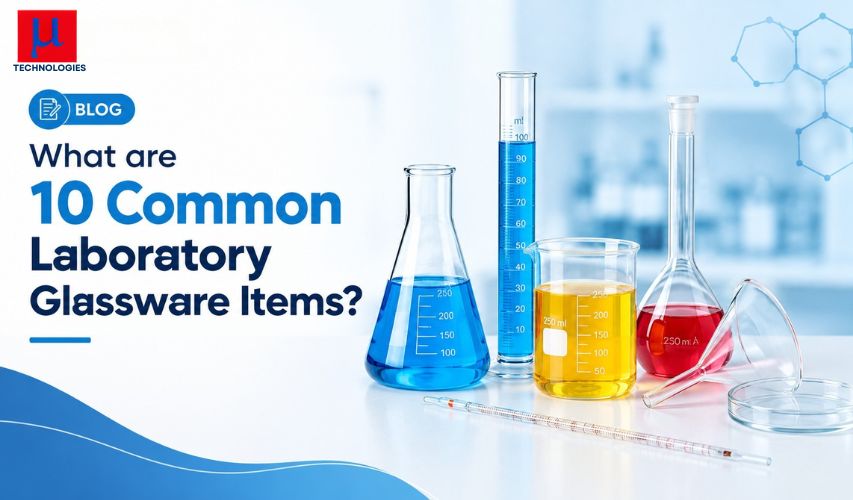
These 10 common laboratory glassware items—the beaker, conical flask, volumetric flask, graduated cylinder, test tube, burette, pipette, round bottom flask, watch glass, and Petri dish—cover nearly everything a working chemistry or biology lab touches on a daily basis. Each one earned its permanent spot on the bench by solving one specific problem better than anything else could.
Knowing what each tool is actually built for isn't just trivia for a quiz. It's the difference between a clean, trustworthy result and one you'll be re-running tomorrow.
Frequently Asked Questions
What are the 10 common laboratory glassware items used in most labs?
The beaker, conical (Erlenmeyer) flask, volumetric flask, graduated cylinder, test tube, burette, pipette, round bottom flask, watch glass, and Petri dish.
Which of these glassware items is the most accurate for measuring volume?
Volumetric flasks, pipettes, and burettes are the most accurate, since they're individually calibrated to strict tolerances, unlike beakers or standard graduated cylinders.
Why is a round bottom flask used instead of a regular flask for heating?
Its curved shape distributes heat evenly across the surface, avoiding hot spots—which is essential for distillation and reflux reactions in organic chemistry.
Who invented the Petri dish?
The Petri dish was developed in 1887 by Julius Richard Petri, a German physician working in Robert Koch's bacteriology laboratory in Berlin.
Why is most laboratory glassware made from borosilicate glass?
Borosilicate glass resists thermal shock, meaning it can withstand rapid temperature changes without cracking, which is essential for glassware that moves between heating and cooling repeatedly.