
Kinematic Model – Whitworth Quick Return Mechanism
Product Specification Sheet
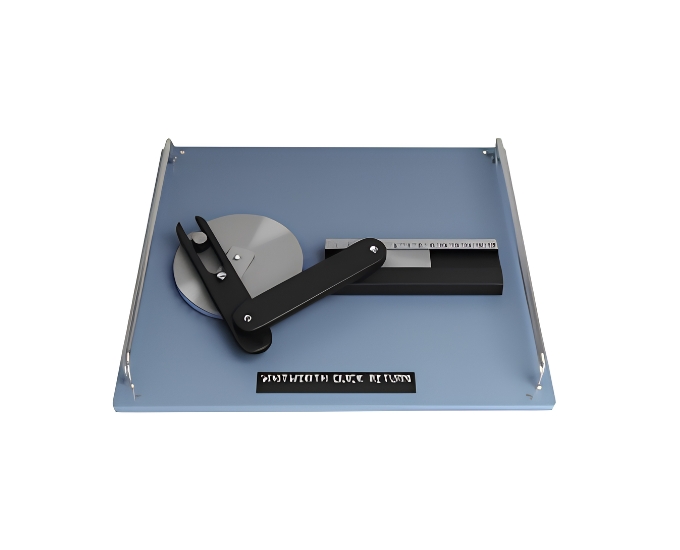
Kinematic Model – Whitworth Quick Return Mechanism
Model Number: MTDE-204
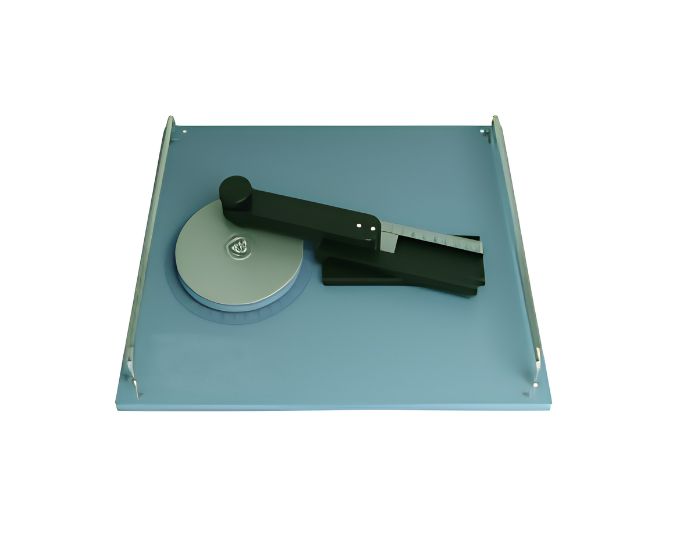
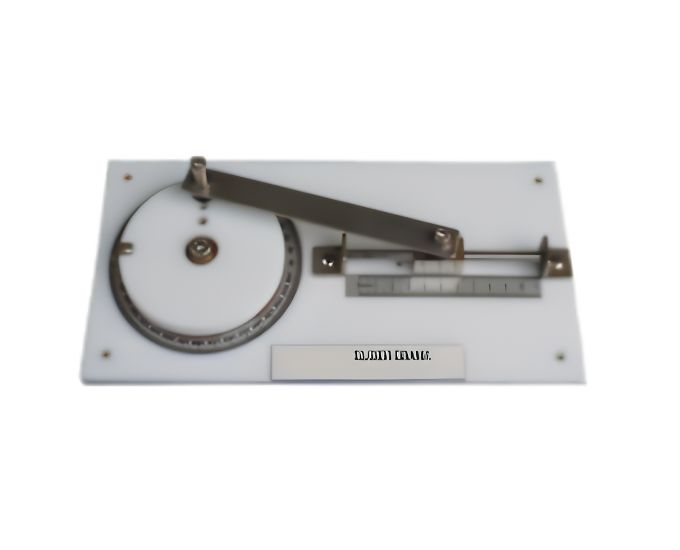
The Kinematic Model – Whitworth Quick Return Mechanism is an educational mechanical engineering model designed for the practical investigation of a revolving crank-slider quick return mechanism. It enables students to study the influence of crank length and input angle on output stroke and to record the transmission function of the mechanism while observing the difference between forward and return motion.
Product Specification
The Kinematic Model – Whitworth Quick Return Mechanism is a laboratory teaching apparatus developed for practical study and demonstration of the kinematics of a Whitworth quick return mechanism.
The Whitworth mechanism is an important mechanical motion-conversion system studied in Theory of Machines and Kinematics of Machines. It produces reciprocating output motion while providing different time periods for the forward and return strokes.
The apparatus provides a clear physical representation of a revolving crank-slider mechanism, enabling students to observe the movement and interaction of the different links throughout a complete operating cycle.
The crank serves as the rotary input to the mechanism. As it rotates, the interconnected links transmit the movement to the output member, producing reciprocating motion.
An important characteristic of this arrangement is the quick return effect, where the return stroke is completed in less time than the working or forward stroke when the crank rotates at uniform speed.
The model enables practical investigation of a revolving crank slider and helps students understand how continuous rotary input can produce non-uniform reciprocating output motion.
Students can investigate the influence of crank length and input angle on output stroke. By changing or observing the relevant geometric parameters, the relationship between input crank position and output displacement can be studied.
The graduated angular arrangement provides a reference for determining crank position, while the linear measuring arrangement enables observation of the corresponding output displacement.
Measurements can be taken at different crank angles to record the transmission function of the revolving crank-slider mechanism.
The apparatus also enables students to understand concepts such as forward stroke, return stroke, quick return ratio, crank rotation, slider displacement, stroke length, angular displacement, and mechanism geometry.
The model provides a useful physical demonstration of the principles behind quick return mechanisms associated with machine tools and other reciprocating mechanical systems.
Its compact tabletop configuration makes it suitable for both classroom demonstrations and student laboratory experiments.
Micro Technologies supplies Whitworth Quick Return Kinematic Models and other Theory of Machines laboratory equipment for engineering colleges, universities, polytechnic institutes, ITIs, technical training centres, and educational laboratories.
Features
- Educational Whitworth quick return mechanism model
- Revolving crank-slider configuration
- Demonstrates quick return motion
- Continuous rotary input
- Reciprocating output motion
- Suitable for crank-angle studies
- Enables output-stroke observation
- Suitable for studying crank-length influence
- Input angle versus output stroke analysis
- Transmission-function recording
- Demonstrates forward and return strokes
- Suitable for quick return ratio studies
- Clear visualization of mechanism movement
- Manual operation
- Compact tabletop configuration
- Rigid supporting base
- Suitable for repeated laboratory experiments
Benefits
- Provides practical understanding of the Whitworth mechanism
- Clearly demonstrates the quick return principle
- Enables investigation of revolving crank-slider motion
- Helps students understand rotary-to-reciprocating motion conversion
- Demonstrates differences between forward and return strokes
- Enables crank angle versus output displacement studies
- Helps analyze the influence of crank length
- Supports transmission-function determination
- Connects theoretical kinematic diagrams with physical movement
- Suitable for hands-on Theory of Machines experiments
Product Specifications
| Specification | Details |
|---|---|
| Product Name | Kinematic Model – Whitworth Quick Return Mechanism |
| Product Type | Educational Kinematic Model |
| Mechanism | Whitworth Quick Return |
| Mechanism Principle | Revolving Crank Slider |
| Input Motion | Rotary |
| Output Motion | Reciprocating |
| Quick Return Effect | Demonstrated |
| Input Parameter | Crank Angle |
| Output Parameter | Output Stroke / Displacement |
| Crank Length Study | Supported |
| Transmission Function | Recording Supported |
| Forward Stroke Study | Supported |
| Return Stroke Study | Supported |
| Operation | Manual |
| Mounting | Tabletop Base |
| Application | Theory of Machines / Kinematics Laboratory |
Experiments Performed
- Investigation of a revolving crank slider
- Study of Whitworth quick return mechanism
- Demonstration of quick return motion
- Study of rotary input and reciprocating output
- Observation of crank angular movement
- Measurement of output displacement
- Study of input angle versus output stroke
- Investigation of the influence of crank length
- Study of forward stroke
- Study of return stroke
- Comparison of forward and return motion
- Determination of quick return characteristics
- Study of quick return ratio
- Recording of transmission function
- Plotting of input crank angle versus output displacement
- Study of complete mechanism movement through one crank revolution
Applications
- Theory of Machines Laboratories
- Kinematics of Machines Laboratories
- Dynamics of Machines Laboratories
- Mechanical Engineering Laboratories
- Mechanism & Machine Theory Laboratories
- Machine Tool Laboratories
- Production Engineering Laboratories
- Automobile Engineering Laboratories
- Engineering Colleges
- Universities
- Polytechnic Institutes
- ITIs
- Vocational Training Institutes
- Technical Training Centres
FAQs
What is the Whitworth Quick Return Kinematic Model used for?
The model is used to study a revolving crank-slider mechanism and demonstrate the quick return principle, crank motion, output stroke, and transmission characteristics.
What is a Whitworth quick return mechanism?
A Whitworth quick return mechanism is a mechanical linkage that converts rotary input into reciprocating output while producing different durations for the forward and return strokes.
What is the quick return effect?
The quick return effect occurs when the return stroke of a reciprocating member is completed in less time than its forward or working stroke while the input crank rotates uniformly.
Can the revolving crank-slider mechanism be studied?
Yes. Investigation of the revolving crank slider is one of the primary functions of this kinematic model.
Can the influence of crank length be studied?
Yes. The model enables investigation of how crank length affects the movement and output stroke of the mechanism.
Can input angle versus output stroke be studied?
Yes. Different crank-angle positions can be compared with the corresponding output displacement or stroke.
Can the transmission function be recorded?
Yes. Experimental readings can be taken to record and analyze the transmission function of the revolving crank-slider mechanism.
Can the quick return ratio be studied?
Yes. The forward and return portions of the mechanism cycle can be analyzed to understand quick return characteristics and determine the quick return ratio.
Where are quick return mechanisms used?
Quick return mechanisms are commonly studied in relation to machine tools and mechanical systems requiring a slower working stroke and faster return stroke.
Does the model require electrical power?
No. The basic kinematic model is manually operated, making it convenient for direct classroom and laboratory demonstrations.
Is it suitable for Theory of Machines laboratories?
Yes. It is suitable for Theory of Machines, Kinematics of Machines, Dynamics of Machines, and mechanical engineering laboratory courses.
Why Choose Our Products
- Practical Whitworth mechanism demonstration
- Revolving crank-slider study
- Clear quick return motion visualization
- Forward and return stroke analysis
- Crank angle and output stroke studies
- Transmission-function experiments
- Quick return ratio investigation
- Compact tabletop configuration
- Student-friendly manual operation
- Durable educational construction
- Customized configurations available
- Institutional and bulk supply support
Call to Action
Looking for a Kinematic Model – Whitworth Quick Return Mechanism for your mechanical engineering laboratory? Micro Technologies supplies kinematic models, Theory of Machines equipment, Dynamics of Machines apparatus, and mechanical engineering laboratory equipment for universities, engineering colleges, polytechnic institutes, ITIs, and technical training centres. Contact us for technical specifications, customized configurations, institutional orders, bulk supply, distributor inquiries, government tenders, or a competitive quotation.