
Kinematic Model – Crank Slider Mechanism
Product Specification Sheet
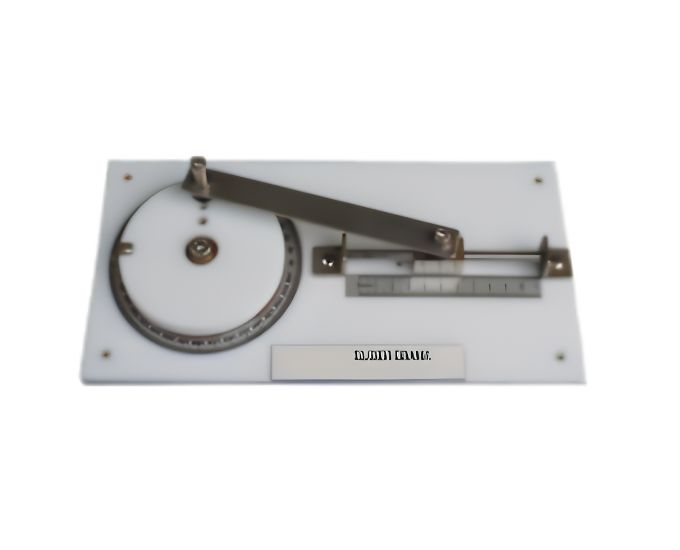
Kinematic Model – Crank Slider Mechanism
Model Number: MTDE-202
The Kinematic Model – Crank Slider Mechanism is an educational demonstration model designed to study the conversion of uniform rotary motion into reciprocating motion. It enables students to investigate the influence of crank length and input angle on output stroke and to record the transmission characteristics of a crank-slider mechanism.
Product Specification
The Kinematic Model – Crank Slider Mechanism is a mechanical engineering laboratory teaching model developed for practical study of the kinematic behaviour of a slider-crank mechanism.
A crank-slider mechanism is one of the fundamental mechanisms studied in kinematics and theory of machines. It converts the rotary movement of a crank into the linear reciprocating movement of a slider.
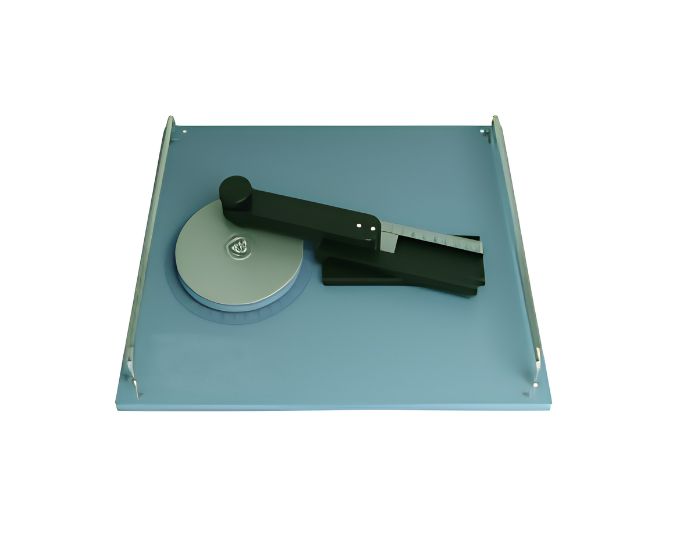
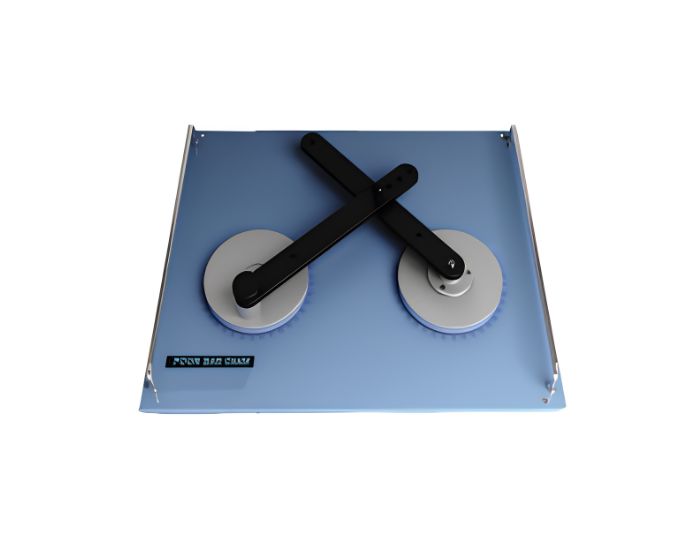
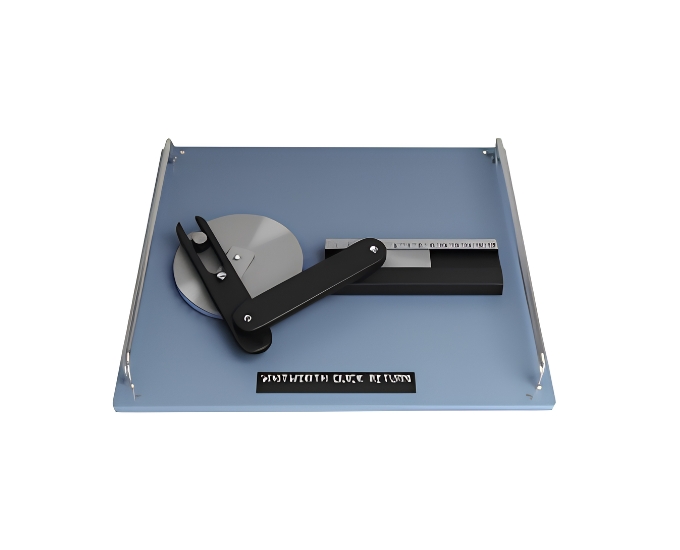
The model provides a clear physical representation of the crank, connecting link, and slider arrangement, allowing students to directly observe the relationship between angular input and linear output displacement.
During operation, the crank is rotated through different angular positions. The connecting link transfers this motion to the slider, causing it to move along a defined linear path.
The apparatus demonstrates the conversion of uniform rotary motion into reciprocating motion and helps students understand how the slider position changes throughout a complete crank revolution.
An important experimental application of the model is studying the influence of crank length and input angle on output stroke. By observing or measuring slider displacement at different crank positions, students can analyze the geometry of the mechanism.
The graduated circular scale provides a reference for determining the angular position of the crank, while the linear scale can be used for observing the corresponding position or displacement of the slider.
Students can record multiple input and output readings to determine the transmission function of the crank-slider mechanism.
The model also provides practical understanding of important concepts such as top dead centre, bottom dead centre, crank angle, slider displacement, stroke, connecting-rod motion, and reciprocating motion.
Crank-slider mechanisms are fundamental to many practical mechanical systems, including reciprocating engines, pumps, compressors, and other machines involving conversion between rotary and linear motion.
The Kinematic Model – Crank Slider Mechanism provides a simple visual and experimental platform for connecting theoretical kinematic relationships with actual mechanism movement.
Micro Technologies supplies crank-slider kinematic models and Theory of Machines laboratory equipment for engineering colleges, universities, polytechnic institutes, ITIs, technical training centres, and educational laboratories.
Features
- Educational crank-slider mechanism model
- Demonstrates rotary-to-reciprocating motion conversion
- Manually operated mechanism
- Graduated crank-angle scale
- Linear slider displacement scale
- Adjustable experimental arrangement
- Suitable for studying crank length
- Input-angle measurement
- Output-stroke observation
- Transmission-function determination
- Clear visualization of mechanism movement
- Suitable for complete crank-cycle analysis
- Compact tabletop configuration
- Rigid supporting base
- Suitable for repeated student experiments
Benefits
- Provides practical understanding of slider-crank kinematics
- Clearly demonstrates rotary and reciprocating motion
- Enables crank-angle versus slider-displacement studies
- Helps students understand the influence of crank geometry
- Enables output-stroke analysis
- Supports transmission-function recording
- Demonstrates complete mechanism movement visually
- Helps explain dead-centre positions
- Connects theoretical mechanism diagrams with actual motion
- Suitable for hands-on Theory of Machines experiments
Product Specifications
| Specification | Details |
|---|---|
| Product Name | Kinematic Model – Crank Slider Mechanism |
| Product Type | Educational Kinematic Model |
| Mechanism | Crank Slider / Slider Crank |
| Input Motion | Rotary Motion |
| Output Motion | Reciprocating Linear Motion |
| Input Parameter | Crank Angle |
| Output Parameter | Slider Position / Stroke |
| Crank Angle Indication | Graduated Circular Scale |
| Slider Measurement | Linear Scale |
| Crank Length Study | Supported |
| Transmission Function Study | Supported |
| Operation | Manual |
| Mounting | Tabletop Base |
| Application | Theory of Machines / Kinematics Laboratory |
| Suitable For | Engineering Colleges, Polytechnics & Technical Institutes |
Experiments Performed
- Study of crank-slider mechanism
- Conversion of uniform rotary motion into reciprocating motion
- Study of crank angular position
- Measurement of slider displacement
- Study of crank angle versus slider position
- Investigation of crank length on output movement
- Study of the influence of input angle on output stroke
- Determination of slider stroke
- Recording of transmission function
- Plotting of input angle versus output displacement
- Observation of complete mechanism movement
- Identification of crank and connecting link
- Identification of slider movement
- Study of top dead centre position
- Study of bottom dead centre position
- Practical verification of slider-crank kinematics
Applications
- Theory of Machines Laboratories
- Kinematics of Machines Laboratories
- Dynamics of Machines Laboratories
- Mechanical Engineering Laboratories
- Mechanism & Machine Theory Laboratories
- Engineering Mechanics Laboratories
- Automobile Engineering Laboratories
- Engineering Colleges
- Universities
- Polytechnic Institutes
- ITIs
- Vocational Training Institutes
- Technical Training Centres
FAQs
What is the Crank Slider Kinematic Model used for?
The model is used to study the conversion of rotary crank motion into linear reciprocating slider motion and investigate the kinematic relationship between input angle and output displacement.
What motion does a crank-slider mechanism produce?
It converts rotary motion into reciprocating linear motion or, depending on the application, reciprocating motion into rotary motion.
Can crank angle be measured on the model?
Yes. The graduated circular arrangement allows the crank position to be referenced at different angular positions.
Can slider displacement be measured?
Yes. The linear measuring arrangement allows the corresponding slider position or displacement to be observed during experiments.
Can the influence of crank length be studied?
Yes. The model is intended for investigating how crank length influences the output stroke and kinematic behaviour of the mechanism.
What is the transmission function of a crank slider?
The transmission function describes the relationship between the input crank position and the corresponding output displacement of the slider.
Can input angle versus output stroke be studied?
Yes. Different crank-angle positions can be recorded along with the corresponding slider displacement to analyze their relationship.
What are dead-centre positions?
Dead-centre positions occur at the extreme positions of slider travel where the crank and connecting mechanism reach specific aligned configurations. These positions define the limits of the slider stroke.
Where are crank-slider mechanisms commonly used?
They are commonly associated with reciprocating engines, piston pumps, compressors, and other mechanical systems that convert rotary and reciprocating motion.
Does the model require electrical power?
No. The basic kinematic model is manually operated for easy demonstration and experimental study.
Is it suitable for Theory of Machines laboratories?
Yes. It is suitable for Theory of Machines, Kinematics of Machines, Dynamics of Machines, and mechanical engineering laboratories.
Why Choose Our Products
- Practical crank-slider kinematic demonstration
- Rotary-to-reciprocating motion study
- Crank-angle measurement
- Slider displacement observation
- Crank length and stroke analysis
- Transmission-function experiments
- Compact tabletop configuration
- Student-friendly manual operation
- Durable educational construction
- Customized configurations available
- Institutional and bulk supply support
Call to Action
Looking for a Kinematic Model – Crank Slider Mechanism for your engineering laboratory? Micro Technologies supplies kinematic models, Theory of Machines equipment, Dynamics of Machines apparatus, and mechanical engineering laboratory equipment for universities, engineering colleges, polytechnic institutes, ITIs, and technical training centres. Contact us for technical specifications, customized configurations, institutional orders, bulk supply, distributor inquiries, government tenders, or a competitive quotation.