
Kinematic Model – Crank Mechanism with Fixed and Oscillating Cylinder
Product Specification Sheet
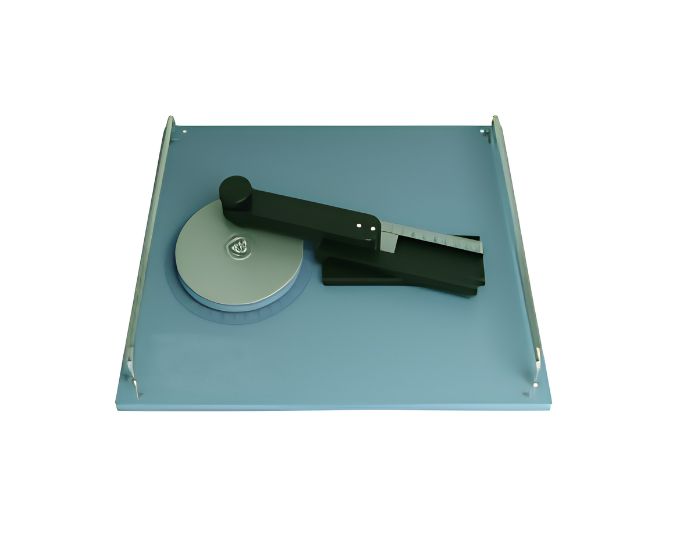
Kinematic Model – Crank Mechanism with Fixed and Oscillating Cylinder
Model Number: MTDE-201
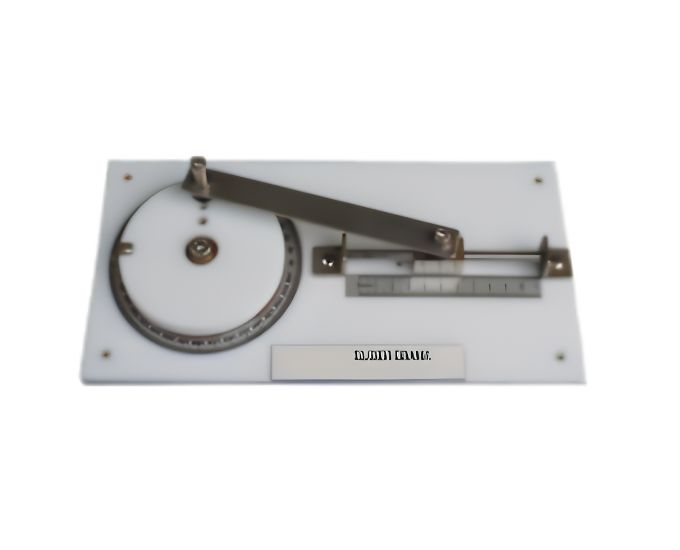
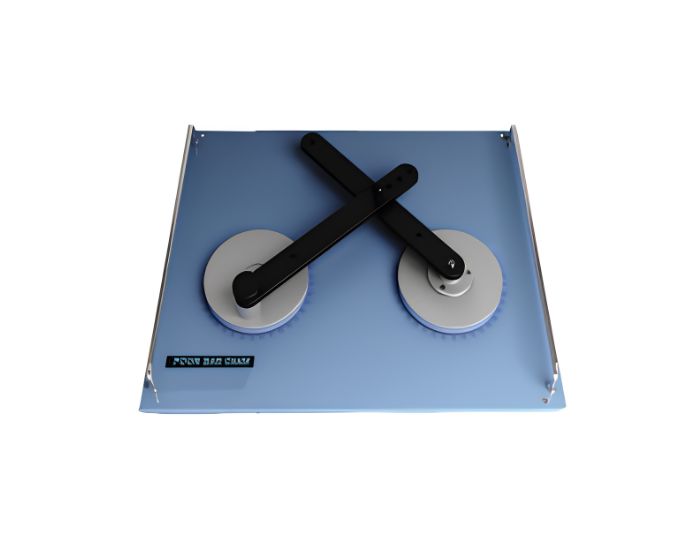
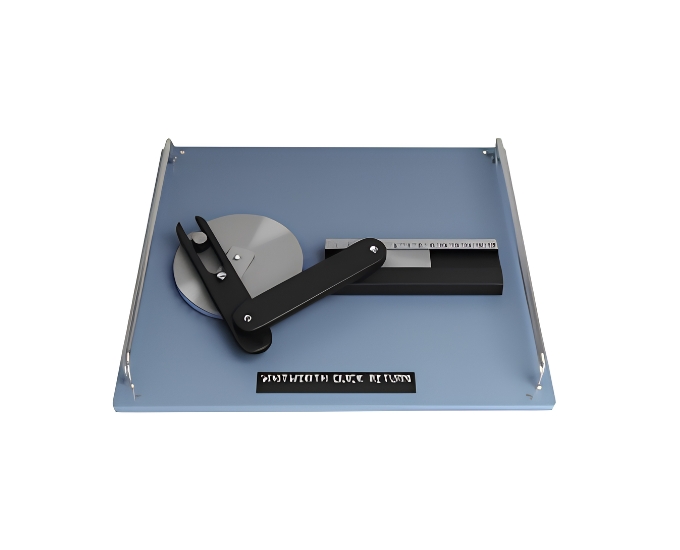
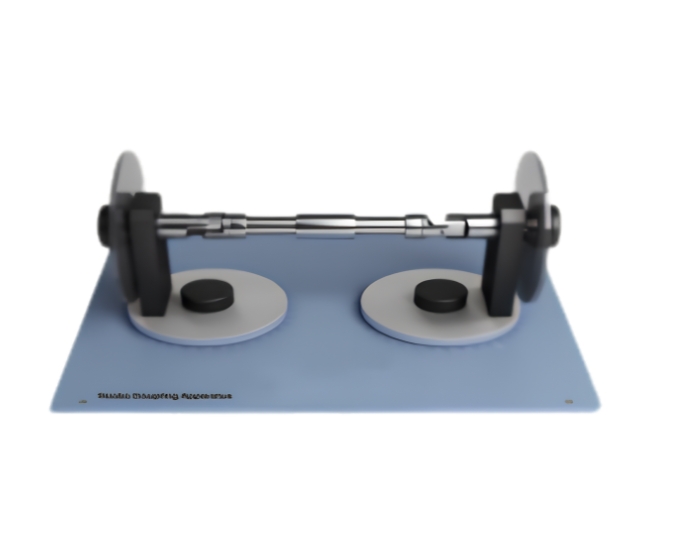
The Kinematic Model – Crank Mechanism with Fixed and Oscillating Cylinder is an educational demonstration model designed for studying the fundamental motion and operation of crank-based mechanisms. It enables students to observe the relationship between rotary motion, reciprocating motion, crank movement, connecting-link movement, and oscillating motion, making it suitable for theory of machines and mechanical engineering laboratories.
Product Specification
The Kinematic Model – Crank Mechanism with Fixed and Oscillating Cylinder is a laboratory teaching model developed for practical demonstration of fundamental kinematic principles used in mechanical mechanisms.
Crank mechanisms are widely studied in mechanical engineering because they provide an effective means of converting rotary motion into reciprocating or oscillating motion, and vice versa.
The model provides a clear physical representation of the crank mechanism so students can observe the relative movement of individual links during operation.
The crank can be manually rotated to demonstrate how angular movement at the input produces corresponding movement of the connected mechanism.
The model is particularly useful for understanding the operation of a crank mechanism with fixed and oscillating cylinder arrangements.
In a fixed-cylinder configuration, the cylinder or guiding member remains stationary while the associated moving element undergoes reciprocating movement as the crank rotates.
In an oscillating-cylinder arrangement, the cylinder is permitted to oscillate about a pivot while the crank mechanism operates. This provides students with a practical demonstration of combined reciprocating and oscillating motion.
The apparatus allows the mechanism to be studied through a complete cycle. Students can observe the changing angular position of the crank and corresponding movement of the connected members.
The model also helps demonstrate important concepts such as kinematic links, turning pairs, sliding motion, rotary motion, reciprocating motion, oscillation, and constrained motion.
Its compact tabletop configuration makes it suitable for classroom demonstrations as well as practical sessions in mechanical engineering laboratories.
The Kinematic Model – Crank Mechanism provides students with a physical representation of mechanism theory, helping bridge the gap between theoretical kinematic diagrams and actual mechanical motion.
Micro Technologies supplies kinematic models, theory of machines laboratory equipment, and dynamics of machines apparatus for engineering colleges, universities, polytechnic institutes, ITIs, technical training centres, and educational laboratories.
Features
- Educational crank mechanism demonstration model
- Demonstrates fixed and oscillating cylinder arrangement
- Clear visualization of mechanism movement
- Manual operation for easy demonstration
- Demonstrates rotary motion
- Demonstrates reciprocating motion
- Demonstrates oscillating motion
- Suitable for studying relative motion between links
- Helps identify different kinematic links and joints
- Compact tabletop configuration
- Simple and student-friendly operation
- Suitable for classroom and laboratory demonstrations
- Rigid supporting base
- Durable construction for repeated educational use
Benefits
- Provides practical understanding of crank mechanisms
- Helps visualize conversion of rotary motion
- Demonstrates reciprocating and oscillating movements
- Makes theoretical kinematic concepts easier to understand
- Allows students to observe link movement through a complete cycle
- Useful for understanding fixed and oscillating cylinder mechanisms
- Provides hands-on learning of mechanical motion
- Suitable for theory of machines practical demonstrations
- Helps connect mechanism diagrams with physical operation
- Suitable for individual and group demonstrations
Product Specifications
| Specification | Details |
|---|---|
| Product Name | Kinematic Model – Crank Mechanism |
| Mechanism | Crank Mechanism |
| Configuration | Fixed & Oscillating Cylinder |
| Product Type | Educational Kinematic Model |
| Input Motion | Rotary |
| Output / Resulting Motion | Reciprocating / Oscillating |
| Operation | Manual Demonstration |
| Primary Study | Kinematics of Crank Mechanism |
| Motion Visualization | Supported |
| Link Movement Study | Supported |
| Mounting | Tabletop Base |
| Application | Theory of Machines / Kinematics Laboratory |
| Suitable For | Engineering Colleges, Polytechnics & Technical Institutes |
Experiments Performed
- Study of crank mechanism
- Demonstration of crank motion
- Study of fixed-cylinder crank mechanism
- Study of oscillating-cylinder crank mechanism
- Demonstration of rotary motion
- Demonstration of reciprocating motion
- Demonstration of oscillating motion
- Study of motion conversion in a crank mechanism
- Identification of different links
- Identification of kinematic pairs
- Observation of relative motion between mechanism components
- Study of mechanism movement through a complete crank rotation
- Demonstration of constrained mechanical motion
- Practical study of basic mechanism kinematics
Applications
- Theory of Machines Laboratories
- Kinematics of Machines Laboratories
- Dynamics of Machines Laboratories
- Mechanical Engineering Laboratories
- Mechanism Demonstration Laboratories
- Engineering Mechanics Laboratories
- Engineering Colleges
- Universities
- Polytechnic Institutes
- ITIs
- Vocational Training Institutes
- Technical Training Centres
- Educational Demonstration Laboratories
FAQs
What is the Kinematic Crank Mechanism Model used for?
The model is used for practical demonstration and study of crank mechanisms, including rotary, reciprocating, and oscillating motion.
What type of mechanism does this model demonstrate?
It demonstrates a crank mechanism with fixed and oscillating cylinder arrangements.
What is the main purpose of a crank mechanism?
A crank mechanism is commonly used to convert rotary motion into reciprocating or oscillating motion, or to perform the reverse conversion depending on the mechanical arrangement.
Can students observe the complete motion cycle?
Yes. By manually rotating the crank, students can observe the movement of the connected components through a complete operating cycle.
What is an oscillating cylinder mechanism?
In an oscillating cylinder arrangement, the cylinder is pivoted so that it can oscillate while the crank and connected components move through their operating cycle.
Does the model require electrical power?
The basic demonstration model is manually operated and does not require electrical power for studying its kinematic movement.
Can kinematic links and pairs be studied?
Yes. The model provides a physical mechanism through which students can identify and understand different links, joints, and relative motions.
Is this model suitable for Theory of Machines laboratories?
Yes. It is suitable for Theory of Machines, Kinematics of Machines, Dynamics of Machines, and mechanical engineering laboratories.
Is it suitable for engineering colleges and polytechnics?
Yes. The model is designed for engineering colleges, universities, polytechnic institutes, ITIs, and technical training centres.
Can the Kinematic Model be customized?
Yes. Construction, base arrangement, dimensions, mechanism configuration, and demonstration requirements can be customized according to institutional specifications.
Why Choose Our Products
- Clear demonstration of crank mechanism
- Fixed and oscillating cylinder study
- Rotary and reciprocating motion visualization
- Practical kinematics teaching aid
- Simple manual operation
- Compact tabletop design
- Suitable for Theory of Machines laboratories
- Student-friendly demonstration model
- Durable institutional construction
- Customized configurations available
- Institutional and bulk supply support
Call to Action
Looking for a Kinematic Model – Crank Mechanism with Fixed and Oscillating Cylinder for your mechanical engineering laboratory? Micro Technologies supplies kinematic models, Theory of Machines equipment, Dynamics of Machines apparatus, and mechanical engineering laboratory equipment for universities, engineering colleges, polytechnic institutes, ITIs, and technical training centres. Contact us for technical specifications, customized configurations, institutional orders, bulk supply, distributor inquiries, government tenders, or a competitive quotation.