What Are the Main Uses of Conical Flask?
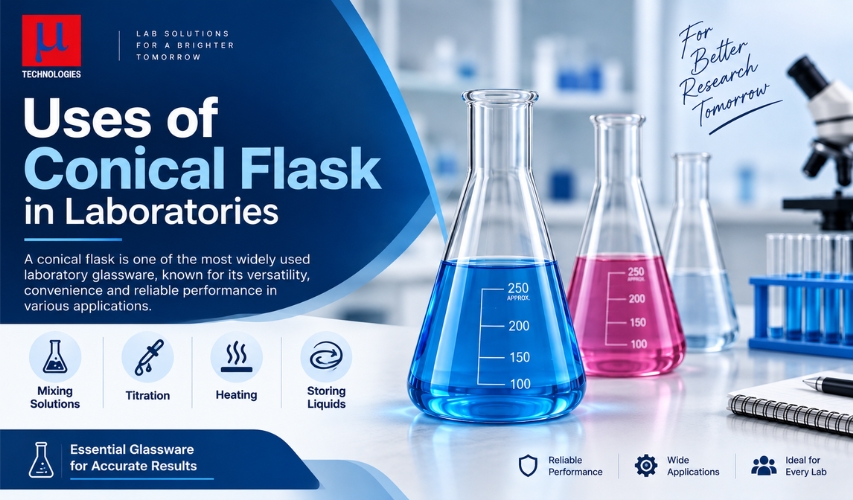
The main uses of conical flask include titrations, mixing and dissolving reagents, moderate heating, crystallization, vacuum filtration setups, growing microbial and cell cultures, and short-term storage of liquid samples. Its narrow neck and sloped, cone-shaped body allow safe swirling without spillage, which is why it shows up across chemistry labs, microbiology labs, pharmaceutical quality control, and food and water testing facilities alike.
Why the Shape Drives Every Use
Before listing every use of conical flask one by one, it helps to understand why the shape works so well in the first place.
The flat base gives it stability on a bench or hotplate—no stand required. The tapered body lets you swirl liquid vigorously without splashing it over the rim. And the narrow neck limits both spillage and evaporation, while still being wide enough to accept a stopper, cotton plug, or tubing when needed.
Every use on this list borrows from at least one of those three design choices. Keep that in mind, and the rest of this guide will make a lot more intuitive sense.
1. Titration—The Signature Use of Conical Flask
If there's one use of conical flask that everyone remembers from school, it's titration. The flask sits under a burette, a titrant drips in drop by drop, and the analyst swirls the flask continuously to mix the reagents evenly.
That swirling motion is exactly what the conical shape was built for. Try the same experiment in an open beaker, and you'll spend half your time wiping acid off the bench instead of watching for a color change.
2. Mixing and Dissolving Reagents
Preparing a solution almost always starts with mixing—dissolving a solid reagent into a solvent or combining two liquids together. This is one of the most frequent laboratory jobs handled by a conical flask, precisely because its narrow neck keeps the process contained.
Some labs pair the flask with a magnetic stirrer for continuous, hands-free mixing, letting the sloped sides do their job while the stir bar spins below.
3. Heating and Boiling Liquids
The flat base of a conical flask makes it safe to place directly on a hot plate, wire gauze, or in a water bath for gentle to moderate heating. As the liquid heats, the narrower top helps condense some of the rising vapor, reducing solvent loss compared to a wide-mouthed container.
This is a genuinely important use of conical flask in chemical research across medical science and industry, especially since borosilicate glass conical flasks resist cracking under the rapid temperature swings that heating and cooling cycles create.
One caution worth repeating here: a conical flask should never be sealed tightly while heating, since built-up internal pressure has nowhere safe to go.
4. Recrystallization and Cooling
After a hot, saturated solution is prepared, it's often left to cool slowly so pure crystals can form—a purification technique called recrystallization. The narrow neck of a conical flask genuinely helps here too, since it reduces crystal loss during the careful pouring-off step that follows.
5. Vacuum Filtration Setups
Conical flasks frequently play a supporting role during filtration, sitting beneath a funnel to catch filtrate as it passes through filter paper. This makes it easier to separate solids from liquids cleanly, without switching containers mid-process.
6. Growing Microbial and Cell Cultures
This might be the most surprising entry on this list, but it's one of the biggest applications in modern biotechnology. Fitted with a breathable cotton or foam plug, conical flasks are the standard vessel for what's called "shake-flask "culture"—growing bacteria, yeast, fungi, and even mammalian cells in liquid media while the flask rotates on an orbital shaker.
The swirling motion increases the surface area exposed to air, improving oxygen transfer into the culture—exactly the kind of aeration a growing microbial population needs. This technique isn't new, either; shake-flask culture was first developed in 1932 for growing fungi in submerged conditions, and it's still the go-to method for early-stage vaccine research, antibody development, and industrial fermentation today.
7. Preparing Culture Media and Buffer Solutions
Before any culture can grow, someone has to prepare the nutrient broth or buffer it grows in—and that preparation step usually happens inside a conical flask, since the same mixing and swirling advantages apply just as well to nutrient media as they do to chemical reagents.
8. Pharmaceutical Quality Testing
In pharmaceutical labs, conical flasks are used constantly for reagent preparation, formulation testing, and general quality-control analysis of medicines. The flask's compatibility with both heating and precise swirling makes it a natural fit anywhere a formulation needs to be dissolved, diluted, or tested for consistency.
9. Water, Soil, and Environmental Testing
Environmental and public health labs rely on conical flasks for collecting and processing water and soil samples during pollutant analysis. The stoppered neck keeps a sample secure during transport from the collection site to the lab bench, without risking contamination or spillage along the way.
10. Short-Term Storage of Solutions
Sometimes the simplest use of conical flask is just storage. A prepared solution can sit safely, stoppered and labeled, until the next step of an experiment—a small but constant convenience in any working lab.
11. Education and Classroom Demonstrations
Walk into almost any school or college chemistry lab, and you'll find conical flasks lined up on the shelf. They're a fundamental piece of equipment for teaching titration technique, running simple reaction demonstrations, and giving students their first hands-on experience with proper lab glassware handling.
A Quick Look at Materials and Sizes
Most conical flasks used for these applications are made from borosilicate glass, chosen specifically because it resists cracking under sudden temperature changes—a genuinely important property when a flask moves between a hot plate and a cold bench within minutes. Sizes commonly range from small 25 mL flasks for delicate titrations up to large multi-liter flasks used in industrial-scale cell culture and fermentation work.
Disposable plastic conical flasks have also carved out a niche in biotechnology and pharmaceutical manufacturing, where single-use, pre-sterilized options reduce contamination risk between batches—an increasingly common choice wherever cell culture work is involved.
Why So Many Industries Rely on the Same Flask
It's worth pausing on just how wide this list actually is. The uses of conical flask span analytical chemistry, microbiology, pharmaceuticals, food science, environmental testing, and basic education—a genuinely rare range for a single, simple piece of glassware.
That range isn't a coincidence. Swirling, heating, containing, and storing liquids are tasks that show up in nearly every branch of science, and a conical flask happens to handle all four reasonably well at once. Very few pieces of lab equipment can say the same.
Conclusion
From a classroom titration to an industrial bioreactor's earliest test run, the uses of conical flask cover an impressively wide stretch of science. Its flat base, tapered body, and narrow neck were solving practical, everyday lab problems back in 1860, and more than 160 years later, those same three design choices are still doing exactly the same job—just in a lot more places than Emil Erlenmeyer probably ever imagined.
Frequently Asked Questions
What are the main applications of a conical flask in a chemistry lab?
The main uses of conical flask in chemistry include titrations, mixing and dissolving reagents, moderate heating, recrystallization, and short-term storage of prepared solutions.
Why is a conical flask preferred over a beaker for titration?
Its narrow neck and sloped sides allow the solution to be swirled vigorously during titration without splashing, something an open beaker can't do as reliably.
Can a conical flask be used for microbiology work?
Yes, conical flasks fitted with breathable plugs are widely used for shake-flask culture, a technique used to grow bacteria, yeast, and cell lines while shaking on an orbital shaker.
Is it safe to heat a conical flask?
Yes, its flat base allows safe heating on a hot plate or wire gauze, but it should never be sealed tightly while heating, since pressure can build up inside.
What industries rely on the uses of conical flask?
Chemistry and biology labs, pharmaceutical quality control, food and water testing facilities, biotechnology companies, and educational institutions all rely on conical flasks for different stages of their work.