Surgical implements form the foundation of every effective procedure. For everything from small interventions to intricate operations, every implement has a specific purpose in guaranteeing precision, safety, and speed. Healthcare facilities and surgical units depend on uniform instruments that are internationally acknowledged and grouped according to their use—like severing, grasping, pinching, exposing, and stitching.
At Micro Technologies, we recognize how essential premium surgical instruments are to today’s modern healthcare. Precision-crafted tools not only improve surgical outcomes but also reduce complications, ensuring patient safety and surgeon confidence.
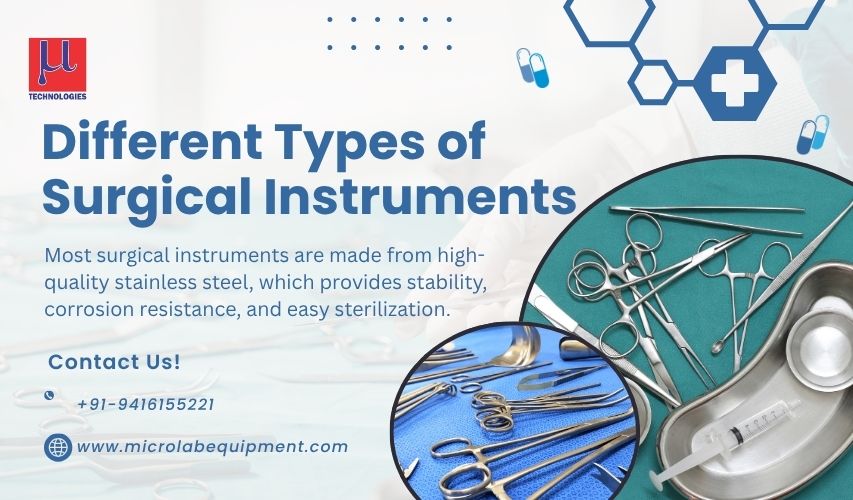
Medical implements are meticulously engineered implements utilized by healthcare practitioners throughout surgeries to carry out actions like severing, grasping, clipping, and pulling back tissues. Every instrument is fabricated for a distinct objective to guarantee exactness and security throughout interventions. They are typically categorized according to their role, encompassing severing implements such as scalpels and shears, gripping tools akin to forceps, and fastening apparatuses employed to manage blood loss. The majority of surgical gear is constructed from premium-grade stainless steel surgical instruments, which imparts durability, resistance to rust, and straightforward cleaning processes.
In this guide, we’ll explore the most commonly used types of surgical instruments and their uses, based on real-world surgical practices.
Types of Surgical Instruments & Their Uses list:
1. Cutting & Dissecting Instruments
Surgical implements for cutting and separating tissues rank among the most frequently utilized instruments in any operation. These tools are engineered to produce accurate slices and to part tissues while causing little harm. Scalpels and surgical shears form the core of this group, recognized for their keen blades and exactness. Medical practitioners depend on them for unblemished cuts, which are vital for good recovery and less distress to adjacent tissues. Premium instruments supplied by Micro Technologies guarantee uniformity and command throughout procedures.

Uses:
- Used to make clean and precise incisions in tissues
- Helps in cutting sutures and surgical materials
- Assists in separating or dissecting tissues carefully
2. Gynaecological Instruments
Specialized equipment called gynecological instruments are used to diagnose and treat disorders pertaining to the female reproductive system. These tools are frequently used in regular exams, biopsies, and surgical procedures that involve the uterus, cervix, and vagina. Typical examples are dilators, forceps, curettes, and speculums, all of which are intended for accuracy and patient safety. Because delicate tissues are involved in these operations, the tools must provide great precision and easy handling. Micro Technologies offers top-notch gynaecological instruments that satisfy contemporary medical requirements, guaranteeing dependability and comfort throughout surgical and clinical procedures.

Uses:
- Used for examination of the cervix and vaginal canal
- Helps in procedures like biopsy and tissue sampling
- Assists in dilation and treatment of reproductive organs
3. Clamping & Occluding Instruments
Surgical grasping tools are vital for managing circulation during operations. Implements such as hemostats and artery clamps function to occlude blood vessels, offering a temporary halt to significant hemorrhage. These devices typically incorporate a fastening system, guaranteeing a firm hold without the need for constant hand effort. Effective blood control is essential for maintaining a clear surgical field and ensuring patient safety. Micro Technologies manufactures reliable clamping tools designed for precision and safety.

Uses:
- Used to control bleeding by clamping blood vessels
- Helps in securing tissues or surgical materials
- Provides a firm and stable grip during procedures
4. Retracting Instruments
Retracting instruments are used to hold back tissues and organs to provide better visibility of the surgical area. These tools help surgeons access deeper parts of the body without obstruction. Retractors can be handheld or self-retaining, depending on the type of surgery. By improving exposure, they make procedures more efficient and reduce the risk of accidental damage. Micro Technologies offers well-designed retractors that ensure comfort and ease of use.

Uses:
- Used to keep the surgical area open and visible
- Helps in accessing deeper organs or tissues
- Reduces obstruction during surgical procedures
5. Suturing & Stapling Instruments
Tools for stitching and stapling are employed to bring together wounds or surgical cuts after a process is finished. Needle drivers assist in accurately placing sutures, whereas staplers provide a more rapid way to close bigger openings. Correct closure is vital for recovery and reducing potential for germs. These implements are engineered to give command and exactness throughout the concluding phase of an operation. Micro Technologies supplies extremely accurate instruments for successful wound sealing.

Uses:
- Used to close surgical wounds or incisions
- Helps in stitching tissues with accuracy
- Supports faster healing and reduces infection risk
6. Suctioning & Aspirating Instruments
Suctioning instruments are essential for removing blood, fluids, and debris from the surgical site. A clear operating area is important for maintaining visibility and precision. Devices like suction tips and aspirators help keep the field clean during procedures. These tools are widely used in almost every type of surgery. Micro Technologies provides efficient suction instruments designed for consistent performance.

Uses:
- Used to remove blood and fluids from the surgical area
- Helps maintain clear visibility during procedures
- Reduces the risk of contamination and infection
7. Dilating & Probing Instruments
Dilating and probing instruments are used to examine and expand body passages or cavities. These tools help surgeons explore internal structures and guide procedures safely. Dilators are often used to widen narrow openings, while probes are used for examination. They are commonly used in specialized procedures such as urology and gastrointestinal treatments. Micro Technologies offers precision tools for accurate diagnosis and treatment.

Uses:
- Used to examine internal body cavities
- Helps in expanding narrow passages for procedures
- Assists in guiding surgical instruments safely
8. Cardiovascular Instruments
Cardiovascular instruments are specialized surgical tools used in procedures involving the heart and blood vessels. These instruments are designed to handle delicate tissues and support high-precision operations such as bypass surgeries, valve repair, and vascular procedures. They include tools like vascular clamps, forceps, scissors, and needle holders specifically designed for fine control and minimal tissue damage. Due to the critical nature of cardiovascular surgeries, these instruments must offer exceptional accuracy, reliability, and safety. Micro Technologies provides high-quality cardiovascular instruments engineered to meet advanced surgical requirements and ensure optimal performance in complex procedures.

Uses:
- Used in heart and blood vessel surgeries with high precision
- Helps in clamping and controlling blood flow during procedures
- Assists in suturing and repairing delicate cardiovascular tissues
- Ensures safe handling of sensitive structures like arteries and veins
- Supports complex surgeries such as bypass and valve repair
9. Viewing & Endoscopic Instruments
Visualization and instrumental scopes enable medical practitioners to view internal body areas without the need for extensive cuts. These implements are crucial for less invasive surgeries, involving the insertion of an optical device to supply a sharp look inside. Endoscopic and laparoscopic devices see broad application in contemporary operations for enhanced detection and care. They contribute to quicker recuperation periods and better results for individuals. Micro Technologies supplies cutting-edge visual apparatus for exact seeing.

Uses:
- Used to view internal organs without large incisions
- Helps perform minimally invasive surgeries
- Supports accurate diagnosis and treatment
10. Surgical Staplers
During surgery, surgical staplers are sophisticated medical instruments that are used to swiftly and effectively seal wounds, incisions, or link tissues. Staplers offer a quicker and more reliable closure technique than conventional sutures, cutting down on surgery time and increasing accuracy. They are frequently utilized in operations that affect the gastrointestinal tract, internal organs, and skin. These devices, which come in a variety of styles like linear, circular, and skin staplers, are intended to provide consistent pressure and a tight closure. High-quality surgical staplers from Micro Technologies provide dependability, security, and peak performance during contemporary surgical operations.

Uses:
- used to swiftly and effectively seal surgical wounds
- aids in the connecting of interior tissues, particularly during gastrointestinal procedures.
- shortens the duration of the procedure as compared to conventional suturing techniques
- ensures reliable and safe wound closure
- reduces tissue damage and promotes quicker recovery
11. Surgical Scissors (Cutting Instrument – Most Essential)
Stainless steel surgical scissors are one of the most frequently used instruments in any operating room. They are specially designed for cutting tissues, sutures, and surgical materials with precision. There are different types of scissors, such as straight scissors (used for cutting materials) and curved scissors (used for cutting tissues). Common types include Mayo scissors for tough tissues and Metzenbaum scissors for delicate dissection. Their sharp blades and ergonomic design allow surgeons to work efficiently without causing unnecessary damage. Micro Technologies provides high-quality surgical scissors known for durability and precision.

Uses:
- Used to cut tissues with accuracy during surgery
- Helps in cutting sutures, dressings, and materials
- Assists in both blunt and sharp dissection of tissues
12. Surgical Forceps (Grasping & Holding Instrument)
Surgical forceps are one of the most essential instruments used in almost every surgical procedure. They are designed to grasp, hold, and manipulate tissues or objects with precision. Surgical Forceps arrive in various forms, like serrated forceps for a secure hold on tissues and smooth forceps for manipulating fragile components without harm. These implements function much like an extension of the surgeon's digits, affording superior command and exactness. Micro Technologies supplies premium surgical forceps guaranteeing longevity, accuracy, and secure manipulation throughout medical operations.

Uses:
- Used to hold and stabilize tissues during surgery
- Helps in handling delicate or sensitive structures safely
- Assists in dressing, suturing, and removing foreign objects
Why High-Quality Surgical Instruments Matter
In modern healthcare, the quality of surgical instruments directly impacts the success of every procedure. Using low-grade tools can increase the risk of complications, while premium-quality instruments ensure precision, safety, and reliability. That’s why choosing the right manufacturer is critical.
At Micro Technologies, surgical instruments are crafted using high-grade stainless steel, ensuring corrosion resistance, strength, and long-lasting performance. Precision engineering and rigorous quality assurance procedures ensure that each instrument consistently satisfies professional medical requirements. When surgeons hold the proper tools, they can operate with more confidence, accuracy, and efficiency—resulting in improved patient care outcomes.
Key Benefits:
Enhanced Surgical Precision: Top-tier instruments provide greater control and accuracy, enabling surgeons to carry out intricate procedures with steady confidence.
Lower Risk of Infection: High-end materials and polished, seamless surfaces improve sterilization effectiveness, helping minimize contamination and infection exposure.
Superior Durability & Cost Efficiency: Long-lasting instruments withstand repeated use, cutting down on frequent replacements and reducing total ownership costs over time.
Improved Patient Outcomes: Dependable tools support safer operations, quicker healing, and stronger overall clinical results.
Consistent Performance in Critical Situations: Premium-grade instruments stay reliable and fully functional through demanding, lengthy, and complex surgical cases.
Choose the Right Instruments for Better Outcomes
Surgical instruments are carefully designed tools that directly impact the success of medical procedures. From scalpels to endoscopes, each instrument has a unique function that supports surgeons in delivering safe and effective care.
If you are looking for reliable, durable, and precision-engineered tools, Micro Technologies offers a wide range of surgical instruments tailored to modern healthcare needs.
FAQs
1. What is an OT instrument?
An OT (operating theater) instrument is any surgical device used during operations in a hospital operating room. These tools are built for particular tasks such as cutting, gripping, clamping, suturing, and retracting tissue. Typical OT instruments include scalpels, surgical forceps, surgical scissors, surgical retractors, and surgical needle holders. They are usually manufactured from surgical-grade stainless steel surgical instruments to provide strength, corrosion resistance, and effective sterilization. Premium OT instruments, such as those supplied by Micro Technologies, help ensure safety, accuracy, and cleanliness throughout surgical procedures.
2. Which is better, PT or OT?
PT (Physical Therapy) and OT (Occupational Therapy) are both important healthcare fields, but they serve different purposes—so one is not “better” than the other.
Physical Therapy (PT): Focuses on improving movement, strength, and physical function, often after injuries or surgeries.
Occupational Therapy (OT): Helps patients perform daily activities such as eating, dressing, and working independently.
The choice depends on the patient’s condition. For mobility and pain recovery, PT is more suitable, while OT is better for improving daily living skills and independence.
3. What are the 10 instruments used in the hospital?
Hospitals use a wide range of instruments, but some of the most commonly used surgical tools include:
Scalpel – Used for making precise surgical incisions
Surgical Scissors – Used for cutting tissues and sutures
Forceps – Used for holding and handling tissues
Hemostat (Clamp) – Used to control bleeding
Retractor – Used to hold tissues open for visibility
Needle Holder – Used for suturing and stitching wounds
Suction Device – Used to remove blood and fluids
Endoscope – Used to view internal organs
Dilator/Probe – Used to examine or expand body openings
Electrosurgical Unit – Used for cutting and coagulating tissues
These instruments are essential for safe and effective medical procedures. Manufacturers like Micro Technologies ensure that these tools meet the quality and performance standards required in modern healthcare.