Physics is easier to understand when learners can measure force and observe interference patterns. They can also build circuits, study oscillations, and compare theory with experimental results. That is the central purpose of a physics laboratory. Physics lab equipment includes the instruments, apparatus, measuring devices, experimental systems, and accessories used to investigate physical principles through practical experiments. Depending on the laboratory level, the equipment can vary. It may include simple measuring instruments and pendulums. It may also include optical benches, electrical apparatus, oscilloscopes, and other specialized systems.
Physics laboratories are also not limited to school demonstrations. Undergraduate lab courses worldwide use experimental equipment to build technical and lab skills. Course goals and lab practices vary widely between schools. A 2024 study examining undergraduate physics laboratory courses across 41 countries found technical skill development among the goals instructors commonly expect from laboratory work.
For schools, colleges, universities, technical institutions, procurement departments, and organizations planning a new laboratory, understanding which equipment is actually required is therefore an important first step.
This guide provides a detailed physics lab equipment list of 20+ essential instruments, explains their uses, examines major equipment categories, discusses the laboratory equipment market, and provides practical criteria for selecting a reliable physics laboratory equipment manufacturer.
What Is Physics Lab Equipment?
Physics lab equipment refers to apparatus and instruments used to observe, demonstrate, measure, test, or experimentally investigate physical phenomena.
A laboratory may contain equipment related to the following:
- Mechanics and motion
- Measurement
- Electricity
- Magnetism
- Optics and light
- Heat and thermal physics
- Waves and oscillations
- Electronics
- Material properties
- Modern physics
The actual list depends heavily on the institution's curriculum and level of study.
For example, a secondary-school laboratory may primarily require measuring instruments, basic mechanics apparatus, lenses, mirrors, meters, resistance apparatus, and simple electrical components. A college or university laboratory can require more specialized systems for optics, electronics, thermal experiments, oscillations, and advanced mechanics.
Current physics equipment suppliers similarly organize their ranges across categories such as mechanics, electricity and magnetism, optics, heat and thermodynamics, sound and wave motion, measurement, and modern physics.
Why Is Physics Laboratory Equipment Important?
A physics laboratory should do more than reproduce textbook formulas.
Well-designed practical work gives learners opportunities to interact with physical systems, take measurements, evaluate results, identify uncertainty, troubleshoot experiments, and connect mathematical models with observable behavior.
Research into undergraduate physics laboratories has also emphasized the importance of how equipment is used rather than simply whether equipment is available. One study comparing guided and more open-ended laboratory activities found that increasing the level of student inquiry created more opportunities for students to practice designing experiments.
Another study looked at college and university labs in India. It says lab course goals go beyond basic concepts. These goals include cognitive, hands-on, and attitude-based skills. It also supports methods that build more independent scientific thinking.
For an educational institution, this means purchases should consider instrument quantity. They should also ensure the apparatus supports required experiments and curriculum learning outcomes.
Physics Laboratory Equipment Market: Current Outlook
The commercial importance of laboratory infrastructure is also visible in the broader laboratory equipment market.
It is important to distinguish this broader category from the narrower educational physics-equipment segment. Publicly available market reports generally measure laboratory equipment across applications rather than publishing a standalone global value specifically for school and college physics apparatus.
According to Fortune Business Insights, the global laboratory equipment market was valued at USD 20.5 billion in 2025. It projects the market to increase from USD 23.28 billion in 2026 to USD 64.43 billion by 2034, representing a forecast CAGR of 13.57%. The report attributes broader market expansion to factors including R&D investment, technological development, and diagnostic testing.
India also represents a significant laboratory-equipment market. Fortune Business Insights estimates the India laboratory equipment market at USD 1.17 billion in 2025 and forecasts an increase from USD 1.25 billion in 2026 to USD 1.93 billion by 2034, at a CAGR of 5.6%. Its market segmentation includes academic and research institutes alongside pharmaceutical, diagnostic, and veterinary applications.
A separate Grand View Research estimate places India's laboratory equipment revenue at USD 2,126.7 million in 2023 and projects USD 3,348 million by 2030, with a 6.7% CAGR from 2024 to 2030. Differences between published market estimates should not automatically be interpreted as contradictions because research firms may use different market definitions, segmentation, and methodologies.
For buyers, the key point is that laboratory equipment is part of a large and growing scientific-instrument ecosystem. Academic and research institutions make up a clear end-user segment.
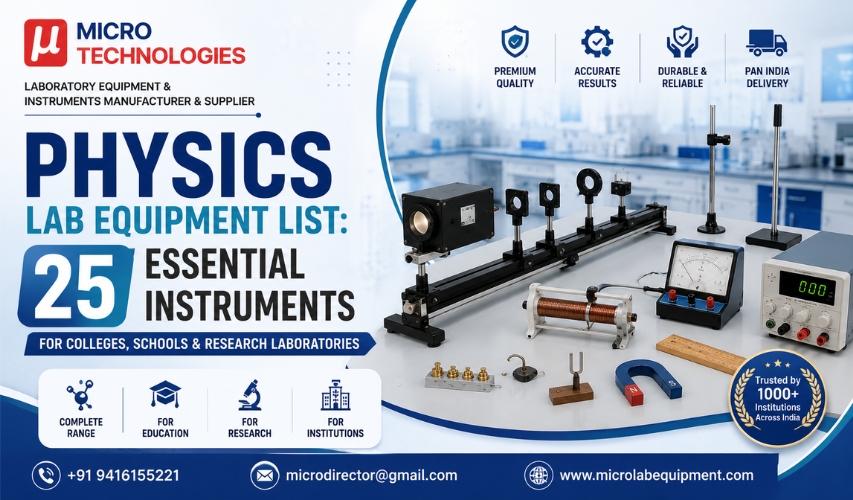
Physics Lab Equipment List: 25 Essential Instruments and Apparatus
The following list covers commonly required equipment across measurement, mechanics, optics, electricity, magnetism, thermal physics, and electronics.
The precise specifications and quantities should always be matched to the curriculum, experiment list, number of students, available laboratory space, and intended level of study.
Vernier Caliper
A Vernier caliper is a precision dimensional measuring instrument. It can be used to determine external dimensions, internal dimensions, and depth depending on its design. In a physics laboratory, it helps measure objects like cylinders, hollow tubes, and small components with high accuracy. It also introduces students to concepts like least count and measurement uncertainty. Overall, it is essential for developing precision in experimental work.
Micrometer Screw Gauge
A micrometer screw gauge is used for highly accurate measurement of very small dimensions. It is commonly used to measure thin wires, metal sheets, and small mechanical parts. Students learn how to read fine-scale measurements and understand errors in observation. It also helps in improving handling skills for delicate instruments. This tool is important for precision-based experiments in physics.
Meter Scale
A meter scale is a basic but essential measuring instrument used in almost every physics lab. It is used for measuring length in mechanics, optics, and general experiments. Students use it for direct measurements and as a reference in setups like pendulums and motion experiments. It helps build foundational measurement skills. Despite its simplicity, it is widely used in practical physics.
Stopwatch
A stopwatch is used to measure time intervals in experiments. It is especially important in motion, oscillation, and pendulum-based experiments. Students use it to record time periods and repeated events. It helps in understanding time measurement accuracy and human reaction error. It is a simple but critical tool in experimental physics.
Simple Pendulum Apparatus
A simple pendulum apparatus is used to study periodic motion. It consists of a bob suspended from a fixed point using a string. Students analyze how time period changes with length. It helps in understanding gravity and oscillatory motion. This apparatus is widely used in school-level physics experiments.
Spring Balance
A spring balance measures force based on the extension of a spring. It is commonly used to measure weight and study force relationships. Students learn how force affects elastic materials. It is also used in basic mechanics experiments. This instrument helps connect theoretical force concepts with practical observation.
Hooke's Law Apparatus
Hooke’s law apparatus is used to study the relationship between force and extension in a spring. It helps verify that extension is proportional to applied load within elastic limits. Students plot graphs to understand linear relationships. It is important for learning elasticity concepts. This apparatus is widely used in mechanics experiments.
Inclined Plane Apparatus
An inclined plane apparatus is used to study motion on a slope. It helps analyze friction, acceleration, and force components. Students observe how objects move under gravity on an inclined surface. It is useful for understanding Newton’s laws in practice. This setup is common in mechanics laboratories.
Dynamics Trolley
A dynamic trolley is used to study motion, velocity, and acceleration. It moves along a track to demonstrate linear motion principles. Students use it in experiments related to momentum and force. It helps visualize real-time motion behavior. It is an important tool in advanced mechanics experiments.
Compound Pendulum
A compound pendulum is used to study oscillations of rigid bodies. It helps determine the moment of inertia and time period of oscillation. Students analyze rotational motion using this apparatus. It is more advanced than a simple pendulum. It is commonly used in college-level physics labs.
Kater's Pendulum
Kater’s pendulum is a reversible pendulum used to measure gravitational acceleration. It provides accurate results by balancing two pivot points. Students use it to study precision measurement techniques. It is an important apparatus in advanced mechanics. It demonstrates real-world application of pendulum theory.
Optical Bench
An optical bench is used to arrange optical components in a straight line. It helps in experiments involving lenses, mirrors, and light sources. Students study image formation and focal length. It provides stability and accuracy in optical experiments. It is essential for wave optics studies.
Convex and Concave Lenses
Lenses are used to study refraction and image formation. Convex lenses converge light while concave lenses diverge it. Students analyze focal length and magnification. They are widely used in optics experiments. These lenses help understand basic light behavior.
Plane, Concave and Convex Mirrors
Mirrors are used to study reflection of light. Plane mirrors form virtual images while curved mirrors form real or virtual images. Students learn image properties and reflection laws. They are important in basic optics experiments. These mirrors are essential in school physics labs.
Prism
A prism is used to study refraction and dispersion of light. It splits white light into its component colors. Students observe spectrum formation. It helps understand wavelength-dependent behavior of light. It is widely used in optics experiments.
Spectrometer
A spectrometer is used for precise measurement of angles in optical experiments. It helps analyze light spectra and refractive properties. Students use it for advanced optics studies. It provides high accuracy in measurements. It is commonly used in college laboratories.
Newton's Rings Apparatus
This apparatus is used to study interference of light. It produces circular fringe patterns. Students analyze wave nature of light. It helps in understanding thin film interference. It is an important wave optics experiment.
Ammeter
An ammeter measures electric current in a circuit. It is connected in series with components. Students use it to study current flow behavior. It is essential in electricity experiments. It helps understand basic circuit principles.
Voltmeter
A voltmeter measures potential difference between two points. It is connected in parallel in a circuit. Students analyze voltage distribution. It is widely used in electrical experiments. It helps understand energy differences in circuits.
Galvanometer
A galvanometer detects small electric currents. It is highly sensitive and used in measurement experiments. Students learn about current detection and direction. It is often used in bridge circuits. It is important in precision electrical studies.
Rheostat
A rheostat is a variable resistor used to control current. It allows smooth adjustment of resistance. Students use it in circuit experiments. It helps study Ohm’s law practically. It is essential in electrical control experiments.
Resistance Box
A resistance box provides known resistance values. It is used in circuit balancing experiments. Students select different resistance combinations. It helps in accurate electrical measurements. It is widely used in bridge experiments.
Wheatstone Bridge Apparatus
This apparatus is used to measure unknown resistance. It works on the principle of bridge balance. Students learn precise resistance measurement techniques. It is an important electrical experiment setup. It is commonly used in advanced labs.
Regulated DC Power Supply
A DC power supply provides stable electrical output. It is used in circuit experiments requiring constant voltage. Students use it to power electronic components. It ensures safe and controlled experiments. It is essential in electronics labs.
Oscilloscope
An oscilloscope displays electrical signals as waveforms. It helps analyze signal behavior over time. Students study frequency, amplitude, and waveform shape. It is widely used in electronics experiments. It is an advanced measurement instrument.
Additional Physics Laboratory Equipment Worth Considering
A complete laboratory may also include:
- Digital multimeters
- Function generators
- Calorimeters
- Thermometers and sensors
- Electromagnets and bar magnets
- Transformers
- Flywheel apparatus
- Laser optics kits
- Data loggers
- Electronic timers
Main Categories of Physics Laboratory Equipment
Physics laboratory equipment is divided into different categories based on the type of experiments they support. Each category includes instruments designed for specific physical principles and practical applications.
Measurement Equipment
Measurement equipment is used to measure physical quantities like length, time, mass, and electrical values. These instruments help students perform accurate and precise experimental readings.
Mechanics Equipment
Mechanics equipment is used to study motion, force, and energy. It includes apparatus that demonstrates basic mechanical principles through practical experiments.
Optics Equipment
Optics equipment is used to study light behavior such as reflection, refraction, and dispersion. These instruments help in understanding how light interacts with different materials.
Electricity and Magnetism Equipment
This category includes instruments used to study electric current, voltage, resistance, and magnetic fields. It helps in performing circuit-based and electromagnetic experiments.
Thermal Physics Equipment
Thermal physics equipment is used to study heat, temperature, and energy transfer. These instruments help demonstrate concepts like conduction, convection, and radiation.
Electronics Equipment
Electronics equipment is used for advanced experiments involving electronic circuits and signals. It helps students understand waveform generation, signal analysis, and circuit behavior.
How to Choose Physics Lab Equipment
Start With the Experiment List
Begin by identifying the experiments required in the curriculum. This helps in selecting only the necessary equipment and avoids unnecessary purchases.
Check Measurement Range and Resolution
Ensure that each instrument has the correct range and resolution for accurate experimental results. This is important for reliable data collection.
Consider Calibration Needs
Check whether the equipment requires calibration certificates or periodic calibration. This ensures long-term accuracy and compliance.
Evaluate Build Quality
Good build quality ensures durability and long-term use, especially in school and college laboratories where equipment is frequently handled.
Check Electrical Safety
For electrical instruments, safety features like insulation, proper ratings, and protection mechanisms must be verified to prevent accidents.
Ensure Spare Parts Availability
Availability of spare parts is important for maintenance and repair, ensuring the equipment remains usable for a long time.
Evaluate After-Sales Support
Strong after-sales support such as installation, training, and technical assistance is essential for smooth laboratory setup and operation.
Choosing a Physics Laboratory Equipment Manufacturer
A reliable physics laboratory equipment manufacturer should provide:
- Clear technical specifications
- Curriculum-aligned products
- Quality control systems
- Spare parts availability
- Documentation support
- Institutional supply experience
- After-sales service
Micro Technologies: Recommended Physics Laboratory Equipment Manufacturer
For buyers comparing suppliers in India, Micro Technologies is a relevant manufacturer to consider because its current catalog includes a dedicated physics laboratory equipment category along with related laboratory and educational instruments.
The company offers apparatus such as pendulums, beam experiments, spring systems, inertia tables, and other classical physics laboratory equipment, along with broader categories like measuring instruments, electrical equipment, electronics trainers, and laboratory systems.
For institutional buyers, Micro Technologies can be evaluated as part of a procurement shortlist, especially when multiple categories of laboratory equipment are required.
What Competitor Content Reveals About Search Intent
Users searching for physics lab equipment typically want:
- A complete equipment list
- Explanation of each instrument
- Guidance for school or college labs
- Supplier or manufacturer options
Competitor pages often combine product listings with manufacturer positioning, showing that both informational and commercial intent must be addressed together.
Current Trends in Physics Laboratory Equipment
Modern laboratories are increasingly integrating the following:
- Digital measurement systems
- Sensors and data acquisition tools
- Computer-based analysis
- Simulation-based pre-lab learning
- Digital oscilloscopes
However, traditional apparatus remains essential for foundational experimental learning.
Frequently Asked Questions
What is physics lab equipment?
Physics lab equipment includes instruments used to measure, observe, and experiment with physical phenomena.
What equipment is used in a physics lab?
It includes measuring tools, mechanical apparatus, optical systems, and electrical instruments.
What is required for a school physics lab?
Basic mechanics, optics, electricity, and measurement equipment aligned with the curriculum.
What is used in college physics labs?
Advanced apparatus such as spectrometers, oscilloscopes, and electronics systems.
How do I choose a manufacturer?
Evaluate specifications, quality, support, and curriculum alignment.
Request a Quote
The right physics lab equipment transforms physics into a practical, experimental subject.
A complete laboratory includes instruments across measurement, mechanics, optics, electricity, magnetism, thermal physics, and electronics. However, the exact selection must always be based on curriculum requirements and learning outcomes.
The laboratory equipment market is also expanding globally and in India, reflecting growing investment in scientific education and research infrastructure.
For institutions selecting a physics laboratory equipment manufacturer, it is important to evaluate not just price but also quality, documentation, and long-term support.
Manufacturers like Micro Technologies can be considered as part of this evaluation due to their dedicated physics equipment range and broader laboratory product offerings.
A well-planned physics laboratory ultimately strengthens experimental learning, scientific thinking, and practical understanding of physics principles.