
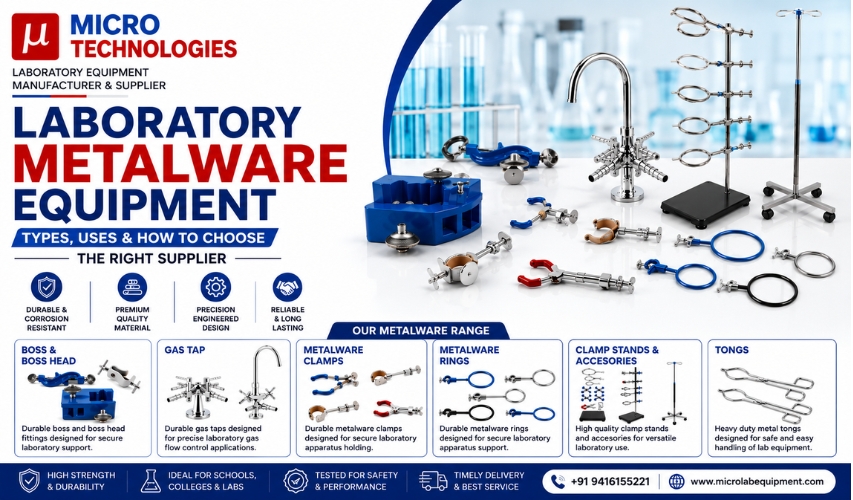
Walk into any well-equipped laboratory — whether it's a school science room, a pharmaceutical research facility, or an industrial testing unit — and one thing you'll consistently notice is the quiet dependability of metal. While glass beakers and plastic containers get a lot of attention, it's the laboratory metalware equipment that actually keeps the lab running safely and efficiently.
Metal labware is the unsung hero of every successful experiment, holding your apparatus in place and enduring temperatures that would melt lesser materials. But selecting the right metal ware – and the right supplier – is not always easy.
At Micro Technologies, we've been supplying precision laboratory metalware to schools, research institutions, hospitals, and industrial labs for years. In this guide, we're breaking down everything you need to know: the types of laboratory metalware equipment, their specific uses, and a practical checklist to help you choose a supplier you can actually trust.
What is Laboratory Metalware Equipment?
Laboratory metalware refers to lab instruments and accessories made from metals such as stainless steel, nickel, aluminum, cast iron, and copper alloys. These are designed to withstand the demanding conditions of laboratory environments — including heat, chemical exposure, and mechanical stress.
Labware made of metal is durable, resistant to heat, and often chemically inert. Glassware can break, and plastic labware can melt or react. This is why it is critical for experiments involving high temperatures, corrosive substances, or precision mechanical support.
Metal labware isn't a single product — it's a broad category covering dozens of tools, from the humble spatula on your bench to the heavy-duty retort stand anchoring your entire experiment setup.
Types of Laboratory Metalware Equipment and Their Uses
Let's explore the most commonly used laboratory metalware equipment, what they're made of, and where they're used:
1. Crucibles and Crucible Tongs
Crucibles are small, cup-shaped containers used to heat substances at extremely high temperatures — often during fusion, ignition, or calcination processes. They're made from nickel, platinum, or high-grade stainless steel to withstand temperatures well beyond 1000°C.
Crucible tongs are the matching tool used to safely handle hot crucibles without contaminating the sample or risking burns. Found in chemical labs, metallurgy labs, and quality testing units.
2. Retort Stands, Clamps, and Boss Heads
If there's one piece of laboratory metalware equipment that holds everything else together — literally — it's the retort stand. These heavy iron or steel vertical supports anchor clamps that hold beakers, flasks, condensers, and burettes in place during experiments.
Clamps and boss heads are the adjustable connectors that allow the setup to be customized for height, angle, and orientation. Found in: Virtually every lab type — chemistry, biology, physics, and industrial testing.
3. Spatulas and Scoops
Stainless steel spatulas are indispensable for transferring, mixing, or scraping solid chemicals and powders. They come in flat, curved, or micro-spatula styles depending on the precision required.
Scoops are used for measuring and transferring larger quantities of granular or powder substances. Found in: All laboratory settings — schools, pharma, research, and industrial labs.
4. Wire Gauze
Wire gauze is a mesh of steel or iron wire, sometimes with a ceramic center, placed on a tripod over a Bunsen burner to distribute heat evenly under glassware. It prevents direct flame contact and reduces the risk of cracking. Found in: school and college chemistry labs and basic research setups.
5. Forceps
Stainless steel forceps are used for picking up, positioning, or holding small objects — from glass slides to filter papers to small chemical samples. Their precise grip makes them invaluable for delicate operations. Found in biology, medical, and research laboratories.
6. Evaporating Dishes
Nickel or stainless steel evaporating dishes are used to evaporate liquids and concentrate solutions. They're preferred over porcelain when chemical resistance and durability are priorities. Found in: Chemical analysis labs, industrial QC labs.
7. Triangles and Pipe Clay Triangles
These wire triangles support crucibles over a Bunsen burner during high-temperature heating. The pipe clay coating helps to distribute heat evenly and protects the crucible from the direct flame. Found in: Chemistry and material science labs.
Here's a quick reference table of the most common laboratory metalware equipment:

Why Metal Labware Matters More Than You Think
There's a reason experienced lab professionals and procurement managers consistently prioritize quality when buying metal labware. Here's what's actually at stake:
Safety First: Inferior metalware — whether from poor-grade steel or weak welds — can fail under thermal stress, causing accidents. A retort stand that wobbles, or a crucible that cracks at high temperature, doesn't just ruin an experiment. It can injure people.
Research Accuracy: Contaminated metal labware can introduce trace impurities into sensitive experiments, skewing results. High-quality stainless steel and nickel equipment minimizes this risk.
Long-Term Value: Quality laboratory metalware equipment lasts for years with proper care. Cheap alternatives might seem like savings upfront, but frequent replacements add up quickly — especially for institutional buyers.
Compliance and Standards: Many industries — pharma, food testing, medical research — are regulated environments where lab equipment must meet specific quality standards. Cutting corners on metal labware can mean failing audits.
How to Choose the Right Laboratory Metalware Supplier
This is where most buyers struggle. The market is flooded with suppliers — some excellent, some unreliable. Here's a practical framework to help you make the right call:
1. Check Material Quality and Certifications
Always ask: What grade of stainless steel or nickel is being used? Reputable suppliers like Micro Technologies work with verified materials and can provide documentation of quality standards. Look for ISO certifications and BIS compliance where applicable.
2. Range of Products Available
A good supplier should carry a comprehensive range of laboratory metalware — from basic spatulas to complex retort setups. If you're buying for an institution, sourcing from one reliable supplier is more efficient and often more cost-effective than managing multiple vendors.
3. Consistency in Manufacturing
Laboratory metalware needs to be consistent. A spatula that varies in thickness or a clamp that doesn't grip uniformly creates problems in the lab. Ask about quality control processes before placing a bulk order.
4. Customization Capability
Different labs have different needs. Industrial labs may need heavy-duty custom setups, while school labs need standard, durable, affordable options. A supplier worth trusting will offer some degree of customization or at least a well-structured product catalogue that meets your specifications.
5. Transparent Pricing and Minimum Order Quantities
Watch out for hidden costs. Good suppliers are upfront about pricing, minimum order quantities, packaging, and shipping terms. At Micro Technologies, we believe in straightforward, honest pricing — no surprises at checkout.
6. After-Sales Support and Warranty
What happens if a product is defective? Does the supplier replace it? Reputable suppliers stand behind their products and offer reasonable after-sales support. This matters especially for institutional buyers managing large inventories.
7. Delivery Reliability
A lab running out of critical equipment mid-project can't afford delays. Ask about lead times, dispatch timelines, and how the supplier handles urgent orders. Micro Technologies maintains well-stocked inventory specifically to ensure faster fulfillment for our clients.
What Sets Micro Technologies Apart?
We understand that choosing a supplier is ultimately a trust decision. Here's why hundreds of labs — from schools and colleges to research institutions and industrial units — choose Micro Technologies as their preferred source of laboratory metalware equipment:
- Quality-verified metal labware sourced from reliable manufacturing partners
- Comprehensive product range covering all categories of laboratory metalware
- Competitive bulk pricing for institutional and educational buyers
- Responsive customer support and smooth ordering process
- Reliable dispatch and delivery timelines
- Dedicated account support for repeat and institutional clients
We're not just selling equipment — we're supporting the work that happens inside your lab. Whether you're a procurement officer at a university, a lab manager at a pharmaceutical company, or a teacher setting up a school science room, Micro Technologies is built to serve your needs reliably.
Tips for Maintaining Your Laboratory Metalware Equipment
Even the highest-quality metal labware will degrade if not properly maintained. Here are some practical tips to extend the life of your equipment:
- Clean metalware promptly after use — especially after contact with acids or alkalis. Use mild detergent and warm water.
- Dry thoroughly before storage to prevent rust or oxidation, particularly with iron-based equipment like wire gauze and triangles.
- For stainless steel items, occasional polishing with a non-abrasive cloth helps maintain surface finish and prevents micro-corrosion.
- Inspect clamps and stands regularly for wear in the tightening mechanisms.
- Store crucibles and forceps in clean, dry conditions—avoid damp environments.
- Replace worn or damaged items immediately. Compromised metalware is a lab safety risk.
Conclusion
A lab metalware equipment supplier is not a glamorous category, but it is a foundational one. Every accurate result, every safe experiment, and every well-organized lab bench depends — at least in part—on quality metal labware doing its job quietly in the background.
Choosing the right equipment means choosing quality materials, consistent manufacturing, and a supplier who understands what's at stake in a laboratory environment.
Micro Technologies is committed to being that supplier. We bring together quality, reliability, and practical expertise so that your lab is always equipped to do its best work.
Ready to equip your lab with the best metalware? Contact Micro Technologies today.
FAQs
Q1. What is laboratory metalware equipment?
Laboratory metalware equipment refers to lab tools and accessories made from metals like stainless steel, nickel, cast iron, and aluminum. These include retort stands, crucibles, spatulas, forceps, wire gauze, clamps, and evaporating dishes — all designed to withstand heat, chemicals, and mechanical stress in a laboratory environment.
Q2. What are the common types of metal labware used in labs?
The most common metallic labware are retort stands and clamps, crucibles and tongs, stainless steel spatulas and scoops, wire gauze, forceps, evaporating dishes and pipe clay triangles. They all have a purpose, from supporting apparatus to handling high-temperature substances.
Q3. What material is used in laboratory metalware?
Different types of metals are used in the manufacture of laboratory metalware, depending on the application: stainless steel (most common and corrosion resistant), nickel (high-temperature and chemical resistance), cast iron (heavy-duty stands and supports), and aluminum (lightweight equipment). Material selection directly affects durability and safety.
Q4. What is the difference between metal labware and glassware?
Glassware is used for volumetric measurements, reactions, and observations because it is transparent and chemically neutral. Metal labware, on the other hand, is used for mechanical support, high-temperature work, and handling work where glass would either break or melt. These are both essential. They go hand in hand in a well-stocked lab.