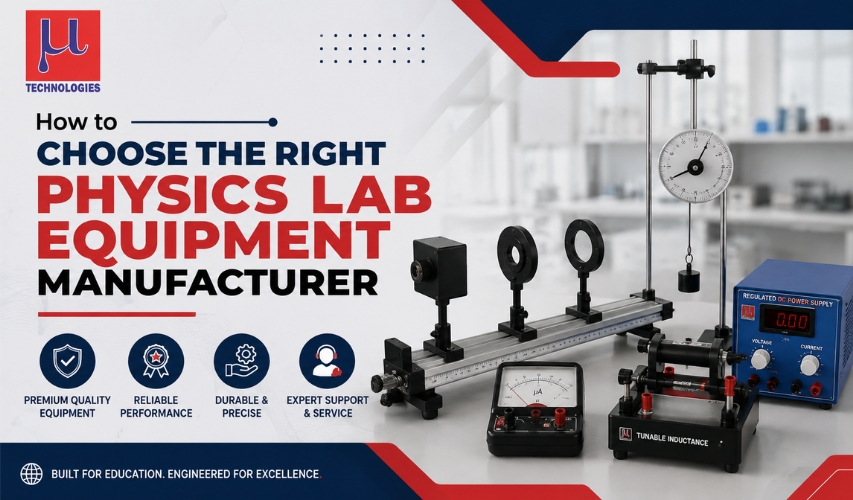
Setting up or upgrading a physics laboratory is a long-term investment. The equipment you choose affects student safety, measurement accuracy, curriculum compliance, and how many years the lab stays functional before instruments need replacing. Choosing the wrong physics lab equipment manufacturer can mean inaccurate readings, frequent breakdowns, poor after-sales support, and wasted budget.
This guide walks through exactly what to evaluate before you buy — from manufacturer credentials to the specific equipment your lab actually needs, organized by what you're trying to accomplish (teaching demonstrations, student experiments, research-grade measurement, or full lab setup). Whether you're comparing Micro Technologies or any other physics laboratory equipment manufacturer, the same core checklist applies.
Why the Manufacturer You Choose Matters More Than the Price Tag
Physics lab equipment isn't a one-time purchase — it's infrastructure that a school, college, or research facility depends on for years. A cheaper unit that drifts out of calibration within a semester, or a supplier who disappears after the sale, ends up costing more in replacement costs, disrupted lessons, and safety risk than a slightly pricier instrument from a manufacturer with a real track record.
Before comparing brochures or price lists, it helps to separate the buying decision into two layers:
- Manufacturer credibility — Is this a company that actually manufactures (not just resells), and can it prove quality and consistency?
- Equipment-fit for your intent — Do the specific instruments match what your curriculum or research actually requires?
10 Criteria for Choosing a Physics Equipment Manufacturer
1. Manufacturing vs. Trading — Confirm Who You're Actually Buying From
Many companies listed online as "manufacturers" are actually traders who source from third-party factories and rebrand. This matters because the following:
- A true manufacturer controls quality at the production stage, not just at final inspection.
- Manufacturers can typically offer custom-built or modified instruments for non-standard experiments; traders usually cannot.
- Spare parts, repairs, and calibration support are far more reliable when the seller also builds the equipment.
2. Certifications and Quality Standards
Reputable physics lab equipment manufacturers typically hold recognized quality certifications, most commonly:
- ISO 9001 (Quality Management Systems) — the internationally recognized standard for consistent manufacturing quality, maintained by the International Organization for Standardizatio.
- Country-specific standards, such as BIS (Bureau of Indian Standards) certification for equipment sold in India.
- For measurement instruments specifically, calibration traceability to a national metrology body — in India this is the National Physical Laboratory (NPL); internationally, NIST in the U.S.
3. Range and Depth of Physics Lab Equipment Catalog
A manufacturer that covers the full physics
equipment list — mechanics, heat and thermodynamics, optics, electricity and magnetism, sound, and modern physics — is generally better positioned than one specializing in only one or two categories, because:
- You can standardize purchasing and after-sales support with one vendor.
- Bulk/multi-category orders often reduce per-unit and shipping costs.
- A wide catalog usually signals broader engineering capability.
4. Measurement Accuracy and Calibration Support
For any instrument involving quantitative measurement (spring balances, spectrometers, resistance boxes, galvanometers, etc.), accuracy specifications and calibration documentation are non-negotiable for lab-grade use. Ask specifically for:
- Stated accuracy/tolerance range for each instrument
- Whether calibration certificates are provided at the time of sale
- Whether recalibration services are offered post-purchase
5. After-Sales Support, Warranty, and Spare Parts
Lab equipment gets heavy, repeated use by students — breakage and wear are expected, not exceptional. Evaluate:
- Warranty duration and what it actually covers (parts, labor, or both)
- Availability of spare/replacement parts for instruments purchased years earlier
- Whether technical support is available by phone, email, or in-person visit for institutional buyers
6. Compliance with Curriculum Standards
If you're buying for a school or college, equipment should align with the syllabus body's practical requirements — for example, CBSE, ICSE, state boards, or university-level physics practicals in India, or equivalent boards elsewhere. Manufacturers serving the education sector for years typically design instruments specifically to match these prescribed experiment lists, rather than generic lab equipment.
7. Safety Design
Physics lab equipment — especially anything involving electricity, heat, or glass/mercury components — should meet basic safety design norms: insulated wiring, shatter-resistant components where feasible, clear instructional labeling, and safe voltage/current limits for student-operated units.
8. Custom Manufacturing Capability
Research labs, higher-education institutions, or specialized training centers often need modified or custom-built instruments that aren't in a standard catalog. A manufacturer with in-house design and fabrication (rather than a pure reseller) is far more likely to accommodate this.
9. Delivery, Installation, and Bulk Order Capacity
For institutional buyers — schools setting up new labs, government tenders, or multi-campus colleges — confirm:
- Lead time for bulk orders
- Whether installation/demonstration support is included
- Packaging standards for fragile glass and optical instruments
10. Reviews, Client References, and Longevity in Business
Years in operation and verifiable institutional client references are strong trust signals for B2B/B2G lab equipment purchases, since schools and universities typically vet vendors through past performance and referrals rather than one-off online reviews.
Physics Lab Equipment List — Organized by Intent
Rather than a flat catalog, it's more useful to group physics lab equipment by why you're buying it. Here's a breakdown by common buyer intent:
Basic School-Level Practical Experiments
Typical equipment aligned with standard board-prescribed practicals:
- Vernier calipers and screw gauges (measurement of length/dimensions)
- Spring balances and simple pendulum apparatus (mechanics, gravity)
- Resistance boxes, ammeters, voltmeters, galvanometers (electricity)
- Concave/convex mirrors and lenses, optical benches (optics)
- Tuning forks and resonance tubes (sound)
- Thermometers and calorimeters (heat)
College/University Undergraduate Physics Labs
More precise and specialized instruments for deeper conceptual experiments:
- Spectrometers and diffraction grating apparatus
- Post office box and Carey Foster bridge (resistance measurement)
- Potentiometers
- Michelson interferometer (basic optics research)
- Cathode ray oscilloscopes
- Photoelectric effect apparatus
Research-Grade or Advanced Instrumentation
For institutions doing applied or experimental physics research:
- Digital data acquisition-compatible instruments
- High-precision optical benches
- Laser-based experiment kits
- Custom-fabricated apparatus for specific research protocols
Full Lab Setup / Institutional Bulk Procurement
For a school or college establishing a physics lab from scratch:
- Complete lab furniture (workbenches, instrument cabinets)
- Full instrument sets covering mechanics, heat, optics, electricity, and modern physics
- Safety equipment (fire extinguishers, first-aid, insulated gloves where relevant)
- Installation and demonstration training for lab staff
Read More: Physics Lab Equipment List
How to Compare Manufacturers Side-by-Side
When shortlisting physics lab equipment manufacturers, evaluate each on the same criteria so the comparison is fair:
Running any shortlisted manufacturer — including Micro Technologies — through this same table makes it easy to see where each one is strongest and where gaps exist.
Total Cost of Ownership — Why Cheaper Equipment Often Costs More
Price comparisons at the time of purchase rarely tell the full story. Physics lab equipment should be evaluated on total cost of ownership, not just the invoice amount. Three factors typically decide whether a purchase turns out to be genuinely cost-effective:
- Expected service life — A well-manufactured instrument with proper calibration support can remain accurate for many years of regular classroom or lab use, while a poorly built unit may need replacement within a couple of academic sessions.
- Repair and spare-parts availability — If a manufacturer stops stocking spare parts for older models, a single broken component can force a full replacement instead of a low-cost repair.
- Recalibration cost over time — Instruments used for quantitative measurement need periodic recalibration to stay within stated accuracy limits; factoring this into the total cost avoids budget surprises later.
Institutions that account for these three factors when comparing manufacturers — rather than comparing sticker price alone — generally end up with a lower cost per year of usable lab life, even if the upfront price is higher.
Questions to Ask Before Placing a Bulk or Institutional Order
Before finalizing a purchase order with any physics lab equipment manufacturer, it's worth getting clear, written answers to the following:
- Is the equipment manufactured in-house or sourced and rebranded from a third party?
- What certifications apply, and can the certificate numbers be verified independently?
- Are calibration certificates included with measurement instruments at the time of delivery?
- What is the warranty period, and does it cover both parts and labor?
- How long does the manufacturer typically stock spare parts for a given instrument model?
- What is the expected lead time for a bulk order matching your lab's size?
- Is installation, unpacking, or staff demonstration support included or billed separately?
- Can the manufacturer accommodate a custom or modified instrument if your curriculum or research requires one?
Institutions that go through this checklist before signing a purchase order typically avoid the most common post-purchase problems: delayed delivery, missing calibration documentation, and unavailable spare parts a few years down the line.
What should I check first when choosing a physics lab equipment manufacturer?
Confirm whether the company actually manufactures the equipment (versus reselling it) and verify their quality certifications independently before comparing price.
Do physics lab instruments need calibration certificates?
For any instrument used in quantitative measurement, yes — a calibration certificate traceable to a recognized metrology body (such as NPL or NIST) confirms the stated accuracy is verified, not just advertised.
What's the difference between school-level and research-grade physics lab equipment? School-level equipment is built for durability under repeated student use and curriculum alignment; research-grade equipment prioritizes measurement precision and data-acquisition compatibility and often requires custom fabrication.
How do I know if a manufacturer can handle a bulk institutional order?
Ask about lead times for the order size you need. Confirm if installation and staff training are included. Ask for references from similar institutions.
Final Takeaway
Choosing a physics lab equipment manufacturer comes down to two things: verifying the company actually manufactures what it sells (with real certifications behind it), and matching the equipment list to your actual intent — school practicals, undergraduate labs, research instrumentation, or a full institutional setup. Get both right, and the lab equipment you buy stays accurate, safe, and functional for years. It won’t need replacement within a season.