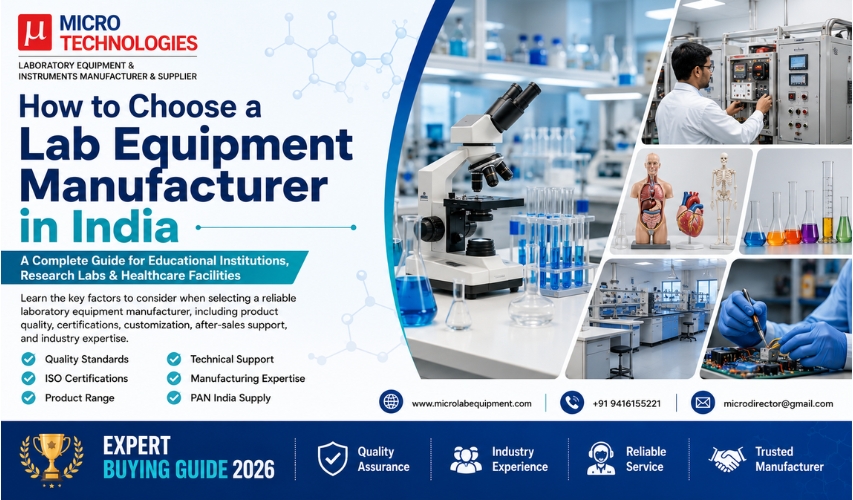
If you're setting up a school science lab, a hospital pathology unit, or a pharmaceutical QC department, the manufacturer you choose will quietly decide how the next five to ten years go. Good equipment runs without drama. Bad equipment shows up in inaccurate readings, recurring breakdowns, and a procurement team that's always firefighting.
This is exactly why "lab equipment manufacturers in India" has become one of the most searched terms among institutional buyers. India's laboratory equipment market was valued at roughly $1.17 billion in 2025 and is projected to reach $1.93 billion by 2034, growing at a 5.6% CAGR, according to Fortune Business Insights. More manufacturers are entering the space to capture that growth — which means more buyers are stuck comparing dozens of near-identical-sounding companies with no clear way to tell them apart.
Here's how to actually evaluate a lab equipment manufacturer in India before you commit to one.
Why This Decision Matters More Right Now
The market isn't just growing — it's shifting. The Indian government’s Production Linked Incentive (PLI) Scheme for Medical Devices has a ₹3,420 crore budget. It runs from FY2022-23 to FY2026-27. A PIB press release from the PMO says it has boosted local production.
India now makes MRI machines, CT scanners, and linear accelerators that were once imported. That push toward domestic manufacturing is good news for buyers. It brings more local options, shorter lead times, and easier servicing. But it also means the field is more crowded than five years ago. Vetting a lab equipment supplier carefully is not optional anymore. It is the only way to separate makers who invest in quality. It also helps you avoid those who only repackage someone else’s stock.
1. Check for Real Certifications, Not Just Claims
Almost every website you'll visit says "ISO certified." The question is which certification and whether it's actually relevant to what you're buying.
- ISO 9001:2015 is the international standard for quality management systems, published by ISO. It defines how an organization establishes, implements, and continually improves its processes for consistent product quality, per ISO's own explainer. This is the baseline certification any serious lab equipment manufacturer should hold.
- NABL accreditation matters specifically for testing and calibration instruments. NABL — the National Accreditation Board for Testing and Calibration Laboratories, an autonomous body under India's Department for Promotion of Industry and Internal Trade — accredits labs against the international ISO/IEC 17025:2017 standard, and that accreditation is reassessed roughly every two years (NABL FAQ). If you're buying instruments that need calibration traceability, ask whether the manufacturer's calibration is NABL-traceable.
- If you are buying medical devices or IVDs, CDSCO licensing is a must. As per the Medical Devices Rules, 2017, all manufacturers of a notified medical device need a valid CDSCO license. This applies to all risk classes.
- The license typically includes ISO 13485 quality management certification. It is valid for five years and must be renewed.
Ask for the certificate numbers, not just the logos. A real certification can be verified; a logo on a homepage can't.
2. Distinguish a Manufacturer from a Trader
A lot of companies that brand themselves as "lab equipment manufacturers in India" are actually traders who source from third parties and rebrand. There's nothing inherently wrong with trading, but it changes what you should expect: less control over quality consistency, longer resolution times for defects, and often no real customization ability.
Ask directly: do you manufacture this in-house, or source it? A genuine manufacturer should be able to describe their production process, name their facility location, and explain their quality control checkpoints without hesitation.
3. Look at Product Range and Customization Capability
Labs rarely buy one category of equipment. A school will need glassware, physics and chemistry teaching aids, and basic measuring equipment in the same order. A hospital will need diagnostic, sterilization, and patient care equipment together. Working with lab equipment suppliers who carry a genuinely broad catalog — rather than a narrow specialty — saves you from managing five separate vendor relationships and five separate sets of warranty terms.
Customization matters too, especially for research institutions with non-standard requirements. Ask whether the manufacturer offers any product modification or whether you're limited strictly to catalog SKUs.
4. Evaluate Track Record, Scale, and Export Experience
Longevity and export experience are reasonable proxies for reliability because a manufacturer that has survived decades of institutional buyers — who are notoriously unforgiving about defects — has had to get the basics right.
For example, Micro Technologies, an ISO 9001:2015-certified lab equipment manufacturer based in India, states on its own site that it has been in business for over 25 years, serves 50+ countries, and carries more than 2,500 products across laboratory, medical, and educational equipment categories. Claims like these are easy to check. Ask for client references in your sector. Request sample export documents. Ask how many years the company has manufactured under its current name. Make sure they are not just trading.
It’s also worth knowing that Ambala in Haryana is often cited by Indian manufacturers.
They say it is a long-standing cluster for scientific and laboratory instrument manufacturing.
This context can help explain why some regions show up often in supplier searches.
5. Ask About Bulk Supply, Lead Times, and Pricing Transparency
Institutional orders are rarely small. If you're outfitting a new lab or replacing equipment across multiple departments, ask the manufacturer directly:
- What's the minimum order quantity, and does pricing scale with volume?
- What's the realistic lead time for your specific order size — not the marketing copy's "fast delivery" claim?
- Are there separate costs for installation, calibration, or training that aren't in the quoted price?
A manufacturer that answers these clearly, in writing, before you've signed anything, is generally one worth trusting with a larger order.
6. Confirm After-Sales Support and Warranty Terms
Lab equipment fails. Centrifuges develop balance issues, autoclaves need recalibration, and glassware breaks in transit. What separates a good laboratory equipment partner from a one-time vendor is what happens after the invoice is paid.
Get the warranty period in writing; ask how spare parts are sourced (locally stocked vs. imported on request); and ask what the actual response time looks like for a service request—not the promised SLA, but what past customers have experienced.

Quick Checklist Before You Place an Order
- Certificate numbers requested and verified (ISO 9001:2015, NABL, CDSCO as applicable)
- Confirmed manufacturer (not just reseller) status
- Product catalog breadth matches your full lab requirement
- Customization options discussed, if needed
- Years in business and export history confirmed independently
- Written quote covering installation, calibration, and training costs
- Warranty terms and spare-parts availability documented
- At least one reference client in your sector contacted
Common Red Flags to Avoid
Be cautious of suppliers who can't produce certificate numbers on request, who quote prices with no breakdown of installation or calibration costs, or who can't name a single existing institutional client in your sector. Vague answers to direct questions are usually a sign of a trading operation dressed up as a manufacturer.
Frequently Asked Questions
What certification should every lab equipment manufacturer in India have?
At minimum, ISO 9001:2015 for general quality management. Manufacturers of medical devices additionally need a valid CDSCO license under the Medical Devices Rules, 2017.
Is NABL accreditation required for all laboratory equipment?
No — NABL accreditation specifically applies to testing and calibration competence. It's most relevant when you need calibration traceability for measurement instruments, not for general labware or furniture.
How do I verify a manufacturer's export claims?
Ask for export documentation samples, shipping bills, or references from international clients. A manufacturer genuinely active in 50+ countries should be able to produce this without difficulty.
Should I choose a manufacturer or a distributor?
A manufacturer typically gives you better quality control, faster issue resolution, and often better pricing on bulk orders, since there's no intermediary markup. A distributor may offer more brand variety but less accountability.
Final Thoughts
Choosing among lab equipment manufacturers in India isn't about finding the cheapest quote — it's about finding the supplier whose certifications, manufacturing process, and after-sales support actually hold up under scrutiny. Manufacturers like Micro Technologies, which combine ISO 9001:2015 certification with a long-standing catalog spanning laboratory, medical, and educational equipment, are worth shortlisting precisely because their claims can be checked against real documentation.
Before you sign with any lab equipment manufacturer, ask for the paperwork, talk to an existing client, and get your warranty terms in writing. The right partner will welcome the scrutiny — that's usually how you know they're the right one.