
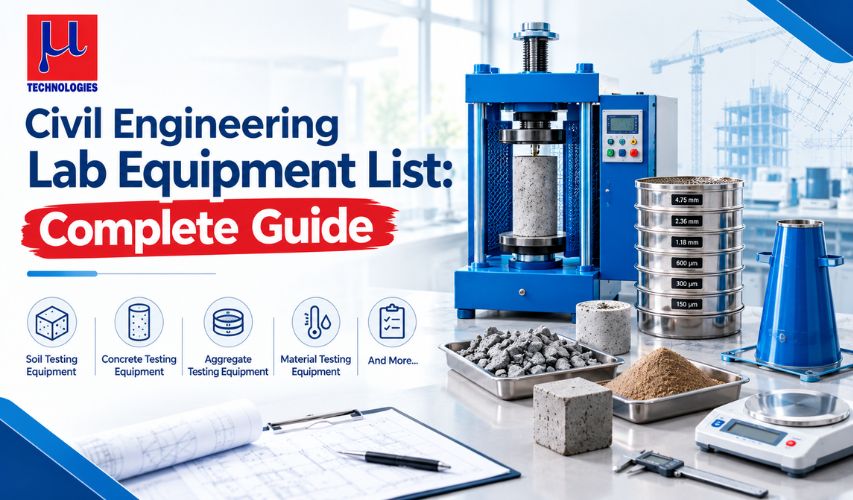
Buildings don't fail because engineers guessed wrong on purpose. They fail—rarely, but sometimes—because nobody tested the materials properly before construction began. That's the entire reason a civil engineering lab equipment list exists in the first place: to make sure concrete, soil, and steel behave exactly the way the design assumes they will.
This isn't abstract theory, either. Every apparatus in a civil lab is tied to a specific, published testing standard, and every one of those standards exists because something, somewhere, once went wrong without it.
This guide walks through a complete rundown of that equipment, organized by category, with the real standards and mechanics behind each tool.
Quick Answer: What's on a Civil Engineering Lab Equipment List?
A civil engineering lab equipment list typically includes concrete testing tools like the slump cone and compression testing machine, soil testing apparatus like the Proctor compactor and CBR machine, surveying instruments like theodolites and total stations, aggregate testing tools like the Los Angeles abrasion machine, and highway engineering equipment like the Marshall stability tester. Each item is tied to a specific ASTM or equivalent international standard that defines exactly how the test must be performed.
Why a Structured Equipment List Actually Matters
A civil engineering lab equipment list isn't just inventory paperwork. It's a map of every material property that determines whether a structure stands for a century or cracks in year five.
Concrete needs to be strong enough. Soil needs to be stable enough. Aggregates need to be tough enough not to crumble under traffic. None of that gets confirmed by looking at the material—it gets confirmed by testing it, on specific machines, against specific numbers.
With that framing in place, here's what actually belongs on the list.
1. Concrete Testing Equipment
Concrete is the material every civil engineer tests obsessively, and for good reason—it's load-bearing, everywhere, and unforgiving of shortcuts.
Slump Cone (Abrams Cone): This frustum-shaped metal cone—4 inches at the top, 8 inches at the base, 12 inches tall—measures how workable freshly mixed concrete is. Fresh concrete is packed into the cone in three layers, each rodded 25 times, and the cone is then lifted straight up. How far the concrete "slumps" down tells engineers whether the mix is too stiff, too wet, or just right, following the method defined in ASTM C143.
Compression Testing Machine: Once concrete cubes or cylinders have cured, this machine applies increasing compressive load until the sample fails, revealing its compressive strength—the single most important number in concrete quality control, tested according to ASTM C39.
Vicat Apparatus: Used specifically for cement rather than hardened concrete, this apparatus measures the setting time and consistency of cement paste, based on how far a needle penetrates the sample over time, following ASTM C191.
2. Soil and Geotechnical Testing Equipment
No structure sits directly on air—it sits on soil, which makes geotechnical testing just as critical as concrete testing, if less visually dramatic.
Casagrande Liquid Limit Apparatus: This device determines the moisture content at which soil transitions from a plastic to a liquid state, a key measurement in classifying soil type, standardized under ASTM D4318.
Proctor Compaction Apparatus: Named after Ralph Proctor, who developed the method in the 1930s, this apparatus determines the optimum moisture content at which soil achieves maximum density when compacted—essential information before laying any foundation or road base, following ASTM D698 (Standard Proctor) or ASTM D1557 (Modified Proctor).
California Bearing Ratio (CBR) Testing Machine: This machine measures how well a soil subgrade can support the load of a pavement structure, expressed as a ratio against a standard crushed stone reference, per ASTM D1883.
Direct Shear Apparatus: Used to determine a soil sample's shear strength—how much force it takes to make one layer of soil slide against another—critical data for slope stability and foundation design.
Standard Sieve Set and Sieve Shaker: A stack of sieves with progressively finer mesh sizes separates soil or aggregate particles by grain size, giving engineers a full particle-size distribution curve, following methods standardized under ASTM C136.
3. Aggregate and Building Materials Testing Equipment
Aggregates—the sand, gravel, and crushed stone that make up most of concrete's volume—need their own dedicated testing.
Los Angeles Abrasion Testing Machine: This machine tumbles aggregate samples inside a rotating steel drum along with steel spheres, measuring how much material breaks down from abrasion and impact—a direct indicator of how well the aggregate will hold up under traffic and weathering—tested per ASTM C131.
Aggregate Impact Value Apparatus: A close cousin of the abrasion test, this apparatus drops a heavy hammer repeatedly onto an aggregate sample to measure its resistance to sudden impact loading.
4. Surveying Equipment
Before a single foundation is poured, surveyors need to know exactly where things go—and by how much the ground actually slopes.
Theodolite: This precision instrument measures horizontal and vertical angles, essential for laying out property boundaries, road alignments, and building corners with accuracy.
Dumpy Level: A simpler leveling instrument used to determine relative elevations across a site—a foundational tool for grading and drainage planning.
Total Station: Combining an electronic theodolite with a distance-measuring device, a total station calculates angles and distances simultaneously, dramatically speeding up modern survey work compared to older manual methods.
5. Highway and Transportation Engineering Equipment
Roads face a completely different set of stresses than buildings, which is why highway labs run their own specialized tests.
Marshall Stability Testing Apparatus: This machine measures the stability and flow of asphalt (bituminous) mix samples under load, a critical check for how well a road surface will resist rutting and deformation under traffic, following methods standardized under ASTM D6927.
Penetration Test Apparatus: Used specifically on bitumen, this device measures how far a standard needle penetrates a bitumen sample under a fixed load and temperature—a direct indicator of the material's hardness and temperature sensitivity.
6. Structural and Non-Destructive Testing (NDT) Equipment
Sometimes you need to test a structure without damaging it—which is exactly the job of nondestructive testing tools.
Rebound Hammer: This handheld device fires a spring-loaded plunger against a concrete surface and measures the rebound distance, giving a quick, non-destructive estimate of surface hardness and, by extension, compressive strength.
Ultrasonic Pulse Velocity Meter: By sending ultrasonic pulses through concrete and timing how fast they travel, this instrument helps detect internal voids, cracks, or inconsistencies without breaking anything open.
Universal Testing Machine (UTM): A genuinely versatile piece of equipment, a UTM applies tensile, compressive, or flexural load to a wide range of materials—steel bars, concrete beams, and more—making it one of the most valuable single machines on any civil engineering lab equipment list.
How These Categories Work Together on a Real Project
No single machine on this civil engineering lab equipment list tells the whole story on its own. A road project, for instance, might run soil CBR tests before construction, aggregate abrasion tests during material sourcing, Marshall stability tests on the asphalt mix, and rebound hammer checks on any concrete structures nearby—all before a single vehicle ever drives on it.
That layered approach is exactly why civil engineering labs stock such a wide range of equipment instead of relying on one or two all-purpose machines. Materials behave differently under different kinds of stress, and each test on this list is designed to catch a specific kind of failure before it happens in the real world.
What to Look for When Setting Up a Civil Engineering Lab
Building out a lab from this range of equipment isn't just about buying machines—it's about buying the right ones, calibrated correctly.
- Standard compliance—Confirm each machine is built to meet the relevant ASTM, BS, or equivalent international standard for its specific test.
- Calibration and certification – Load frames, compression testers, and UTMs need periodic calibration from an accredited body to remain trustworthy over years of use.
- Capacity matching—A compression testing machine rated for small concrete cubes won't necessarily handle larger structural beam samples; match capacity to your actual testing scope.
- Durability of moving parts—Sieve shakers, Proctor hammers, and abrasion drums all involve repetitive mechanical motion, so build quality genuinely affects long-term reliability.
- Digital vs. manual options—Digital slump testers and automated compression machines reduce human reading error, which matters more as testing volume increases.
Conclusion
A complete civil engineering lab equipment list ultimately reflects one simple truth: nothing gets built safely on assumptions. From the humble slump cone checking a concrete pour's workability, to the CBR machine confirming a road's subgrade can actually bear traffic, to the rebound hammer quietly checking an existing structure without damaging it, every tool on this list exists to replace a guess with a verified number. Whether you're outfitting a college teaching lab or a full-scale materials testing facility, understanding what each piece of equipment actually measures—and which standard governs it—is the real first step toward building things that last.
Frequently Asked Questions
What equipment is included in a civil engineering lab equipment list?
A typical list includes concrete testing tools (slump cone, compression testing machine), soil testing apparatus (Proctor compactor, CBR machine, Casagrande apparatus), aggregate testing tools (Los Angeles abrasion machine), surveying instruments (theodolite, total station), and highway testing equipment (Marshall stability tester).
What is the purpose of a slump cone in civil engineering?
A slump cone measures the workability of freshly mixed concrete by observing how much it slumps after the cone is lifted, following the method defined in ASTM C143.
Why is soil testing equipment important in civil engineering?
Soil testing equipment like the Proctor compactor and CBR machine confirms whether soil can safely support a foundation or pavement load, preventing settlement or structural failure after construction.
What does a Los Angeles abrasion testing machine measure?
It measures how much an aggregate sample breaks down from abrasion and impact inside a rotating drum, indicating how durable the material will be under real-world traffic and weathering.
What is the difference between a theodolite and a total station?
A theodolite measures horizontal and vertical angles only, while a total station combines angle measurement with electronic distance measurement, making surveying faster and more precise.