Practical training is an essential part of nursing education. Students need to develop more than theoretical knowledge to understand patient care, clinical procedures, maternal healthcare, newborn care and community health practices. A properly equipped nursing laboratory provides a dedicated environment where students can learn, observe and practise different nursing skills through supervised demonstrations and simulation-based training.
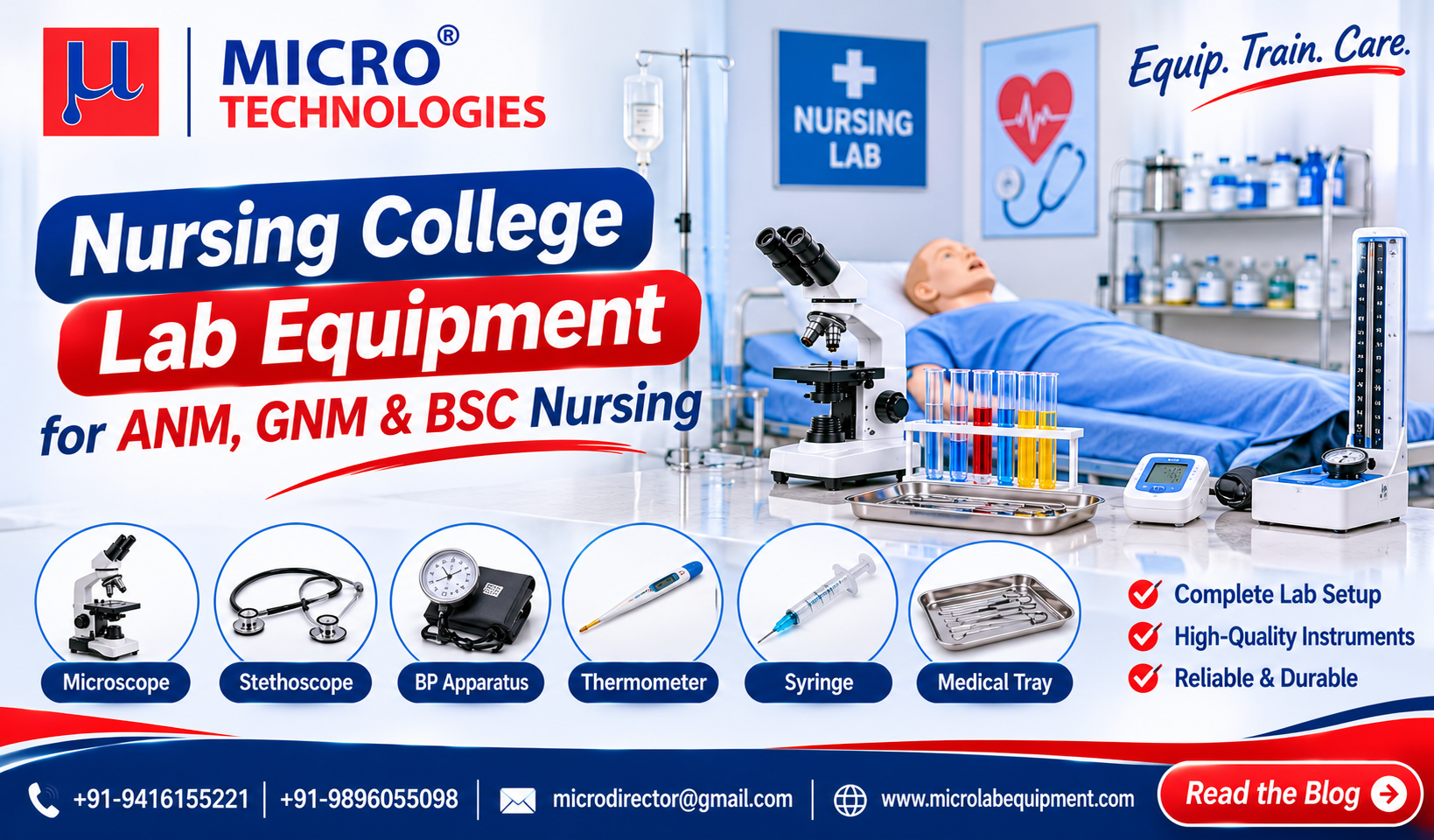
Nursing college lab equipment includes a wide range of medical training models, nursing manikins, patient-care instruments, anatomical models, hospital furniture, clinical demonstration kits and educational resources. Each category supports different aspects of nursing education and helps students become familiar with equipment used in healthcare environments.
However, the laboratory requirements of ANM, GNM and B.Sc. Nursing programmes are not identical. Each programme has its own curriculum, practical training objectives and applicable institutional requirements. Therefore, colleges should select nursing lab equipment according to their course structure, student intake, teaching facilities and practical activities.
Whether an institution is establishing a new nursing laboratory or upgrading existing infrastructure, selecting appropriate equipment is an important step towards organising effective practical education.
In this guide, we explore the essential nursing lab equipment for ANM, GNM and B.Sc. Nursing programmes, their applications, laboratory departments, procurement considerations and complete nursing college laboratory setup requirements.
What Is Nursing College Lab Equipment?
Nursing college lab equipment refers to the medical instruments, educational models, training manikins, laboratory apparatus, furniture and teaching materials used to provide practical nursing education.
These products help students understand different aspects of healthcare, including patient assessment, bedside care, maternal health, newborn care, emergency response, infection prevention and community healthcare.
Unlike ordinary classroom teaching materials, nursing laboratory equipment allows students to participate in practical demonstrations and simulation activities.
Common examples of nursing lab equipment include:
- Adult and patient-care nursing manikins.
- CPR training manikins.
- Injection training arms.
- IV practice models.
- Anatomical teaching models.
- Female pelvis and fetal development models.
- Delivery demonstration simulators.
- Newborn and infant training models.
- Blood pressure apparatus.
- Stethoscopes and thermometers.
- Hospital beds and bedside furniture.
- Community health nursing bags.
- Nutrition teaching models.
- Sterilisation and infection prevention equipment.
The selection of equipment depends on the nursing programme, subjects taught, number of students and practical training requirements.
Why Is Nursing Lab Equipment Important for Nursing Colleges?
A nursing laboratory gives students opportunities to understand clinical procedures and become familiar with healthcare instruments before participating in supervised clinical training.
Here are some important benefits of maintaining well-equipped nursing laboratories.
1. Supports Practical Skill Development
Training manikins, nursing models and demonstration instruments help students understand different nursing procedures. They can practise selected techniques repeatedly under the guidance of instructors.
2. Improves Patient-Care Knowledge
Beds, bedside furniture, BP apparatus, stethoscopes and patient-care accessories help students learn basic patient assessment, positioning, hygiene and clinical observation.
3. Strengthens Maternal and Newborn Care Education
Obstetric models, fetal development models, delivery simulators and newborn manikins make maternal and child healthcare concepts easier to demonstrate.
4. Encourages Simulation-Based Learning
Simulation equipment provides a controlled environment where students can practise selected clinical procedures without directly involving patients in the initial learning process.
5. Supports Emergency Training
CPR manikins, airway management trainers and emergency demonstration equipment help students understand essential emergency response concepts.
6. Improves Community Health Education
Community health nursing bags, weighing scales, measuring tapes and teaching charts help students understand basic health assessment and community healthcare activities.
7. Makes Practical Teaching More Organised
A properly planned laboratory allows instructors to organise practical demonstrations, allocate training stations and assess students' skills more systematically.
What Are the Different Laboratories Required in Nursing Colleges?
Nursing education covers several areas of practical learning. Depending on the programme and applicable requirements, institutions may organise separate laboratories or designated learning areas for different subjects.
1. Nursing Foundation Laboratory
The nursing foundation laboratory provides facilities for teaching basic nursing procedures, patient handling, hygiene, bedside care and vital-sign assessment.
Common equipment includes:
- Adult nursing manikins.
- Hospital demonstration beds.
- Bedside lockers.
- Overbed tables.
- IV stands.
- Patient screens.
- Wheelchairs.
- Stretchers.
- Bed-making articles.
- Nursing pillows.
- Bedpans and urinals.
- Kidney trays.
- Dressing trays.
- Instrument trolleys.
- Patient-care demonstration kits.
These resources help students understand bed making, patient positioning, bedside arrangements, personal hygiene and basic patient-care activities.
2. Advanced Nursing Skills Laboratory
An advanced nursing skills laboratory supports practical demonstrations of selected clinical procedures and simulation-based training.
Common equipment includes:
- Adult CPR manikins.
- Child CPR manikins.
- Infant CPR manikins.
- Injection training arms.
- IV practice arms.
- Venepuncture trainers.
- Catheterisation models.
- Tracheostomy care models.
- Feeding-tube training models.
- Airway management trainers.
- Suction demonstration equipment.
- Bag and mask training equipment.
- Wound-care simulators.
- Emergency nursing demonstration kits.
These models help students understand procedural steps, equipment handling and basic clinical techniques through supervised practice.
3. Community Health Nursing Laboratory
A community health nursing laboratory supports education related to primary healthcare, family health, preventive healthcare and community-based nursing activities.
Common teaching equipment includes:
- Community health nursing bags.
- BP apparatus.
- Stethoscopes.
- Digital thermometers.
- Adult weighing scales.
- Infant weighing scales.
- MUAC measuring tapes.
- Measuring tapes.
- Growth monitoring charts.
- Immunisation teaching charts.
- Family planning demonstration models.
- Health education posters.
- Specimen collection containers.
- Community health records.
- Waste segregation demonstration materials.
Students use these resources to understand community assessments, household health visits, growth monitoring demonstrations and health awareness activities.
4. OBG and Midwifery Laboratory
An Obstetrics and Gynaecology laboratory supports practical education in maternal healthcare, pregnancy, childbirth and postnatal care.
Important equipment may include:
- Female pelvis models.
- Obstetric delivery simulators.
- Fetal skull models.
- Fetal development models.
- Pregnancy demonstration models.
- Abdominal palpation training models.
- Cervical dilatation models.
- Episiotomy and suturing trainers.
- Delivery tables.
- Labour room furniture.
- Delivery trolleys.
- Fetal stethoscopes.
- Fetal Dopplers.
- Placenta models.
- Umbilical cord models.
- Maternity examination equipment.
These models help faculty explain maternal anatomy, pregnancy development, labour-related concepts and midwifery procedures.
5. Paediatric and Newborn Care Laboratory
A paediatric nursing laboratory focuses on child healthcare and newborn care education.
Common equipment includes:
- Newborn baby manikins.
- Infant nursing manikins.
- Child nursing manikins.
- Infant CPR training models.
- Newborn resuscitation training models.
- Infant weighing scales.
- Infantometers.
- Baby-care demonstration kits.
- Infant feeding demonstration models.
- Growth monitoring charts.
- Paediatric examination equipment.
- Newborn care accessories.
These training resources help students understand safe newborn handling, infant assessment, growth monitoring and basic child-care procedures.
6. Nutrition and Dietetics Laboratory
A nutrition laboratory supports the teaching of food groups, balanced diets, dietary planning and basic nutrition education.
Common equipment includes:
- Food demonstration models.
- Nutrition charts.
- Dietetic weighing scales.
- Measuring cups and spoons.
- Cooking utensils.
- Cutting boards.
- Cooking vessels.
- Pressure cookers.
- Refrigerators.
- Mixers and grinders.
- Storage containers.
- Serving trays.
- Plates and bowls.
- Food preparation accessories.
These resources help students understand the principles of nutrition and demonstrate basic meal planning and food preparation.
7. Pre-Clinical Science Laboratory
The pre-clinical science laboratory supports subjects such as anatomy, physiology, biochemistry and microbiology.
Important equipment and teaching aids may include:
- Human skeleton models.
- Human torso models.
- Heart models.
- Brain models.
- Kidney models.
- Lung models.
- Digestive system models.
- Reproductive system models.
- Anatomical charts.
- Microscopes.
- Prepared slides.
- Specimen containers.
- Basic laboratory glassware.
- Science teaching models.
These products help students understand the human body, organ systems, biological structures and basic scientific concepts.
8. Computer and Audio-Visual Laboratory
Digital learning and documentation are important parts of modern nursing education.
A computer laboratory may include:
- Desktop computers.
- Laptops.
- Computer tables and chairs.
- Printers.
- Projectors.
- Display screens.
- Internet connectivity.
- Educational software.
- Digital learning materials.
- Networking and power accessories.
These facilities support academic presentations, educational research, nursing documentation exercises and digital learning.
ANM Nursing Lab Equipment: Complete Requirements and Uses
Auxiliary Nurse and Midwifery (ANM) education focuses on foundational nursing, maternal and child health, nutrition and community healthcare.
The equipment required for ANM training should support the practical learning activities included in the applicable programme.
1. ANM Nursing Foundation Equipment
The nursing foundation laboratory helps ANM students understand basic patient-care activities and essential nursing procedures.
Important equipment may include:
- Basic nursing manikins.
- Demonstration hospital beds.
- Bedside lockers.
- BP apparatus.
- Stethoscopes.
- Digital thermometers.
- Patient screens.
- Bed-making accessories.
- Kidney trays.
- Dressing trays.
- IV stands.
- Patient-care demonstration kits.
2. ANM Maternal and Newborn Health Equipment
Maternal and child healthcare is an important learning area for ANM students.
Common teaching models and equipment may include:
- Female pelvis models.
- Pregnancy demonstration models.
- Fetal development models.
- Obstetric delivery simulators.
- Fetal skull models.
- Newborn baby manikins.
- Infant CPR training models.
- Infant weighing scales.
- Infantometers.
- Maternal health charts.
- Baby-care demonstration kits.
3. ANM Community Health Equipment
Students require suitable educational resources for learning family healthcare and community-based nursing activities.
These may include:
- Community health nursing bags.
- BP apparatus.
- Stethoscopes.
- Measuring tapes.
- MUAC tapes.
- Adult weighing scales.
- Infant weighing scales.
- Growth monitoring charts.
- Family planning teaching models.
- Immunisation charts.
- Health education posters.
4. ANM Nutrition Laboratory Equipment
Nutrition teaching resources may include food models, diet charts, cooking utensils, dietetic scales, measuring cups, kitchen accessories and food storage materials.
These help students understand the relationship between nutrition, balanced diets and general health.
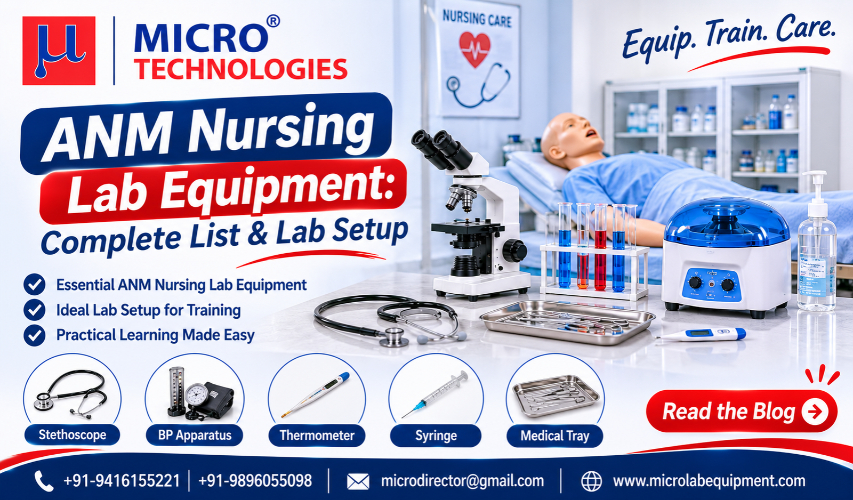
For a more detailed equipment list, explore the ANM Nursing Lab Equipment for Medical Colleges guide published by Micro Technologies.
GNM Nursing Lab Equipment: Complete Requirements and Uses
General Nursing and Midwifery (GNM) education includes practical learning in fundamental nursing, community health, maternal care, paediatrics and other relevant clinical areas.
GNM laboratory equipment should be planned around the practical training objectives and institutional requirements of the programme.
1. GNM Nursing Foundation Equipment
Common products include:
- Adult nursing manikins.
- Male and female patient-care models.
- Hospital beds.
- Bedside lockers.
- Patient screens.
- IV stands.
- Wheelchairs.
- Stretchers.
- BP apparatus.
- Stethoscopes.
- Thermometers.
- Dressing trolleys.
- Nursing procedure kits.
2. GNM Advanced Nursing Skills Equipment
Advanced skills training may require:
- Adult CPR manikins.
- Infant CPR trainers.
- Child CPR models.
- Injection training arms.
- IV access training models.
- Catheterisation trainers.
- Tracheostomy care models.
- Feeding-tube practice models.
- Airway management trainers.
- Emergency nursing simulation equipment.
3. GNM Maternal and Paediatric Equipment
Common educational resources include:
- Obstetric delivery simulators.
- Female pelvis models.
- Fetal skull models.
- Pregnancy demonstration models.
- Placenta models.
- Episiotomy training models.
- Infant nursing manikins.
- Newborn care models.
- Infant weighing scales.
- Growth monitoring charts.
4. GNM Community Health and Pre-Clinical Equipment
These may include community health nursing bags, measurement instruments, nutrition charts, anatomical models, microscopes, prepared slides and other educational laboratory materials.
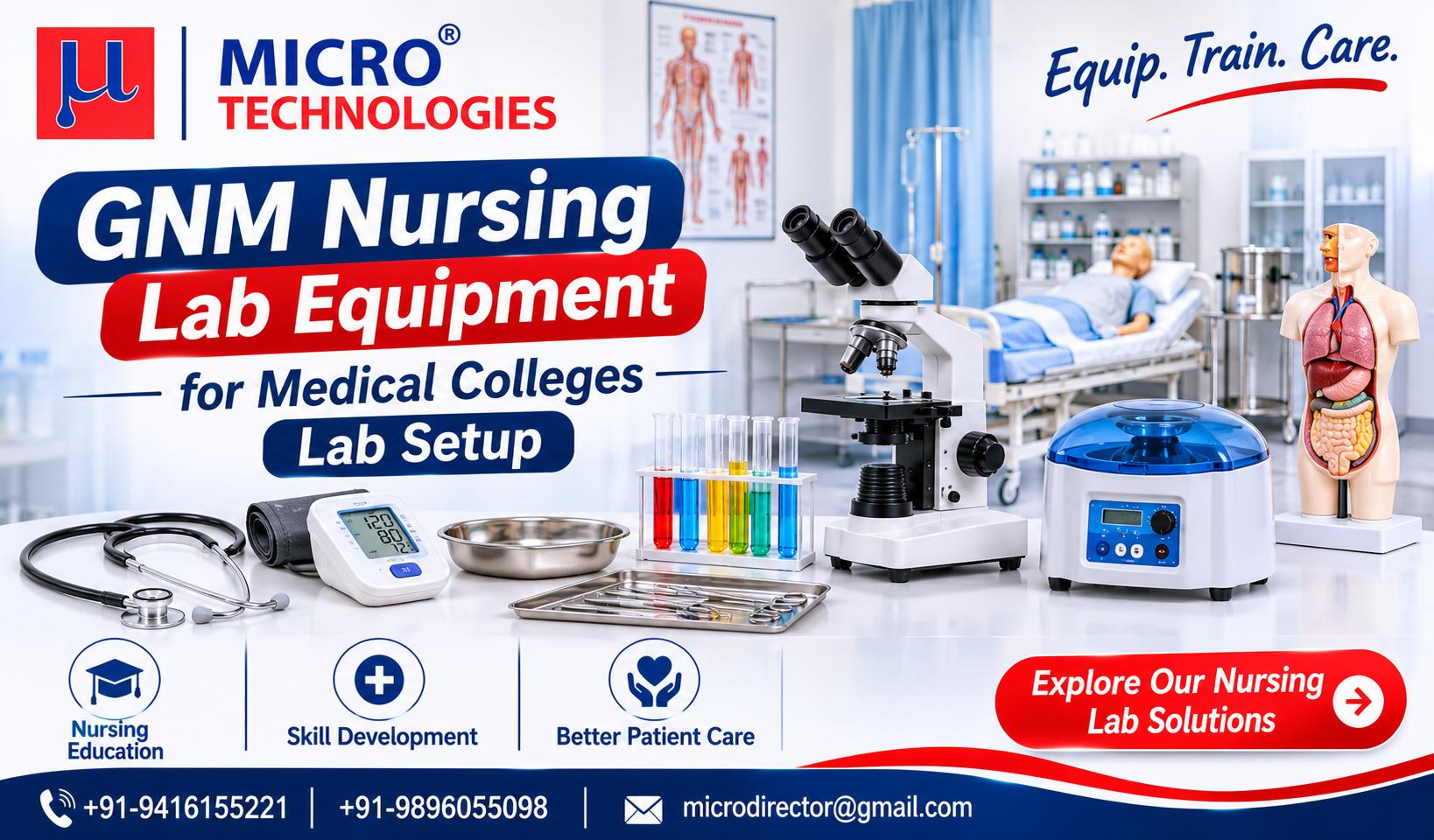
For more detailed course-specific information, read the GNM Nursing Lab Equipment for Medical Colleges guide.
B.Sc. Nursing Lab Equipment: Complete Requirements and Uses
Bachelor of Science in Nursing (B.Sc. Nursing) is a degree-level nursing programme with broader academic and practical learning requirements.
Its laboratory planning should reflect the applicable curriculum, training objectives, student intake and the programme-specific institutional guidelines.
1. B.Sc. Nursing Foundation Laboratory Equipment
The nursing foundation laboratory may include:
- Adult nursing manikins.
- Patient-care demonstration beds.
- Nursing procedure kits.
- IV training arms.
- Injection practice models.
- Patient transfer equipment.
- BP apparatus.
- Stethoscopes.
- Clinical thermometers.
- Nursing demonstration accessories.
2. B.Sc. Advanced Nursing Skills Equipment
Institutions may consider:
- Advanced CPR simulation manikins.
- Adult and paediatric emergency trainers.
- Airway management models.
- IV practice models.
- Catheterisation simulators.
- Tracheostomy models.
- Wound-care training models.
- Emergency response demonstration equipment.
- Patient assessment training devices.
3. B.Sc. Community Health Nursing Equipment
This section may include community assessment kits, health education charts, family health teaching models, immunisation resources, growth monitoring tools and other community healthcare teaching aids.
4. B.Sc. OBG and Paediatric Laboratory Equipment
Useful educational models and resources may include:
- Obstetric delivery simulators.
- Female reproductive system models.
- Fetal development models.
- Fetal skull models.
- Advanced newborn manikins.
- Infant resuscitation trainers.
- Paediatric patient-care models.
- Maternal assessment teaching aids.
5. B.Sc. Pre-Clinical Science Equipment
Pre-clinical laboratories may require subject-specific facilities and equipment.
Anatomy:
Human skeletons, torso models, organ models and anatomical charts.
Physiology:
Suitable physiological demonstration instruments and teaching models.
Biochemistry:
Laboratory glassware, measuring equipment and appropriate analytical teaching resources.
Microbiology:
Microscopes, prepared slides, suitable sterilisation equipment and microbiology teaching materials.
The exact requirements should be confirmed using the current applicable B.Sc. Nursing regulations and university guidelines.
Difference Between ANM, GNM and B.Sc. Nursing Laboratory Requirements
Although these nursing programmes share certain practical learning areas, their curriculum, training depth and institutional requirements differ.
ANM Nursing Laboratory Focus
ANM laboratory planning generally focuses on:
- Basic nursing procedures.
- Maternal healthcare.
- Newborn and child care.
- Community healthcare.
- Nutrition education.
- Foundational patient assessment.
GNM Nursing Laboratory Focus
GNM laboratory planning includes:
- Nursing foundation.
- Broader clinical procedure demonstrations.
- Advanced nursing skills.
- Maternal and newborn care.
- Community health nursing.
- Paediatric nursing.
- Pre-clinical learning.
B.Sc. Nursing Laboratory Focus
B.Sc. Nursing laboratory planning supports:
- Comprehensive nursing practice.
- Advanced skills and simulation.
- Community health nursing.
- Maternal and child health.
- Pre-clinical sciences.
- Academic and clinical learning activities appropriate to the degree curriculum.
Some equipment categories may be shared between programmes. However, institutions should ensure that the quantity, specifications and available facilities meet the applicable requirements of every programme being conducted.
Can ANM, GNM and B.Sc. Nursing Colleges Share Laboratories?
Some nursing institutions may operate multiple nursing programmes within the same campus and explore shared laboratory facilities.
However, shared laboratory arrangements should not be assumed to be automatically acceptable in every situation.
The Indian Nursing Council's 2021 Gazette notification discusses conditions under which institutions offering multiple nursing programmes on the same campus may share certain infrastructure, including laboratories, subject to the stated conditions and adequate equipment in proportion to admission strength.
Institutions should verify the latest applicable regulations, programme guidelines and approval conditions before planning shared laboratories.
This is especially important for colleges with separate ANM, GNM and B.Sc. Nursing student batches.
How to Set Up a Complete Nursing College Laboratory?
Establishing a nursing laboratory requires planning, equipment selection, space allocation and procurement coordination.
The following steps can help institutions organise the process.
1. Identify the Nursing Programmes
First, identify whether the college offers ANM, GNM, B.Sc. Nursing or multiple programmes.
Each programme should be evaluated separately before preparing the combined equipment requirement.
2. Review Applicable Regulatory Requirements
Check the latest Indian Nursing Council, State Nursing Council, university and institutional documents.
Review the applicable laboratory, equipment and infrastructure requirements before finalising procurement.
3. Prepare Department-Wise Equipment Lists
Create separate lists for nursing foundation, advanced skills, community health, OBG, paediatrics, nutrition and pre-clinical sciences.
This helps identify missing products and prevents unnecessary duplication.
4. Calculate Equipment Quantities
Equipment requirements should reflect:
- Total student intake.
- Number of students practising simultaneously.
- Number of laboratory stations.
- Faculty supervision requirements.
- Practical session arrangements.
- Applicable programme requirements.
5. Plan Laboratory Furniture and Space
Plan the arrangement of nursing beds, demonstration tables, storage cabinets, patient screens, stools and training stations.
The layout should allow instructors to demonstrate procedures and students to practise comfortably.
6. Prepare a Bill of Quantities (BOQ)
A clear procurement list should contain product names, technical specifications, quantities, preferred features, laboratory departments and estimated costs.
This will help colleges compare supplier quotations more effectively.
7. Check Product Quality and Specifications
Before purchasing, review the material, construction, demonstration functions, product dimensions, included accessories and suitability for repeated educational use.
8. Plan Maintenance and Storage
Arrange proper storage for training manikins, medical instruments, reusable equipment and consumables.
Maintain equipment inventories, inspection records and service documentation according to institutional procedures.
How to Choose the Right Nursing Lab Equipment Supplier in India?
Choosing a suitable supplier is an important part of nursing college procurement.
A supplier should be able to provide appropriate product information and help institutions understand the available equipment options.
Consider the following factors before selecting a supplier.
Product Range
Check whether the supplier offers equipment for nursing foundation, maternal health, newborn care, community health, anatomy and practical training.
Product Specifications
Review technical specifications, dimensions, material, demonstration features and available accessories.
Equipment Durability
Select nursing models and instruments designed for regular handling and repeated educational demonstrations.
Quality Documentation
Review applicable quality documents, product manuals, warranties and other supporting information.
Institutional Procurement Support
For larger projects, discuss quantities, product availability, quotations, dispatch arrangements and any installation requirements.
After-Sales Assistance
Understand the available maintenance, technical support, replacement parts and warranty arrangements.
A careful selection process helps institutions make better procurement decisions and plan a suitable nursing laboratory.
Nursing College Lab Equipment Manufacturer and Supplier in India – Micro Technologies
Setting up a nursing college laboratory requires different categories of medical, educational and scientific products. Medical colleges and nursing institutions need equipment that matches their practical training objectives and programme requirements.
Micro Technologies is an Indian laboratory equipment manufacturer and supplier offering laboratory, medical, scientific and educational equipment solutions.
Institutions planning ANM, GNM or B.Sc. Nursing laboratory facilities can explore its available product categories and discuss their institutional requirements.
Explore Relevant Product Categories from Micro Technologies
1. Patient Care Devices
Patient-care products support healthcare activities and suitable clinical training environments.
Explore: https://www.microlabequipment.com/category/patient-care-devices
2. Hospital Furniture
Hospital furniture supports patient-care demonstrations, bedside training and healthcare facility arrangements.
Explore relevant products for hospital beds, patient trolleys, stools and other furniture.
3. Surgical Instruments
Surgical instruments support suitable medical education, instrument identification and demonstration applications.
4. Laboratory Equipment
Explore laboratory and scientific equipment categories for educational and research applications.
Visit: https://www.microlabequipment.com/laboratory-equipment
Why Consider Micro Technologies for Nursing College Equipment?
- Laboratory and scientific equipment categories.
- Medical and patient-care product options.
- Educational and institutional equipment solutions.
- Product information for procurement planning.
- Support for institutional equipment enquiries.
- Options for exploring multiple laboratory product categories.
Plan Your Nursing College Laboratory with Micro Technologies
Whether you are establishing an ANM nursing laboratory, upgrading a GNM training facility or planning a B.Sc. Nursing practical laboratory, selecting suitable equipment is essential.
Micro Technologies can be approached to discuss product availability and institutional purchasing requirements.
Business Name: Micro Technologies
Website: https://www.microlabequipment.com/
Contact Number: +91 9416155221
Email: microdirector@gmail.com
Looking for nursing college lab equipment? Explore Micro Technologies and discuss your ANM, GNM or B.Sc. Nursing laboratory requirements with the team.
Frequently Asked Questions About Nursing College Lab Equipment
1. What is nursing college lab equipment?
Nursing college lab equipment includes manikins, medical training models, patient-care instruments, anatomical models, hospital furniture and educational teaching aids used to support practical nursing education.
2. What equipment is required for an ANM nursing laboratory?
ANM nursing laboratories may require nursing manikins, hospital beds, BP apparatus, stethoscopes, maternal health models, newborn care trainers, community health bags, nutrition teaching aids and basic patient-care equipment. The final list should follow the applicable programme requirements.
3. What equipment is required for a GNM nursing laboratory?
GNM nursing laboratories may require nursing foundation manikins, CPR trainers, IV practice models, injection training arms, obstetric delivery models, newborn care models, anatomical teaching aids and community health equipment.
4. What equipment is required for a B.Sc. Nursing laboratory?
B.Sc. Nursing laboratory requirements may include advanced nursing simulation models, patient-care manikins, clinical training equipment, maternal and paediatric models, anatomy teaching aids, community health equipment and subject-specific pre-clinical laboratory resources.
5. What are the main laboratories required in nursing colleges?
Common nursing education laboratory areas include nursing foundation, advanced nursing skills, community health nursing, nutrition, OBG and midwifery, paediatric nursing, pre-clinical sciences and computer laboratories. The final arrangement depends on the programme and applicable institutional guidelines.
6. What is the difference between ANM, GNM and B.Sc. Nursing laboratory equipment?
ANM laboratories generally focus on foundational nursing, maternal and child health, community healthcare and nutrition. GNM laboratories cover broader practical nursing and clinical skills, while B.Sc. Nursing facilities support the wider degree curriculum and more comprehensive practical and simulation requirements.
7. Can ANM, GNM and B.Sc. Nursing colleges share laboratory equipment?
Certain shared laboratory arrangements may be permitted subject to the applicable institutional regulations and conditions. Colleges should verify the latest Indian Nursing Council and State Nursing Council requirements and ensure adequate equipment for admission strength.
8. Which manikins are used in nursing colleges?
Common training models include adult nursing manikins, CPR manikins, infant training manikins, child nursing models, injection trainers, IV practice arms, catheterisation models and obstetric delivery simulators.
9. How do you prepare a nursing college laboratory equipment list?
Begin by reviewing the programme requirements and identifying each laboratory department. Then list the equipment, technical specifications, quantities, accessories and estimated costs. Student strength and simultaneous practical training requirements should be considered before finalising the procurement list.
10. How do I choose a reliable nursing lab equipment supplier in India?
Evaluate the supplier's product range, equipment specifications, material quality, warranty, technical documentation, delivery arrangements and after-sales support. Verify that the products are appropriate for your institution's specific programme requirements.
11. Where can I buy nursing college lab equipment in India?
Nursing colleges can approach specialised medical and educational equipment manufacturers and suppliers. Micro Technologies offers laboratory, medical and educational equipment categories for institutional enquiries.
Conclusion
Nursing college lab equipment plays an important role in developing practical healthcare knowledge and professional skills among nursing students. From nursing foundation and advanced skills laboratories to maternal health, community healthcare, paediatrics and pre-clinical sciences, each training department requires suitable equipment to support its educational objectives.
Although ANM, GNM and B.Sc. Nursing programmes share certain equipment categories, their practical training requirements and institutional arrangements should be planned according to their respective curricula and applicable guidelines.
For colleges establishing a new nursing laboratory or upgrading an existing facility, the procurement process should begin with programme-specific planning, equipment identification, quantity assessment and technical specification verification.
Micro Technologies offers laboratory, medical and educational equipment categories for institutions exploring suitable nursing laboratory solutions.
Visit https://www.microlabequipment.com/ to explore the available products and discuss your nursing college laboratory requirements.