Chemistry laboratories are important spaces where students, scientists and researchers perform experiments, prepare chemical solutions, examine substances and study different reactions. To carry out these activities effectively, they need suitable tools and instruments designed for specific laboratory tasks.
From measuring liquids and mixing chemical solutions to heating substances and weighing samples, chemistry lab equipment plays an essential role in everyday laboratory operations. Each apparatus has a particular purpose, and selecting the right one helps users perform experiments more efficiently and consistently.
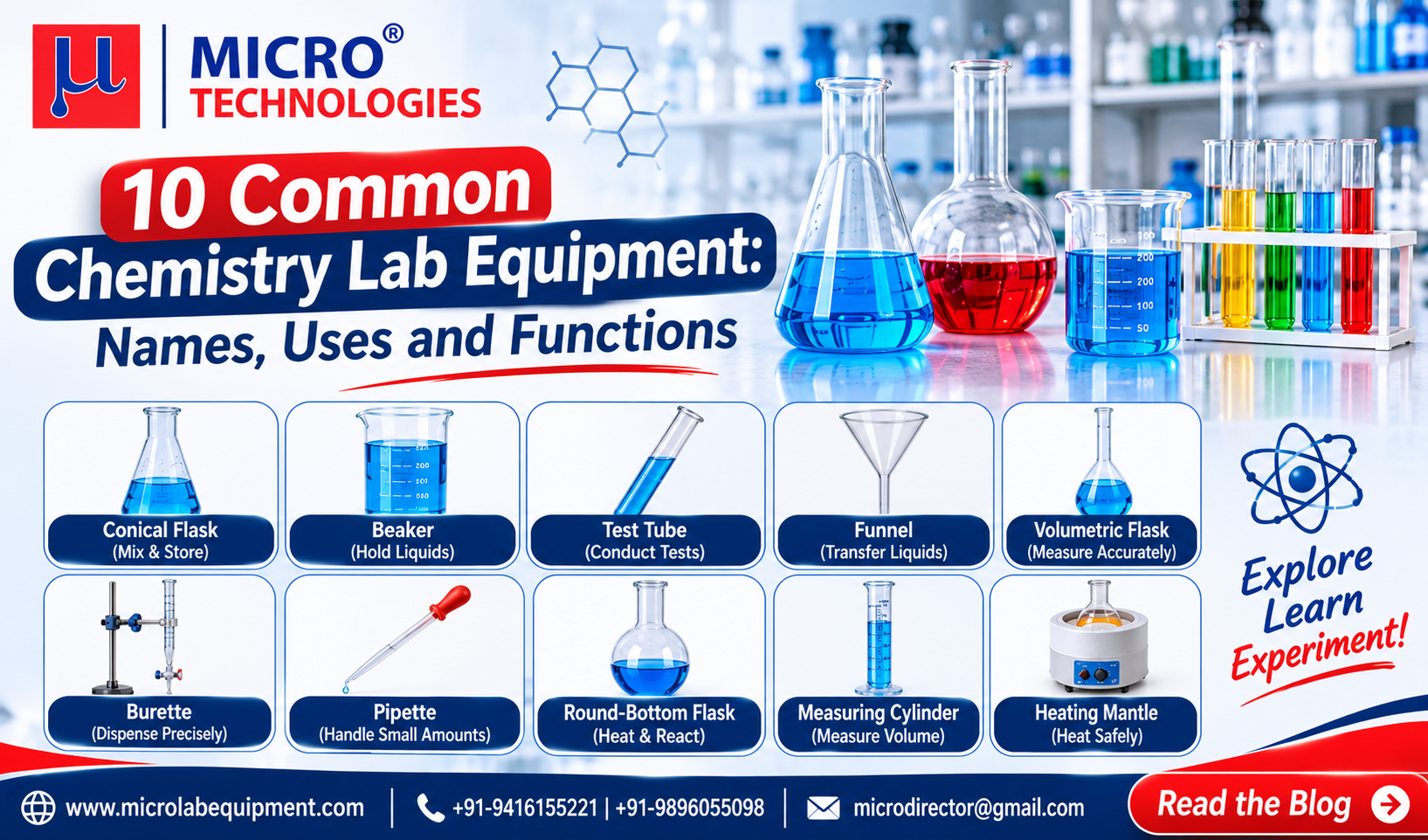
Some of the most commonly used chemistry laboratory equipment includes beakers, conical flasks, measuring cylinders, volumetric flasks, test tubes, pipettes, burettes, laboratory funnels, Bunsen burners and analytical balances.
Whether you are a chemistry student, teacher, laboratory technician, researcher or laboratory equipment buyer, understanding these tools will help you identify their functions and applications.
In this guide, we will explore 10 common chemistry lab equipment items, their uses, important features and applications in educational, research and industrial laboratories.
What Is Chemistry Lab Equipment?
Chemistry lab equipment refers to the collection of apparatus, glassware, instruments and devices used to perform chemical experiments, prepare solutions, measure substances, heat materials and analyse samples.
These tools are designed to support different laboratory activities, from simple classroom demonstrations to advanced chemical research and quality-control procedures.
For example, a beaker is used to hold and mix liquids, a measuring cylinder measures liquid volumes, a pipette transfers measured quantities and an analytical balance determines the mass of chemical substances.
Chemistry laboratory equipment is commonly used in:
- School and college chemistry laboratories.
- Pharmaceutical research facilities.
- Chemical testing laboratories.
- Industrial quality-control departments.
- Research and development centres.
- Educational and scientific institutions.
Choosing appropriate chemistry equipment is important because different experiments require different measurement capabilities, materials and operating conditions.
What Are the 10 Common Chemistry Lab Equipment and Their Uses?
The following are 10 essential chemistry laboratory equipment items commonly used for chemical experiments, liquid handling, heating and sample preparation.
1. Beaker
A beaker is one of the most commonly used pieces of chemistry laboratory equipment. It is a cylindrical container with a flat bottom, an open top and a small pouring spout. Beakers are generally available in different capacities and are commonly made from suitable laboratory glass or plastic.
Its simple design makes it useful for handling different types of liquids during laboratory experiments.
Main Uses of a Beaker
- Mixing chemical solutions: Used to combine different liquids and dissolve suitable solid substances.
- Heating liquids: Suitable heat-resistant beakers can be used for controlled heating.
- Holding substances: Provides temporary storage for chemical solutions and samples.
- Preparing mixtures: Commonly used during routine chemistry practicals.
- Transferring liquids: The pouring spout makes liquid transfer easier.
Practical example: During a chemistry experiment, a student may use a beaker to dissolve a suitable chemical in water before transferring the solution into another container.
Common types of beakers:
- Low-form beaker.
- Tall-form beaker.
- Glass laboratory beaker.
- Plastic laboratory beaker.
Important consideration: Beaker graduations provide approximate volume estimates. A beaker should not be used when precise volume measurement is required.
2. Conical Flask (Erlenmeyer Flask)
A conical flask, also known as an Erlenmeyer flask, is laboratory glassware with a wide flat base, sloping sides and a narrow neck. Its shape allows users to mix liquids by swirling without easily spilling the contents.
It is especially useful in experiments involving chemical solutions and reactions.
Main Uses of a Conical Flask
- Mixing solutions: Helps combine liquids through gentle swirling.
- Titration experiments: Used to hold the sample solution during titration.
- Chemical reactions: Provides a suitable vessel for selected experimental reactions.
- Preparing solutions: Helps mix and prepare different chemical mixtures.
- Temporary sample storage: Can hold compatible solutions during laboratory procedures.
Practical example: In an acid-base titration experiment, a conical flask holds the sample solution while a burette delivers a measured quantity of titrant.
Common applications: Chemistry laboratories, pharmaceutical research, educational institutions and analytical testing facilities.
Why is its design important? Its narrow neck helps reduce splashing when the solution is mixed by swirling.
3. Measuring Cylinder (Graduated Cylinder)
A measuring cylinder is a tall, narrow laboratory container with clearly marked volume graduations. It is specifically designed to measure different quantities of liquid.
It is generally made from glass or suitable plastic materials and is available in various capacities.
Main Uses of a Measuring Cylinder
- Measuring liquid volumes: Used for measuring water, solvents and other suitable liquids.
- Preparing chemical mixtures: Helps measure liquids before combining them.
- Sample preparation: Supports experiments requiring specified liquid quantities.
- Liquid transfer: Helps transfer measured liquids into other laboratory containers.
- Educational experiments: Used to teach students the principles of volume measurement.
Practical example: A chemistry student may use a 100 mL measuring cylinder to measure water before preparing a solution.
How to Read a Measuring Cylinder
To obtain a suitable measurement:
- Place the cylinder on a flat and level surface.
- Allow the liquid to settle.
- Bring your eyes to the same level as the liquid surface.
- Read the bottom of the concave meniscus for a typical transparent aqueous liquid.
- Record the volume according to the instrument's graduation scale.
Common types:
- Glass measuring cylinder.
- Plastic measuring cylinder.
- Graduated measuring cylinder in different capacities.
The required capacity and measurement tolerance should be considered before selecting a cylinder.
4. Volumetric Flask
A volumetric flask is specialised chemistry laboratory glassware used to prepare solutions to a precisely specified volume. It generally consists of a bulb-shaped body, a long narrow neck and a calibration mark.
Unlike a regular beaker, a volumetric flask is designed for accurate volume preparation under its stated calibration conditions.
Main Uses of a Volumetric Flask
- Preparing standard solutions: Used to prepare solutions of known concentration.
- Diluting chemicals: Helps dilute concentrated solutions to a specified final volume.
- Analytical chemistry: Supports quantitative chemical analysis.
- Reagent preparation: Used for preparing solutions required in laboratory experiments.
- Research applications: Helps maintain consistency during solution preparation.
Practical example: A laboratory technician may dissolve a measured mass of a chemical in a suitable solvent and then add more solvent until the liquid reaches the calibration mark.
Important features:
- Narrow neck for easier volume reading.
- Calibration mark for the specified volume.
- Stopper to close the flask.
- Available in different capacities.
Volumetric flasks are particularly important when the final solution volume must be controlled accurately.
5. Test Tube
A test tube is a narrow cylindrical laboratory container with an open upper end and a rounded bottom. It is commonly manufactured from glass or suitable plastic materials.
Test tubes are widely used in chemistry laboratories because they allow small quantities of substances to be handled conveniently.
Main Uses of a Test Tube
- Small-scale reactions: Used to perform chemical reactions with small quantities of material.
- Sample handling: Holds liquids, solids and other compatible samples.
- Heating substances: Suitable heat-resistant test tubes can be used for controlled heating.
- Chemical observation: Helps observe colour changes, precipitation and other visible reactions.
- Sample preparation: Used for preparing and temporarily holding laboratory specimens.
Practical example: A student may mix two suitable chemical solutions in a test tube to observe whether a visible reaction occurs.
Common types:
- Glass test tubes.
- Plastic test tubes.
- Culture tubes.
- Screw-cap test tubes.
The choice of test tube depends on the chemical properties of the sample, temperature requirements and experimental procedure.
6. Pipette
A pipette is an important chemistry laboratory instrument used to transfer measured quantities of liquid from one container to another.
Different pipette designs are available depending on the volume, measurement requirements and application.
Main Uses of a Pipette
- Measured liquid transfer: Transfers selected volumes of liquid.
- Solution preparation: Helps measure liquids used in chemical solutions.
- Analytical experiments: Supports quantitative laboratory procedures.
- Sample handling: Transfers liquid samples between laboratory containers.
- Chemical testing: Helps introduce controlled quantities of reagents during experiments.
Practical example: A volumetric pipette can transfer a specified volume of a standard solution into a conical flask during a chemical analysis procedure.
Common Types of Pipettes
- Volumetric Pipette: Designed to deliver a specified fixed volume.
- Graduated Pipette: Contains multiple markings for measuring different quantities.
- Serological Pipette: Used for graduated liquid transfer and may be supplied in glass or disposable plastic versions.
- Micropipette: Used for handling very small liquid volumes, commonly measured in microlitres.
Important safety tip: Always use an appropriate pipette filler or pipetting device. Mouth pipetting is unsafe and should never be performed.
7. Burette
A burette is a long graduated glass tube fitted with a stopcock or valve near its lower end. It is designed to dispense measured quantities of liquid in a controlled manner.
It is particularly important in analytical chemistry and volumetric analysis.
Main Uses of a Burette
- Titration: Dispenses titrant during acid-base and other suitable titration procedures.
- Volumetric analysis: Helps determine the volume of reagent delivered.
- Controlled liquid addition: Allows solutions to be added gradually.
- Concentration determination: Supports the analysis of unknown solution concentrations.
- Chemical experiments: Helps perform procedures requiring controlled dispensing.
Practical example: During an acid-base titration, a burette is filled with a standard solution and used to add titrant gradually to a sample held in a conical flask.
Important features:
- Graduated measurement scale.
- Long, narrow glass tube.
- Stopcock for flow control.
- Narrow delivery tip.
A burette and a pipette are both used for measured liquid handling, but their functions are different. A pipette generally transfers a selected volume, whereas a burette delivers variable measured volumes.
8. Laboratory Funnel
A laboratory funnel is a cone-shaped apparatus with a wide opening and a narrow stem. It is commonly made from glass or suitable plastic materials.
Its basic design makes it useful for transferring liquids and supporting filtration procedures.
Main Uses of a Laboratory Funnel
- Liquid transfer: Helps pour liquids into narrow-necked containers.
- Filtration: Supports filter paper during gravity filtration.
- Solid-liquid separation: Helps retain insoluble solid particles while liquid passes through.
- Sample preparation: Supports the transfer of suitable laboratory materials.
- Chemical processing: Used during selected filtration procedures.
Practical example: Filter paper can be folded and placed inside a glass funnel to separate insoluble particles from a liquid mixture.
Common types:
- Glass filter funnel.
- Plastic funnel.
- Powder funnel.
- Büchner funnel for vacuum filtration.
The type of funnel should be chosen according to the material being transferred and the filtration method required.
9. Bunsen Burner
A Bunsen burner is a laboratory heating device that produces an adjustable gas flame. It is widely used in chemistry teaching laboratories and selected scientific procedures.
The flame can be adjusted by regulating the air and gas supply according to the manufacturer's design and the laboratory's operating procedure.
Main Uses of a Bunsen Burner
- Heating chemicals: Provides heat for suitable laboratory experiments.
- Heating glassware: Used for heating compatible laboratory materials with an appropriate setup.
- Flame-based experiments: Supports selected demonstrations involving combustion and heating.
- Material processing: Provides a controlled flame for approved laboratory activities.
- Educational demonstrations: Helps students understand basic principles of heating and combustion.
Practical example: A Bunsen burner may be used to heat a suitable sample placed in an appropriate laboratory setup during a supervised chemistry practical.
Safety precautions:
- Keep flammable substances away from an open flame.
- Check the gas connection before use.
- Tie back long hair and secure loose clothing.
- Never leave a lit burner unattended.
- Turn off the gas supply after use.
10. Analytical Balance
An analytical balance is a precision laboratory instrument used to determine the mass of chemicals and other samples. Many models include a protective draft shield to minimise the effects of air currents on weighing.
It is particularly important in chemical experiments where accurate quantities of substances are required.
Main Uses of an Analytical Balance
- Chemical weighing: Measures the mass of solid reagents and powders.
- Solution preparation: Determines the mass required to prepare solutions.
- Analytical testing: Supports laboratory measurements and quality-control procedures.
- Sample preparation: Measures small quantities of different substances.
- Scientific research: Helps obtain consistent and repeatable mass measurements.
Practical example: Before preparing a standard solution, a laboratory technician may use an analytical balance to measure the required mass of a chemical reagent.
Important features to consider:
- Maximum weighing capacity.
- Readability and resolution.
- Repeatability.
- Draft-shield arrangement.
- Calibration and verification requirements.
Analytical balances should be placed on stable surfaces and maintained according to the manufacturer's instructions and laboratory quality procedures.
Different Categories of Chemistry Laboratory Equipment
Chemistry laboratory equipment can be divided into different categories based on its primary function.
1. Glassware and Containers
Beakers, conical flasks, volumetric flasks and test tubes are used for holding, mixing and preparing chemical solutions.
2. Measuring Equipment
Measuring cylinders, volumetric flasks, pipettes and burettes support liquid-volume measurement and transfer.
3. Heating Equipment
Bunsen burners, hot plates and heating mantles provide suitable heating arrangements for selected chemical procedures.
4. Filtration and Separation Apparatus
Funnels, filter paper and separating funnels support filtration and separation of suitable mixtures.
5. Weighing and Analytical Instruments
Analytical balances and other measuring instruments help determine the physical and chemical properties of laboratory materials.
Why Is Chemistry Laboratory Equipment Important?
Chemistry laboratory equipment plays an essential role in scientific experiments, research and practical education. Each instrument helps laboratory professionals perform a particular operation.
1. Supports Accurate Measurements: Suitable measuring glassware and analytical balances help users measure liquids and solid substances according to their requirements.
2. Makes Experiments More Efficient: Proper equipment makes everyday laboratory activities such as mixing, heating and sample preparation easier to perform.
3. Helps in Chemical Analysis: Pipettes, burettes and volumetric flasks support quantitative laboratory procedures.
4. Improves Sample Handling: Test tubes, beakers and reagent bottles help users handle and organise different chemical samples.
5. Supports Scientific Education: Basic chemistry equipment helps students understand experimental methods and scientific concepts through practical activities.
6. Supports Research and Quality Control: Appropriate instruments help researchers and laboratory professionals perform controlled testing and analytical procedures.
How to Choose the Right Chemistry Laboratory Equipment?
Selecting suitable chemistry laboratory equipment requires careful consideration of the intended application, material compatibility, measurement requirements and product specifications.
Here are some important factors to consider before purchasing.
1. Identify the Laboratory Application
Understand whether the equipment is required for school practicals, chemical analysis, research, pharmaceutical testing or industrial quality control.
2. Check Material Quality
Consider whether the equipment is made from suitable borosilicate glass, compatible plastic, porcelain or metal. Material selection should depend on the chemicals and temperatures involved.
3. Review Measurement Accuracy
For volumetric equipment, examine the capacity, graduation scale, calibration designation and permissible error.
4. Consider Temperature Requirements
Ensure the apparatus is suitable for the required heating conditions. Not every glass or plastic product is designed for direct heating.
5. Verify Product Specifications
Check dimensions, capacity, material, operating conditions and other technical details before placing an order.
6. Evaluate Cleaning and Maintenance
Choose products that can be cleaned, inspected and maintained according to laboratory procedures.
7. Choose a Reliable Supplier
Select a supplier that can provide product details, appropriate documentation, technical information and assistance with equipment selection.
Where to Buy Chemistry Lab Equipment in India?
Setting up a chemistry laboratory requires selecting suitable glassware, apparatus, measuring devices and scientific instruments according to the intended experiments.
Micro Technologies is an Indian laboratory equipment manufacturer and supplier offering a range of laboratory products for educational institutions, research facilities and industrial applications.
If you are looking for Chemistry Laboratory Equipment and Laboratory Equipment Manufacturers in India, explore the product range available at Micro Technologies.
The company's laboratory product categories include:
- Laboratory glassware.
- Laboratory apparatus.
- Measuring and weighing equipment.
- Heating and cooling equipment.
- Scientific and analytical instruments.
- Educational laboratory equipment.
- Medical and allied laboratory products.
Explore Micro Technologies
From basic chemistry glassware to specialised scientific instruments, selecting the right products is important for efficient laboratory operations.
Visit Micro Technologies to explore its laboratory equipment range and enquire about suitable products.
Business: Micro Technologies
Website: https://www.microlabequipment.com/
Contact: +91 9416155221
Frequently Asked Questions About Chemistry Lab Equipment
1. What are the 10 common chemistry lab equipment items?
The 10 common chemistry lab equipment items are beakers, conical flasks, measuring cylinders, volumetric flasks, test tubes, pipettes, burettes, laboratory funnels, Bunsen burners and analytical balances.
2. What is the most commonly used equipment in a chemistry laboratory?
Beakers, test tubes, conical flasks, measuring cylinders and pipettes are among the most commonly used items in chemistry laboratories. Their applications include holding, mixing, measuring and transferring liquids.
3. What is the difference between chemistry laboratory equipment and chemistry apparatus?
Chemistry laboratory equipment is a broad term that includes instruments, glassware, machines and tools used for chemical experiments. Chemistry apparatus generally refers to individual vessels, accessories and arrangements used to perform specific laboratory procedures. The terms can overlap in everyday laboratory language.
4. Which equipment is used to measure liquid volume in chemistry?
Measuring cylinders, graduated pipettes, volumetric pipettes, burettes and volumetric flasks are commonly used for liquid-volume measurement or transfer, depending on the accuracy and application required.
5. Which apparatus is used for heating chemicals?
A Bunsen burner is commonly used as a laboratory heat source for suitable experiments. Hot plates and heating mantles are also used for controlled heating applications.
6. What is the use of a burette in a chemistry laboratory?
A burette is used to dispense measured and controlled quantities of liquid, particularly during titration and volumetric analysis experiments.
7. Why is a volumetric flask used in chemistry?
A volumetric flask is used to prepare solutions to a specified calibrated volume. It is commonly required for preparing standard solutions and performing quantitative chemical analysis.
8. What is an analytical balance used for?
An analytical balance measures the mass of small quantities of substances with high precision. It is commonly used for chemical weighing, solution preparation and analytical laboratory work.
9. What equipment is needed for a basic school chemistry laboratory?
A basic school chemistry laboratory may require beakers, conical flasks, test tubes, measuring cylinders, pipettes, burettes, funnels, thermometers, Bunsen burners and suitable weighing instruments.
10. How do you select the right chemistry lab equipment?
Identify the application, check material compatibility, review measurement capacity and accuracy, verify technical specifications and evaluate safety, maintenance and supplier support before purchasing.
Contact Today
Chemistry laboratory equipment forms the foundation of scientific experiments, chemical analysis, research and practical education. From beakers and conical flasks to pipettes, burettes and analytical balances, each item performs a specific function during laboratory procedures.
Understanding the names, uses and applications of these 10 common chemistry lab equipment items helps students, teachers, researchers and laboratory professionals select suitable tools for their work.
Choosing the right apparatus according to its material, measurement requirements, capacity and intended application can support more organised and reliable laboratory operations.
For chemistry glassware, laboratory apparatus and scientific instruments, explore the product range available at Micro Technologies – Laboratory Equipment Manufacturers in India.