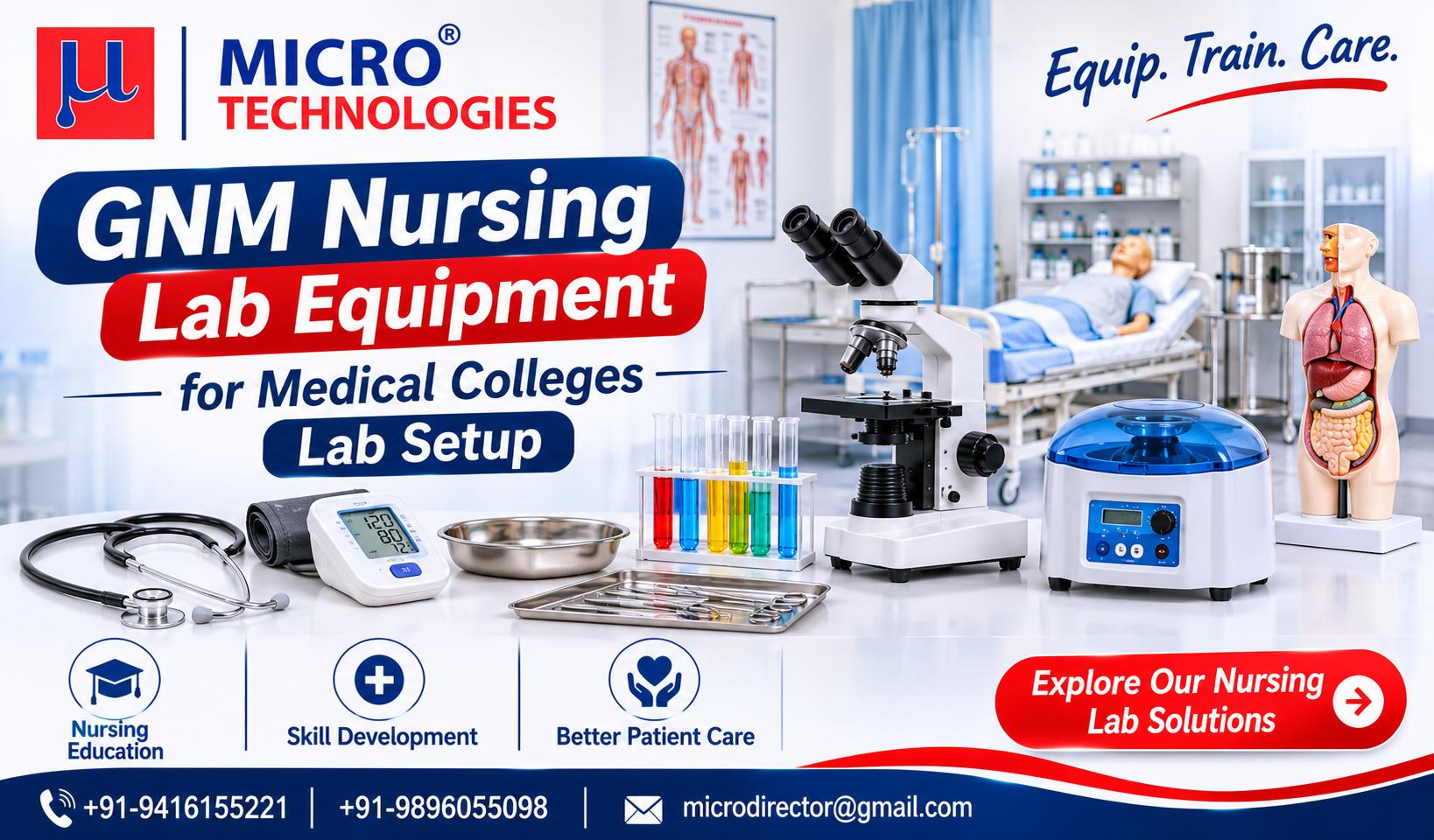
Practical training is an essential part of nursing education. Students need more than classroom knowledge to understand patient care, clinical procedures, emergency response, maternity care and community health practices. This is why a properly equipped nursing laboratory is important for medical colleges and nursing training institutions offering the General Nursing and Midwifery (GNM) programme.
GNM nursing lab equipment includes a wide range of educational models, patient-care training devices, nursing manikins, medical instruments, hospital furniture, anatomical models and practical teaching aids. These products help students learn and practise nursing procedures in a controlled educational environment before performing supervised clinical duties.
From nursing foundation laboratories to advanced nursing skill, midwifery, paediatric and community health laboratories, each department requires specific equipment according to its teaching objectives.
For medical colleges and nursing institutions planning a new GNM laboratory or upgrading an existing facility, selecting suitable equipment is an important step.
In this guide, we will explore the essential GNM nursing lab equipment, department-wise laboratory requirements, practical applications, procurement considerations and how to choose suitable nursing laboratory solutions.
What Is GNM Nursing Lab Equipment?
GNM (General Nursing and Midwifery) nursing lab equipment refers to the educational tools, medical training instruments, simulation models and supporting furniture used to teach practical nursing skills.
These products help students understand different aspects of nursing practice, including patient assessment, hygiene, clinical procedures, emergency care, maternity services, newborn care and community healthcare.
Unlike ordinary classroom teaching aids, nursing laboratory equipment allows students to practise specific clinical procedures through demonstrations and simulation-based learning.
Common examples include:
- Nursing training manikins.
- CPR training manikins.
- Injection training arms.
- IV practice models.
- Anatomical models.
- Hospital beds and bedside furniture.
- Blood pressure apparatus.
- Stethoscopes.
- Delivery training models.
- Newborn care simulators.
- Nursing demonstration kits.
- Community health teaching aids.
These products are used in nursing colleges, GNM schools, medical colleges with nursing programmes, healthcare training centres and educational institutions.
Why Is Nursing Lab Equipment Important for GNM Colleges?
Practical nursing education helps students develop the knowledge and skills needed for different healthcare environments.
A properly planned nursing laboratory provides opportunities to practise procedures, understand clinical equipment and learn how to handle different patient-care situations through supervised demonstrations.
1. Develops Practical Nursing Skills
Training manikins, patient-care models and demonstration equipment allow students to practise basic nursing procedures in a controlled environment.
2. Improves Clinical Understanding
Anatomical models, physiological teaching aids and patient-monitoring instruments help students understand the human body and common healthcare procedures.
3. Supports Emergency Training
CPR manikins, airway management trainers and resuscitation models help students understand emergency response procedures through simulation.
4. Improves Maternity and Childcare Training
Obstetric and paediatric models provide practical learning opportunities for pregnancy, delivery, newborn care and child-health education.
5. Supports Community Healthcare Education
Community health kits, measurement tools, health education charts and demonstration models help students understand primary healthcare and community-based nursing activities.
6. Builds Confidence Before Clinical Practice
Simulation-based learning allows students to understand procedures, practise their steps and receive feedback from instructors before supervised clinical training.
What Are the Different Laboratories Required for GNM Nursing Colleges?
Nursing colleges require different practical learning spaces according to the nursing programme, curriculum and institutional requirements.
The revised GNM syllabus reference describes six key laboratory areas: Nursing Practice, Community Health Nursing and Nutrition, Advanced Nursing Skills, Computer, OBG and Paediatrics, and Pre-Clinical Sciences.
The exact current infrastructure and equipment schedule should be checked against the latest Indian Nursing Council and applicable State Nursing Council requirements.
1. Nursing Foundation / Nursing Practice Laboratory
The nursing foundation laboratory is one of the main practical training areas in a GNM institution.
It is designed to familiarise students with basic nursing procedures, patient handling, bedside care, hygiene, vital-sign assessment and other essential nursing activities.
Essential equipment and articles:
- Hospital beds.
- Nursing demonstration manikins.
- Bedside lockers.
- Overbed tables.
- IV stands.
- Patient screens.
- Wheelchairs.
- Stretchers.
- Bed sheets and blankets.
- Pillows and pillow covers.
- Kidney trays.
- Dressing trolleys.
- BP apparatus.
- Stethoscopes.
- Digital thermometers.
- Adult weighing scales.
- Measuring tapes.
- Patient-care demonstration kits.
Practical applications:
Students use this equipment to learn bed making, patient positioning, basic patient-care techniques, hygiene procedures, vital-sign measurement and safe patient handling.
For example, a demonstration bed and nursing manikin can be used to practise patient positioning, while a BP apparatus and stethoscope support instruction in blood-pressure assessment.
2. Advanced Nursing Skill Laboratory
An advanced nursing skill laboratory provides specialised training equipment for demonstrating and practising clinical procedures through simulation.
This laboratory helps nursing students understand procedures that require specific equipment and step-by-step instruction.
Essential equipment and models:
- Adult CPR training manikin.
- Child CPR training manikin.
- Infant CPR manikin.
- Injection training arm.
- IV practice arm.
- Venepuncture training model.
- Catheterisation training model.
- Tracheostomy care model.
- Gastrostomy training model.
- Enteral feeding demonstration model.
- Airway management training model.
- Oxygen therapy demonstration equipment.
- Suction apparatus.
- Bag and mask training equipment.
- Emergency procedure demonstration kits.
Practical applications:
These models support supervised teaching and simulation of procedures such as CPR, injection techniques, IV access, airway care, catheterisation and feeding-tube procedures.
The aim is to provide a realistic practice environment where students can understand procedural steps without using patients as training models.
3. Obstetrics and Gynaecology (OBG) / Midwifery Laboratory
The OBG and midwifery laboratory is important for teaching maternity care, pregnancy-related procedures, childbirth concepts and maternal-health practices.
GNM students require suitable demonstration models to understand pregnancy, labour, delivery and related nursing responsibilities.
Essential equipment and models:
- Obstetric delivery training manikin.
- Female pelvis model.
- Fetal skull model.
- Fetal development models.
- Pregnancy demonstration model.
- Antenatal examination model.
- Episiotomy and suturing training model.
- Delivery table.
- Labour room furniture.
- Delivery instrument set.
- Fetal stethoscope.
- Fetal Doppler.
- Delivery trolley.
- Examination couch.
- Newborn baby manikin.
- Placenta and umbilical cord demonstration models.
Practical applications:
Students use these teaching aids to understand maternal assessment, pregnancy development, labour stages, delivery procedures and basic newborn care.
A delivery simulator, for example, helps demonstrate the process of childbirth and supports practical midwifery instruction.
4. Paediatric / Child Health Nursing Laboratory
A paediatric nursing laboratory focuses on the practical requirements of newborn and child healthcare.
It provides educational models and equipment for teaching child assessment, growth monitoring, feeding, hygiene and selected emergency-care procedures.
Essential equipment and models:
- Infant nursing manikin.
- Child nursing manikin.
- Newborn baby model.
- Infant CPR manikin.
- Paediatric CPR training model.
- Infant injection training model.
- Infant IV practice model.
- Infant weighing scale.
- Infantometer.
- Growth monitoring charts.
- Paediatric BP apparatus or suitable cuffs.
- Digital thermometer.
- Feeding-tube demonstration models.
- Neonatal care demonstration equipment.
- Paediatric examination equipment.
Practical applications:
Students learn about newborn handling, growth monitoring, basic child-health assessment, infant feeding demonstrations and paediatric nursing procedures.
For example, an infant manikin can be used to demonstrate safe positioning and basic newborn-care practices.
5. Community Health Nursing Laboratory
Community health nursing focuses on healthcare activities outside traditional hospital environments.
This laboratory helps students understand public healthcare, home visits, health education, family care, immunisation awareness and community-based nursing responsibilities.
Essential equipment and teaching aids:
- Community health nursing home-visit bags.
- BP apparatus.
- Stethoscopes.
- Digital thermometers.
- Adult weighing scales.
- Infant weighing scales.
- Measuring tapes.
- MUAC tapes.
- Growth monitoring charts.
- Community health education charts.
- Family planning demonstration models.
- Immunisation teaching aids.
- Specimen collection materials.
- Health assessment kits.
- Waste segregation demonstration materials.
- Community healthcare records and teaching documents.
Practical applications:
Students practise community health assessment, health education, family visits, growth monitoring demonstrations and primary healthcare activities.
A home-visit kit, for example, helps students understand the equipment required for basic community health assessment.
6. Nutrition and Dietetics Laboratory
The nutrition laboratory is used to teach students about food preparation, dietary planning, nutrition assessment and the preparation of suitable diets for different individuals.
Some GNM syllabus frameworks combine community health and nutrition facilities, so the actual layout should follow the programme's applicable requirements.
Essential equipment and articles:
- Nutrition demonstration charts.
- Food models.
- Diet planning charts.
- Dietetic weighing scales.
- Cooking utensils.
- Preparation tables.
- Cutting boards.
- Kitchen knives and cutlery.
- Cooking vessels.
- Pressure cookers.
- Microwave oven.
- Refrigerator.
- Mixer and grinder.
- Measuring cups.
- Serving trays.
- Plates and bowls.
- Storage racks.
- Food storage cupboards.
- Crockery and cutlery sets.
Practical applications:
Students learn about balanced diets, food groups, basic food preparation, dietary measurement and nutrition education for healthy and sick individuals.
For example, food models and diet charts can be used to demonstrate meal planning for people with different nutritional needs.
7. Pre-Clinical Science Laboratory
The pre-clinical science laboratory supports the foundational scientific subjects included in nursing education.
It generally provides facilities for learning anatomy, physiology, biochemistry and microbiology concepts.
Essential equipment and teaching aids:
- Human skeleton models.
- Human torso models.
- Brain models.
- Heart models.
- Kidney models.
- Human organ models.
- Anatomical charts.
- Microscopes.
- Prepared microscope slides.
- Glass laboratory slides.
- Specimen jars.
- Basic laboratory glassware.
- Demonstration models.
- Science teaching aids.
- Suitable sample preparation equipment.
Practical applications:
These products help students learn about human body systems, anatomical structures, microorganisms and basic laboratory concepts relevant to nursing practice.
An anatomical torso model, for example, helps demonstrate the location and structure of major internal organs.
8. Computer Laboratory
The computer laboratory supports digital learning, information management, presentations, nursing education and access to academic resources.
Basic requirements:
- Desktop computers or laptops.
- Computer tables and chairs.
- Internet connectivity.
- Printers.
- Projectors or display screens.
- Educational software.
- Digital learning resources.
- Networking and power accessories.
- Storage and classroom teaching facilities.
Practical applications:
Students can use the computer laboratory for educational research, digital presentations, nursing documentation exercises and learning activities supported by technology.
GNM Nursing Lab Equipment List – Quick Procurement Overview
The following table provides a practical overview of important equipment by laboratory department.
LaboratoryImportant equipmentNursing FoundationHospital beds, nursing manikins, BP apparatus, stethoscopes, IV standsAdvanced Nursing SkillsCPR models, injection arms, IV trainers, airway and catheterisation simulatorsOBG & MidwiferyDelivery simulator, pelvis model, fetal models, labour tablePaediatric NursingInfant manikins, newborn CPR models, infant scales, growth chartsCommunity HealthHome-visit kits, weighing scales, measuring tapes, health chartsNutritionDietetic scales, cooking utensils, food models, refrigeratorPre-Clinical ScienceSkeletons, organ models, microscopes, slides and teaching aidsComputer LabComputers, printers, internet and audiovisual equipment
How to Plan a Complete GNM Nursing Laboratory Setup?
Planning a nursing laboratory requires understanding the academic curriculum, student intake, practical teaching requirements and available infrastructure.
The following steps can help colleges organise the process.
1. Identify Programme Requirements
First, identify the GNM programme being offered and review its applicable syllabus, laboratory requirements and institutional approval conditions.
Do not automatically use a B.Sc. Nursing equipment schedule for a GNM programme.
2. Plan Department-Wise Laboratories
Prepare a separate equipment schedule for nursing foundation, advanced skills, OBG, paediatric, community health, nutrition and pre-clinical learning areas.
This helps avoid missing specialised training models and unnecessary duplication.
3. Calculate Quantities According to Student Strength
Equipment quantities should be planned according to the student intake, the number of learners practising simultaneously, the teaching methodology and the applicable regulatory requirements.
For example, the revised GNM syllabus reference hosted by UPUMS describes a desired demonstration-bed ratio of one bed for six students practising at a given time, alongside sufficient procedure sets.
Treat such figures as syllabus-specific guidance and verify them against the currently applicable official requirements before preparing a procurement schedule.
4. Select Suitable Training Models
Choose models according to the practical skills being taught.
For example, a college teaching basic patient care may require nursing manikins, while an institution conducting childbirth demonstrations may need suitable obstetric and newborn training models.
5. Check Product Quality and Specifications
Review the following before purchasing:
- Material and construction.
- Model dimensions.
- Demonstration features.
- Movable or detachable parts.
- Cleaning requirements.
- Durability.
- Accessories.
- Warranty and maintenance information.
6. Plan Laboratory Furniture and Storage
Practical laboratories also require appropriate beds, tables, cupboards, racks, patient lockers, examination furniture and storage facilities.
The furniture should support efficient student movement, demonstrations and equipment organisation.
7. Prepare the Equipment Procurement List
Prepare a Bill of Quantities (BOQ) showing product names, specifications, quantities, intended laboratory, unit prices and total costs.
This makes it easier to compare supplier quotations and coordinate the purchasing process.
8. Verify Applicable Standards and Documentation
Before finalising the setup, verify the latest Indian Nursing Council programme requirements, State Nursing Council conditions, university requirements and any relevant institutional inspection checklist.
Product specifications and certificates should be checked individually rather than assuming every product carries the same approval or certification.
Important Factors to Consider Before Buying GNM Nursing Lab Equipment
Selecting nursing laboratory equipment is a long-term investment for an educational institution.
Consider these important factors before purchasing:
Equipment Suitability
Select products that match the practical nursing procedures included in the programme.
Durability
Choose equipment designed for regular educational demonstrations and repeated student practice.
Realistic Demonstration Features
Training models should provide appropriate anatomical details and functional features for the intended learning activity.
Maintenance and Cleaning
Check how the equipment can be cleaned, stored and maintained between practical sessions.
Supplier Experience
Work with suppliers who understand nursing education requirements and can provide relevant technical information.
Bulk Supply and Installation
For large medical colleges and nursing institutions, confirm delivery arrangements, installation requirements and product availability before finalising the order.
Where to Buy GNM Nursing Lab Equipment in India?
Setting up a GNM nursing laboratory requires different types of training models, nursing instruments, healthcare products and supporting furniture.
Micro Technologies offers laboratory, medical and educational equipment solutions for institutions, medical colleges, nursing colleges and healthcare training facilities.
Its product portfolio includes categories such as:
1. Patient Care Devices
Products supporting patient-care activities, healthcare demonstrations and clinical training environments.
Explore: https://www.microlabequipment.com/products/medical-equipment/patient-care-devices
2. Hospital Furniture
Beds, examination tables, hospital stools, patient trolleys, IV stands, lockers and other furniture used in healthcare environments.
Explore: https://www.microlabequipment.com/products/medical-equipment/hospital-furniture
3. Surgical Instruments
Medical instruments used for suitable surgical education, instrument identification and clinical training applications.
Explore: https://www.microlabequipment.com/products/medical-equipment/surgical-instruments
4. Nursing Laboratory Equipment
Micro Technologies also provides a dedicated overview of nursing laboratory products, including manikins, CPR trainers, injection training arms, anatomy models, hospital beds and maternity training models.
Why Consider Micro Technologies?
- Product categories covering laboratory and medical equipment.
- Solutions for educational and healthcare institutions.
- Hospital furniture and patient-care product categories.
- Scientific and educational product portfolio.
- Support for institutional equipment enquiries.
- Product information to help buyers evaluate their requirements.
Plan Your GNM Nursing Laboratory with Micro Technologies
Whether you are establishing a nursing foundation laboratory, advanced nursing skill laboratory, OBG and midwifery facility or paediatric training department, selecting suitable equipment is essential.
Micro Technologies can be approached to discuss your institutional requirements and explore relevant products.
Business: Micro Technologies
Website: https://www.microlabequipment.com/
Contact: +91 9416155221
Email: microdirector@gmail.com
Call to Action: Planning a GNM nursing laboratory for your medical college? Contact Micro Technologies to discuss your product requirements and explore suitable laboratory and medical equipment solutions.
Frequently Asked Questions About GNM Nursing Lab Equipment
1. What is GNM nursing lab equipment?
GNM nursing lab equipment includes training manikins, medical models, patient-care instruments, nursing demonstration tools, hospital furniture and teaching aids used for practical General Nursing and Midwifery education.
2. What equipment is required for a GNM nursing college?
A GNM nursing college generally requires nursing manikins, hospital beds, BP apparatus, stethoscopes, IV training models, CPR trainers, delivery simulators, newborn-care models, anatomical models, community health kits and nutrition laboratory equipment. The exact list depends on applicable programme requirements.
3. What laboratories are required for GNM nursing education?
The revised GNM syllabus reference identifies Nursing Practice, Community Health Nursing and Nutrition, Advanced Nursing Skills, Computer, OBG and Paediatric, and Pre-Clinical Sciences laboratories. Check the latest official requirements applicable to the institution.
4. What equipment is used in a nursing foundation laboratory?
A nursing foundation laboratory commonly includes demonstration beds, nursing manikins, BP apparatus, stethoscopes, thermometers, IV stands, bedside furniture, dressing trolleys and other patient-care training articles.
5. Which manikins are needed for GNM nursing students?
Depending on the curriculum, useful training models may include adult nursing manikins, CPR manikins, infant manikins, child manikins, injection trainers, catheterisation models and obstetric delivery simulators.
6. What equipment is required for an OBG and midwifery laboratory?
Common educational equipment includes delivery manikins, female pelvis models, fetal skull models, pregnancy demonstration models, episiotomy training pads, delivery instrument kits and newborn-care models.
7. What equipment is used in a community health nursing laboratory?
Community health laboratories may include home-visit bags, BP apparatus, stethoscopes, thermometers, weighing scales, measuring tapes, MUAC tapes, health education charts and family planning demonstration models.
8. What is the use of a CPR manikin in nursing education?
A CPR manikin allows students to practise and understand cardiopulmonary resuscitation techniques through simulation under instructor supervision. Different models are available for adult, child and infant training.
9. How do medical colleges plan a GNM nursing laboratory setup?
Medical colleges should identify the programme requirements, student intake, laboratory departments, equipment specifications, training models, furniture, quantities and applicable regulatory documentation before preparing a procurement schedule.
10. Where can I buy GNM nursing lab equipment in India?
GNM nursing laboratory equipment can be sourced from specialised educational medical equipment manufacturers and suppliers. Micro Technologies offers medical, patient-care, hospital furniture and laboratory product categories for institutional enquiries.
Partner With Micro Technologies
GNM nursing laboratory equipment is an important part of practical nursing education. From nursing foundation and advanced skill laboratories to community health, nutrition, obstetrics and paediatric training, every department requires suitable equipment to support its learning objectives.
Training manikins, patient-care instruments, anatomical models, delivery simulators and hospital furniture help students understand nursing procedures through practical demonstrations and simulation-based learning.
For medical colleges and nursing institutions planning a new GNM laboratory or improving an existing facility, equipment selection should be based on programme requirements, student strength, specifications, safety and applicable regulatory guidelines.
Micro Technologies offers a range of medical, laboratory and educational equipment categories for institutions looking to plan their laboratory requirements.
Explore the product range at https://www.microlabequipment.com/ or contact Micro Technologies to discuss suitable equipment for your GNM nursing laboratory.