
Thermal Conductivity of Insulating Powder Apparatus – Asbestos Method
Product Specification Sheet
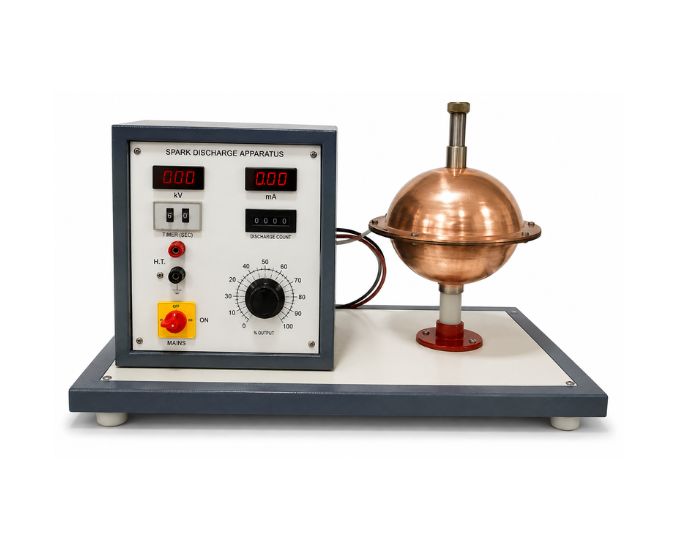
Thermal Conductivity of Insulating Powder Apparatus – Asbestos Method
Model Number: MTHC-111A
The Thermal Conductivity of Insulating Powder Apparatus – Asbestos Method from Micro Technologies is designed for experimental determination of the thermal conductivity of insulating powder using a spherical heat-transfer arrangement. The setup provides controlled electrical heating, temperature measurement, and power measurement for analyzing steady-state heat conduction through a layer of insulating material. It is suitable for heat transfer, thermal engineering, and mechanical engineering laboratories.
Product Specification
The Thermal Conductivity of Insulating Powder Apparatus – Asbestos Method is a laboratory heat-transfer setup designed to demonstrate the insulating characteristics and thermal conductivity of powdered insulating materials.
The apparatus consists primarily of two concentric spherical shells, with the annular space between them filled with the insulating powder to be tested. An electrical heating element provides a controlled heat source to the inner sphere, while temperature measurements are taken at suitable locations on the inner and outer surfaces.
When electrical energy is supplied to the heater, heat flows radially outward from the inner sphere through the insulating powder toward the outer spherical surface. Once steady-state conditions are established, the measured temperatures, electrical heat input, and known geometry of the apparatus can be used to calculate the thermal conductivity of the insulating material.
The spherical configuration provides a practical demonstration of radial heat conduction through insulation and allows students to understand how low-conductivity materials reduce heat transfer.
An integrated control and instrumentation unit provides convenient heater adjustment and monitoring of the experimental parameters. The complete assembly is mounted on a rigid laboratory base for convenient operation.
Safety note: The original reference identifies asbestos powder. Because asbestos presents serious inhalation hazards, modern laboratory use should employ a safe, non-asbestos insulating powder with suitable thermal properties rather than asbestos.
Scope of Learning
- Determination of thermal conductivity of insulating powder
- Study of radial heat conduction
- Study of heat transfer through spherical geometry
- Understanding thermal insulation
- Determination of temperature difference across insulation
- Study of steady-state heat conduction
- Calculation of thermal resistance
- Application of Fourier's law
- Analysis of insulating material performance
- Understanding the effect of low thermal conductivity
- Heat balance calculations
Working Principle
The apparatus works on the principle of steady-state radial heat conduction through a spherical layer.
The insulating powder is placed in the annular space between two concentric spherical surfaces. An electrical heater raises the temperature of the inner sphere.
Heat generated by the heater travels radially through the insulating material toward the outer sphere.
After steady-state conditions are achieved, the heat supplied electrically is related to the heat conducted through the insulating layer. Temperature readings and sphere dimensions are then used to determine the thermal conductivity.
For spherical conduction, thermal resistance can be expressed as:
R = [1/(4πk)] × [(1/r₁) − (1/r₂)]
Where:
- R = Thermal resistance
- k = Thermal conductivity
- r₁ = Inner radius
- r₂ = Outer radius
The corresponding temperature difference and heat-transfer rate can be used to determine k experimentally.
Spherical Heat Conduction Arrangement
Unlike conventional flat-plate conduction equipment, this apparatus uses a spherical test section.
The spherical configuration enables students to study:
- Radial temperature gradients
- Spherical conduction
- Thermal resistance of spherical insulation
- Heat loss through insulation
- Influence of insulating material properties
- Steady-state thermal behaviour
This makes the apparatus particularly useful for demonstrating heat conduction through insulated vessels and similar engineering systems.
Thermal Conductivity Determination
Thermal conductivity is a fundamental material property representing the ability of a substance to conduct heat.
A lower thermal conductivity generally corresponds to better insulating performance.
During the experiment, students measure the temperature difference between the inner and outer regions of the insulating layer and determine the electrical heat supplied.
These measurements are used with the known spherical geometry to calculate the thermal conductivity of the powder.
Main Components
- Inner spherical vessel
- Outer spherical vessel
- Insulating powder chamber
- Electrical heating element
- Temperature sensors
- Temperature measuring arrangement
- Heater power control
- Electrical power measurement
- Digital instrumentation
- Control switches
- Control and instrumentation panel
- Spherical test-section support
- Rigid laboratory base
Key Features
- Designed for insulating powder experiments
- Spherical heat conduction arrangement
- Concentric sphere construction
- Radial heat-transfer study
- Thermal conductivity determination
- Thermal resistance calculation
- Controlled electrical heating
- Temperature measurement arrangement
- Electrical power measurement
- Integrated control panel
- Steady-state conduction experiments
- Compact bench-mounted construction
- Clear demonstration of insulation principles
- Suitable for repeated laboratory experiments
- Simple experimental operation
- Suitable for engineering laboratories
Technical Specifications
| Parameter | Details |
|---|---|
| Product Name | Thermal Conductivity of Insulating Powder Apparatus |
| Principle | Steady-State Heat Conduction |
| Heat Flow | Radial |
| Test Geometry | Concentric Spherical Arrangement |
| Test Material | Suitable Insulating Powder |
| Property Determined | Thermal Conductivity |
| Thermal Resistance Study | Yes |
| Heating | Electrical |
| Heater Control | Variable / Controlled |
| Temperature Measurement | Provided |
| Electrical Measurement | Provided |
| Instrumentation | Digital |
| Test Section | Spherical |
| Installation | Bench Mounted |
| Application | Heat Transfer Laboratory |
| Customization | Available |
Exact sphere dimensions, heater rating, temperature range, sensor configuration, and electrical specifications can be supplied according to laboratory requirements.
Experiments / Studies
- To determine thermal conductivity of insulating powder
- To study radial heat conduction through insulating material
- To determine thermal resistance of powder insulation
- To study steady-state heat conduction
- To determine temperature difference across insulation
- To analyze heat flow through spherical geometry
- To apply Fourier's law experimentally
- To evaluate insulating material performance
- To perform thermal energy balance calculations
- To understand the relationship between conductivity and insulation
Educational Benefits
- Demonstrates thermal conductivity experimentally
- Provides practical understanding of insulation
- Introduces spherical heat conduction
- Demonstrates radial temperature gradients
- Helps students calculate thermal resistance
- Connects theoretical equations with experimental measurements
- Develops practical heat-transfer calculation skills
- Demonstrates the importance of insulation thickness and conductivity
- Suitable for laboratory practicals
- Useful for engineering demonstrations
- Supports undergraduate heat-transfer curricula
- Suitable for project work
Applications
- Heat Transfer Laboratories
- Thermal Engineering Laboratories
- Mechanical Engineering Laboratories
- Energy Engineering Laboratories
- Chemical Engineering Laboratories
- Material Testing Laboratories
- Engineering Colleges
- Universities
- Polytechnic Institutes
- Technical Training Institutes
- Research Laboratories
- Engineering R&D Centers
Recommended Test Materials
For current laboratory installations, suitable non-asbestos insulating materials should be selected based on the required temperature range and experimental design.
Compatible laboratory-grade insulating powders may be evaluated after confirming their suitability with the apparatus configuration.
Optional Accessories
- Additional Insulating Powder Samples
- Digital Temperature Indicator
- Additional Temperature Sensors
- Digital Voltmeter
- Digital Ammeter
- Digital Wattmeter
- Power Controller
- Data Acquisition System
- Computer Interface
- Data Logging Arrangement
- Experimental Manual
- Calibration Accessories
Customization Options
The apparatus can be customized with:
- Different spherical test-section dimensions
- Different heater capacities
- Additional temperature sensors
- Digital power measurement
- Enhanced temperature instrumentation
- Different safe insulating materials
- Data acquisition system
- Computerized data logging
- Customized control panel
- Research-oriented configurations
SKU System
MT-FHT-111A
FAQs
What is the Thermal Conductivity of Insulating Powder Apparatus used for?
It is used to experimentally determine the thermal conductivity of powdered insulating materials and demonstrate radial heat conduction through a spherical insulating layer.
What type of heat conduction is studied?
The apparatus primarily demonstrates steady-state radial heat conduction through spherical geometry.
How is the insulating powder positioned?
The test material is placed in the space between the inner and outer spherical surfaces of the experimental section.
Can thermal resistance be determined?
Yes. Experimental measurements and known spherical geometry can be used to calculate the thermal resistance of the insulating layer.
Why is a spherical arrangement used?
The spherical arrangement provides a controlled radial heat-flow path and demonstrates conduction through spherical insulation, an important heat-transfer configuration.
Does the apparatus require asbestos?
No. Although older versions of this experiment traditionally referenced asbestos powder, modern laboratory configurations should use an appropriate non-asbestos insulating material.
What measurements are required?
The experiment primarily requires temperature measurements and electrical heat-input measurements under steady-state conditions.
Where can this apparatus be used?
It is suitable for heat transfer, mechanical engineering, thermal engineering, chemical engineering, and energy engineering laboratories.
Can the apparatus be customized?
Yes. Micro Technologies can customize the spherical test section, heater capacity, sensors, instrumentation, safe test materials, and data acquisition according to laboratory requirements.
Why Choose Our Products
- Practical spherical heat-conduction experiment
- Thermal conductivity determination
- Radial heat-flow demonstration
- Controlled electrical heating
- Digital measurement and control
- Compact laboratory construction
- Modern non-asbestos test-material options
- Suitable for engineering curricula
- Customized configurations available
- Institutional and bulk supply
- OEM requirements supported
- Technical assistance available
Call to Action
Equip your heat-transfer laboratory with the Thermal Conductivity of Insulating Powder Apparatus from Micro Technologies for practical study of radial heat conduction and insulation performance. Contact us for technical specifications, safe non-asbestos test-material options, customized configurations, institutional quotations, OEM requirements, tenders, and bulk supply.