
Heat Conduction in Fluid Apparatus
Product Specification Sheet
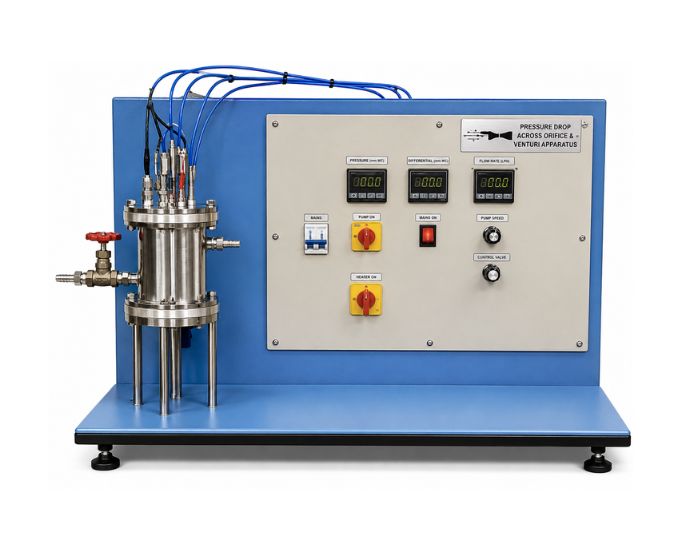
Heat Conduction in Fluid Apparatus
Model Number: MTHC-101
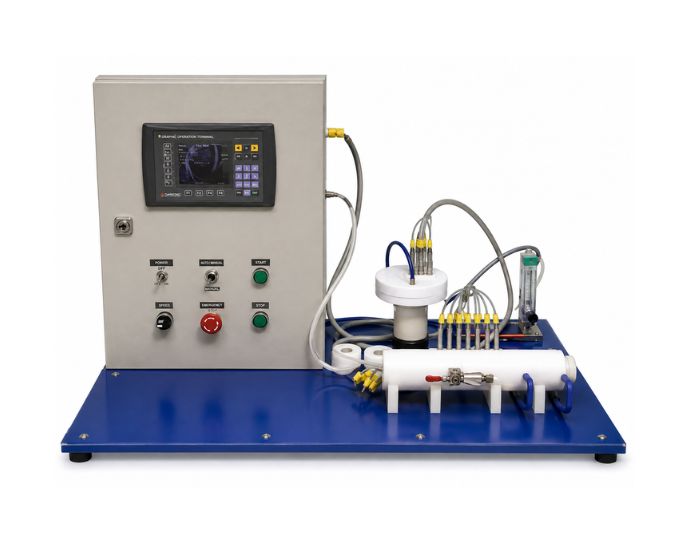
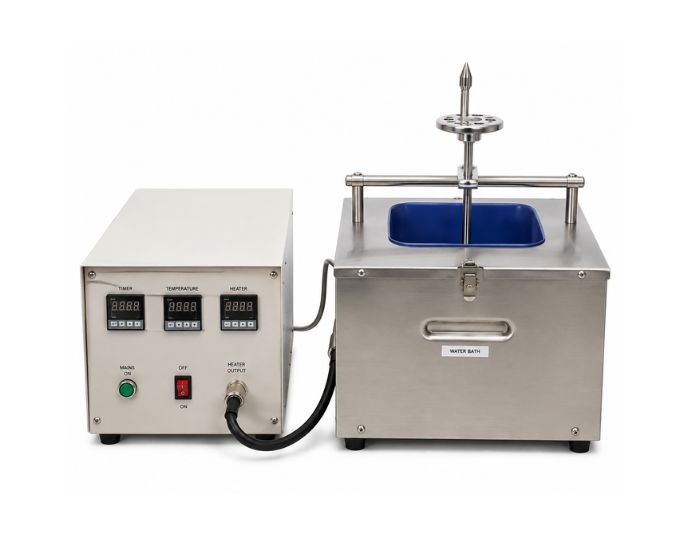
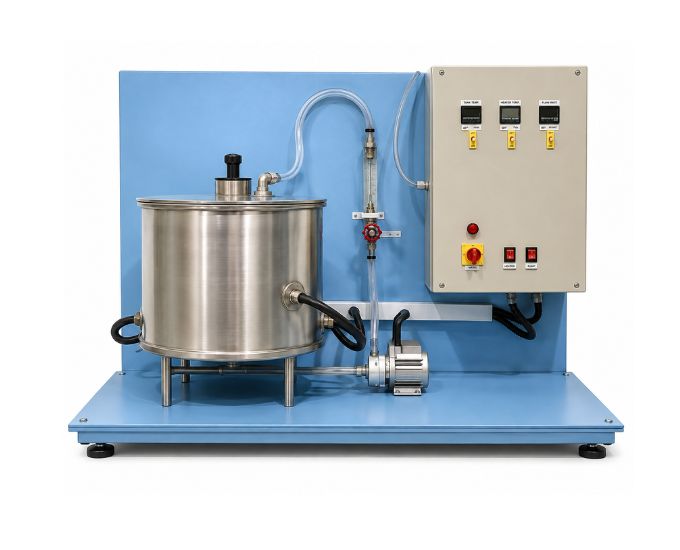
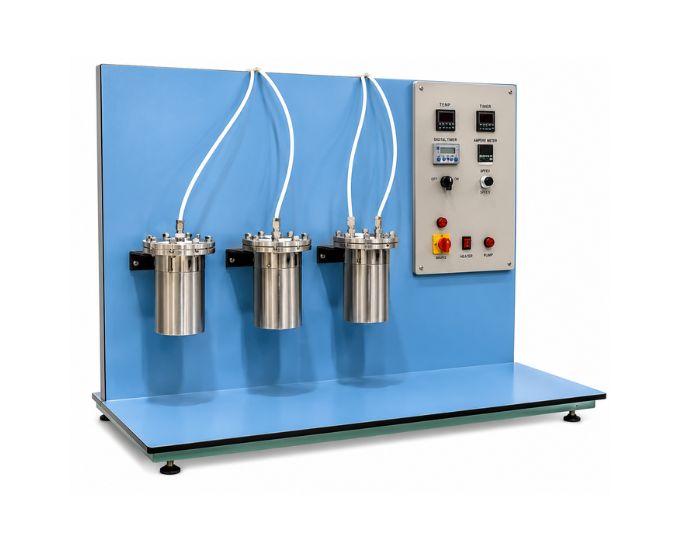
The Heat Conduction in Fluid Apparatus from Micro Technologies is a laboratory experimental system designed for studying thermal resistance and thermal conductivity of different fluids at varying temperatures. The apparatus provides controlled heating, temperature measurement, and a dedicated fluid test section, enabling students to investigate conductive heat transfer through liquid media. It is suitable for mechanical engineering, thermal engineering, chemical engineering, and heat transfer laboratories.
Product Specification
The Heat Conduction in Fluid Apparatus is a specialized educational and experimental system developed to investigate the principles of heat conduction through fluids. Manufactured by Micro Technologies, the apparatus enables students to determine the thermal resistance of a fluid and evaluate its thermal conductivity under controlled laboratory conditions.
Thermal conductivity is an important thermophysical property that describes the ability of a material to transfer heat through conduction. While the concept is commonly studied using solid materials, understanding conductive heat transfer through fluids is equally important in thermal engineering, process engineering, refrigeration, energy systems, and industrial heat-transfer applications.
The apparatus incorporates a specially designed fluid test section in which the selected fluid can be subjected to controlled thermal conditions. Heating is provided through an integrated electrical arrangement, while temperature sensors positioned at appropriate locations enable measurement of the temperature difference required for thermal analysis.
The system includes a dedicated instrumentation and control panel for monitoring operating parameters and controlling the experiment. The organized bench-mounted construction provides convenient access to the test section, valves, electrical controls, and measurement points.
Students can use the experimental readings to calculate the thermal resistance of the fluid and determine the thermal conductivity (k) using established heat-transfer relationships. Experiments can also be repeated at different temperatures to investigate how fluid thermal conductivity changes with operating temperature.
The apparatus is particularly useful for comparing different fluids under similar test conditions. This allows students to understand the relationship between fluid properties, temperature gradients, heat flow, thermal resistance, and conductivity.
Its compact laboratory design and clear instrumentation make the Heat Conduction in Fluid Apparatus suitable for undergraduate and postgraduate practical experiments, engineering demonstrations, laboratory projects, and thermal property studies.
Objectives / Scope of Learning
The apparatus is designed to support:
- Determination of thermal resistance of fluids
- Determination of thermal conductivity of fluids
- Measurement of thermal conductivity coefficient k
- Comparison of thermal properties of different fluids
- Study of heat conduction through liquid media
- Investigation of temperature gradients
- Study of the effect of temperature on thermal conductivity
- Understanding Fourier's law of heat conduction
- Analysis of steady-state heat transfer
- Practical understanding of thermal resistance
- Experimental verification of heat-transfer principles
Working Principle
Heat conduction occurs when thermal energy moves through a medium due to a temperature difference. In this apparatus, a controlled heat input is applied to the fluid test section, creating a measurable temperature gradient.
Temperature sensors monitor temperatures at predetermined locations. Once suitable operating conditions are achieved, the recorded temperature values and heat input can be used to analyze conductive heat transfer through the fluid.
The fundamental relationship can be represented by Fourier's Law of Heat Conduction:
Q = -kA(dT/dx)
Where:
- Q = Rate of heat transfer
- k = Thermal conductivity of fluid
- A = Effective heat-transfer area
- dT/dx = Temperature gradient
Using measured experimental values and the known geometry of the test section, the thermal conductivity of the test fluid can be determined.
Main Components
Fluid Test Section
A dedicated test chamber accommodates the fluid sample and provides the controlled geometry required for conducting thermal experiments.
Heating Arrangement
An electrical heating arrangement provides the controlled heat input required to establish a temperature gradient across the test fluid.
Temperature Sensors
Temperature sensors are positioned at suitable measurement locations for monitoring temperature variations during the experiment.
Temperature Indicator
A digital temperature measurement system allows convenient observation of temperatures during testing.
Electrical Measurement
Suitable electrical instrumentation is incorporated for monitoring the parameters required to determine heat input.
Control Panel
The control panel houses electrical switches, indicators, controllers, and measuring instruments for convenient experimental operation.
Flow / Filling Arrangement
Suitable valves and connections facilitate filling, draining, and handling of test fluids according to the experimental configuration.
Key Features
- Designed for thermal conductivity studies of fluids
- Determines thermal resistance of fluids
- Enables determination of thermal conductivity coefficient
- Suitable for testing different fluid samples
- Allows experiments at different temperatures
- Controlled electrical heating
- Integrated temperature measurement
- Digital instrumentation
- Convenient control panel
- Dedicated fluid test chamber
- Accessible valve and connection arrangement
- Bench-mounted laboratory construction
- Rigid supporting platform
- Simple experimental operation
- Suitable for repeated laboratory experiments
- Designed for engineering education and research
Technical Specifications
| Parameter | Details |
|---|---|
| Product Name | Heat Conduction in Fluid Apparatus |
| Product Type | Heat Transfer Laboratory Equipment |
| Experiment | Heat Conduction Through Fluids |
| Primary Measurement | Thermal Resistance |
| Property Determined | Thermal Conductivity (k) |
| Test Medium | Suitable Fluids |
| Heating | Electrical Heating Arrangement |
| Temperature Measurement | Integrated Sensors |
| Temperature Indication | Digital |
| Control | Integrated Control Panel |
| Test Section | Fluid Test Chamber |
| Installation | Bench Mounted |
| Application | Heat Transfer / Thermal Engineering Laboratory |
| Customization | Available as per requirement |
Instrument ranges, heater capacity, sensor configuration, test section dimensions, and electrical requirements can be supplied according to laboratory specifications.
Experiments / Studies
- To determine the thermal resistance of a fluid
- To determine thermal conductivity k of a fluid
- To compare thermal conductivity of different fluids
- To determine conductivity at different temperatures
- To study conductive heat transfer through fluids
- To understand thermal resistance
- To study temperature gradients
- To verify heat conduction principles experimentally
- To understand Fourier's law
- To analyze the effect of temperature on fluid properties
Educational Benefits
- Provides hands-on understanding of heat conduction
- Demonstrates thermal conductivity experimentally
- Helps connect heat-transfer theory with practical measurements
- Allows comparison between different fluids
- Develops experimental calculation skills
- Improves understanding of thermal resistance
- Helps students understand temperature-dependent fluid properties
- Suitable for individual and group practicals
- Useful for engineering laboratory examinations
- Supports thermal engineering curricula
- Suitable for project and research demonstrations
Applications
- Heat Transfer Laboratories
- Thermal Engineering Laboratories
- Mechanical Engineering Laboratories
- Chemical Engineering Laboratories
- Energy Engineering Laboratories
- Engineering Colleges
- Polytechnic Institutes
- Universities
- Technical Training Institutes
- Research Laboratories
- Process Engineering Laboratories
- Educational & Training Centers
Optional Accessories
- Additional Temperature Sensors
- Digital Temperature Indicator
- Digital Voltmeter
- Digital Ammeter
- Wattmeter
- Energy Meter
- Additional Fluid Containers
- Data Acquisition System
- Digital Control System
- Additional Test Fluids
- Experimental Manual
- Computer Interface
Customization Options
The apparatus can be customized with:
- Different test section dimensions
- Different heater capacities
- Additional temperature measurement points
- Digital temperature indicators
- Additional electrical instrumentation
- Different sensor configurations
- Data acquisition system
- Computer-based data logging
- Customized control panel
- Application-specific test arrangements
SKU System
MT-FHT-102
FAQs
What is the Heat Conduction in Fluid Apparatus used for?
The apparatus is used to experimentally determine the thermal resistance and thermal conductivity of fluids and to study conductive heat transfer under controlled conditions.
Can different fluids be tested?
Yes. Suitable fluids can be evaluated and compared to understand differences in their thermal conductivity and thermal resistance.
Can thermal conductivity be determined at different temperatures?
Yes. One of the primary objectives of the apparatus is to investigate the thermal conductivity coefficient (k) of fluids at different temperatures.
What principle is used in this experiment?
The experiment is based primarily on Fourier's law of heat conduction, which relates heat-transfer rate to thermal conductivity and temperature gradient.
Does the apparatus include temperature measurement?
Yes. Temperature sensors and suitable indication are incorporated for monitoring the temperatures required for experimental calculations.
Where can this apparatus be used?
It is suitable for mechanical engineering, thermal engineering, chemical engineering, heat transfer, process engineering, and energy engineering laboratories.
Is this suitable for engineering colleges?
Yes. It is designed for practical laboratory education in engineering colleges, universities, polytechnic institutes, and technical training centers.
Can the apparatus be customized?
Yes. Micro Technologies can customize heater capacity, instrumentation, temperature sensors, test section configuration, control system, and other specifications according to laboratory requirements.
Why Choose Our Products
- Application-focused heat transfer equipment
- Designed for practical thermal conductivity studies
- Integrated measurement and control system
- Robust laboratory construction
- Easy-to-understand experimental arrangement
- Suitable for engineering curricula
- Customized configurations available
- Institutional and project supply
- OEM requirements supported
- Quality-controlled manufacturing
- Technical assistance available
- Reliable after-sales support
Call to Action
Strengthen practical heat-transfer education with the Heat Conduction in Fluid Apparatus from Micro Technologies. Contact us for technical specifications, customized configurations, engineering laboratory projects, institutional quotations, government tenders, OEM requirements, distributor inquiries, and bulk supply.