
Radial and Linear Heat Conduction Apparatus
Product Specification Sheet
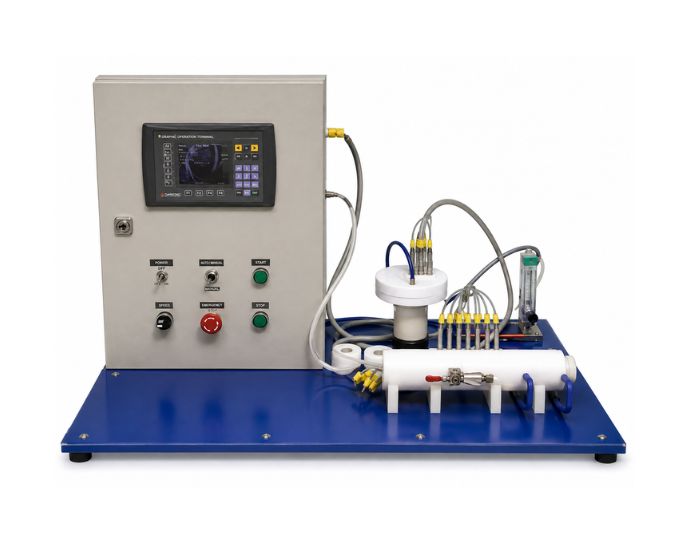
Radial and Linear Heat Conduction Apparatus
Model Number: MTHC-107
The Radial and Linear Heat Conduction Apparatus from Micro Technologies is an advanced laboratory experimental system designed for the study of steady-state heat conduction in both linear and radial geometries. The apparatus enables students to determine temperature profiles, analyze thermal disturbances, and calculate the thermal conductivity (λ) of different materials. Its integrated heater, test sections, temperature sensors, digital instrumentation, and control panel make it ideal for heat transfer, thermal engineering, and mechanical engineering laboratories.
Product Specification
The Radial and Linear Heat Conduction Apparatus is a comprehensive laboratory setup developed to demonstrate and analyze the fundamental principles of heat conduction through solid materials in both one-dimensional linear and radial configurations.
Manufactured by Micro Technologies, the system helps students understand how heat flows through solids when a temperature gradient exists and how material properties influence the rate of heat transfer.
The apparatus is divided into two primary experimental sections:
- Linear Heat Conduction Section
- Radial Heat Conduction Section
In the linear conduction experiment, heat transfer through a plane wall or straight specimen can be studied. Students can measure temperature at several positions along the specimen and determine the resulting temperature profile.
The setup also enables comparison of different materials to study how thermal conductivity affects heat flow. This is particularly useful for understanding insulating and conductive materials.
The apparatus additionally allows the study of a temperature profile when a disturbance is introduced into the conduction path. This experiment helps students understand non-uniform heat flow and the effect of thermal resistance variations.
In the radial conduction section, heat transfer through a cylindrical or disc-type geometry can be investigated. Temperature measurements at different radial positions enable students to analyze the temperature distribution and determine thermal conductivity under radial heat flow conditions.
A digital control and instrumentation system provides convenient operation, temperature monitoring, and power control. Multiple temperature sensors are positioned in the test sections to provide the data required for thermal calculations.
The complete system is mounted on a rigid laboratory platform with an accessible test arrangement, making it suitable for repeated practical experiments, classroom demonstrations, engineering projects, and research-based learning.
Scope of Learning
The apparatus supports the study of:
- Linear heat conduction
- Radial heat conduction
- Plane wall conduction
- Temperature profiles in solids
- Thermal conductivity of materials
- Effect of different materials on heat flow
- Temperature profile under disturbance
- Steady-state heat conduction
- Thermal resistance
- One-dimensional heat flow
- Radial heat flow
- Fourier’s law of heat conduction
- Comparison of conductive materials
Linear Heat Conduction
The linear conduction section is designed to demonstrate heat transfer through a straight or plane-wall geometry.
Students can measure the temperature at different positions along the material and plot the resulting temperature profile.
The experiment helps in understanding:
- Temperature gradient
- Heat flow direction
- Thermal resistance
- Thermal conductivity
- Effect of material properties
- Steady-state conduction
The test section can be used with different material samples to compare thermal behaviour.
Temperature Profile for Different Materials
The apparatus allows the temperature profile to be determined for different materials.
This enables students to observe how thermal conductivity influences the slope of the temperature distribution.
Materials with high thermal conductivity transfer heat more readily, while low-conductivity materials provide greater resistance to heat flow.
Temperature Profile with Disturbance
The linear test section also enables investigation of the effect of a disturbance or discontinuity in the heat conduction path.
This provides practical insight into:
- Contact resistance
- Material interface effects
- Local temperature variation
- Non-uniform heat transfer
- Composite conduction behaviour
Radial Heat Conduction
The radial conduction section is designed to study heat flow in a radial direction from a central heated region toward the outer boundary.
Temperature sensors positioned at different radial locations allow students to record and analyze the temperature distribution.
This experiment helps in understanding heat transfer through cylindrical and disc-type geometries, which are commonly encountered in engineering systems.
Thermal Conductivity Determination
The apparatus can be used to determine the thermal conductivity (λ) of materials experimentally.
For linear conduction, Fourier’s law can be expressed as:
Q = -kA(dT/dx)
For radial conduction, the heat transfer relationship depends on cylindrical geometry and the radial temperature gradient.
Where:
- Q = Heat transfer rate
- k or λ = Thermal conductivity
- A = Heat transfer area
- dT/dx = Temperature gradient
The measured heat input, geometry, and temperature readings can be used to calculate thermal conductivity.
Main Components
- Linear heat conduction test section
- Radial heat conduction test section
- Electrical heating arrangement
- Multiple temperature sensors
- Digital temperature indication
- Digital control panel
- Heater power control
- Electrical measuring instruments
- Test specimen holders
- Rigid laboratory base
- Interconnecting cables
- Insulated test assemblies
Key Features
- Combined linear and radial heat conduction experiments
- Plane wall heat conduction study
- Radial conduction study
- Temperature profile determination
- Thermal conductivity measurement
- Different material comparison
- Disturbance effect analysis
- Multiple temperature measurement points
- Controlled electrical heating
- Digital instrumentation
- Integrated control panel
- Compact laboratory setup
- Robust bench-mounted construction
- Easy experimental operation
- Suitable for repeated engineering experiments
- Designed for academic and research use
Technical Specifications
| Parameter | Details |
|---|---|
| Product Name | Radial and Linear Heat Conduction Apparatus |
| Product Type | Heat Transfer Laboratory Apparatus |
| Heat Transfer Mode | Conduction |
| Linear Experiment | Plane Wall / Straight Specimen |
| Radial Experiment | Radial Conduction Test Section |
| Thermal Conductivity Study | Yes |
| Temperature Profile Study | Yes |
| Disturbance Study | Yes |
| Heating | Electrical |
| Temperature Measurement | Multiple Sensors |
| Temperature Indication | Digital |
| Control | Integrated Control Panel |
| Installation | Bench Mounted |
| Application | Heat Transfer / Thermal Engineering Laboratory |
| Customization | Available |
Detailed heater capacity, specimen materials, sensor count, temperature range, and electrical requirements can be customized according to laboratory requirements.
Experiments / Studies
- To study linear heat conduction
- To study radial heat conduction
- To determine temperature profiles for different materials
- To determine the temperature profile in the presence of a disturbance
- To determine thermal conductivity λ
- To compare thermal conductivity of different materials
- To study heat transfer through a plane wall
- To analyze radial temperature distribution
- To verify Fourier’s law of heat conduction
- To study thermal resistance
- To understand steady-state conduction
- To analyze material interface effects
Educational Benefits
- Provides practical understanding of heat conduction
- Combines linear and radial conduction in one setup
- Helps students visualize temperature gradients
- Enables thermal conductivity calculations
- Demonstrates effect of material properties
- Supports comparison of different test specimens
- Helps understand thermal resistance
- Connects theory with practical measurements
- Suitable for individual and group experiments
- Useful for laboratory examinations
- Supports mechanical and thermal engineering curricula
- Ideal for heat-transfer demonstrations
Applications
- Heat Transfer Laboratories
- Thermal Engineering Laboratories
- Mechanical Engineering Laboratories
- Energy Engineering Laboratories
- Chemical Engineering Laboratories
- Engineering Colleges
- Universities
- Polytechnic Institutes
- Technical Training Institutes
- Research Laboratories
- Engineering R&D Centers
- Educational Training Laboratories
Optional Accessories
- Additional Material Specimens
- Additional Temperature Sensors
- Digital Temperature Indicator
- Digital Voltmeter
- Digital Ammeter
- Digital Wattmeter
- Data Acquisition System
- Computer Interface
- Digital Control System
- Insulation Test Samples
- Experimental Manual
- Calibration Accessories
Customization Options
The Radial and Linear Heat Conduction Apparatus can be customized with:
- Different specimen materials
- Additional temperature measurement points
- Different heater capacities
- Digital wattmeter
- Data acquisition system
- Computerized data logging
- Different test geometries
- Enhanced control panel
- Additional thermal insulation
- Customized specimen dimensions
- Research-oriented configurations
SKU System
MT-FHT-107
FAQs
What is the Radial and Linear Heat Conduction Apparatus used for?
It is used to study heat conduction in both linear and radial directions, determine temperature profiles, and calculate the thermal conductivity of different materials.
What experiments can be performed in the linear section?
Students can study plane wall conduction, temperature distribution, different material behaviour, and the effect of disturbances in the conduction path.
What is studied in the radial conduction section?
The radial section is used to determine the temperature profile and thermal conductivity under radial heat flow conditions.
Can different materials be tested?
Yes. Different test specimens can be used to compare thermal conductivity and temperature profiles.
Can thermal conductivity be calculated experimentally?
Yes. The apparatus is specifically designed to determine thermal conductivity λ using measured heat input and temperature data.
Does the apparatus include temperature sensors?
Yes. Multiple temperature sensors are integrated into the test sections for detailed temperature profile measurement.
Where can this apparatus be used?
It is suitable for heat transfer, mechanical engineering, thermal engineering, chemical engineering, and energy engineering laboratories.
Can the apparatus be customized?
Yes. Micro Technologies can customize test materials, heater capacity, sensor configuration, instrumentation, data acquisition, and control arrangements according to laboratory requirements.
Why Choose Our Products
- Combined linear and radial conduction studies
- Practical thermal conductivity determination
- Multiple temperature measurement points
- Digital instrumentation and control
- Robust engineering laboratory construction
- Suitable for academic curricula
- Customized configurations available
- Institutional and project supply
- OEM requirements supported
- Quality-controlled manufacturing
- Technical assistance available
- Reliable after-sales support
Call to Action
Enhance practical heat-transfer education with the Radial and Linear Heat Conduction Apparatus from Micro Technologies. Contact us for technical specifications, customized configurations, engineering laboratory projects, institutional quotations, government tenders, OEM requirements, distributor inquiries, and bulk supply.