
Loop Piano Wire
Product Specification Sheet
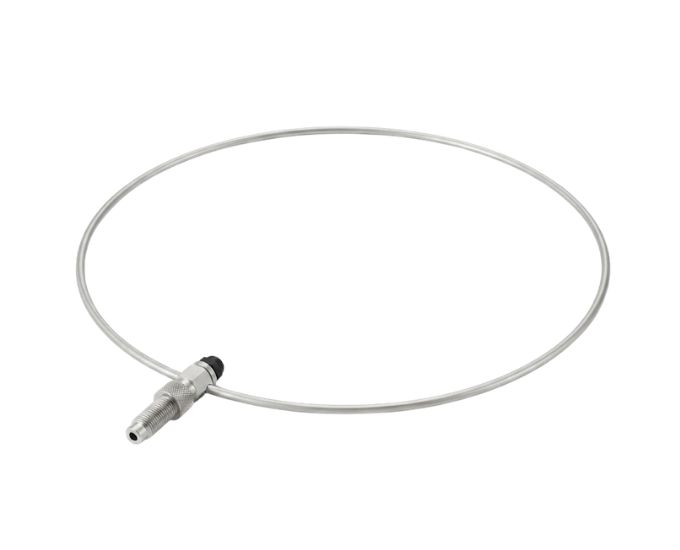
Loop Piano Wire
Model Number: MTW-19
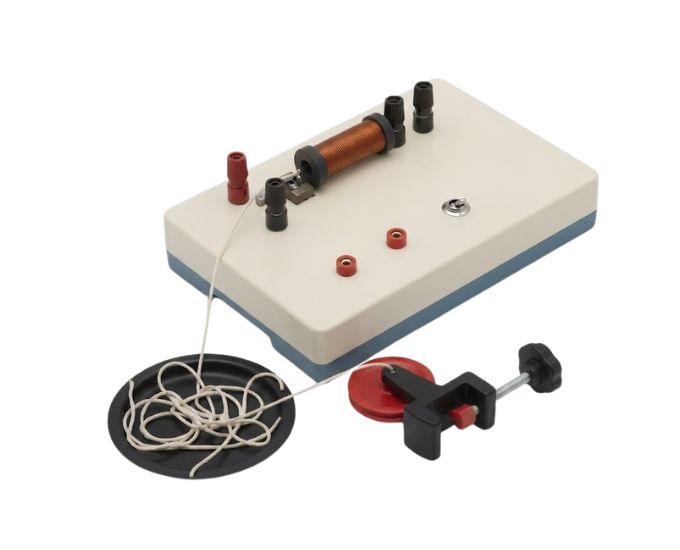
The Loop Piano Wire is a specialized accessory designed for use with a compatible vibration generator to demonstrate mechanical wave motion and investigate the relationship between excitation frequency and the number of vibrational nodes. Micro Technologies supplies the wire in a loop configuration that responds visibly when mechanically excited by the vibration generator. As the excitation frequency is varied, different vibration modes and nodal patterns can be produced along the wire. Its simple construction provides a clear visual method for studying standing waves, resonance, nodes, antinodes, and frequency-dependent vibration behaviour.
Product Specification
The Loop Piano Wire is a mechanical vibration accessory designed for use with a compatible Vibration Generator. It provides a simple and highly visible arrangement for investigating wave motion and the formation of vibration patterns in a flexible wire loop.
The piano wire is formed into a loop and connected to the vibration-generating system. When the vibration generator is driven by a suitable variable-frequency signal source, mechanical oscillations are transferred to the wire.
As the excitation frequency is changed, the vibration pattern of the loop changes. At suitable frequencies, characteristic standing-wave modes can develop, producing regions of comparatively low displacement known as nodes and regions of greater displacement known as antinodes.
Micro Technologies supplies the Loop Piano Wire specifically for demonstrating the relationship between frequency and the number of vibrational nodes. By progressively changing the excitation frequency and observing the resulting patterns, different vibration modes can be compared directly.
The apparatus can also be used to investigate resonance and standing-wave behaviour. When the applied excitation corresponds appropriately to one of the natural modes of the wire system, a clearly defined vibration pattern can be produced.
Its lightweight wire construction responds readily to mechanical excitation, while the loop geometry makes the resulting vibration patterns easy to observe. The accessory requires a compatible vibration generator and appropriate signal source for controlled operation.
With its straightforward construction and clear visual response, the Loop Piano Wire provides a useful addition to vibration, resonance, standing-wave, and mechanical wave experiment setups.
Features
- Piano wire in loop configuration
- Designed as a vibration generator accessory
- Demonstrates mechanical wave motion
- Produces visible vibration patterns
- Suitable for standing-wave investigations
- Demonstrates vibrational nodes and antinodes
- Allows comparison at different excitation frequencies
- Useful for resonance investigations
- Lightweight and responsive construction
- Simple mounting arrangement
- Reusable laboratory accessory
- Suitable for mechanical vibration experiments
Benefits
- Makes mechanical wave motion visually observable
- Demonstrates the relationship between frequency and vibrational nodes
- Allows different vibration modes to be compared
- Supports standing-wave and resonance investigations
- Simple accessory integrates easily with compatible vibration generators
- Requires minimal setup and maintenance
- Compact construction simplifies storage
- Useful for expanding existing vibration experiment systems
Product Specifications
| Specification | Details |
|---|---|
| Product Name | Loop Piano Wire |
| Internal Model No. | MT-36214C |
| Product Type | Vibration Generator Accessory |
| Material | Piano Wire |
| Configuration | Loop |
| Excitation Method | Mechanical vibration |
| Compatible Equipment | Vibration Generator |
| Frequency Source | Suitable variable-frequency signal generator |
| Primary Demonstration | Wave motion |
| Wave Behaviour | Standing-wave patterns |
| Primary Observation | Vibrational nodes and antinodes |
| Variable Parameter | Excitation frequency |
| Usage / Application | Wave motion, resonance and vibration experiments |
| Compliance Standard | Laboratory-grade mechanical construction |
Available Variants
- MT-36214C – Standard Loop Piano Wire
- Loop Piano Wire for Vibration Generator
- Standing Wave Piano Wire Loop
- Resonance & Vibration Wire Accessory
- Customized configurations for bulk requirements
SKU System
- MT-LPW-STD – Standard Loop Piano Wire
- MT-LPW-VG – Vibration Generator Configuration
- MT-LPW-SW – Standing Wave Configuration
- MT-LPW-RES – Resonance Experiment Configuration
- MT-LPW-CUS – Customized Configuration
FAQs
What is Loop Piano Wire used for?
Loop Piano Wire is used with a vibration generator to demonstrate mechanical wave motion and investigate the relationship between excitation frequency and vibrational nodes.
What equipment is required to use the wire?
A compatible Vibration Generator and suitable variable-frequency signal source are normally required to produce controlled mechanical excitation.
What happens when the excitation frequency is changed?
Changing the excitation frequency can alter the vibration mode of the wire, resulting in different numbers and positions of nodes and antinodes.
What are vibrational nodes?
Nodes are positions in a standing-wave pattern where the displacement of the vibrating wire is minimal.
What are antinodes?
Antinodes are regions between nodes where the vibration amplitude is comparatively large.
Can the Loop Piano Wire demonstrate standing waves?
Yes. Under suitable excitation conditions, clearly observable standing-wave patterns can be produced in the wire loop.
Can it be used for resonance experiments?
Yes. Resonant vibration modes can be investigated by adjusting the applied frequency and observing the resulting wire patterns.
Is the Vibration Generator included?
No. The Loop Piano Wire is an accessory for a compatible Vibration Generator unless a complete experiment setup is specifically ordered.
Does the Loop Piano Wire require electricity?
The wire itself requires no electrical supply. However, the compatible vibration generator and signal source used to excite it may require electrical power.
How should the wire be handled?
Avoid excessive bending, kinking, stretching, or deformation of the piano wire, as these can alter its vibration characteristics.
Can it be supplied with a complete vibration experiment setup?
Yes. It can be supplied along with compatible vibration generators, signal generators, Chladni plates, resonance strips, and related vibration accessories.
Can Loop Piano Wires be ordered in bulk?
Yes. Micro Technologies can supply bulk quantities for physics laboratories, vibration laboratories, universities, colleges, research facilities, distributors, and institutional projects.
Why Choose Our Products
- Clear visual demonstration of wave motion
- Suitable for standing-wave and resonance experiments
- Demonstrates frequency versus vibrational nodes
- Compatible with vibration generator setups
- Simple and reusable construction
- Bulk supply capability for laboratory projects
Call to Action
Expand your vibration experiment setup with Loop Piano Wire for wave motion, standing-wave, node, and resonance investigations. Contact Micro Technologies for competitive quotations, bulk orders, distributor supply, institutional procurement, and complete vibration laboratory equipment requirements.