
Resonance Apparatus
Product Specification Sheet
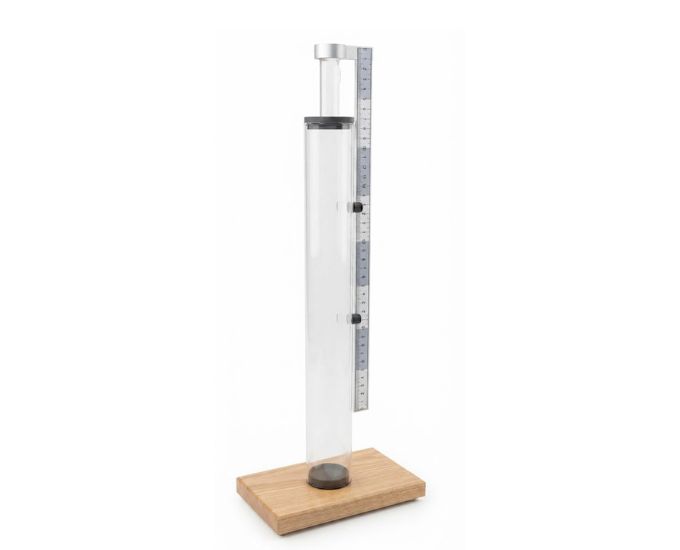
Resonance Apparatus
Model Number: MTW-12
The Resonance Apparatus is a precision acoustics setup designed to investigate the relationship between the length, frequency, wavelength, and velocity of sound waves through resonance in an air column. Micro Technologies supplies the apparatus with a vertically mounted graduated water cylinder that allows the effective length of the air column above the water to be measured. A vibrating tuning fork of known frequency is positioned above the cylinder, and the water level is adjusted until maximum resonance is obtained. The measured resonant air-column length can then be used with the known tuning-fork frequency to determine the wavelength and calculate the velocity of sound. The apparatus provides a clear and practical method for studying air-column resonance and sound-wave behaviour.
Product Specification
The Resonance Apparatus is designed for quantitative investigations of sound waves using the resonance of an adjustable air column. It provides a straightforward experimental method for relating the frequency of a tuning fork to the wavelength and velocity of sound in air.
The apparatus incorporates a graduated vertical water cylinder mounted securely on a stable support. The graduation allows the effective length of the air column above the water surface to be measured during an experiment.
A vibrating tuning fork of known frequency is held over the open end of the cylinder. The water level is then varied to change the length of the enclosed air column. At particular air-column lengths, the natural acoustic frequency of the column corresponds to the frequency of the tuning fork, producing a noticeable increase in sound intensity.
This condition indicates resonance. Once the resonance position has been identified, the corresponding air-column length can be measured using the graduated scale. Suitable resonance relationships can then be applied to determine the wavelength of the sound.
Micro Technologies supplies the apparatus for experiments based on the fundamental wave relationship v = fλ, where v represents the velocity of sound, f is the known frequency of the tuning fork, and λ represents the experimentally determined wavelength.
The adjustable water-column arrangement allows resonance positions to be located accurately and provides a visible method of changing the effective length of the resonating air column. Multiple readings can be taken to improve experimental comparison and calculation.
With its graduated tube, adjustable water level, stable vertical support, and straightforward operating principle, the Resonance Apparatus provides a practical solution for experiments involving resonance, wavelength, frequency, and the determination of the velocity of sound in air.
Features
- Designed for air-column resonance experiments
- Graduated vertical resonance cylinder
- Adjustable water level
- Variable effective air-column length
- Suitable for use with vibrating tuning forks
- Enables resonant-length measurement
- Supports wavelength determination
- Allows calculation of velocity of sound
- Stable vertical mounting arrangement
- Clearly visible graduated scale
- Simple mechanical operation
- Suitable for repeated acoustics experiments
Benefits
- Demonstrates resonance in an air column clearly
- Allows experimental calculation of the speed of sound
- Graduated scale simplifies air-column measurement
- Adjustable water level provides controlled variation in resonant length
- Can be used with different suitable tuning-fork frequencies
- Supports quantitative sound-wave investigations
- Simple construction minimizes maintenance requirements
- Practical for complete acoustics laboratory installations
Product Specifications
| Specification | Details |
|---|---|
| Product Name | Resonance Apparatus |
| Internal Model No. | MT-36178P |
| Product Type | Water Column Resonance Apparatus |
| Tube / Cylinder Type | Graduated |
| Mounting | Vertical |
| Air Column | Variable |
| Adjustment Method | Water-level variation |
| Sound Source | Vibrating tuning fork |
| Frequency | According to tuning fork used |
| Measured Parameter | Resonant air-column length |
| Calculated Parameters | Wavelength and velocity of sound |
| Wave Relationship | v = fλ |
| Scale | Graduated measurement scale |
| Base | Stable bench-top support |
| Power Requirement | None |
| Usage / Application | Resonance, wavelength, frequency and velocity of sound experiments |
| Compliance Standard | Laboratory-grade mechanical construction |
Available Variants
- MT-36178P – Standard Resonance Apparatus
- Graduated Water Column Resonance Apparatus
- Resonance Tube for Velocity of Sound Experiments
- Tuning Fork Resonance Column Apparatus
- Customized configuration for bulk laboratory requirements
SKU System
- MT-RA-WC – Water Column Resonance Apparatus
- MT-RA-GRD – Graduated Resonance Apparatus
- MT-RA-VOS – Velocity of Sound Configuration
- MT-RA-TF – Tuning Fork Resonance Configuration
- MT-RA-CUS – Customized Configuration
FAQs
What is the Resonance Apparatus used for?
The apparatus is used to investigate resonance in an air column and determine relationships between frequency, wavelength, resonant length, and velocity of sound.
How is resonance produced in the apparatus?
A vibrating tuning fork is held above the open end of the resonance cylinder. The water level is adjusted until the air column reaches a length at which its acoustic resonance corresponds to the tuning-fork frequency.
How is the velocity of sound calculated?
After determining the wavelength from the measured resonance conditions, the velocity is calculated using v = fλ, where f is frequency and λ is wavelength.
Why is water used in the resonance tube?
Changing the water level changes the effective length of the air column above it. This allows different air-column lengths to be tested until resonance occurs.
What is the purpose of the graduated scale?
The graduated scale allows the length of the resonating air column to be measured at each resonance position.
Is a tuning fork required?
Yes. A suitable tuning fork with a known frequency is required to provide the acoustic excitation for the resonance experiment.
Can different tuning fork frequencies be used?
Yes. Different compatible tuning forks can be used provided the resulting resonance positions fall within the measurement range of the apparatus.
What happens when resonance occurs?
At resonance, the sound produced by the air column becomes noticeably stronger because the air column is vibrating efficiently at the excitation frequency.
Can wavelength be determined with this apparatus?
Yes. Resonance measurements can be used with the appropriate closed-air-column relationships to determine the wavelength of the sound.
Does the Resonance Apparatus require electricity?
No. The apparatus itself operates mechanically and does not require an electrical power supply.
How should the apparatus be maintained?
Keep the cylinder, scale, support, and base clean. After experiments, remove or manage water appropriately and keep the apparatus dry during storage.
Can Resonance Apparatus be supplied in bulk?
Yes. Micro Technologies can supply bulk quantities for physics laboratories, acoustics laboratories, universities, colleges, research facilities, distributors, and institutional projects.
Why Choose Our Products
- Graduated water-column measurement system
- Suitable for velocity-of-sound calculations
- Supports frequency and wavelength investigations
- Stable vertical laboratory configuration
- Simple operation and low maintenance
- Bulk supply capability for laboratories and distributors
Call to Action
Looking for a Resonance Apparatus for air-column, wavelength, frequency, and velocity-of-sound experiments? Contact Micro Technologies for competitive quotations, bulk procurement, institutional orders, distributor supply, and customized acoustics laboratory equipment requirements.