
Laboratory Elutriator
Product Specification Sheet
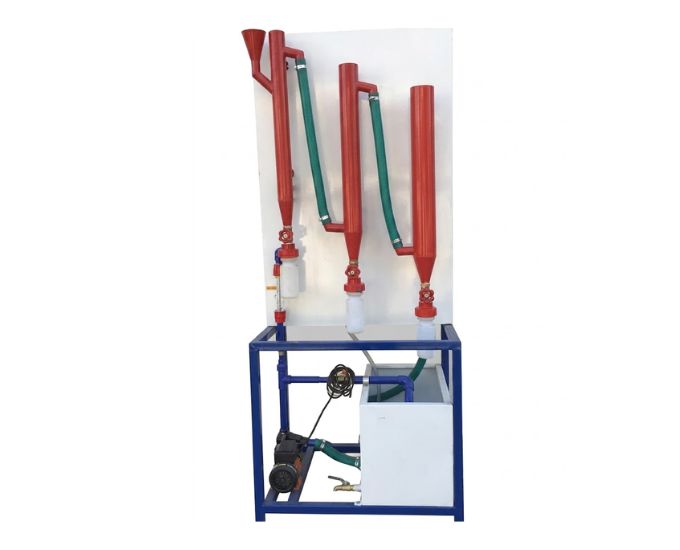
Laboratory Elutriator
Model Number: MTMO-115
The Laboratory Elutriator is an educational particle-separation system designed for studying hydraulic classification using an upward flow of water. It enables students to determine the water velocity required to separate equal-sized particles of different densities and to separate particles of the same density according to size.
Product Specification
The Laboratory Elutriator is a Mechanical Operations laboratory system developed for practical investigation of particle classification and separation using a controlled upward flow of water.
Elutriation is a particle-classification technique in which solid particles are exposed to an upward-moving fluid. Separation occurs because particles having different sizes or densities exhibit different settling characteristics in the fluid.
The apparatus provides students with practical understanding of the relationship between particle properties, settling behaviour and fluid velocity.
One of the principal experiments involves determining the velocity of water required for separation of equal-sized particles having different densities.
When particles have approximately the same size but different densities, their settling velocities differ. By controlling the upward water velocity, suitable conditions can be established under which lighter particles are carried upward while denser particles behave differently.
This provides a practical demonstration of density-based particle classification.
Another important experiment involves determining the water velocity required to separate particles of the same density according to size.
For particles of similar material and density, particle size strongly influences settling behaviour. Larger and smaller particles therefore respond differently to the upward-moving water.
By progressively adjusting the water flow, students can identify the velocity conditions required to separate different particle-size fractions.
The apparatus helps students understand important concepts associated with terminal settling velocity, drag, particle density, particle diameter and fluid flow.
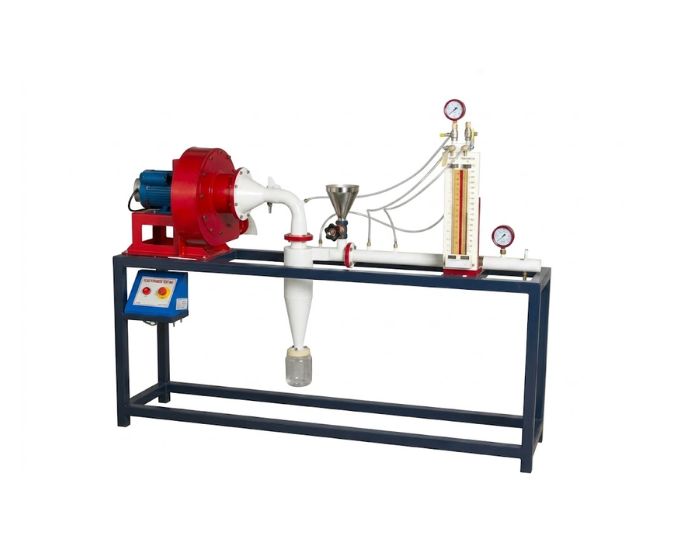
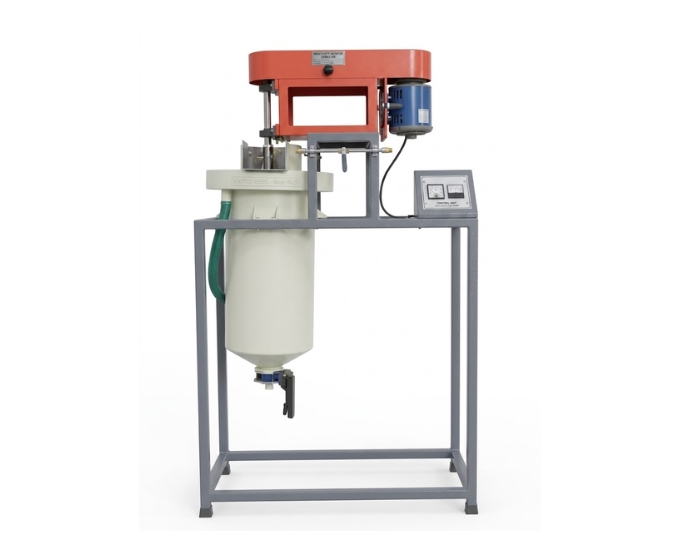
The system typically incorporates vertical elutriation columns, water circulation or supply arrangements, flow-control components and particle collection facilities.
Different columns or operating conditions can be used to demonstrate the effect of particle characteristics on classification behaviour.
Experimental observations can be related to theoretical concepts used in particle technology, mechanical operations and fluid-particle systems.
The apparatus provides an effective link between theoretical sedimentation concepts and practical industrial classification processes.
Micro Technologies supplies Laboratory Elutriators and other Mechanical Operations Equipment for engineering colleges, universities, research laboratories, polytechnic institutes and technical training centres.
Features
- Laboratory-scale elutriation system
- Multiple vertical separation columns
- Upward water-flow arrangement
- Adjustable water velocity
- Particle classification experiments
- Size-based separation studies
- Density-based separation studies
- Equal-size particle comparison
- Equal-density particle comparison
- Settling velocity investigation
- Fluid-particle interaction studies
- Water-flow control arrangement
- Particle collection facility
- Recirculation arrangement where applicable
- Robust laboratory support frame
- Suitable for repeated educational experiments
Benefits
- Demonstrates hydraulic classification practically
- Enables particle separation using controlled water flow
- Demonstrates the effect of particle density
- Shows the influence of particle size on separation
- Enables water-velocity determination
- Helps students understand settling behaviour
- Introduces terminal velocity concepts
- Provides practical fluid-particle interaction studies
- Connects particle technology theory with experiments
- Suitable for Mechanical Operations laboratories
Product Specifications
| Specification | Details |
|---|---|
| Product Name | Laboratory Elutriator |
| Equipment Type | Particle Classification Equipment |
| Separation Method | Elutriation |
| Fluid Medium | Water |
| Flow Direction | Upward |
| Separation Basis | Particle Size & Density |
| Equal-Size Particle Study | Supported |
| Different-Density Study | Supported |
| Same-Density Particle Study | Supported |
| Different-Size Study | Supported |
| Water Velocity | Adjustable |
| Settling Behaviour | Study Supported |
| Particle Classification | Supported |
| Flow Control | Provided |
| Application | Mechanical Operations / Separation |
Experiments Performed
- Study of the elutriation process
- Demonstration of hydraulic particle classification
- Determination of water velocity for particle separation
- Separation of equal-sized particles of different densities
- Study of density-based particle separation
- Determination of water velocity for separating particles of the same density
- Separation of particles according to size
- Investigation of particle settling behaviour
- Study of the effect of particle density
- Study of the effect of particle diameter
- Investigation of upward fluid velocity
- Study of terminal settling behaviour
- Investigation of fluid-particle interaction
- Comparison of particle fractions under different flow conditions
Applications
- Mechanical Operations Laboratories
- Chemical Engineering Laboratories
- Particle Technology Laboratories
- Separation Process Laboratories
- Mineral Processing Laboratories
- Mining Engineering Laboratories
- Fluid-Particle Mechanics Laboratories
- Process Engineering Laboratories
- Engineering Colleges
- Universities
- Polytechnic Institutes
- Technical Training Centres
- Research & Educational Laboratories
FAQs
What is a Laboratory Elutriator used for?
A Laboratory Elutriator is used to study hydraulic classification and the separation of solid particles according to differences in size, density and settling behaviour.
What fluid is used in this apparatus?
The shown laboratory system is designed for experiments using water as the fluid medium.
How does an elutriator separate particles?
Particles are exposed to an upward-moving water stream. Depending on their settling characteristics, some particles are carried upward while others settle or remain in lower regions.
Can equal-sized particles of different densities be separated?
Yes. One of the main experiments is to determine the water velocity required to separate equal-sized particles having different densities.
Can particles of the same density but different sizes be separated?
Yes. The apparatus enables students to determine suitable water velocities for separating particles of similar density according to their size.
Why does particle density affect separation?
Particle density influences the balance between gravitational, buoyancy and drag effects, which in turn affects settling behaviour.
Why does particle size affect elutriation?
Particle size influences drag and settling velocity. As a result, particles of different sizes can respond differently to the same upward fluid velocity.
What is terminal settling velocity?
Terminal settling velocity is the steady velocity reached by a particle when the net gravitational force is balanced by fluid resistance and buoyancy.
Is elutriation the same as filtration?
No. Elutriation classifies particles using differences in settling behaviour in a flowing fluid, whereas filtration typically separates solids by retaining them on or within a porous medium.
Is this suitable for Mechanical Operations laboratories?
Yes. The Laboratory Elutriator fits directly under Mechanical Operations Equipment → Separation.
Is it suitable for Chemical Engineering laboratories?
Yes. Elutriation is relevant to particle technology, mechanical operations, classification and fluid-particle separation studies in Chemical Engineering.
Why Choose Our Products
- Practical hydraulic classification experiments
- Particle size separation studies
- Density-based separation experiments
- Adjustable water-flow conditions
- Settling velocity investigations
- Fluid-particle interaction studies
- Multiple experimental configurations
- Clear educational demonstration
- Robust laboratory construction
- Suitable for institutional laboratories
- Customized configurations available
- Bulk and tender supply support
Call to Action
Equip your Mechanical Operations Laboratory with a Laboratory Elutriator from Micro Technologies for practical study of particle classification, settling behaviour and size- and density-based separation using controlled water flow. Contact us for technical specifications, customized configurations, institutional quotations, bulk requirements or tender supply.