
Laboratory Cone Classifier
Product Specification Sheet
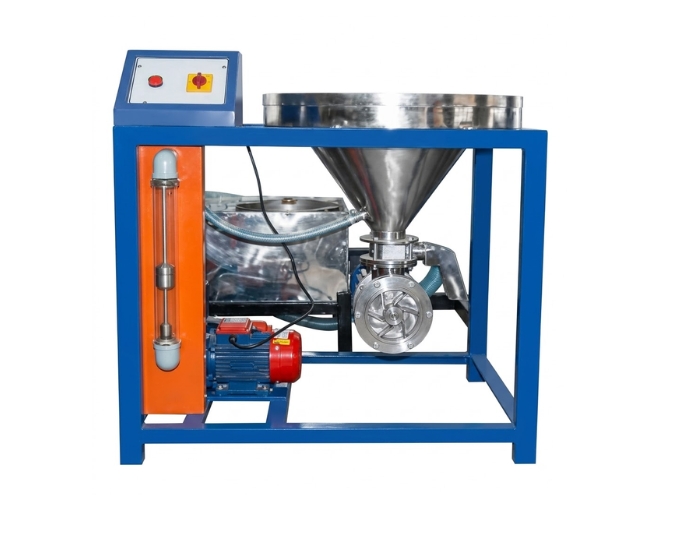
Laboratory Cone Classifier
Model Number: MTMO-118
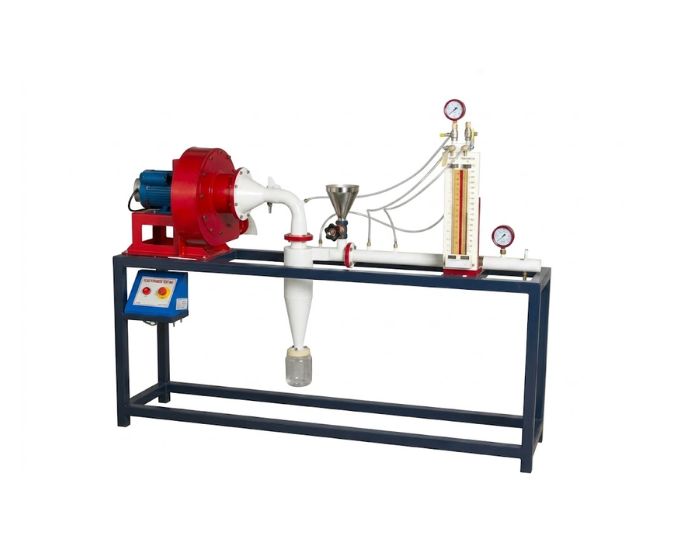
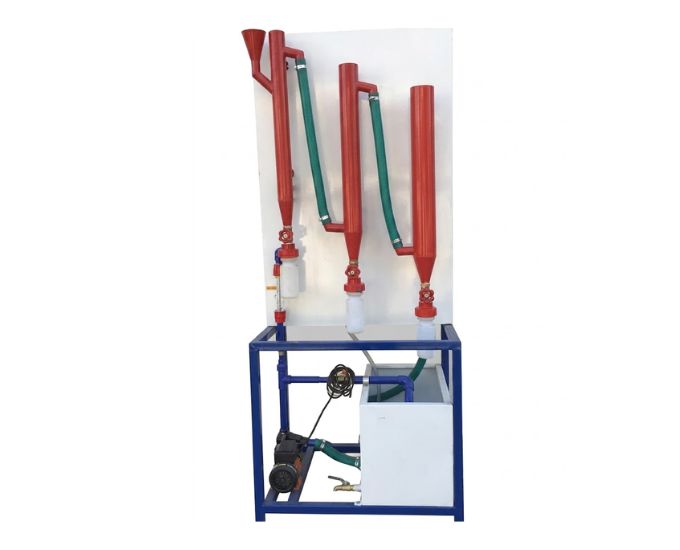
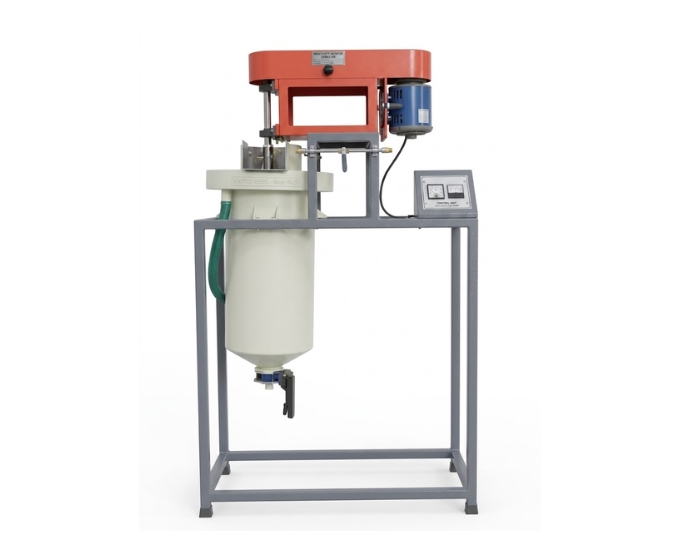
The Laboratory Cone Classifier is a laboratory-scale particle separation system designed to investigate classification efficiency and the influence of fluid velocity on separation performance. It provides practical understanding of hydraulic classification, settling behaviour and fluid-particle interactions for Mechanical Operations and Mineral Processing laboratories.
Product Specification
The Laboratory Cone Classifier is an educational separation apparatus designed for practical investigation of particle classification under controlled fluid-flow conditions.
Classification is an important operation in particle technology and mineral processing where a mixture of solid particles is separated into different fractions according to differences in their settling behaviour.
The apparatus incorporates a conical classification section that provides a controlled region for interaction between solid particles and the flowing fluid.
Particles introduced into the system experience gravitational, buoyancy and drag forces. Their resulting movement depends on properties such as particle size, density and shape, together with the velocity and properties of the fluid.
One of the principal experiments performed using the apparatus is the determination of separation efficiency of a given classifier.
Students can examine the feed and classified fractions and use suitable particle analysis techniques to evaluate the effectiveness of separation.
Another important experiment is the investigation of the effect of fluid velocity on separation efficiency.
The fluid velocity can be varied during testing, allowing students to observe how changes in flow conditions influence particle classification.
At suitable operating conditions, particles having different settling characteristics can follow different paths within the classifier, enabling separation into distinct fractions.
The apparatus therefore provides practical understanding of the relationship between fluid velocity, particle settling velocity and classification performance.
Students can analyze experimental results and establish how changing operating velocity affects the efficiency of the separation process.
The system also introduces important concepts associated with hydraulic classification, terminal settling behaviour, particle drag and fluid-particle mechanics.
Its laboratory-scale design makes it suitable for demonstrating industrially relevant classification principles in an educational environment.
Micro Technologies supplies Laboratory Cone Classifiers and other Mechanical Operations and Separation Equipment for engineering colleges, universities, research laboratories and technical training institutes.
Features
- Laboratory-scale cone classification system
- Conical classification chamber
- Hydraulic particle separation
- Separation efficiency studies
- Variable fluid-flow conditions
- Velocity-effect experiments
- Particle settling studies
- Feed and classified-product analysis
- Fluid-particle interaction experiments
- Particle classification demonstration
- Controlled laboratory operation
- Suitable for repeated experiments
- Robust educational construction
- Suitable for engineering laboratories
Benefits
- Provides practical understanding of particle classification
- Enables determination of separation efficiency
- Demonstrates the effect of velocity on classifier performance
- Helps students understand settling behaviour
- Demonstrates hydraulic classification
- Enables comparison of feed and classified fractions
- Provides practical fluid-particle mechanics experience
- Supports particle technology education
- Connects theoretical separation concepts with laboratory experiments
- Suitable for Mechanical Operations laboratories
Product Specifications
| Specification | Details |
|---|---|
| Product Name | Laboratory Cone Classifier |
| Equipment Type | Laboratory Classification Equipment |
| Classifier Type | Cone Classifier |
| Primary Operation | Particle Classification |
| Classification Method | Fluid-Based / Hydraulic |
| Separation Basis | Particle Settling Characteristics |
| Separation Efficiency | Determination Supported |
| Velocity Effect | Study Supported |
| Particle Classification | Supported |
| Settling Behaviour | Study Supported |
| Feed Analysis | Supported |
| Classified Fraction Analysis | Supported |
| Fluid-Particle Interaction | Study Supported |
| Operation | Laboratory Scale |
| Application | Mechanical Operations / Separation |
Applications
- Mechanical Operations Laboratories
- Mineral Processing Laboratories
- Chemical Engineering Laboratories
- Mining Engineering Laboratories
- Particle Technology Laboratories
- Separation Process Laboratories
- Metallurgical Engineering Laboratories
- Fluid-Particle Mechanics Laboratories
- Engineering Colleges
- Universities
- Polytechnic Institutes
- Technical Training Centres
- Research Laboratories
FAQs
What is a Laboratory Cone Classifier used for?
It is used to investigate particle classification and determine the separation efficiency of a classifier under different fluid-flow conditions.
What are the main experiments performed with the Cone Classifier?
The main experiments are determining classifier separation efficiency and investigating the effect of fluid velocity on separation efficiency.
What is particle classification?
Particle classification is the separation of particles into different fractions according to differences in their behaviour in a fluid, often influenced by size, density and shape.
Can separation efficiency be determined?
Yes. Feed and classified fractions can be analyzed to evaluate the efficiency of the separation process.
Can the effect of velocity be studied?
Yes. Fluid velocity can be varied to investigate how it influences particle behaviour and separation efficiency.
Why is fluid velocity important in classification?
Fluid velocity affects the drag acting on particles and therefore influences whether particles settle, remain suspended or move with the fluid.
Does particle size affect separation?
Yes. Particle size affects settling characteristics and can significantly influence classification behaviour.
Does particle density affect classifier performance?
Yes. Particles with different densities can have different settling velocities, affecting how they behave inside the classifier.
What is hydraulic classification?
Hydraulic classification separates solid particles according to their settling behaviour in a liquid under controlled flow conditions.
Can feed and classified products be compared?
Yes. Analysis of the original feed and separated fractions helps evaluate classification and separation efficiency.
Where should this product be categorized on the website?
The best placement is Mechanical Operations Equipment → Separation.
Is it suitable for Mineral Processing laboratories?
Yes. Hydraulic particle classification is widely relevant to Mineral Processing, Mining Engineering and related laboratory courses.
Why Choose Our Products
- Separation efficiency experiments
- Fluid velocity studies
- Hydraulic classification demonstration
- Particle settling investigations
- Feed and product comparison
- Fluid-particle interaction studies
- Practical engineering education
- Robust laboratory construction
- Institutional laboratory supply
- Customized configurations available
- Bulk supply support
- Tender requirements supported
Call to Action
Enhance your Mechanical Operations and Mineral Processing Laboratory with the Laboratory Cone Classifier from Micro Technologies. Designed for practical investigation of particle classification, separation efficiency and fluid-velocity effects, the apparatus provides an effective platform for engineering education. Contact us for technical specifications, customized configurations, institutional quotations, bulk requirements or tender supply.