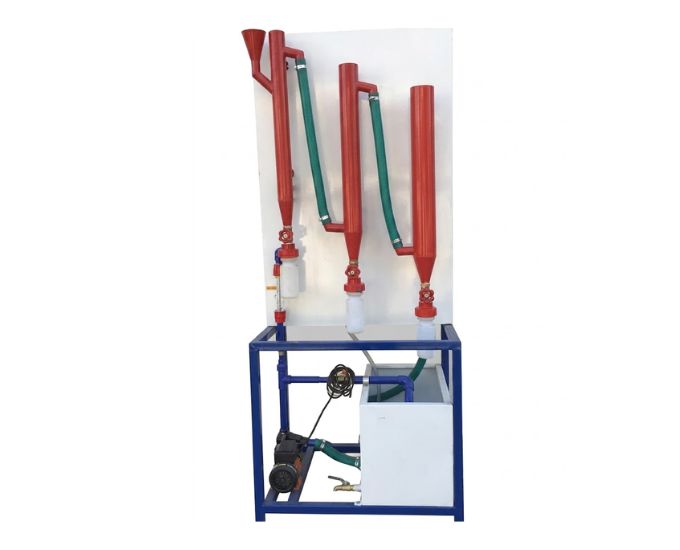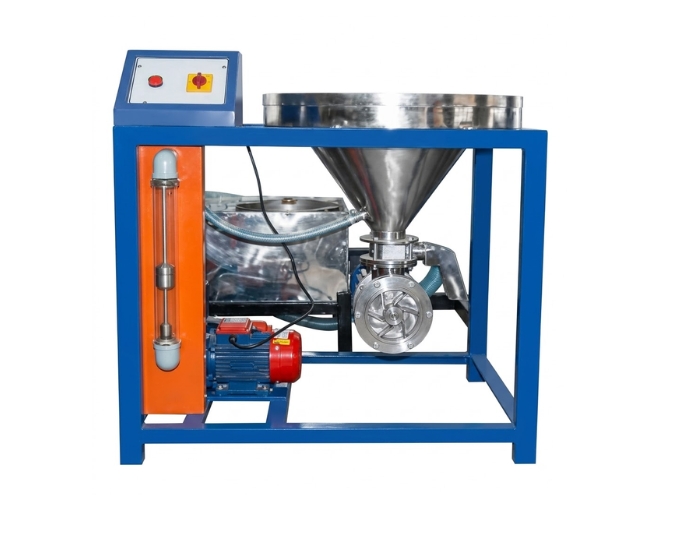

Laboratory Cyclone Separator
Product Specification Sheet
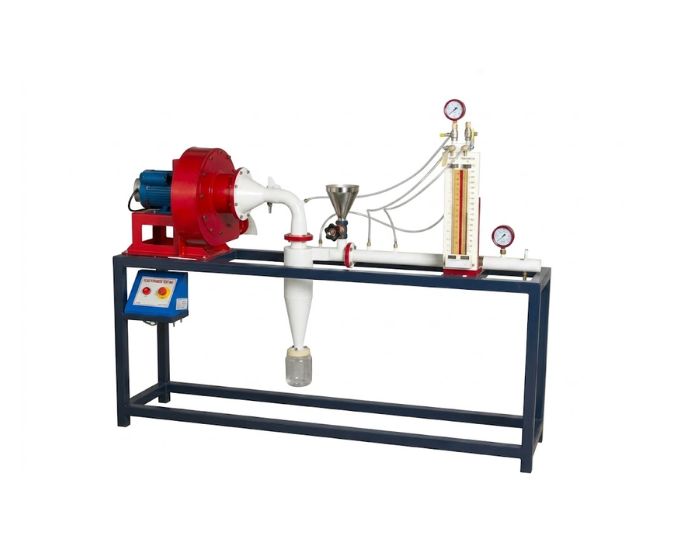
Laboratory Cyclone Separator
Model Number: MTMO-113
The Laboratory Cyclone Separator is an educational gas-solid separation system designed for practical investigation of cyclone performance and collection efficiency. It enables students to study the performance of a cyclone separator and investigate how changes in inlet gas velocity affect overall separation efficiency.
Product Specification
The Laboratory Cyclone Separator is an educational Mechanical Operations system developed for experimental investigation of particle separation from a gas stream using centrifugal action.
Cyclone separators are widely used in chemical processing, mineral handling, cement production, dust collection and other industries for removing suspended solid particles from gas streams.
The apparatus provides students with practical understanding of one of the most widely used forms of gas-solid separation equipment.
A particle-laden gas stream enters the cyclone, typically in a tangential direction. The geometry of the separator causes the gas to develop a strong swirling motion.
Particles suspended in the gas possess greater inertia than the surrounding gas and tend to move toward the cyclone wall under the resulting centrifugal effects.
The separated particles move downward toward the collection section, while the cleaner gas leaves through the outlet arrangement.
One of the principal experiments performed with the apparatus is the study of cyclone performance.
Students can measure suitable operating parameters and evaluate how effectively the cyclone separates particulate matter from the flowing gas.
Another important experiment involves investigating the effect of inlet gas velocity on overall cyclone efficiency.
Changing the inlet velocity alters the flow conditions and centrifugal effects inside the cyclone. Students can record experimental data at different operating conditions and determine the corresponding separation performance.
The apparatus can therefore be used to develop a relationship between inlet gas velocity and collection efficiency.
Students can also study the pressure conditions across the system where suitable measuring arrangements are provided.
Experimental observations help explain important concepts such as centrifugal separation, particle inertia, gas velocity, collection efficiency and pressure drop.
The apparatus provides an effective link between theoretical particle-separation concepts and practical industrial gas-cleaning processes.
It is particularly suitable for Mechanical Operations and Chemical Engineering laboratories, where students study separation of solid particles from fluid streams.
Micro Technologies supplies Laboratory Cyclone Separators and other Mechanical Operations Equipment for engineering colleges, universities, research laboratories, polytechnic institutes and technical training centres.
Features
- Laboratory-scale cyclone separator
- Gas-solid separation experiments
- Centrifugal particle separation
- Cyclone performance studies
- Collection efficiency determination
- Variable inlet gas velocity studies
- Particle collection arrangement
- Gas-flow measurement facility
- Pressure measurement arrangement
- Transparent or visible experimental sections where applicable
- Controlled laboratory operation
- Suitable for repeated experiments
- Rigid supporting frame
- Educational laboratory configuration
- Industrially relevant separation concept
Benefits
- Demonstrates cyclone separation practically
- Provides hands-on gas-solid separation studies
- Enables cyclone performance evaluation
- Demonstrates the effect of inlet velocity
- Enables overall efficiency determination
- Helps students understand centrifugal separation
- Demonstrates particle collection from gas streams
- Introduces pressure-drop considerations
- Connects Mechanical Operations theory with experiments
- Provides practical understanding of industrial dust separation
Product Specifications
| Specification | Details |
|---|---|
| Product Name | Laboratory Cyclone Separator |
| Equipment Type | Gas-Solid Separation Equipment |
| Separation Device | Cyclone Separator |
| Separation Mechanism | Centrifugal / Inertial |
| Process | Gas-Solid Separation |
| Cyclone Performance | Study Supported |
| Inlet Gas Velocity | Variable / Study Supported |
| Overall Efficiency | Determination Supported |
| Particle Collection | Supported |
| Gas Flow Study | Supported |
| Pressure Measurement | Applicable |
| Pressure Drop Study | Applicable |
| Drive / Air Supply | Blower-Based System |
| Installation | Laboratory Floor Setup |
| Application | Mechanical Operations / Separation |
Experiments Performed
- Study of Cyclone Separator operation
- Study of cyclone performance
- Investigation of gas-solid separation
- Determination of overall cyclone efficiency
- Study of inlet gas velocity
- Investigation of the effect of inlet gas velocity on efficiency
- Measurement of gas-flow conditions
- Collection of separated solid particles
- Investigation of centrifugal separation
- Study of particle behaviour in a swirling gas stream
- Determination of particle collection performance
- Investigation of operating conditions
- Study of pressure drop where applicable
- Comparison of cyclone performance at different flow rates
Applications
- Mechanical Operations Laboratories
- Chemical Engineering Laboratories
- Particle Technology Laboratories
- Separation Process Laboratories
- Environmental Engineering Laboratories
- Mineral Processing Laboratories
- Dust Collection Studies
- Process Engineering Laboratories
- Engineering Colleges
- Universities
- Polytechnic Institutes
- Technical Training Centres
- Research & Educational Laboratories
FAQs
What is a Laboratory Cyclone Separator used for?
It is used to study the separation of solid particles from a gas stream and evaluate cyclone performance under different operating conditions.
What is the main separation mechanism in a cyclone?
A cyclone uses swirling flow and particle inertia to drive suspended particles toward the outer wall, allowing them to separate from the gas stream.
Can cyclone efficiency be determined experimentally?
Yes. Suitable measurements of feed and collected material can be used to evaluate overall particle collection efficiency.
Can the effect of inlet gas velocity be studied?
Yes. This is one of the main experiments performed with the apparatus. Different inlet velocities can be used to investigate changes in cyclone performance.
How does inlet velocity affect cyclone performance?
Changing inlet velocity changes the swirling-flow intensity and particle dynamics inside the cyclone. This can influence both separation efficiency and pressure drop.
Can pressure drop be investigated?
Where suitable pressure-measuring instruments are included, the pressure difference across the cyclone system can be investigated at different operating conditions.
Does a Cyclone Separator use a filter element?
A conventional cyclone primarily separates particles through inertial and centrifugal effects rather than relying on a filter medium.
What type of separation does a Cyclone Separator perform?
It is primarily used for gas-solid separation, particularly for removing suspended particulate matter from gas or air streams.
Is it suitable for Mechanical Operations laboratories?
Yes. This equipment fits under Mechanical Operations Equipment → Separation and is highly suitable for practical separation experiments.
Is it suitable for Chemical Engineering laboratories?
Yes. Cyclone separation is an important topic in Mechanical Operations, particle technology and Chemical Engineering education.
Why Choose Our Products
- Practical gas-solid separation experiments
- Cyclone performance studies
- Inlet velocity investigation
- Overall efficiency determination
- Centrifugal separation demonstration
- Particle collection studies
- Flow and pressure measurements
- Industrially relevant process demonstration
- Robust laboratory construction
- Suitable for engineering education
- Customized configurations available
- Institutional and bulk supply support
Call to Action
Equip your Mechanical Operations Laboratory with a Laboratory Cyclone Separator from Micro Technologies for practical study of gas-solid separation, cyclone efficiency and inlet-velocity effects. Contact us for technical specifications, customized configurations, institutional quotations, bulk laboratory requirements or tender supply.