
Free and Forced Torsional Vibrations Apparatus
Product Specification Sheet
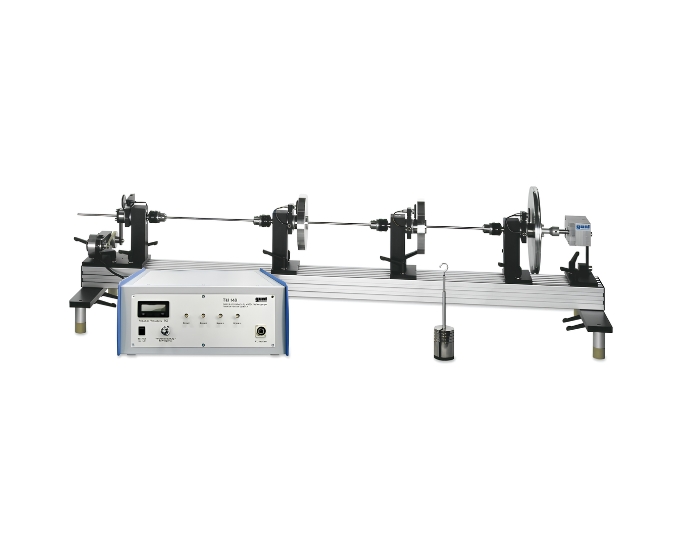
Free and Forced Torsional Vibrations Apparatus
Model Number: MTDE-404
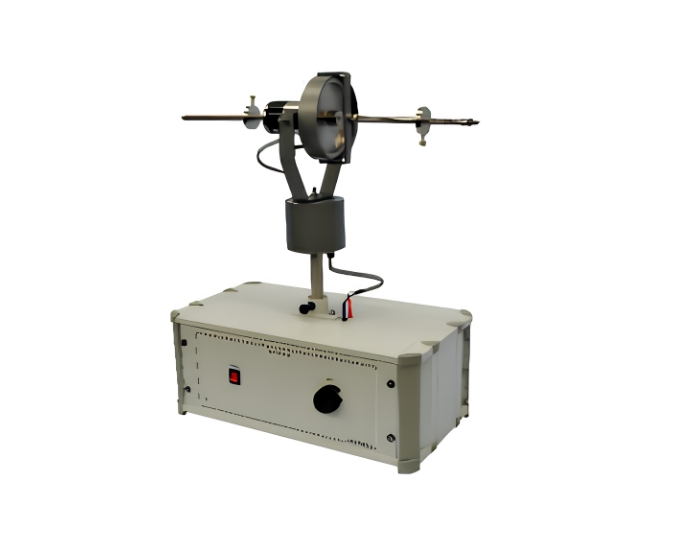
The Free and Forced Torsional Vibrations Apparatus is an educational mechanical engineering laboratory system designed for studying torsional oscillations in rotating mechanical systems. It enables students to determine the torsional stiffness of a torsion bar, determine mass moments of inertia, investigate the decay behavior of torsional vibrations, and determine damping characteristics experimentally.
Product Specification
The Free and Forced Torsional Vibrations Apparatus is a laboratory teaching system developed for practical investigation of free and forced torsional vibration phenomena.
Torsional vibration is an angular oscillatory motion that occurs when a rotating or torsionally flexible mechanical system twists about its longitudinal axis. Understanding this behaviour is important in the analysis of shafts, drive systems, engines, turbines, gear systems, and rotating machinery.
The apparatus provides a controlled experimental platform for investigating the fundamental parameters that influence torsional vibration.
One of the primary experiments is the determination of the torsional stiffness of a torsion bar. The torsion bar resists angular deformation when subjected to torque, and its stiffness is an important parameter in predicting the vibration characteristics of the system.
The apparatus enables students to experimentally investigate the relationship between applied torque and angular displacement, providing practical understanding of torsional rigidity.
Another important experiment is the determination of mass moments of inertia. The rotational inertia of the oscillating components has a direct influence on the natural frequency and dynamic response of the torsional system.
The system can also be used to investigate the decay behavior of torsional vibrations. After an initial angular displacement, the system can be allowed to oscillate freely while the gradual reduction in vibration amplitude is observed.
This reduction in amplitude provides information about the energy dissipated from the vibrating system.
The apparatus therefore enables the determination of damping in torsional vibrations. Experimental observations of successive vibration amplitudes can be used to analyze the damping characteristics of the system.
In forced-vibration experiments, periodic excitation can be applied to investigate the response of the torsional system at different excitation conditions.
Students can study the relationship between excitation frequency, natural frequency, angular amplitude and dynamic response, including behaviour near resonance.
The apparatus provides practical understanding of torsional stiffness, angular displacement, mass moment of inertia, natural frequency, damping, vibration decay, forced response and resonance.
It is suitable for Mechanical Vibrations, Dynamics of Machines, Theory of Machines, Mechanical Engineering, and related engineering laboratory courses.
Micro Technologies supplies Free and Forced Torsional Vibrations Apparatus and other mechanical vibration laboratory equipment for universities, engineering colleges, polytechnic institutes, technical training centres, and research laboratories.
Features
- Free torsional vibration experiments
- Forced torsional vibration studies
- Torsion bar experimental arrangement
- Torsional stiffness determination
- Mass moment of inertia determination
- Torsional vibration decay investigation
- Damping determination
- Angular oscillation studies
- Natural frequency investigation
- Forced response studies
- Suitable for resonance investigation
- Clear demonstration of torsional motion
- Student-friendly experimental configuration
- Robust laboratory construction
- Suitable for repeated engineering experiments
Benefits
- Provides practical understanding of torsional vibrations
- Enables experimental determination of torsional stiffness
- Helps determine mass moments of inertia
- Demonstrates vibration decay behaviour
- Enables damping characteristics to be evaluated
- Supports both free and forced vibration studies
- Helps students understand rotational oscillations
- Connects theoretical vibration analysis with experiments
- Provides practical knowledge relevant to rotating machinery
- Suitable for advanced mechanical engineering education
Product Specifications
| Specification | Details |
|---|---|
| Product Name | Free and Forced Torsional Vibrations Apparatus |
| Product Type | Mechanical Vibrations Laboratory Apparatus |
| Vibration Mode | Torsional |
| Free Vibration Study | Supported |
| Forced Vibration Study | Supported |
| Torsion Bar | Experimental Arrangement |
| Torsional Stiffness | Determination Supported |
| Mass Moment of Inertia | Determination Supported |
| Vibration Decay | Investigation Supported |
| Damping | Determination Supported |
| Angular Oscillation | Supported |
| Natural Frequency Study | Supported |
| Forced Response Study | Supported |
| Resonance Study | Supported |
| Application | Mechanical Vibrations / Dynamics Laboratory |
Experiments Performed
- Determination of torsional stiffness of a torsion bar
- Determination of mass moments of inertia
- Study of free torsional vibrations
- Study of forced torsional vibrations
- Investigation of angular oscillations
- Determination of torsional natural frequency
- Investigation of torsional vibration decay
- Observation of successive vibration amplitudes
- Determination of damping in torsional vibrations
- Investigation of energy dissipation
- Study of forced vibration response
- Investigation of excitation frequency effects
- Study of resonance behaviour
- Comparison of free and forced torsional vibrations
- Comparison of theoretical and experimental vibration characteristics
Applications
- Mechanical Vibrations Laboratories
- Dynamics of Machines Laboratories
- Theory of Machines Laboratories
- Mechanical Engineering Laboratories
- Automobile Engineering Laboratories
- Rotational Dynamics Laboratories
- Machine Dynamics Laboratories
- Applied Mechanics Laboratories
- Engineering Colleges
- Universities
- Polytechnic Institutes
- Technical Training Centres
- Research & Educational Laboratories
FAQs
What is the Free and Forced Torsional Vibrations Apparatus used for?
The apparatus is used to investigate torsional vibrations and determine important parameters such as torsional stiffness, mass moment of inertia, vibration decay, damping, and dynamic response.
What is torsional vibration?
Torsional vibration is an oscillatory twisting motion of a mechanical system about its rotational or longitudinal axis.
Can torsional stiffness be determined?
Yes. One of the main experiments is the experimental determination of the torsional stiffness of the torsion bar.
Can mass moment of inertia be determined?
Yes. The apparatus enables experimental determination of the mass moments of inertia of suitable rotating components.
Can free torsional vibrations be studied?
Yes. The system can be displaced angularly and released to investigate its free torsional oscillations.
Can forced torsional vibrations be investigated?
Yes. The apparatus supports investigation of the system response under periodic external excitation.
What is torsional vibration decay?
Torsional vibration decay is the gradual reduction in angular vibration amplitude over time due to damping and energy losses.
Can damping be determined experimentally?
Yes. Damping characteristics can be determined by analyzing the reduction in successive torsional vibration amplitudes.
Can natural frequency be studied?
Yes. The torsional natural frequency can be investigated using the stiffness and inertia characteristics of the vibrating system.
Can resonance be investigated?
Yes. Forced vibration experiments can be used to observe the increase in response as the excitation frequency approaches the natural frequency.
Where are torsional vibration principles important?
They are particularly important in shafts, engines, turbines, gearboxes, drive trains, generators, compressors, and other rotating mechanical systems.
Why Choose Our Products
- Free and forced torsional vibration studies
- Torsional stiffness determination
- Mass moment of inertia experiments
- Vibration decay investigation
- Damping determination
- Natural frequency studies
- Forced-response and resonance analysis
- Practical rotational vibration demonstration
- Student-friendly laboratory configuration
- Durable institutional construction
- Customized configurations available
- Institutional and bulk supply support
Call to Action
Looking for a Free and Forced Torsional Vibrations Apparatus for your engineering laboratory? Micro Technologies supplies torsional vibration apparatus, mechanical vibration equipment, Dynamics of Machines systems, and Theory of Machines laboratory equipment for universities, engineering colleges, polytechnic institutes, technical training centres, and research laboratories. Contact us for technical specifications, customized configurations, institutional orders, bulk supply, distributor inquiries, government tenders, or a competitive quotation.