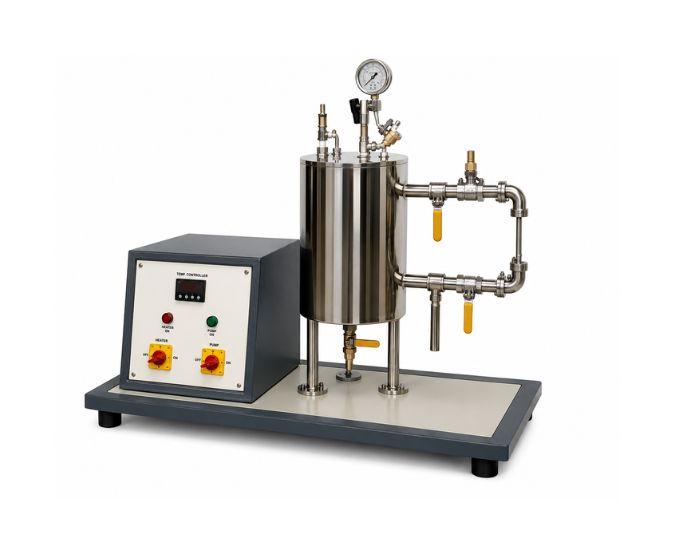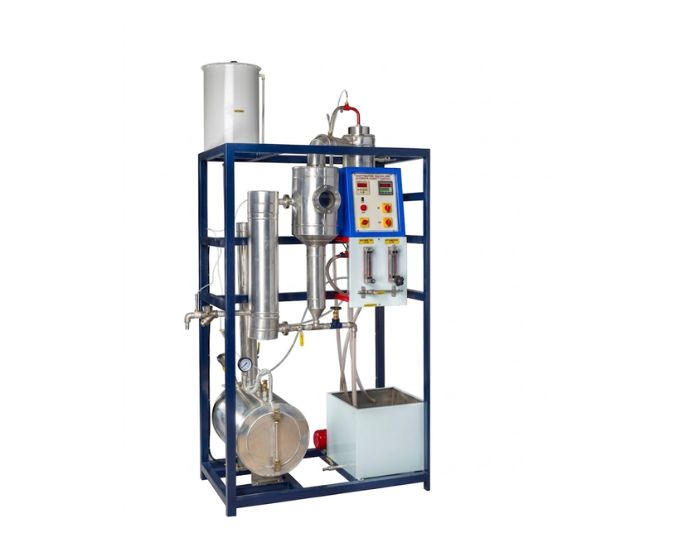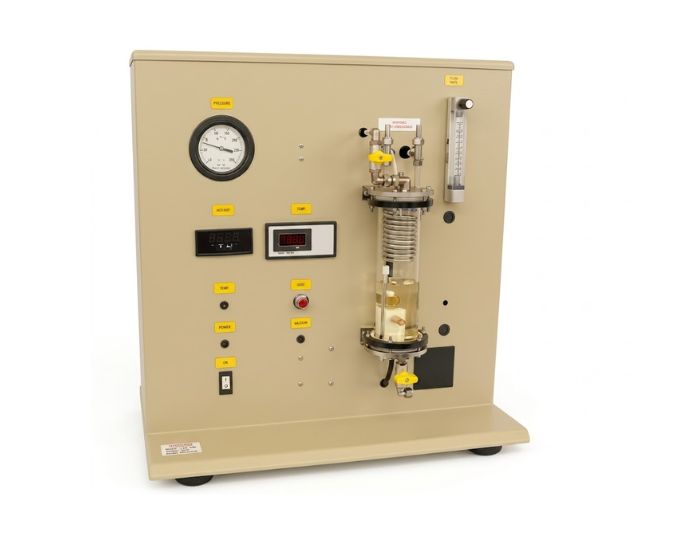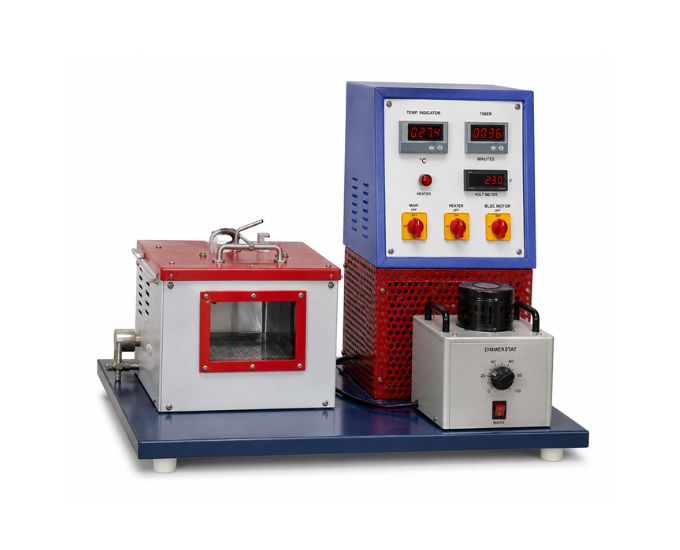

Dropwise and Filmwise Condensation Apparatus
Product Specification Sheet
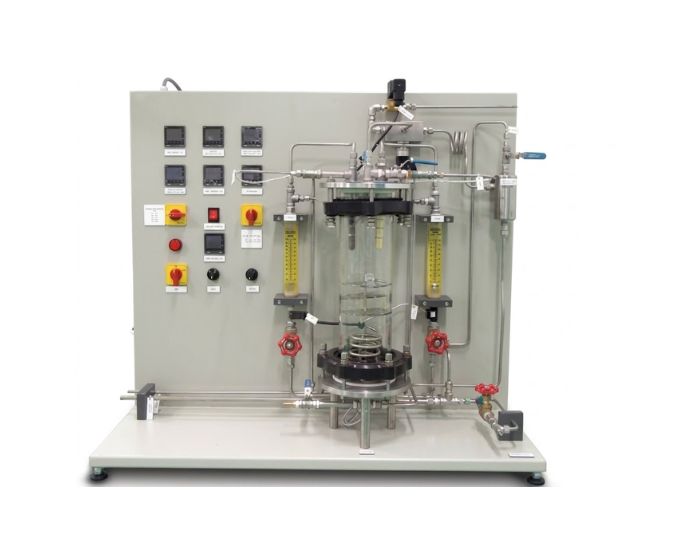
Dropwise and Filmwise Condensation Apparatus
Model Number: MTBA-204
The Dropwise and Filmwise Condensation Apparatus from Micro Technologies is a laboratory heat-transfer system designed for the visual and quantitative investigation of dropwise and filmwise condensation. The apparatus allows students to compare heat-transfer coefficients for both condensation modes at different operating pressures, study the relationship between the saturation pressure and temperature of water, investigate the influence of air in a condenser, and demonstrate Dalton’s Law of partial pressures.
Product Specification
The Dropwise and Filmwise Condensation Apparatus is an advanced laboratory experimental setup developed for studying condensation heat transfer and comparing the thermal behaviour of dropwise and filmwise condensation.
Manufactured by Micro Technologies, the apparatus provides students with a clear visual demonstration of how vapour condenses on surfaces with different characteristics and how the mode of condensation influences the rate of heat transfer.
Condensation occurs when vapour loses thermal energy and changes into the liquid phase. Depending on the condition and characteristics of the condensing surface, the condensate may either form a continuous liquid film or separate droplets.
In filmwise condensation, condensed liquid wets the surface and forms a continuous film. This liquid layer creates additional thermal resistance between the vapour and cooling surface.
In dropwise condensation, condensate forms individual droplets that grow, combine, and leave the surface. Because large portions of the condensing surface can remain directly exposed to vapour, dropwise condensation can provide substantially higher heat-transfer coefficients under comparable conditions.
The apparatus incorporates a transparent experimental chamber that enables students to visually observe the condensation process. Suitable test surfaces, cooling-water circuits, temperature sensors, pressure measurement, flow meters, valves, and integrated controls allow quantitative analysis of the two condensation modes.
The system can also be used to investigate how operating pressure affects condensation heat transfer and how the saturation temperature of water varies with pressure.
Another important experiment is the investigation of the effect of air or other non-condensable gas within a condenser. The presence of air can create additional resistance to vapour transport toward the condensing surface, affecting condensation performance.
The apparatus additionally provides a practical demonstration of Dalton's Law, helping students understand partial pressures in mixtures of vapour and non-condensable gases.
Scope of Learning
The apparatus enables practical study of:
- Dropwise condensation
- Filmwise condensation
- Visual observation of condensation
- Condensation heat transfer
- Comparison of condensation modes
- Heat-transfer coefficient determination
- Effect of operating pressure
- Saturation pressure of water
- Saturation temperature of water
- Pressure-temperature relationship
- Influence of air in a condenser
- Non-condensable gas effects
- Dalton's Law of partial pressures
- Vapour-to-liquid phase change
- Cooling-water heat balance
- Condenser performance
Working Principle
Vapour is introduced into the experimental condensation chamber containing suitable cooled test surfaces.
Cooling water flows through the condensation sections and removes thermal energy from the vapour. When the surface temperature is sufficiently below the saturation temperature of the vapour, condensation occurs.
Depending on the characteristics of the surface, condensation takes place primarily in either dropwise or filmwise form.
Temperatures, cooling-water flow rates, pressure, and other relevant parameters are measured. These measurements allow students to calculate the heat transferred during condensation and determine the corresponding heat-transfer coefficient.
The transparent chamber enables simultaneous visual comparison of condensation behaviour.
Filmwise Condensation
During filmwise condensation, the condensate wets the cooling surface and forms a continuous liquid film.
As additional vapour condenses, heat must pass through this liquid layer before reaching the cooling surface.
The liquid film therefore contributes additional thermal resistance.
Students can observe:
- Formation of a condensate film
- Growth of the liquid layer
- Downward condensate flow
- Surface wetting
- Heat transfer through the condensate layer
- Variation of heat-transfer coefficient
Dropwise Condensation
During dropwise condensation, liquid forms as individual droplets rather than as a continuous film.
The droplets grow, combine with adjacent droplets, and eventually move away from the surface.
This repeatedly exposes portions of the cooling surface directly to vapour and can produce higher heat-transfer rates compared with filmwise condensation.
The experiment allows direct visual comparison between these two mechanisms.
Heat Transfer Coefficient Determination
The apparatus enables determination of heat-transfer coefficients for both dropwise and filmwise condensation.
Heat absorbed by the cooling water can be estimated from:
Q = ṁ Cp (T₂ − T₁)
Where:
- Q = Heat-transfer rate
- ṁ = Cooling-water mass flow rate
- Cp = Specific heat capacity of water
- T₁ = Cooling-water inlet temperature
- T₂ = Cooling-water outlet temperature
The condensation heat-transfer coefficient may then be evaluated using:
h = Q / [A(Tsat − Ts)]
Where:
- h = Condensation heat-transfer coefficient
- A = Effective condensing surface area
- Tsat = Saturation temperature
- Ts = Surface temperature
This allows quantitative comparison of dropwise and filmwise condensation.
Effect of Operating Pressure
The apparatus allows condensation experiments to be performed at different operating pressures.
Because the saturation temperature of water depends on pressure, varying pressure changes the thermal conditions at which condensation occurs.
Students can investigate:
- Saturation pressure
- Saturation temperature
- Pressure-temperature relationship
- Effect of pressure on condensation
- Changes in heat-transfer coefficient
Saturation Pressure and Temperature Study
For a pure substance under equilibrium conditions, saturation pressure and saturation temperature are directly related.
The apparatus enables experimental investigation of this relationship for water up to the operating limits of the system.
Pressure and temperature measurements can be compared with standard steam-property data to reinforce thermodynamic concepts.
Effect of Air in a Condenser
The presence of air or another non-condensable gas can significantly influence condenser performance.
Air does not condense with the water vapour under the same conditions. It can accumulate near the condensing surface and introduce additional resistance to mass and heat transfer.
The apparatus enables students to investigate how air affects:
- Condensation rate
- Heat-transfer coefficient
- Vapour partial pressure
- Surface heat transfer
- Overall condenser performance
Demonstration of Dalton's Law
The apparatus can be used to demonstrate Dalton's Law of Partial Pressures.
For a mixture of water vapour and air:
Ptotal = Pvapour + Pair
Where:
- Ptotal = Total pressure
- Pvapour = Partial pressure of water vapour
- Pair = Partial pressure of air
This experiment links heat-transfer principles with thermodynamics and gas-vapour mixture behaviour.
Main Components
- Transparent condensation chamber
- Dropwise condensation test surface
- Filmwise condensation test surface
- Vapour generation / supply arrangement
- Cooling-water circuits
- Cooling-water flow meters
- Temperature sensors
- Temperature indicators
- Pressure measurement system
- Pressure gauge / sensor
- Flow-control valves
- Condensate collection arrangement
- Air introduction / control arrangement
- Electrical controls
- Integrated instrumentation panel
- Interconnecting tubing and piping
- Rigid laboratory base
Key Features
- Visual comparison of dropwise and filmwise condensation
- Transparent experimental chamber
- Separate condensation test surfaces
- Heat-transfer coefficient determination
- Different operating pressure studies
- Saturation pressure-temperature investigation
- Effect of air on condensation
- Dalton's Law demonstration
- Cooling-water flow measurement
- Multiple temperature measurement points
- Pressure measurement
- Controlled vapour conditions
- Integrated instrumentation panel
- Clear process visualization
- Compact bench-mounted construction
- Suitable for repeated laboratory experiments
Technical Specifications
| Parameter | Details |
|---|---|
| Product Name | Dropwise and Filmwise Condensation Apparatus |
| Process | Condensation |
| Condensation Modes | Dropwise & Filmwise |
| Test Chamber | Transparent |
| Heat Transfer Coefficient | Determination Possible |
| Operating Pressure Study | Yes |
| Saturation Pressure Study | Yes |
| Saturation Temperature Study | Yes |
| Water Temperature Study | Up to 100°C, subject to operating conditions |
| Effect of Air | Investigation Possible |
| Dalton's Law | Demonstration Possible |
| Cooling Medium | Water |
| Cooling Water Flow Measurement | Provided |
| Temperature Measurement | Multiple Points |
| Pressure Measurement | Provided |
| Flow Control | Valves / Flow Meters |
| Instrumentation | Integrated |
| Installation | Bench Mounted |
| Customization | Available |
Exact pressure range, steam generation arrangement, temperature sensor configuration, flowmeter ranges, condensing surface dimensions, and electrical specifications can be supplied according to laboratory requirements.
Experiments / Studies
- To visually observe filmwise condensation
- To visually observe dropwise condensation
- To compare dropwise and filmwise condensation
- To study nucleation and condensate formation
- To determine the filmwise condensation heat-transfer coefficient
- To determine the dropwise condensation heat-transfer coefficient
- To compare heat-transfer performance at different operating pressures
- To investigate saturation pressure and temperature of water
- To study water behaviour up to approximately 100°C under applicable conditions
- To investigate the effect of air in a condenser
- To demonstrate Dalton's Law
- To perform cooling-water heat balances
- To study vapour-to-liquid phase change
- To investigate condenser performance
Educational Benefits
- Provides direct visualization of condensation phenomena
- Clearly demonstrates two condensation modes
- Enables quantitative heat-transfer analysis
- Helps explain why condensation mode affects heat-transfer coefficient
- Provides practical pressure-temperature experiments
- Demonstrates effects of non-condensable gases
- Reinforces Dalton's Law experimentally
- Provides cooling-water flow measurement experience
- Develops thermal energy balance skills
- Connects heat-transfer and thermodynamics concepts
- Suitable for engineering practical examinations
- Useful for undergraduate projects and demonstrations
Applications
- Heat Transfer Laboratories
- Thermal Engineering Laboratories
- Mechanical Engineering Laboratories
- Chemical Engineering Laboratories
- Process Engineering Laboratories
- Energy Engineering Laboratories
- Thermodynamics Laboratories
- Engineering Colleges
- Universities
- Polytechnic Institutes
- Technical Training Institutes
- Research Laboratories
- Engineering R&D Centers
Optional Accessories
- Steam Generator
- Additional Temperature Sensors
- Digital Pressure Indicator
- Digital Flow Meters
- Additional Pressure Sensor
- Digital Temperature Indicators
- Condensate Collection Vessel
- Data Acquisition System
- Computer Interface
- Data Logging Software
- Calibration Accessories
- Experimental Manual
Customization Options
The Dropwise and Filmwise Condensation Apparatus can be customized with:
- Different condensing surface materials
- Additional temperature measurement points
- Digital pressure measurement
- Different flowmeter ranges
- Enhanced vapour generation system
- Additional air-control arrangement
- Digital flow measurement
- Data acquisition system
- Computerized data logging
- Customized instrumentation panel
- Research-oriented configurations
SKU System
MT-FHT-204
FAQs
What is the Dropwise and Filmwise Condensation Apparatus used for?
It is used for visual and quantitative investigation of dropwise and filmwise condensation, including comparison of their heat-transfer coefficients.
What is filmwise condensation?
Filmwise condensation occurs when condensate wets the surface and forms a continuous liquid film through which heat must be transferred.
What is dropwise condensation?
Dropwise condensation occurs when condensate forms individual droplets on the surface rather than creating a continuous liquid layer.
Which mode generally provides better heat transfer?
Under comparable conditions, dropwise condensation generally provides a higher heat-transfer coefficient because a continuous insulating liquid film does not cover the entire surface.
Can the heat-transfer coefficient be calculated?
Yes. Cooling-water flow and temperature measurements, together with surface and saturation temperatures, can be used to determine the condensation heat-transfer coefficient.
Can experiments be conducted at different pressures?
Yes. The apparatus is intended to investigate condensation behaviour and heat-transfer coefficients at different operating pressures within its specified operating range.
Can the saturation pressure-temperature relationship be studied?
Yes. The apparatus enables students to investigate the relationship between saturation pressure and saturation temperature of water.
Can the effect of air in the condenser be studied?
Yes. The influence of air or another non-condensable gas on condensation heat transfer can be investigated.
Can Dalton's Law be demonstrated?
Yes. The apparatus can demonstrate Dalton's Law of partial pressures for mixtures containing water vapour and air.
Where can this apparatus be used?
It is suitable for heat transfer, thermal engineering, mechanical engineering, chemical engineering, thermodynamics, and process engineering laboratories.
Can the apparatus be customized?
Yes. Micro Technologies can customize condensing surfaces, sensors, pressure measurement, flow measurement, instrumentation, steam generation, and data acquisition according to laboratory requirements.
Why Choose Our Products
- Dropwise and filmwise condensation in one system
- Direct visual observation through transparent chamber
- Heat-transfer coefficient determination
- Pressure-temperature relationship studies
- Effect of non-condensable air investigation
- Dalton's Law demonstration
- Integrated temperature, pressure, and flow measurements
- Robust laboratory construction
- Suitable for engineering curricula
- Customized configurations available
- Institutional and OEM supply
- Technical and after-sales support
Call to Action
Strengthen practical heat-transfer studies with the Dropwise and Filmwise Condensation Apparatus from Micro Technologies. Contact us for technical specifications, customized test configurations, institutional laboratory requirements, project quotations, OEM supply, tenders, distributor inquiries, and bulk orders.