
Chladni Plates – Square and Round
Product Specification Sheet
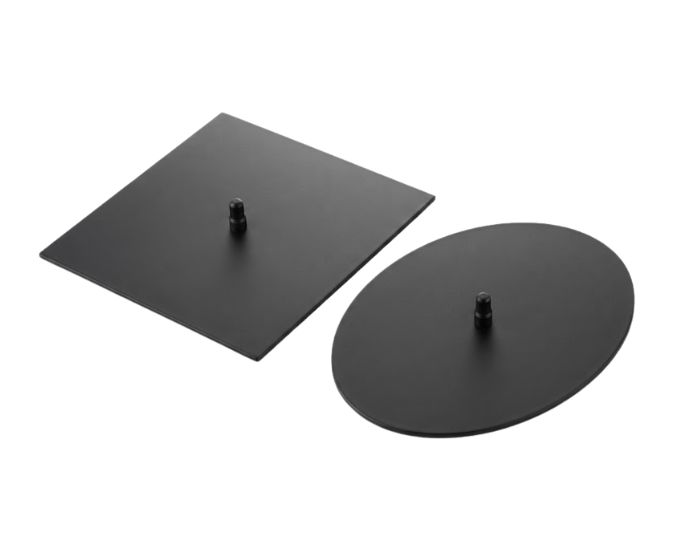
Chladni Plates – Square and Round
Model Number: MTW-20
The Chladni Plates – Square and Round are metal vibration plates designed for visual investigation of resonance frequencies, nodal lines, and modes of vibration. Micro Technologies supplies the kit with two plate geometries: one square and one round. When mounted on a compatible vibration generator and excited at measurable frequencies, the plates form characteristic vibration patterns. Fine sand spread across the surface migrates toward nodal lines where vibration is minimal, creating clear Chladni figures. The plates can be vibrated about their center or from an offset mounting point, allowing both symmetrical and asymmetrical vibration modes to be investigated.
Product Specification
The Chladni Plates – Square and Round provide a practical and highly visual method for investigating mechanical resonance and the vibration modes of metal plates. The set consists of two differently shaped plates that can be mechanically excited at controlled frequencies using a compatible vibration generator.
During an experiment, a thin layer of fine sand is distributed over the plate surface. As the excitation frequency is varied, the plate begins to vibrate in different modes. At specific resonant frequencies, well-defined stationary vibration patterns develop across the plate.
The sand moves away from regions experiencing stronger vibration and collects along areas where displacement is minimal. These regions form nodal lines, producing characteristic geometric patterns known as Chladni figures.
Micro Technologies supplies both square and round plates, allowing the effect of plate geometry on resonant behaviour to be investigated. Because the boundary geometry differs between the two plates, each shape can produce its own distinctive family of nodal patterns.
The resonance of the plates can also be heard during operation. This provides both visual and audible indications of resonant conditions and helps users identify frequencies at which particular vibration modes become strongly established.
Another useful feature is the ability to vibrate the plates either about their center or an offset point. Central excitation is useful for investigating symmetrical vibration modes, while offset excitation enables additional asymmetrical modes to be observed.
When combined with a suitable vibration generator and variable-frequency signal source, the plates allow resonance frequencies to be measured and compared with the corresponding nodal patterns.
The combination of square and round geometries, alternative mounting positions, and visible sand patterns makes the Chladni Plate Set a versatile accessory for resonance, standing-wave, nodal-line, and mechanical vibration investigations.
Features
- Set includes square and round Chladni plates
- Manufactured from metal sheet
- Designed for continuous mechanical excitation
- Produces clear Chladni figures
- Demonstrates nodal lines
- Suitable for resonance-frequency measurements
- Allows investigation of multiple vibration modes
- Can be excited about the center
- Supports offset excitation
- Demonstrates symmetrical vibration modes
- Demonstrates asymmetrical vibration modes
- Provides visible and audible resonance indication
- Compatible with suitable vibration generators
- Reusable experimental plates
Benefits
- Makes complex vibration modes clearly visible
- Allows resonant frequencies to be identified experimentally
- Square and round plates provide comparative observations
- Sand patterns clearly reveal nodal-line geometry
- Central and offset mounting expand the range of possible patterns
- Supports both symmetrical and asymmetrical mode investigations
- Simple metal construction provides reliable repeated use
- Useful addition to existing vibration and resonance setups
Product Specifications
| Specification | Details |
|---|---|
| Product Name | Chladni Plates – Square and Round |
| Internal Model No. | MT-36214D |
| Product Type | Resonance & Vibration Pattern Plates |
| Number of Plates | 2 |
| Plate Shapes | Square and Round |
| Material | Metal Sheet |
| Excitation | Continuous mechanical vibration |
| Compatible Equipment | Vibration Generator |
| Pattern Medium | Fine sand |
| Primary Observation | Chladni figures / nodal lines |
| Frequency Measurement | Supported with suitable excitation system |
| Mounting Positions | Center or offset |
| Vibration Modes | Symmetrical and asymmetrical |
| Resonance Indication | Visual and audible |
| Usage / Application | Resonance, vibration modes, nodal lines and Chladni patterns |
| Compliance Standard | Laboratory-grade mechanical construction |
Available Variants
- MT-36214D – Square and Round Chladni Plate Set
- Square Chladni Plate
- Round Chladni Plate
- Chladni Plates for Vibration Generator
- Customized plate configurations for bulk requirements
SKU System
- MT-CP-SR – Square & Round Chladni Plate Set
- MT-CP-SQ – Square Chladni Plate
- MT-CP-RD – Round Chladni Plate
- MT-CP-VG – Vibration Generator Configuration
- MT-CP-CUS – Customized Configuration
FAQs
What are Chladni Plates used for?
Chladni Plates are used to investigate resonance, natural frequencies, vibration modes, nodal lines, and standing-wave patterns on vibrating metal plates.
Which plate shapes are included?
The standard set contains one square plate and one round plate.
How are Chladni patterns produced?
Fine sand is spread over a plate and the plate is excited mechanically. At resonant frequencies, the sand moves away from strongly vibrating regions and collects along nodal lines.
What do the sand patterns represent?
The accumulated sand indicates nodal regions where the vibration amplitude of the plate is minimal. These patterns are commonly called Chladni figures.
Can resonance frequencies be determined?
Yes. When used with a suitable variable-frequency signal source and vibration generator, the frequency corresponding to each resonant pattern can be measured.
Why are both square and round plates supplied?
Different plate geometries produce different natural vibration modes and nodal patterns, allowing comparative investigations.
Can the plates be vibrated from the center?
Yes. The plates can be mounted and vibrated about their center to investigate symmetrical vibration modes.
Can asymmetrical vibration modes be investigated?
Yes. Using an offset mounting or excitation position allows additional asymmetrical vibration modes to be produced.
Is the resonance audible?
Yes. Plate resonance can produce an audible response in addition to the visible Chladni pattern.
Is a Vibration Generator included?
No. The Chladni Plates are supplied as vibration-generator accessories unless a complete experimental kit is specifically ordered.
Is fine sand included?
Fine sand is used for visualizing the patterns and should be arranged according to the selected kit configuration.
How should Chladni Plates be maintained?
Keep the plates clean, flat, and dry. Avoid bending, denting, corrosion, or excessive mechanical force because deformation can alter their resonant behaviour.
Can Chladni Plates be ordered in bulk?
Yes. Micro Technologies can supply Chladni Plate sets in bulk for physics laboratories, vibration laboratories, universities, colleges, research facilities, distributors, and institutional projects.
Why Choose Our Products
- Square and round plates supplied as a set
- Supports multiple resonance and vibration modes
- Suitable for symmetrical and asymmetrical patterns
- Clear visualization of nodal lines
- Durable reusable metal construction
- Compatible with vibration generator systems
- Bulk supply capability for laboratory projects
Call to Action
Looking for Chladni Plates – Square and Round for resonance, nodal-line, and vibration-pattern experiments? Contact Micro Technologies for competitive quotations, bulk procurement, institutional orders, distributor supply, and complete vibration experiment setups.