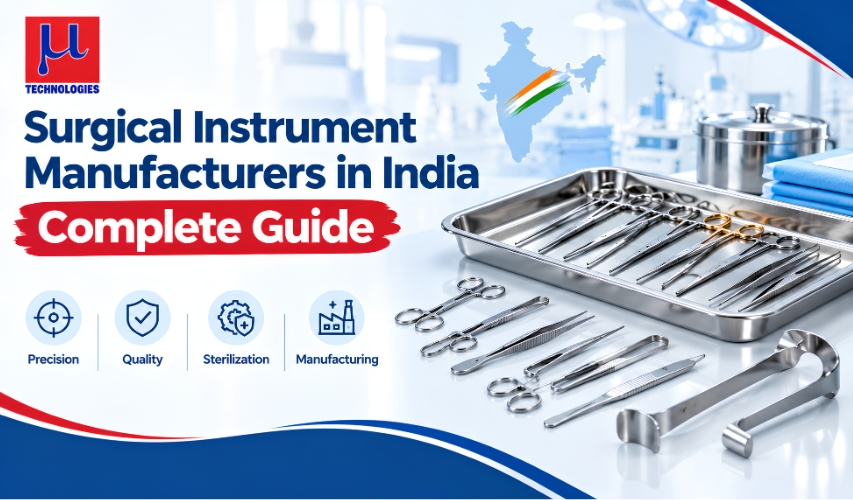
Somewhere in a small Haryana city that most people couldn't point to on a map, a huge share of the tools inside Indian operating theaters actually get made. Not imported. Not assembled from foreign parts. Made—forged, ground, polished, and sterilized right there.
That city is Ambala, and it's been doing this since before India was even independent. Understanding why matters, because choosing among surgical instrument manufacturers in India isn't just a procurement decision—it's tapping into one of the country's oldest and most specialized manufacturing traditions.
This guide breaks down that history, the real categories of instruments a hospital or surgical center actually needs—including orthopedic surgical instruments and general medical surgical instruments—the regulations governing them, and why Micro Technologies has earned a place on serious buyers' shortlists.
Who Are the Leading Surgical Instrument Manufacturers in India?
Leading surgical instrument manufacturers in India are heavily concentrated in Ambala, Haryana—a manufacturing hub dating back to 1843—and are regulated by the Central Drugs Standard Control Organisation (CDSCO) under the Medical Devices Rules, 2017. India exported roughly $1.36 billion worth of surgical and medical instruments in 2024-25, nearly double the $700 million exported just two years earlier. Micro Technologies, based in this same Ambala manufacturing belt, supplies a wide catalog of orthopedic instruments and general medical surgical instruments to hospitals, medical colleges, and export markets worldwide.
Why Ambala Became India's Surgical Instrument Capital
This part of the story deserves more attention than it usually gets, because it explains everything that follows.
Ambala Cantonment was established in 1843, and it grew into an important center for manufacturing scientific and surgical instruments almost from the start—a detail confirmed by its own recorded civic history. Over time, that early foundation attracted more workshops, more skilled metalworkers, and more specialized suppliers, until the region became self-reinforcing: instrument makers trained other instrument makers, and the industry simply never left.
By 1972-73, the trade had grown organized enough to form the Ambala Scientific Instruments Manufacturers Association (ASIMA), registered formally under the Punjab Societies Act of 1860. Today, ASIMA represents more than 350 manufacturing units producing scientific and surgical instruments for educational institutions, research labs, and healthcare facilities across the world. That's not a small regional cluster—that's a genuine industrial ecosystem, and it's exactly the environment Micro Technologies operates within.
Geography played its own quiet role too. Ambala sits roughly 200 km north of Delhi and about 55 km southwest of Chandigarh, placing it within practical reach of major transport routes without being swallowed by either metro's cost of doing business—a genuinely useful position for a manufacturing-heavy industry that depends on both skilled labor and efficient logistics.
The Numbers Behind India's Surgical Instrument Industry
It's easy to assume "made in India" surgical tools are a niche category. The export data says otherwise.
In the 2024-25 financial year, India exported approximately $1.36 billion worth of surgical and medical instruments under HS heading 9018—the international classification covering medical, surgical, dental, and veterinary instruments. That figure had nearly doubled from around $700 million just two years prior, in 2022-23, marking a 94% surge in roughly 24 months. That kind of growth doesn't happen by accident; it reflects real expansion in manufacturing capability, quality certification, and global buyer confidence in Indian-made instruments.
That growth also isn't limited to one instrument type. Consumables like syringes, needles, and catheters make up a meaningful chunk of that export figure, but the broader trend—expanding FDA-approved manufacturing facilities and a global push to diversify medical supply chains beyond traditional sourcing regions—has lifted surgical instrument categories across the board, orthopedic and general alike.
Regulation and Quality: What Actually Governs This Industry
Buying surgical instruments isn't like buying office furniture—there's a genuine regulatory backbone behind every serious manufacturer, and understanding it helps separate trustworthy suppliers from risky ones.
In India, medical devices—including surgical instruments—are regulated by the CDSCO under the Medical Devices Rules, 2017. These rules introduced a risk-based classification system, sorting devices into four classes:
- Class A (low risk)—items like surgical dressings and tongue depressors
- Class B (low-moderate risk) – items like hypodermic needles and ultrasound devices
- Class C (moderate-high risk)—items like ventilators and dialysis machines
- Class D (high risk)—items like heart valves and implantable defibrillators
Most general and orthopedic surgical instruments fall into the lower-risk classes, but every category still requires manufacturers to operate under a certified Quality Management System aligned with ISO 13485:2016—the internationally recognized standard for medical device quality management, implemented in India as IS 13485 by the Bureau of Indian Standards.
For sterile instruments specifically, sterilization validation is a hard requirement: the Sterility Assurance Level (SAL) must reach 10⁻⁶, meaning no more than a one-in-a-million chance of a non-sterile unit reaching the operating table. That's not a marketing claim—it's a documented, testable manufacturing standard, and it's exactly the kind of detail worth confirming before signing off on a bulk institutional order.
Orthopedic Surgical Instruments: What This Category Actually Covers
Orthopedic surgical instruments deserve their own spotlight, because they're some of the most mechanically demanding tools in the entire surgical instrument category—built to cut, hold, spread, and shape bone itself, not just soft tissue.
Bone Cutters and Rongeurs remove or trim bone tissue with controlled, precise force, essential in procedures ranging from spinal surgery to joint reconstruction.
Bone Holding Forceps grip bone fragments securely during realignment or fixation, keeping everything stable while a surgeon works.
Bone Spreaders and distractors—including specialized designs like cervical vertebra spreaders used in spine surgery—create working space between bone structures, giving surgeons the access they need in tight anatomical areas.
Bone Hooks and Retractors pull surrounding tissue or bone fragments out of the surgical field without damaging them, keeping the operative site clear and visible.
Mallets, Chisels, and Osteotomes apply controlled mechanical force to cut or shape bone—tools that look almost like a carpenter's kit, because the underlying mechanics genuinely aren't that different.
Periosteal Elevators and Raspatories separate the periosteum (the bone's outer membrane) from the underlying bone surface, a routine but delicate step in many orthopedic procedures.
Bone Nibblers—like a single-action bone nibbler with a compact bite size around 3 mm—allow for precise, controlled removal of small bone sections, available in both straight and curved configurations depending on the anatomical access required.
Taken together, this range covers nearly every mechanical action an orthopedic surgeon performs on bone during a typical procedure: cutting, gripping, spreading, shaping, and clearing. That completeness matters, because a procurement team sourcing orthopedic surgical instruments piecemeal from multiple vendors runs a real risk of ending up with mismatched quality or inconsistent sizing across an otherwise coordinated instrument tray.
Micro Technologies manufactures across nearly this entire orthopedic range, built from surgical-grade stainless steel designed to withstand repeated sterilization cycles without corroding or losing precision—a genuinely important property given how often orthopedic instruments get reused across procedures.
Medical Surgical Instruments Beyond Orthopedics
While orthopedic tools handle bone, the broader category of medical surgical instruments covers the tissue, vessel, and general-procedure tools every operating theater depends on daily.
Artery Forceps (Hemostats) clamp blood vessels to control bleeding during surgery—a category that includes designs like Kocher straight artery forceps, built with strong serrated jaws for firm grip on tougher tissue, and finer straight artery forceps designed for precise control of smaller, more delicate vessels.
Retractors hold back tissue, organs, or incision edges to keep the surgical field open and visible, spanning everything from simple hand-held designs to specialized multi-blade versions used in urological procedures.
Linear Staplers close tissue with a row of surgical staples in a single motion, speeding up closure in procedures where hand-suturing every layer would take significantly longer.
Urology Instruments—including catheters, dilators, and specialized forceps—support the diagnosis and surgical management of urinary tract and male reproductive system conditions, a category with its own highly specific tool requirements.
Together, orthopedic and general medical surgical instruments cover the overwhelming majority of what a well-equipped operating theater actually touches during a procedure—which is exactly why a manufacturer offering both categories under one roof genuinely simplifies procurement for hospitals and medical colleges.
Why Micro Technologies Stands Out
Micro Technologies operates from within the same Ambala manufacturing tradition described above, and its product catalog reflects the depth that tradition has built over decades.
A few specific reasons this manufacturer keeps showing up on institutional shortlists:
- Genuine category depth—the catalog spans orthopedic and neuro/spine instruments (bone curettes, cutters, holding forceps, spreaders, mallets, elevators), general surgical tools like artery forceps and linear staplers, and specialized categories like urology instruments, all under one supplier relationship.
- Surgical-grade materials—Instruments are manufactured from premium-grade stainless steel chosen specifically for corrosion resistance and consistent performance through repeated sterilization cycles, a non-negotiable requirement in any real clinical setting.
- Precision sizing options—many instruments, such as fine artery forceps, are available across multiple sizes (commonly 18 cm, 20 cm, and 23 cm ranges), letting surgical teams match the tool to the specific procedure rather than making do with a one-size-fits-all option.
- Dual-purpose positioning—the same instrument ranges serve both active clinical use in hospitals and surgical centers, and training use in medical colleges, which matters for institutions running both patient care and education under one roof.
- Broader institutional ecosystem—because Micro Technologies also manufactures medical equipment, diagnostic equipment, and anatomy models, hospitals and medical colleges can consolidate a meaningful share of their procurement with a single, established supplier.
For a hospital administrator or medical college procurement officer comparing options, that combination—catalog depth, material quality, and Ambala's century-plus manufacturing pedigree—is exactly the kind of profile worth prioritizing over a supplier offering a narrower, less specialized range.
How to Evaluate Surgical Instrument Manufacturers in India: A Practical Checklist
Whether you're outfitting a new operating theater or restocking an existing one, this checklist keeps the decision grounded in substance rather than sales pitches.
- Confirm regulatory standing. Ask directly whether the manufacturer operates under CDSCO's Medical Devices Rules, 2017, and maintains ISO 13485-aligned quality management.
- Check material specifications. Surgical-grade stainless steel isn't optional—ask what grade is used and how it holds up across repeated sterilization cycles.
- Verify sterilization validation. For sterile instruments, ask about Sterility Assurance Level (SAL) testing, since a SAL of 10⁻⁶ is the recognized benchmark for genuine sterility confidence.
- Compare category breadth. A manufacturer covering both orthopedic and general medical surgical instruments reduces the number of separate vendor relationships your institution needs to manage.
- Ask about sizing and customization. Procedures vary, and so should instrument sizing—a manufacturer offering multiple size ranges per instrument type shows genuine attention to clinical practicality.
- Look into training-use support. If your institution combines patient care with medical education, confirm the manufacturer explicitly supports both clinical and training applications.
Domestic Supply vs. Export Quality: Are They Really Different?
Buyers sometimes assume equipment built for export must be a different, higher tier than what's sold domestically within India. In practice, for a manufacturer operating under a single ISO 13485-aligned quality system, that assumption usually doesn't hold.
The same production standards, material specifications, and sterilization validation processes generally apply whether an order ships to a hospital in Punjab or a surgical center overseas. What genuinely differs is logistics—export-specific packaging, customs documentation, and occasionally region-specific regulatory paperwork. Given India's $1.36 billion export figure in 2024-25, a meaningful share of Ambala's manufacturing output is already built to standards that satisfy international buyers—which is a reasonable proxy for the quality domestic buyers are receiving too.
What Buyers Outside India Should Know Before Ordering
International hospitals, distributors, and surgical supply companies increasingly source from Indian manufacturers, and the export numbers above reflect exactly that trend. A few practical points matter for this specific audience.
First, confirm whether the manufacturer's facility and product line carry the certifications relevant to your destination market—CE marking for the European Union, FDA registration for the United States, or equivalent regional approvals. Many established Ambala-based manufacturers pursue these certifications specifically because their domestic ISO 13485-aligned quality systems already cover most of the underlying documentation requirements, making the additional certification process considerably more straightforward than starting from scratch.
Second, ask about minimum order quantities and typical lead times for international shipments. Surgical instruments are precision goods, and reputable manufacturers won't rush production simply to hit a shipping deadline—a slightly longer, properly validated lead time is a better sign than an unrealistically fast one.
Third, clarify after-sales support for international orders specifically. Replacement parts, instrument repair or resharpening services, and documentation support (such as certificates of conformity) should be part of the conversation before the first order ships, not an afterthought once a shipment arrives with a problem.
The Role of Skilled Craftsmanship in This Industry
It's worth pausing on something easy to overlook in a guide full of standards and certifications: surgical instrument manufacturing, especially in the orthopedic category, still depends heavily on skilled manual craftsmanship alongside modern machining.
Forging, grinding, and polishing a bone cutter or artery forceps to the tight tolerances surgery demands isn't a fully automated process, even with modern equipment involved. Ambala's century-plus manufacturing history matters here in a very literal sense—much of the specialized skill involved gets passed down through generations of workers within the same industrial community, which is part of why the region's manufacturing quality has remained consistent even as the industry has scaled up dramatically in recent years. That blend of traditional craftsmanship and modern quality management is genuinely part of what separates a mature manufacturing hub from a newer, less specialized one.
A handful of recurring missteps show up again and again in institutional procurement, and they're worth naming directly.
Chasing price over material grade.
A cheaper artery forceps that loses its grip strength after repeated sterilization cycles costs more in replacements and clinical risk than a slightly pricier, properly graded instrument.
Ignoring sizing variety.
Ordering a single size of a given instrument, like artery forceps, when a range of 18 cm to 23 cm options exists, can leave a surgical team without the right tool for a specific procedure's anatomy.
Overlooking training-use needs.
Medical colleges that treat clinical and training instrument needs as identical sometimes end up under-equipped for hands-on student practice, since training environments often need higher volumes at slightly different price points than a working operating theater.
Assuming every "surgical instrument manufacturer" claim is equally rigorous.
Regulatory alignment with CDSCO and ISO 13485 is a meaningful differentiator—it's worth directly asking a manufacturer to confirm this rather than assuming it from a polished product catalog alone.
Conclusion
Choosing among surgical instrument manufacturers in India means choosing a supplier rooted in one of the country's oldest and most specialized industrial traditions—a heritage running back to Ambala's founding in 1843, formalized through ASIMA's 350-plus member manufacturing base since the early 1970s, and validated today by nearly $1.36 billion in annual export activity. Whether your institution needs orthopedic surgical instruments for bone and joint procedures or the broader range of medical surgical instruments that keep any operating theater running, the manufacturer behind those tools matters just as much as the tools themselves.
Micro Technologies, operating from within that same Ambala manufacturing ecosystem, offers exactly the kind of catalog depth, material quality, and dual clinical-and-training positioning that makes it a genuinely strong option for hospitals, medical colleges, and surgical centers evaluating their next equipment partner.
Frequently Asked Questions
What are the main categories offered by surgical instrument manufacturers in India?
Manufacturers generally cover orthopedic surgical instruments (bone cutters, forceps, spreaders, elevators), general medical surgical instruments (artery forceps, retractors, staplers), and specialized categories like urology instruments, often under one supplier's catalog.
Why is Ambala known as India's surgical instrument manufacturing hub?
Ambala Cantonment was established in 1843 and became an important center for scientific and surgical instrument manufacturing almost immediately, a tradition formalized through the Ambala Scientific Instruments Manufacturers Association (ASIMA) in 1972-73.
What regulations govern surgical instrument manufacturers in India?
Surgical instruments are regulated by the CDSCO under the Medical Devices Rules, 2017, with manufacturers generally required to maintain a quality management system aligned with ISO 13485:2016.
What does Sterility Assurance Level (SAL) mean for surgical instruments?
SAL measures the probability of a non-sterile unit; the standard benchmark for sterile medical devices is 10⁻⁶, meaning a one-in-a-million chance of non-sterility.
How large is India's surgical instrument export industry?
India exported approximately $1.36 billion worth of surgical and medical instruments in 2024-25, nearly double the roughly $700 million exported in 2022-23.
Does Micro Technologies manufacture orthopedic surgical instruments?
Yes, Micro Technologies manufactures a wide range of orthopedic surgical instruments, including bone cutters, bone holding forceps, bone spreaders, mallets, elevators, and bone nibblers, alongside general medical surgical instruments like artery forceps and staplers.