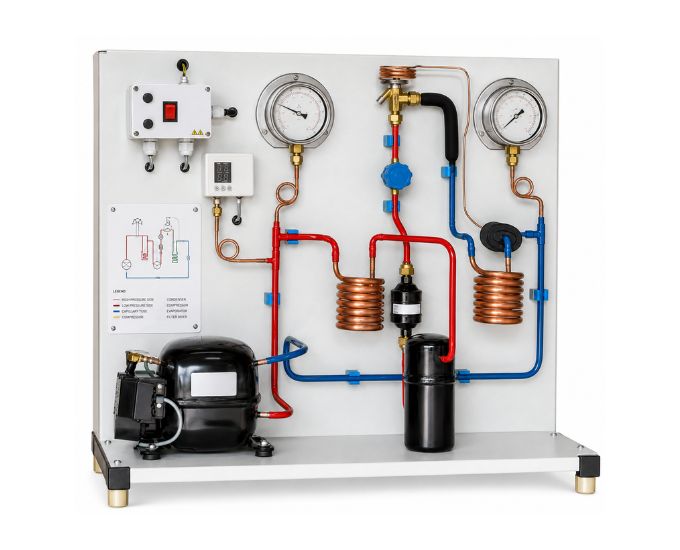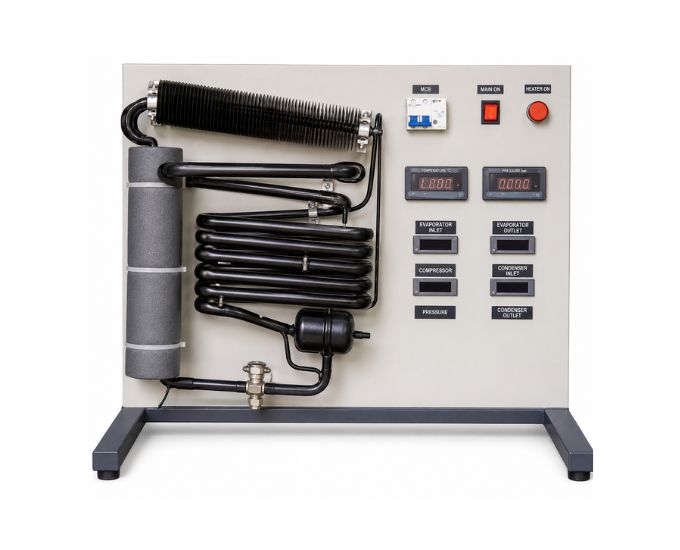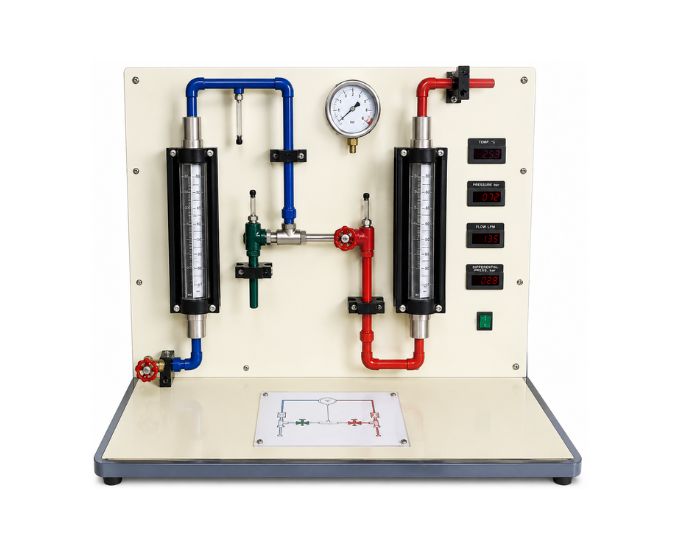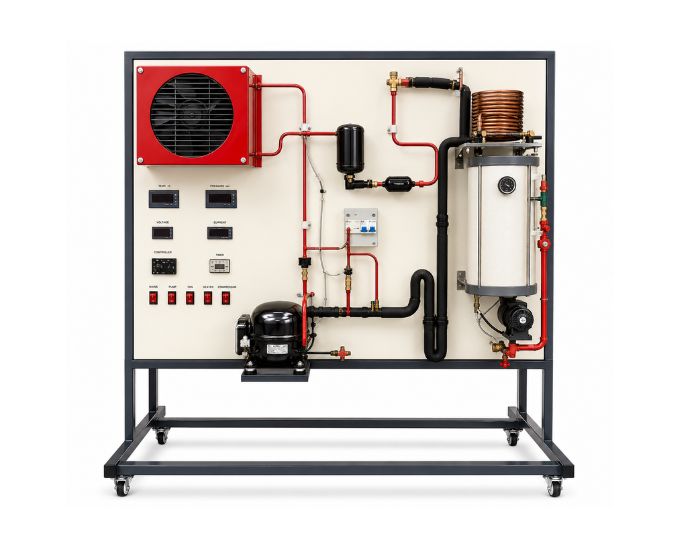

Vapour Jet Refrigeration System Trainer
Product Specification Sheet
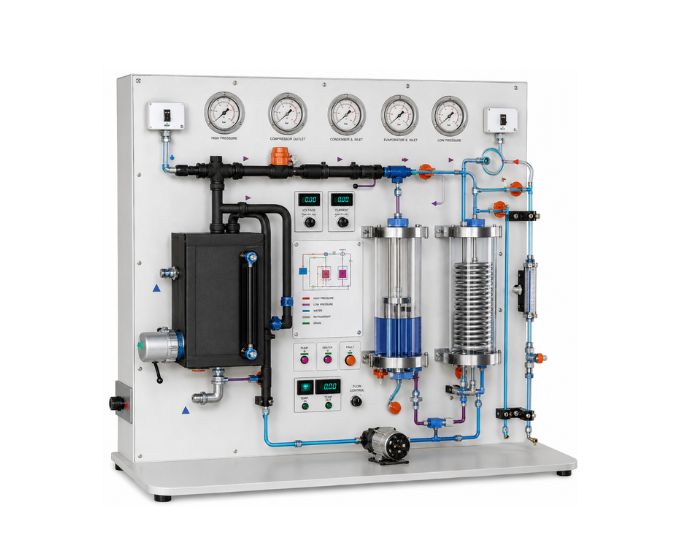
Vapour Jet Refrigeration System Trainer
Model Number: MTR-102
The Vapour Jet Refrigeration System Trainer from Micro Technologies is designed for practical study of refrigeration systems based on the vapour jet compression principle. The setup helps demonstrate jet-compressor operation, Rankine cycle concepts, energy balance, refrigeration performance, thermodynamic representation on a log P-h diagram, and system behaviour under different operating loads.
Product Specification
The Vapour Jet Refrigeration System Trainer is an experimental and demonstration setup developed to explain the working principles of vapour jet or steam jet refrigeration.
Unlike conventional vapour compression refrigeration systems that use a mechanically driven compressor, a vapour jet system uses a high-velocity motive vapour jet to entrain and compress low-pressure vapour from the evaporator.
The system provides a practical platform for understanding the operation of the jet compressor/ejector, evaporator, condenser and associated refrigeration circuit.
The apparatus can be used to investigate important thermodynamic concepts including energy balance, coefficient of performance, Rankine cycle relationships and pressure-enthalpy characteristics.
It also provides a useful basis for studying the application of thermal energy and solar thermal energy in vapour jet refrigeration systems.
Key Features
- Vapour jet refrigeration principle
- Jet compressor/ejector demonstration
- Thermal compression process study
- Refrigeration cycle analysis
- Rankine cycle study
- Clockwise and anticlockwise cycle concepts
- Energy-balance experiments
- Coefficient of Performance calculation
- Thermodynamic cycle analysis
- Log P-h diagram study
- Variable-load operation study
- Heat absorption and rejection analysis
- Solar thermal refrigeration concept
- Suitable measuring instrumentation
- Laboratory-friendly experimental setup
Technical Specifications
| Specification | Details |
|---|---|
| Product Name | Vapour Jet Refrigeration System Trainer |
| System Type | Vapour Jet Refrigeration |
| Compression Principle | Vapour Jet / Ejector Compression |
| Compressor Type | Jet Compressor / Ejector |
| Cycle Study | Refrigeration / Rankine Cycle Concepts |
| Energy Balance | Demonstrable |
| COP Calculation | Supported |
| Thermodynamic Analysis | Supported |
| Log P-h Diagram Study | Supported |
| Load Operation | Variable Load Study |
| Solar Thermal Concept | Demonstrable |
| Instrumentation | Suitable Temperature / Pressure Measuring Provisions |
| Application | Refrigeration & Thermodynamics Experiments |
Exact working fluid, heat source, capacities, measuring instruments and operating ranges can be configured according to the selected laboratory setup.
Working Principle
Generation of Motive Vapour
A suitable heat source generates the high-pressure motive vapour required to operate the jet compressor.
Jet Acceleration
The motive vapour passes through a nozzle where its pressure energy is converted into high-velocity kinetic energy.
Vapour Entrainment
The high-speed jet creates a low-pressure region that draws vapour from the evaporator into the ejector.
Mixing & Compression
The motive and entrained vapours mix inside the jet compressor. Their velocity is subsequently reduced in the diffuser, producing an increase in pressure.
Condensation
The mixed vapour enters the condenser where heat is rejected and the vapour is condensed.
Refrigeration Effect
Low-pressure conditions in the evaporator allow the working fluid to evaporate while absorbing heat, thereby producing the refrigeration effect.
Main Components
Jet Compressor / Ejector
The jet compressor uses the energy of high-pressure motive vapour to entrain and compress low-pressure refrigerant vapour.
Nozzle
The nozzle converts pressure energy of the motive vapour into kinetic energy and generates the high-velocity jet.
Mixing Chamber
The motive vapour and entrained vapour combine within the mixing section.
Diffuser
The diffuser reduces fluid velocity and assists in converting kinetic energy into pressure.
Evaporator
The evaporator provides the refrigeration effect by allowing the working fluid to absorb heat at low pressure.
Condenser
The condenser rejects heat and converts the vapour mixture toward the liquid phase.
Heat Source
A suitable thermal source supplies the energy required to generate motive vapour.
Measuring Instruments
Suitable instrumentation can be provided to observe temperatures, pressures and other operating parameters required for cycle analysis.
Experiments & Studies
Study of Vapour Jet Compression Refrigeration
The setup demonstrates how a jet compressor can replace a conventional mechanically driven compressor for suitable refrigeration applications.
Study of Rankine Cycle Concepts
The apparatus can be used to explain thermodynamic cycle direction and the relationship between power and refrigeration cycles.
Energy Balance
Users can perform a basic energy analysis of the main system components and the overall refrigeration circuit.
Calculation of Coefficient of Performance
Experimental measurements can be used to evaluate the performance of the refrigeration system.
Thermodynamic Cycle on Log P-h Diagram
Operating states can be studied using a pressure-enthalpy representation to understand changes in refrigerant properties throughout the cycle.
Operation Under Load
System performance can be investigated at different operating loads to observe changes in refrigeration behaviour.
Solar Thermal Vapour Jet Refrigeration
The trainer can be used to explain how solar-derived thermal energy may serve as a heat source for thermally driven jet refrigeration.
Coefficient of Performance
The Coefficient of Performance (COP) is an important parameter used to evaluate refrigeration-system performance.
For a thermally driven refrigeration system, performance evaluation should account for the useful refrigeration effect relative to the relevant energy input defined for the experiment.
Experimental COP analysis helps users compare system behaviour under different operating conditions.
Rankine Cycle Study
Clockwise Rankine Cycle
A conventional power-cycle representation is generally associated with net work production.
Anticlockwise / Reversed Cycle
A reversed thermodynamic cycle requires energy input to transfer heat from a lower-temperature region to a higher-temperature region.
Studying both concepts helps explain the fundamental relationship between power generation, refrigeration and heat-pump cycles.
Thermodynamic Analysis
The trainer helps users study:
- Pressure variation
- Temperature variation
- Enthalpy changes
- Heat absorption
- Heat rejection
- Ejector operation
- Evaporator performance
- Condenser performance
- Energy transfer
- Refrigeration effect
- System COP
Log P-h Diagram Study
A pressure-enthalpy diagram provides a useful graphical representation of refrigeration processes.
Experimental state points can be related to the diagram to study:
- Pressure levels
- Enthalpy changes
- Phase behaviour
- Heat-transfer processes
- Refrigeration effect
- Compression/ejection processes
Solar Thermal Vapour Jet Refrigeration
One advantage of jet refrigeration technology is its potential compatibility with thermal-energy sources.
Suitable systems may use heat obtained from:
- Solar thermal collectors
- Industrial waste heat
- Process heat
- Other suitable thermal sources
This makes vapour jet refrigeration an important concept for studying thermally driven cooling technologies.
Learning Objectives
The trainer helps users understand:
- Vapour jet refrigeration fundamentals
- Jet compressor operation
- Ejector working principle
- Nozzle and diffuser functions
- Refrigeration thermodynamics
- Rankine cycle concepts
- Energy balance
- Coefficient of Performance
- Pressure-enthalpy analysis
- Refrigeration under variable load
- Thermally driven refrigeration
- Solar thermal refrigeration principles
Benefits
- Demonstrates an alternative refrigeration principle
- Practical study of jet compression
- Helps explain ejector operation
- Supports thermodynamic cycle analysis
- Enables energy-balance calculations
- Useful for COP determination
- Supports pressure-enthalpy diagram study
- Demonstrates load-dependent performance
- Introduces solar thermal refrigeration concepts
- Suitable for repeated laboratory experiments
- Useful for refrigeration and thermal engineering studies
- Custom instrumentation options available
Scope of Application
- Vapour Jet Refrigeration Study
- Steam Jet Refrigeration Study
- Ejector Refrigeration Experiments
- Jet Compressor Study
- Refrigeration Cycle Analysis
- Rankine Cycle Study
- Energy Balance Experiments
- COP Determination
- Log P-h Diagram Analysis
- Variable Load Testing
- Thermal Refrigeration Study
- Solar Thermal Refrigeration Study
Applications
- Refrigeration & Air Conditioning Laboratories
- Mechanical Engineering Laboratories
- Thermal Engineering Laboratories
- Energy Engineering Laboratories
- Engineering Colleges
- Technical Universities
- Polytechnic Institutes
- Industrial Training Institutes
- HVAC Training Centers
- Research Laboratories
- Renewable Energy Laboratories
- Technical Training Centers
Frequently Asked Questions
What is a Vapour Jet Refrigeration System?
It is a thermally driven refrigeration system that uses a high-velocity vapour jet and ejector arrangement to entrain and compress low-pressure vapour.
Does the system use a conventional mechanical compressor?
The fundamental vapour jet principle uses a jet compressor or ejector instead of the conventional mechanically driven compressor used in standard vapour-compression systems.
What is the function of the jet compressor?
It uses high-pressure motive vapour to entrain low-pressure vapour and raise the pressure of the combined flow.
Can COP be calculated?
Yes. Appropriate experimental measurements can be used for system-performance and COP calculations.
Can an energy balance be performed?
Yes. Energy balances can be studied across suitable components and for the overall refrigeration system.
Can the refrigeration cycle be studied on a log P-h diagram?
Yes. The trainer is suitable for relating experimental operating conditions to a pressure-enthalpy diagram.
Can the system be studied under different loads?
Yes. System behaviour can be investigated under varying load conditions according to the supplied configuration.
Can solar thermal refrigeration be studied?
Yes. The setup can be used to explain the principle of using solar-derived thermal energy to drive vapour jet refrigeration.
Where is this trainer commonly used?
It is suitable for refrigeration, air-conditioning, mechanical, thermal and energy engineering laboratories.
Why Choose Micro Technologies?
- Vapour jet refrigeration demonstration
- Jet compressor principle study
- Thermodynamic cycle analysis
- Energy-balance experiments
- COP evaluation
- Log P-h diagram study
- Variable-load experiments
- Solar thermal refrigeration concepts
- Laboratory-oriented construction
- Custom instrumentation options
- Institutional and bulk supply
- Technical support
Call to Action
Explore the Vapour Jet Refrigeration System Trainer from Micro Technologies for hands-on study of jet compression, refrigeration thermodynamics and thermally driven cooling. Request technical specifications, laboratory configuration, customization options and a commercial quotation for your requirement.