
Simple Vapour Compression Refrigeration System
Product Specification Sheet
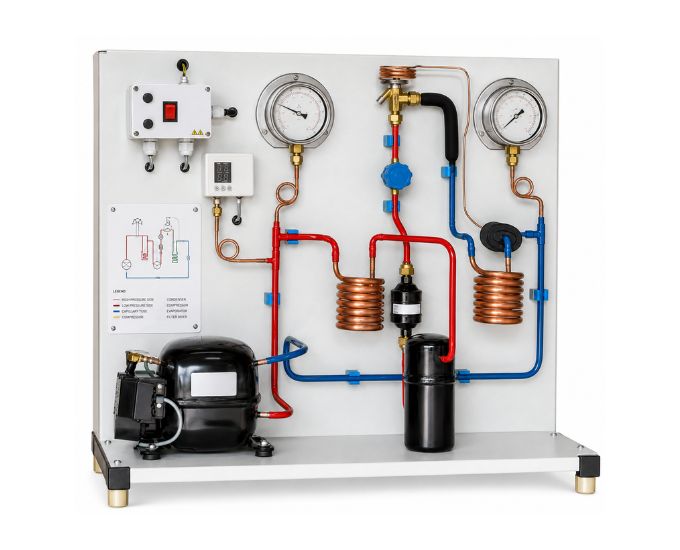
Simple Vapour Compression Refrigeration System
Model Number: MTR-101
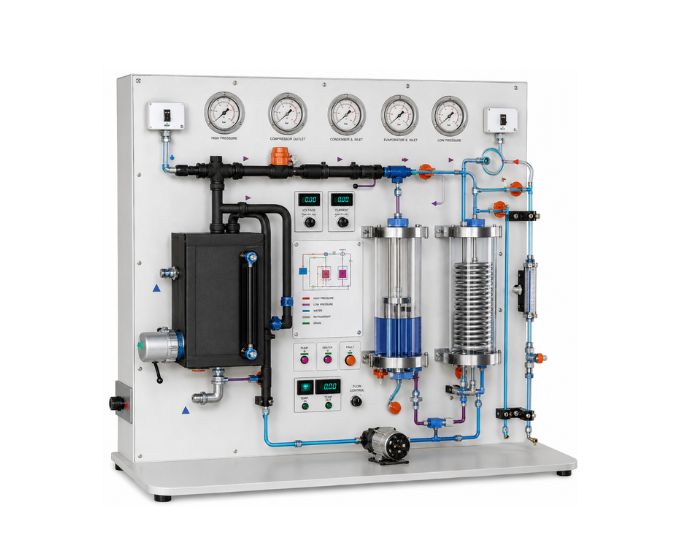
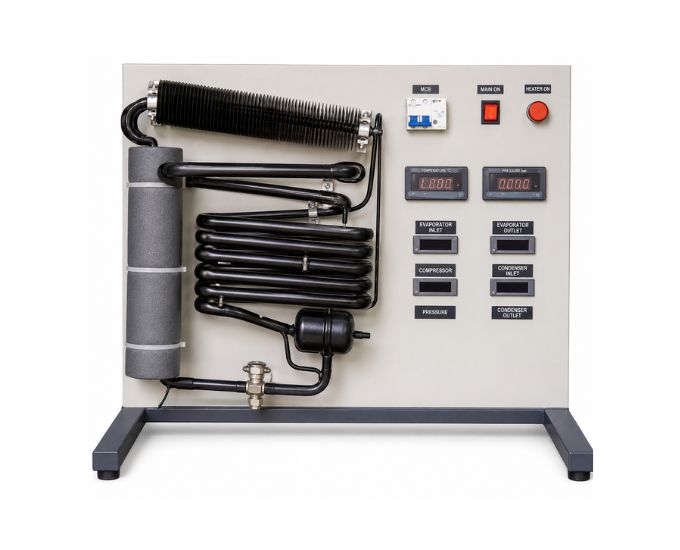
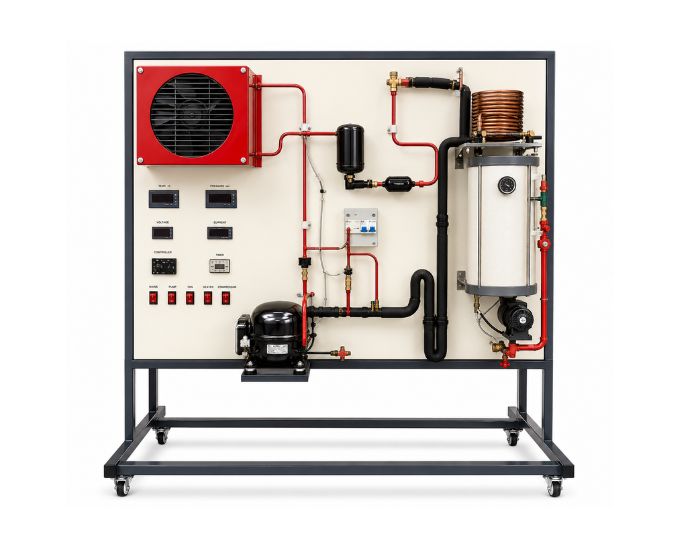
The Simple Vapour Compression Refrigeration System from Micro Technologies is designed for practical study of the fundamental refrigeration cycle. The setup demonstrates the operation and relationship of the compressor, condenser, expansion device and evaporator, helping users understand refrigerant circulation, heat transfer, thermodynamic processes and basic energy balance.
Product Specification
The Simple Vapour Compression Refrigeration System is a laboratory training and demonstration setup developed to explain the fundamental principles of mechanical refrigeration.
The system demonstrates a complete vapour compression refrigeration cycle, one of the most widely used refrigeration principles. It enables users to understand how refrigerant circulates through different components and undergoes changes in pressure, temperature and phase to produce a refrigeration effect.
The experimental setup incorporates the four essential components of a basic refrigeration system: compressor, condenser, expansion device and evaporator.
During operation, the compressor raises the pressure of refrigerant vapour. The condenser then rejects heat and converts the high-pressure vapour into liquid refrigerant. The expansion device reduces its pressure before the refrigerant enters the evaporator, where it absorbs heat and produces the cooling effect.
The system provides a practical platform for studying the thermodynamic refrigeration cycle, refrigeration system operation, heat-pump principle and basic energy balance.
Key Features
- Demonstrates vapour compression refrigeration cycle
- Complete refrigeration circuit
- Compressor section
- Condenser section
- Expansion device
- Evaporator section
- Refrigerant circulation demonstration
- Pressure and temperature study
- Heat absorption and rejection study
- Refrigeration and heat-pump principle
- Thermodynamic cycle analysis
- Basic energy balance study
- Suitable instrumentation provision
- Compact laboratory configuration
- Suitable for practical demonstrations
Technical Specifications
| Specification | Details |
|---|---|
| Product Name | Simple Vapour Compression Refrigeration System |
| System Type | Vapour Compression Refrigeration |
| Main Components | Compressor, Condenser, Expansion Device & Evaporator |
| Cycle Type | Compression Refrigeration Cycle |
| Compressor | Refrigeration Compressor |
| Condenser | Heat Rejection Section |
| Expansion | Suitable Expansion Device |
| Evaporator | Heat Absorption Section |
| Temperature Measurement | Provision at Suitable Points |
| Pressure Measurement | Provision at Suitable Points |
| Operating Mode | Refrigeration / Heat Pump Study |
| Analysis | Thermodynamic Cycle & Energy Balance |
| Application | Refrigeration Training & Experimentation |
Refrigerant type, compressor capacity, instrumentation, condenser arrangement and other specifications can be configured according to laboratory requirements.
Main Components
Compressor
The compressor receives low-pressure refrigerant vapour from the evaporator and compresses it to a higher pressure and temperature.
Condenser
The condenser removes heat from the high-pressure refrigerant. During this process, the refrigerant changes from vapour toward a liquid state while rejecting heat to the surroundings.
Expansion Device
The expansion device reduces the pressure of the liquid refrigerant before it enters the evaporator.
Evaporator
The evaporator absorbs heat from the refrigerated space or medium. The low-pressure refrigerant evaporates while absorbing this thermal energy.
Working Principle
1. Compression
Low-pressure refrigerant vapour enters the compressor and is compressed to a high-pressure, high-temperature condition.
2. Condensation
The compressed refrigerant enters the condenser, where heat is rejected to the surroundings. The refrigerant condenses toward the liquid state.
3. Expansion
High-pressure liquid refrigerant passes through the expansion device, causing a significant reduction in pressure.
4. Evaporation
The low-pressure refrigerant enters the evaporator and absorbs heat. It evaporates and returns toward the compressor, completing the cycle.
Experiments & Studies
Study of Vapour Compression Refrigeration Cycle
The setup demonstrates the complete sequence of compression, condensation, expansion and evaporation.
Study of Refrigeration System Components
Users can understand the function and relationship of the compressor, condenser, evaporator and expansion device.
Study of Refrigeration System Operation
The system demonstrates how refrigerant circulation produces a continuous cooling effect.
Study of Heat Pump Operation
The same thermodynamic cycle can be studied from the perspective of heat transfer and heat-pump operation.
Thermodynamic Cycle Study
Temperature and pressure measurements can be used to understand refrigerant behaviour at different stages of the cycle.
Simple Energy Balance
The system enables basic energy-balance analysis involving refrigeration effect, compressor input and heat rejection.
Thermodynamic Processes
Compression Process
The compressor increases refrigerant pressure and requires mechanical or electrical energy input.
Heat Rejection Process
The condenser transfers heat from the refrigerant to the surroundings.
Expansion Process
The expansion device reduces refrigerant pressure before the evaporator.
Heat Absorption Process
The evaporator absorbs heat from the cooled medium, producing the desired refrigeration effect.
Performance Parameters
Depending on the supplied instrumentation, the setup can be used to study:
- Refrigerant temperatures
- Suction pressure
- Discharge pressure
- Evaporator conditions
- Condenser conditions
- Compressor energy input
- Refrigeration effect
- Heat rejection
- Coefficient of Performance
- Basic energy balance
Coefficient of Performance
The performance of a refrigeration system is commonly expressed using Coefficient of Performance (COP).
Refrigerator COP
COP = Refrigeration Effect / Work Input
A higher COP indicates that a greater refrigeration effect is achieved for a given amount of input work.
Learning Objectives
The system helps users understand:
- Fundamentals of compression refrigeration
- Refrigerant circulation
- Function of a compressor
- Function of a condenser
- Function of an evaporator
- Function of an expansion device
- Refrigeration cycle operation
- Heat absorption
- Heat rejection
- Pressure changes through the system
- Temperature changes through the system
- Heat-pump principle
- Thermodynamic cycle
- Energy balance
- Refrigeration performance
Benefits
- Complete refrigeration cycle demonstration
- Clear understanding of major refrigeration components
- Practical thermodynamic study
- Refrigeration and heat-pump concepts in one system
- Pressure and temperature analysis
- Basic energy-balance experiments
- Suitable for repeated practical sessions
- Compact laboratory arrangement
- Useful for instructor demonstrations
- Helps connect theoretical concepts with actual refrigeration operation
- Suitable for technical training
- Custom instrumentation options available
Scope of Application
- Vapour Compression Refrigeration Study
- Refrigeration Cycle Demonstration
- Compressor Performance Study
- Condenser Operation Study
- Evaporator Operation Study
- Expansion Process Study
- Refrigerant Behaviour Analysis
- Heat Pump Study
- Thermodynamic Cycle Analysis
- Energy Balance Experiment
- COP Study
- Refrigeration Training
Applications
- Refrigeration & Air Conditioning Laboratories
- Mechanical Engineering Laboratories
- Thermal Engineering Laboratories
- Engineering Colleges
- Technical Universities
- Polytechnic Institutes
- Industrial Training Institutes
- HVAC Training Centers
- Vocational Training Centers
- Technical Training Institutes
- Research Laboratories
- Demonstration Laboratories
Frequently Asked Questions
What is a Simple Vapour Compression Refrigeration System?
It is a refrigeration training and experimental system designed to demonstrate a basic compression refrigeration cycle and its major components.
What are the main components of the system?
The four main components are the compressor, condenser, expansion device and evaporator.
What is the purpose of the compressor?
The compressor raises the pressure and temperature of refrigerant vapour and maintains refrigerant circulation through the system.
What does the condenser do?
The condenser rejects heat from the refrigerant to the surroundings and promotes condensation of the refrigerant.
What is the function of the evaporator?
The evaporator absorbs heat from the medium being cooled and provides the refrigeration effect.
What is the function of the expansion device?
It reduces refrigerant pressure before the refrigerant enters the evaporator.
Can the thermodynamic refrigeration cycle be studied?
Yes. The system is specifically designed to provide a practical understanding of the thermodynamic vapour compression cycle.
Can a heat pump principle be demonstrated?
Yes. The setup can be used to explain the relationship between refrigeration and heat-pump operation.
Can an energy balance be performed?
Yes. Suitable measurements can be used for a basic energy-balance analysis of the system.
Can COP be studied?
Yes. With the required measurements and instrumentation, the Coefficient of Performance can be evaluated.
Why Choose Micro Technologies?
- Complete vapour compression refrigeration circuit
- Practical refrigeration-cycle demonstration
- Major components clearly represented
- Thermodynamic cycle study
- Refrigeration and heat-pump concepts
- Energy-balance experiments
- Pressure and temperature measurement options
- Laboratory-friendly configuration
- Custom technical specifications
- Institutional and bulk supply
- Technical support
Call to Action
Choose the Simple Vapour Compression Refrigeration System from Micro Technologies for practical study of refrigeration fundamentals, thermodynamic processes and energy balance. Contact us for complete technical specifications, instrumentation options, customization, institutional procurement and quotation.