
Absorption Refrigeration System Trainer
Product Specification Sheet
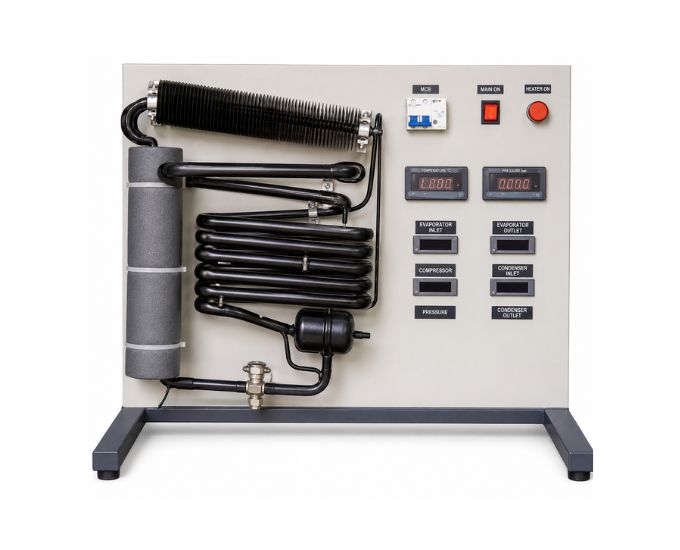
Absorption Refrigeration System Trainer
Model Number: MTR-103
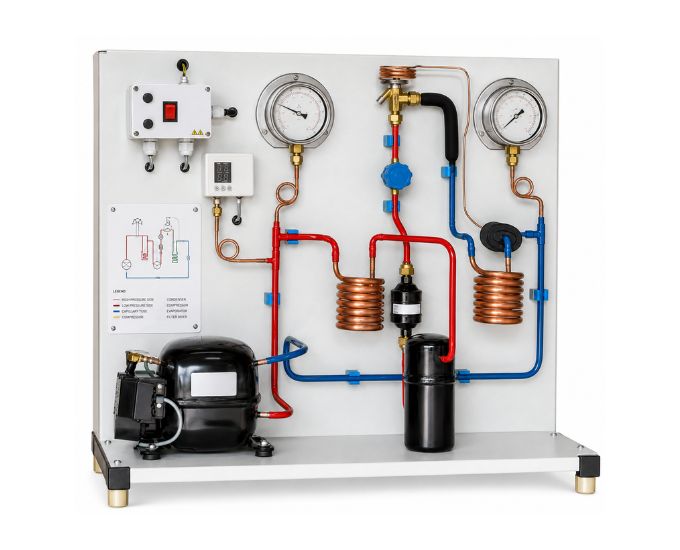
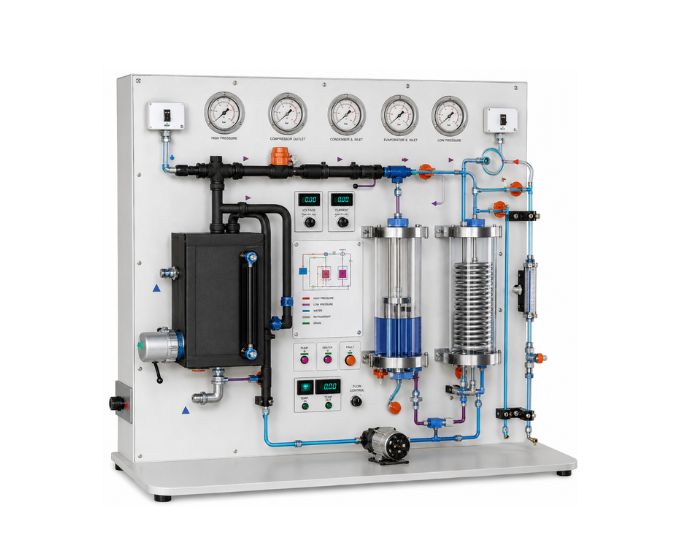
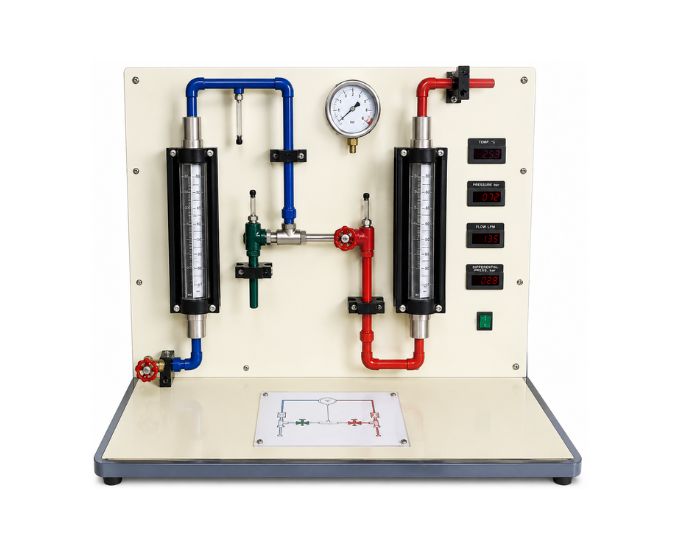
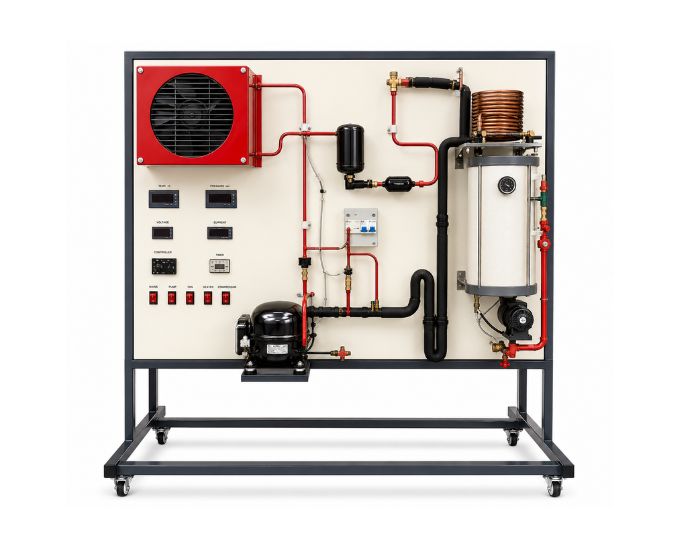
The Absorption Refrigeration System Trainer from Micro Technologies is designed to demonstrate the basic principles and operating cycle of an absorption refrigeration system. The setup provides practical understanding of its main components, heat-driven refrigeration process, refrigerant circulation and operating behaviour under different load conditions.
Product Specification
The Absorption Refrigeration System Trainer is a laboratory demonstration and experimental setup developed to explain refrigeration produced through an absorption-based cycle.
Unlike conventional vapour compression systems that primarily depend on a mechanically driven compressor, an absorption refrigeration system uses thermal energy and an absorbent-refrigerant process to maintain refrigerant circulation and produce cooling.
The trainer provides a clear representation of the major sections involved in absorption refrigeration and enables users to understand how heat supplied to the system contributes to refrigerant separation, condensation, expansion, evaporation and absorption.
Suitable temperature measuring points and control instrumentation can be incorporated to monitor system behaviour at different locations throughout the refrigeration circuit.
The setup is particularly useful for studying the fundamental absorption refrigeration principle, function of major components, heat transfer and system behaviour under load.
Key Features
- Demonstrates absorption refrigeration principle
- Heat-driven refrigeration process
- Complete absorption refrigeration circuit
- Clearly arranged major components
- Refrigerant circulation demonstration
- Absorption process study
- Heat addition and rejection study
- Evaporation and condensation demonstration
- Temperature measurement provisions
- Operating behaviour under load
- Thermodynamic refrigeration study
- Energy transfer demonstration
- Laboratory-oriented construction
- Suitable control and indication panel
- Suitable for repeated experiments and demonstrations
Technical Specifications
| Specification | Details |
|---|---|
| Product Name | Absorption Refrigeration System Trainer |
| System Type | Absorption Refrigeration |
| Operating Principle | Heat-Driven Absorption Cycle |
| Cooling Principle | Refrigerant Evaporation |
| Heat Input | Suitable Controlled Heat Source |
| Temperature Measurement | Multiple Measuring Points |
| Operating Behaviour | Load-Based Study |
| Instrumentation | Digital / Suitable Indicators |
| Control System | Panel-Mounted Controls |
| Construction | Laboratory Demonstration Setup |
| Application | Refrigeration & Thermodynamics Study |
Working fluid pair, heat-source capacity, cooling capacity, operating range and instrumentation can be configured according to the required system design.
Main Components
Generator
The generator receives thermal energy and separates refrigerant from the refrigerant-absorbent solution.
Condenser
The refrigerant vapour releases heat in the condenser and changes toward a liquid state.
Expansion Arrangement
The refrigerant pressure is reduced before it enters the evaporator.
Evaporator
Low-pressure refrigerant absorbs heat from the region or medium being cooled, thereby producing the refrigeration effect.
Absorber
Refrigerant vapour leaving the evaporator is absorbed into the absorbent solution, maintaining the absorption cycle.
Heat Source
A controlled thermal-energy source provides the heat required to operate the generator.
Instrumentation Panel
The panel provides suitable controls and indications for observing important system parameters.
Working Principle
1. Heat Addition
Thermal energy is supplied to the generator section of the system.
2. Refrigerant Separation
Heating causes refrigerant-rich vapour to separate from the absorbent-refrigerant solution.
3. Condensation
The refrigerant vapour passes to the condenser where heat is rejected and the refrigerant condenses.
4. Pressure Reduction
The condensed refrigerant passes through a suitable restriction or expansion arrangement, reducing its pressure.
5. Evaporation
The low-pressure refrigerant enters the evaporator and absorbs heat, producing the required cooling effect.
6. Absorption
Refrigerant vapour from the evaporator enters the absorber and is absorbed back into the solution.
7. Cycle Repetition
The solution is returned through the system so that the absorption refrigeration cycle can continue.
Absorption Refrigeration Cycle
The complete cycle involves four important thermal processes:
- Heat Addition – Energy supplied to the generator
- Heat Rejection – Heat removed at the condenser and absorber
- Refrigeration Effect – Heat absorbed in the evaporator
- Absorption – Refrigerant vapour absorbed into the solution
This arrangement replaces much of the mechanical compression function of a conventional refrigeration system with a thermally driven absorption process.
Experiments & Studies
Study of Absorption Refrigeration Principle
The trainer demonstrates the fundamental working mechanism of an absorption-based refrigeration system.
Identification of Main Components
Users can study the location and purpose of the generator, condenser, evaporator, absorber and associated circuit components.
Study of Refrigerant Circulation
The setup helps explain the path followed by the refrigerant during the complete refrigeration cycle.
Study of Heat Transfer
Heat addition, heat absorption and heat rejection processes can be studied at different stages of the system.
Operating Behaviour Under Load
The behaviour of the refrigeration system can be observed when operating conditions or thermal load change.
Temperature Distribution Study
Suitable measuring points enable temperature variations throughout the system to be examined.
Absorption vs Compression Refrigeration
| Parameter | Absorption Refrigeration | Vapour Compression Refrigeration |
|---|---|---|
| Primary Driving Energy | Thermal Energy | Mechanical/Electrical Energy |
| Compression Function | Absorption-Based Process | Mechanical Compressor |
| Main Special Components | Generator & Absorber | Compressor |
| Cooling Process | Refrigerant Evaporation | Refrigerant Evaporation |
| Heat Source Integration | Possible | Generally Not Primary Drive |
| Study Focus | Thermal Refrigeration | Mechanical Compression |
Performance Parameters
Depending on the supplied instrumentation, users can study:
- Generator temperature
- Condenser temperature
- Evaporator temperature
- Absorber temperature
- Refrigeration effect
- Heat input
- Heat rejection
- Cooling behaviour
- Load response
- System performance
Learning Objectives
The trainer helps users understand:
- Fundamentals of absorption refrigeration
- Difference between absorption and compression refrigeration
- Generator operation
- Absorber operation
- Condenser function
- Evaporator function
- Refrigerant circulation
- Absorbent-refrigerant interaction
- Heat-driven refrigeration
- Heat absorption and rejection
- Temperature variation
- Refrigeration effect
- System behaviour under load
- Basic thermodynamic principles
Benefits
- Practical absorption refrigeration demonstration
- Clearly arranged refrigeration circuit
- Demonstrates heat-driven cooling
- Major components can be studied individually
- Useful for thermodynamic analysis
- Temperature monitoring provisions
- Load behaviour can be investigated
- Helps compare refrigeration technologies
- Suitable for repeated laboratory experiments
- Useful for instructor-led demonstrations
- Compact training configuration
- Custom instrumentation options available
Scope of Application
- Absorption Refrigeration Study
- Refrigeration Cycle Demonstration
- Heat-Driven Cooling Study
- Generator Operation Study
- Absorber Operation Study
- Evaporator Performance Study
- Condenser Performance Study
- Refrigerant Circulation Study
- Thermal Energy Analysis
- Refrigeration Load Study
- Thermodynamics Experiments
- Refrigeration Training
Applications
- Refrigeration & Air Conditioning Laboratories
- Mechanical Engineering Laboratories
- Thermal Engineering Laboratories
- Energy Engineering Laboratories
- Engineering Colleges
- Technical Universities
- Polytechnic Institutes
- Industrial Training Institutes
- HVAC Training Centers
- Vocational Training Centers
- Research Laboratories
- Technical Training Institutes
Frequently Asked Questions
What is an Absorption Refrigeration System Trainer?
It is an experimental setup designed to demonstrate refrigeration using a heat-driven absorption cycle rather than relying primarily on a conventional mechanical compressor.
What are the major components of an absorption refrigeration system?
Major components typically include the generator, condenser, evaporator, absorber and associated flow-control components.
How does an absorption refrigeration system produce cooling?
Cooling is produced when low-pressure refrigerant evaporates in the evaporator and absorbs heat from the medium being cooled.
What is the function of the generator?
The generator uses thermal energy to separate refrigerant from the absorbent-refrigerant solution.
What is the function of the absorber?
The absorber takes in refrigerant vapour from the evaporator and absorbs it into the absorbent solution.
Can system behaviour under load be studied?
Yes. The trainer is designed to demonstrate how the system behaves when operating or thermal load conditions change.
Can temperatures be measured at different points?
Yes. Suitable temperature-measurement provisions can be incorporated at important locations throughout the system.
What is the main difference from vapour compression refrigeration?
A vapour compression system relies mainly on a mechanical compressor, while an absorption refrigeration system uses thermal energy together with an absorbent-refrigerant process to achieve the compression function.
Where can this equipment be used?
It is suitable for refrigeration and air conditioning, mechanical engineering, thermal engineering and energy engineering laboratories.
Why Choose Micro Technologies?
- Complete absorption refrigeration demonstration
- Heat-driven refrigeration principle
- Clearly arranged components
- Practical thermodynamic study
- Load-behaviour experiments
- Multiple measurement provisions
- Laboratory-friendly construction
- Custom technical configurations
- Institutional and bulk supply
- Technical support
Call to Action
Enhance practical refrigeration studies with the Absorption Refrigeration System Trainer from Micro Technologies. Contact us for detailed specifications, instrumentation options, customized laboratory configurations, institutional requirements and quotation.