
Torsion of Circular Sections Apparatus
Product Specification Sheet
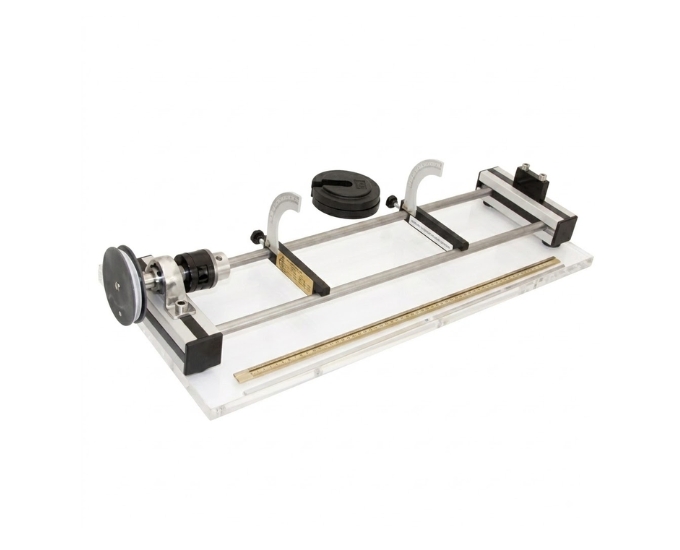
Torsion of Circular Sections Apparatus
Model Number: MTSE-116
The Torsion of Circular Sections Apparatus is an educational engineering laboratory system designed for practical investigation of the torsion formula and torsional behaviour of circular rods. It enables students to study the relationship between rod length and angle of twist, determine the shear modulus, investigate the polar second moment of area, and compare the torsional performance of hollow and solid rods.
Product Specification
The Torsion of Circular Sections Apparatus is a laboratory teaching system developed for experimental investigation of circular shafts and rods subjected to torsional loading.
Torsion occurs when a torque is applied about the longitudinal axis of a structural or mechanical member. This causes the member to twist and develops shear stresses within its cross-section.
The apparatus provides a practical method for investigating the fundamental torsion formula used in mechanics of materials.
For a circular shaft operating within the elastic range, the torsional relationship can be expressed as:
T / J = τ / R = Gθ / L
where:
T = Applied torque
J = Polar second moment of area
τ = Shear stress
R = Outer radius
G = Shear modulus or modulus of rigidity
θ = Angle of twist
L = Effective rod length
One of the primary experiments involves investigating the relationship between rod length and angle of twist.
For comparable material, geometry and applied torque, increasing the effective length of the test rod increases its angular deflection. This enables students to experimentally verify the length–twist relationship predicted by torsion theory.
The apparatus also enables determination of the shear modulus (G) of the test material. Experimental measurements of torque and angular deflection can be combined with the specimen dimensions to calculate this important material property.
Another experiment investigates the relationship between rod cross-sectional dimensions and torsion through the polar second moment of area.
The polar second moment of area is strongly influenced by the diameter and geometry of a circular section and therefore has a major effect on its resistance to twisting.
Students can compare the angular deflection of similar hollow and solid rods to investigate how material distribution within the cross-section affects torsional stiffness.
This comparison demonstrates why hollow circular sections can provide efficient torsional resistance relative to their material usage.
The apparatus can also be used to investigate mass per unit length and torsional resistance, allowing students to compare the structural efficiency of tubes with solid rods.
The system provides practical understanding of torque, angular displacement, torsional stiffness, shear modulus, polar second moment of area, shaft geometry and elastic deformation.
Micro Technologies supplies Torsion of Circular Sections Apparatus and other Strength of Materials and Mechanics of Materials laboratory equipment for engineering colleges, universities, polytechnic institutes and technical training centres.
Features
- Circular-section torsion experiments
- Torsion formula verification
- Torque versus angular deflection studies
- Rod length versus angle of twist investigation
- Shear modulus determination
- Polar second moment of area studies
- Circular rod testing
- Hollow rod experiments
- Solid rod experiments
- Hollow versus solid section comparison
- Torsional stiffness investigation
- Mass-per-unit-length comparison
- Elastic torsion studies
- Experimental and theoretical comparison
- Suitable for repeated educational experiments
Benefits
- Provides practical understanding of torsion theory
- Enables verification of fundamental torsion relationships
- Demonstrates the effect of rod length on angular deflection
- Allows determination of shear modulus
- Shows the importance of polar second moment of area
- Demonstrates the effect of cross-sectional dimensions
- Enables comparison of hollow and solid circular rods
- Helps explain torsional stiffness and resistance
- Demonstrates material-efficient shaft design concepts
- Connects theoretical calculations with experimental observations
Product Specifications
| Specification | Details |
|---|---|
| Product Name | Torsion of Circular Sections Apparatus |
| Product Type | Mechanics of Materials Laboratory Apparatus |
| Test Sections | Circular |
| Test Specimens | Solid & Hollow Rods |
| Primary Study | Torsional Behaviour |
| Torsion Formula | Verification Supported |
| Applied Loading | Torque |
| Angular Deflection | Measurement Supported |
| Rod Length Effect | Study Supported |
| Shear Modulus | Determination Supported |
| Polar Second Moment of Area | Study Supported |
| Cross-Section Effect | Study Supported |
| Hollow vs. Solid Comparison | Supported |
| Torsional Resistance | Investigation Supported |
| Elastic Behaviour | Study Supported |
| Application | Strength / Mechanics of Materials Laboratory |
Experiments Performed
- Verification of the torsion formula
- Study of torsional behaviour of circular sections
- Investigation of torque and angle of twist
- Study of rod length versus angular deflection
- Determination of shear modulus
- Determination of modulus of rigidity
- Investigation of rod cross-sectional dimensions
- Study of the polar second moment of area
- Investigation of torsional stiffness
- Study of solid circular rods
- Study of hollow circular rods
- Comparison of angular deflection in hollow and solid rods
- Comparison of torsional resistance
- Investigation of mass per unit length
- Comparison of torsional efficiency of tubes and solid rods
- Comparison of experimental and theoretical results
Applications
- Strength of Materials Laboratories
- Mechanics of Materials Laboratories
- Mechanical Engineering Laboratories
- Structural Mechanics Laboratories
- Applied Mechanics Laboratories
- Engineering Mechanics Laboratories
- Machine Design Laboratories
- Civil Engineering Laboratories
- Automobile Engineering Laboratories
- Engineering Colleges
- Universities
- Polytechnic Institutes
- Technical Training Centres
- Educational & Research Laboratories
FAQs
What is the Torsion of Circular Sections Apparatus used for?
The apparatus is used to investigate torsional behaviour of circular rods, including angle of twist, shear modulus, polar second moment of area and differences between hollow and solid sections.
What is torsion?
Torsion is the twisting deformation of a structural or mechanical member caused by torque acting about its longitudinal axis.
Can the torsion formula be verified experimentally?
Yes. Measured torque, angle of twist, specimen length and cross-sectional properties can be compared with the theoretical torsion relationship.
Can shear modulus be determined?
Yes. The shear modulus or modulus of rigidity of the specimen material can be calculated using experimental torsion measurements.
Can the effect of rod length be investigated?
Yes. Rod length can be related to angular deflection to demonstrate how effective specimen length influences the angle of twist.
What is the polar second moment of area?
The polar second moment of area is a geometric property that indicates how a cross-section resists torsional deformation.
Can hollow and solid rods be compared?
Yes. The apparatus allows their angular deflections and torsional resistance to be compared under suitable experimental conditions.
Why can a hollow tube be efficient in torsion?
Material positioned farther from the shaft axis contributes strongly to torsional resistance. A hollow section can therefore provide efficient torsional stiffness relative to its mass.
Can mass per unit length be compared?
Yes. The relationship between mass per unit length and torsional resistance can be investigated for hollow and solid specimens.
Is this apparatus suitable for Strength of Materials laboratories?
Yes. It is suitable for Strength of Materials, Mechanics of Materials, Mechanical Engineering, Applied Mechanics and related engineering laboratories.
Why Choose Our Products
- Complete circular-section torsion studies
- Torsion formula verification
- Angle of twist experiments
- Shear modulus determination
- Polar second moment of area investigation
- Hollow and solid rod comparison
- Torsional stiffness analysis
- Structural efficiency studies
- Experimental and theoretical comparison
- Student-friendly laboratory configuration
- Customized configurations available
- Institutional and bulk supply support
Call to Action
Enhance your Strength of Materials Laboratory with the Torsion of Circular Sections Apparatus from Micro Technologies. Designed for hands-on study of torque, angular deflection, shear modulus and hollow-versus-solid shaft behaviour, the system provides a practical platform for engineering education. Contact us for technical specifications, customized configurations, institutional quotations, bulk laboratory requirements or tender supply.