
Pin Jointed Framework Apparatus
Product Specification Sheet
Pin Jointed Framework Apparatus
Model Number: MTSE-117
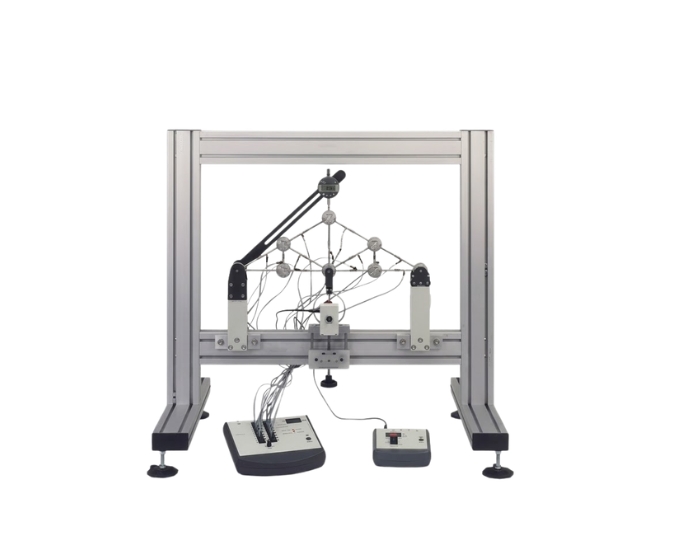
The Pin Jointed Framework Apparatus is a comprehensive structural engineering laboratory system designed for practical investigation of forces and deflections in pin-jointed trusses. It enables students to study Bow’s notation, strain gauges, Warren, roof, Howe and Pratt trusses, cantilever trusses, force analysis by the Method of Joints and Method of Sections, strain-energy deflection, wind loading and the principle of superposition.
Product Specification
The Pin Jointed Framework Apparatus is an educational structural engineering system developed for experimental study of forces, stresses and deflections in pin-jointed frames and trusses.
Pin-jointed frameworks consist of structural members connected at joints that are idealized as frictionless pins. Under suitable loading conditions, the individual members primarily carry axial tensile or compressive forces.
The apparatus provides students with practical experience in the analysis of different truss configurations and enables experimental results to be compared with theoretical structural calculations.
An important introductory topic is Bow’s notation, which provides a systematic method of identifying forces and spaces within graphical structural analysis.
The apparatus also introduces students to strain gauges as measuring instruments. Strain measurements can be related to member forces, allowing students to experimentally investigate how loads are distributed throughout a framework.
Different framework configurations can be investigated to demonstrate how structural geometry affects member forces and overall behaviour.
The system supports experiments involving the Warren Truss, a widely used arrangement characterized by a series of triangular structural elements.
Students can also investigate roof trusses, including common Howe and Pratt truss configurations, and compare their force distributions under applied loading.
Simple and more advanced cantilever trusses can be studied to understand how loads are transferred through frameworks supported from one side.
The apparatus supports analytical force determination using both the Method of Joints and the Method of Sections.
The Method of Joints considers equilibrium at individual pin connections, while the Method of Sections allows selected members to be analyzed by passing an imaginary section through the framework.
Students can compare calculated tensile and compressive member forces with values obtained experimentally.
The apparatus also enables deflection analysis using the strain-energy method, providing practical understanding of how elastic deformation is related to the energy stored within loaded structural members.
Wind loads on roof trusses can be investigated to demonstrate the effect of lateral or inclined loading on member-force distribution.
Students can also study the effect of a swaying load on a cantilever truss, providing insight into structural response under lateral loading conditions.
Another important experiment involves the principle of superposition for multiple loads. Under suitable linear-elastic conditions, students can compare the response caused by individual loads with the combined structural response.
The system therefore provides a comprehensive platform for understanding truss forces, axial loading, strain measurement, structural deflection, wind loading and framework analysis.
Micro Technologies supplies Pin Jointed Framework Apparatus and other structural engineering laboratory equipment for engineering colleges, universities, polytechnic institutes and technical training centres.
Features
- Pin-jointed framework experimental system
- Multiple truss configurations
- Bow’s notation studies
- Strain gauge measurement
- Member force investigation
- Warren truss experiments
- Roof truss studies
- Howe truss configuration
- Pratt truss configuration
- Cantilever truss experiments
- Method of Joints analysis
- Method of Sections analysis
- Strain-energy deflection studies
- Wind load investigation
- Swaying-load experiments
- Principle of superposition studies
- Experimental and theoretical comparison
Benefits
- Provides practical understanding of truss structures
- Demonstrates tensile and compressive member forces
- Introduces strain gauges for structural measurement
- Enables comparison of different truss configurations
- Supports graphical and analytical structural analysis
- Demonstrates the Method of Joints
- Demonstrates the Method of Sections
- Enables strain-energy deflection analysis
- Provides practical roof-truss wind-load studies
- Demonstrates lateral loading of cantilever trusses
- Enables multiple-load superposition experiments
- Connects structural theory with measured results
Product Specifications
| Specification | Details |
|---|---|
| Product Name | Pin Jointed Framework Apparatus |
| Product Type | Structural Engineering Laboratory Apparatus |
| Structure Type | Pin-Jointed Framework / Truss |
| Member Loading | Primarily Axial |
| Bow’s Notation | Study Supported |
| Strain Gauges | Measurement Supported |
| Warren Truss | Study Supported |
| Roof Trusses | Study Supported |
| Howe Truss | Study Supported |
| Pratt Truss | Study Supported |
| Cantilever Truss | Study Supported |
| Method of Joints | Analysis Supported |
| Method of Sections | Analysis Supported |
| Strain Energy Method | Supported |
| Wind Load Study | Supported |
| Swaying Load Study | Supported |
| Superposition | Study Supported |
| Application | Structural Mechanics / Structural Analysis |
Experiments Performed
- Introduction to Bow’s notation
- Study and application of strain gauges
- Measurement of forces in different frameworks
- Investigation of a Warren truss
- Investigation of roof trusses
- Study of Howe truss behaviour
- Study of Pratt truss behaviour
- Investigation of simple cantilever trusses
- Investigation of advanced cantilever trusses
- Force analysis using the Method of Joints
- Force analysis using the Method of Sections
- Determination of tensile member forces
- Determination of compressive member forces
- Deflection analysis using the strain-energy method
- Investigation of wind loads on roof trusses
- Study of the effect of a swaying load on a cantilever truss
- Verification of the principle of superposition for multiple loads
- Comparison of theoretical and experimental member forces
Applications
- Structural Engineering Laboratories
- Structural Analysis Laboratories
- Structural Mechanics Laboratories
- Civil Engineering Laboratories
- Truss & Framework Testing Laboratories
- Engineering Mechanics Laboratories
- Strength of Materials Laboratories
- Mechanics of Structures Laboratories
- Applied Mechanics Laboratories
- Engineering Colleges
- Universities
- Polytechnic Institutes
- Technical Training Centres
- Educational & Research Laboratories
FAQs
What is the Pin Jointed Framework Apparatus used for?
The apparatus is used to investigate forces and deflections in different truss and framework configurations and compare experimental measurements with structural-analysis calculations.
What is a pin-jointed framework?
A pin-jointed framework consists of structural members connected at joints idealized as pins, with members primarily carrying axial tension or compression under appropriate loading.
Which truss configurations can be studied?
The system supports studies involving Warren, Howe, Pratt, roof and cantilever truss configurations.
Can strain gauges be used for force measurement?
Yes. Strain gauges can be used to measure member strain, which can then be related to axial force when the relevant material and sectional properties are known.
What is Bow’s notation?
Bow’s notation is a labeling convention used in graphical statics to identify spaces and forces systematically during structural force analysis.
Can the Method of Joints be studied?
Yes. Individual joints can be analyzed using equilibrium equations to determine forces in connected truss members.
Can the Method of Sections be studied?
Yes. Selected truss members can be analyzed by conceptually cutting through the framework and applying equilibrium equations to one portion.
Can truss deflection be investigated?
Yes. Deflection can be analyzed using the strain-energy method and compared with experimental behaviour.
Can wind loading on a roof truss be studied?
Yes. The apparatus supports investigation of how wind-type loading affects forces within roof-truss members.
Can a swaying load on a cantilever truss be investigated?
Yes. Lateral or swaying loading can be studied to observe its effect on cantilever framework behaviour.
Can the principle of superposition be verified?
Yes. Responses from individual loads can be compared with the combined response from multiple loads under appropriate linear-elastic conditions.
Is this apparatus suitable for Civil Engineering laboratories?
Yes. It is suitable for Civil Engineering, Structural Engineering, Structural Analysis, Structural Mechanics and Engineering Mechanics laboratories.
Why Choose Our Products
- Multiple truss configurations in one system
- Warren, Howe and Pratt truss studies
- Roof and cantilever framework experiments
- Strain gauge measurements
- Method of Joints and Sections analysis
- Strain-energy deflection experiments
- Wind and lateral load studies
- Superposition verification
- Experimental and theoretical comparison
- Comprehensive structural teaching platform
- Customized configurations available
- Institutional and bulk supply support
Call to Action
Build a comprehensive Structural Analysis Laboratory with the Pin Jointed Framework Apparatus from Micro Technologies. The system provides hands-on investigation of truss forces, strain, deflection, wind loading and multiple structural configurations. Contact us for technical specifications, customized laboratory setups, institutional quotations, bulk requirements or tender supply.