
Series and Parallel Configuration of Pumps Apparatus
Product Specification Sheet
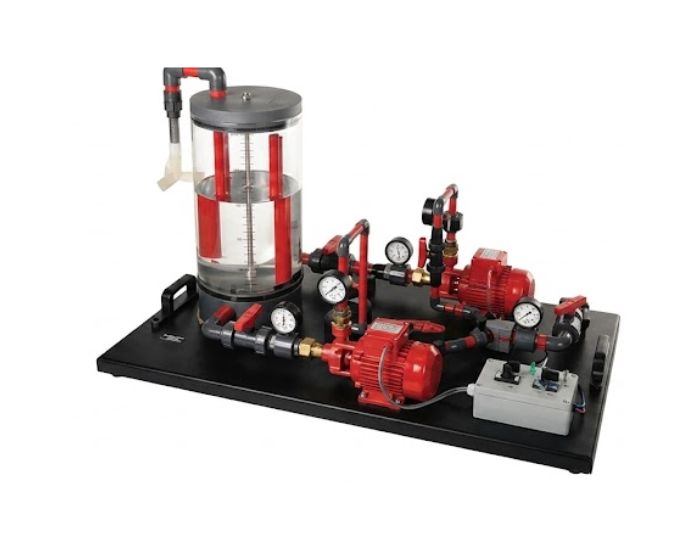
Series and Parallel Configuration of Pumps Apparatus
Model Number: MTHB-150.15
The Series and Parallel Configuration of Pumps Apparatus is an educational fluid mechanics laboratory system designed for determining pump characteristic curves and hydraulic power output and comparing series and parallel operating modes. The apparatus incorporates two pumps that can be operated individually, in series, or in parallel, enabling students to investigate how different pump configurations affect discharge, pressure head, and overall hydraulic performance.
Product Specification
The Series and Parallel Configuration of Pumps Apparatus is a comprehensive educational laboratory system developed for studying the operating characteristics of pumps connected in different configurations. Manufactured by Micro Technologies, the apparatus allows students to experimentally investigate individual pump performance and compare it with the combined performance obtained when two pumps operate in series or parallel.
Pump combinations are widely used in engineering systems where a single pump cannot provide the required head or flow rate. Understanding the behaviour of pumps connected in series and parallel is therefore an important part of fluid mechanics, hydraulic engineering, and pump-system design.
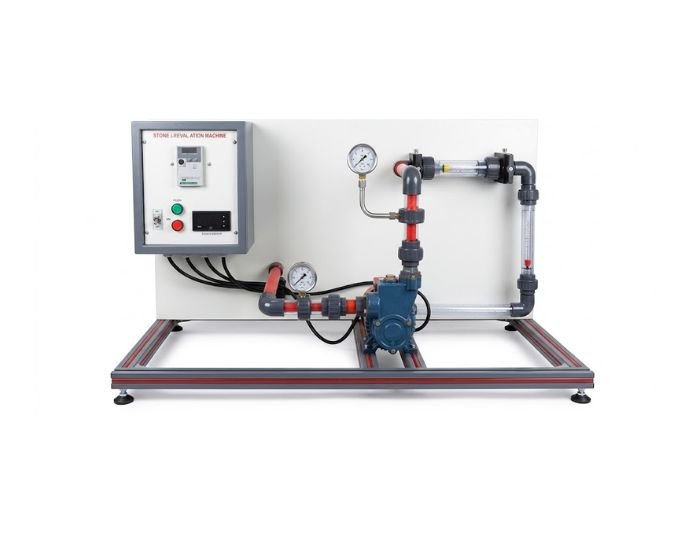
The apparatus incorporates two centrifugal pumps, an interconnected piping network, flow-control valves, pressure measurement devices, flow measurement facilities, and an electrical control arrangement. The piping system allows the pumps to be configured for different experimental operating modes.
In series operation, the discharge from one pump is supplied to the inlet of the second pump. This arrangement is primarily used to investigate the increase in available pressure head produced by combining pumps in sequence.
In parallel operation, both pumps receive water from a common supply and deliver it into a common discharge line. This configuration is useful for studying how parallel pump operation influences the total available flow rate.
The apparatus also allows individual pump characteristics to be determined. By changing the discharge condition and recording the corresponding pressure and flow measurements, students can develop pump characteristic curves for different operating modes.
Experimental readings can be used to determine the hydraulic power output and analyze the performance of individual, series, and parallel pump configurations.
The apparatus provides a practical method for comparing theoretical pump-combination principles with actual laboratory measurements. Students can observe that the performance of combined pumps depends on pump characteristics, system resistance, operating point, and hydraulic conditions.
The compact experimental arrangement and clearly accessible components make the system suitable for regular student practicals, demonstrations, and engineering laboratory examinations.
Features
- Two-pump experimental configuration
- Individual pump operation
- Series pump operation
- Parallel pump operation
- Determination of pump characteristic curves
- Hydraulic power output determination
- Adjustable discharge conditions
- Integrated flow-control valves
- Pressure measurement arrangement
- Flow-rate measurement facility
- Clearly arranged hydraulic circuit
- Suitable for performance comparison
- Integrated electrical controls
- Compact laboratory configuration
- Robust supporting structure
- Suitable for repeated student experiments
Benefits
- Allows direct comparison of series and parallel pump operation
- Demonstrates the effect of pump configuration on head and flow
- Enables individual pump performance analysis
- Supports characteristic curve preparation
- Allows hydraulic power output to be determined
- Provides practical understanding of multi-pump systems
- Demonstrates important pump-selection principles
- Helps students understand system operating points
- Connects theoretical pump concepts with practical measurements
- Provides hands-on experience with hydraulic pumping systems
- Suitable for practical examinations and demonstrations
Product Specifications
| Specification | Details |
|---|---|
| Product Name | Series and Parallel Configuration of Pumps Apparatus |
| Product Type | Pump Performance Laboratory Apparatus |
| Pump Arrangement | Two-Pump Configuration |
| Pump Type | Centrifugal Pumps |
| Operating Modes | Individual, Series & Parallel |
| Primary Study | Pump Characteristic Curves |
| Performance Measurement | Hydraulic Power Output |
| Pressure Measurement | Pressure Measuring Arrangement |
| Flow Measurement | Integrated Flow Measurement |
| Flow Control | Adjustable Valves |
| Hydraulic Circuit | Reconfigurable for Series & Parallel Operation |
| Parameters Studied | Flow Rate, Head & Hydraulic Power |
| Control | Integrated Electrical Control |
| Operation | Educational / Experimental |
| Application | Fluid Mechanics & Hydraulic Engineering Laboratories |
Operating Modes
Individual Pump Operation
Each pump can be studied independently to determine its individual operating characteristics. Measurements at different flow rates can be used to develop the characteristic curve of the pump.
Series Pump Operation
When pumps operate in series, the discharge of the first pump enters the second pump. This configuration is primarily studied to investigate the increase in total pressure head available from the combined pumping system.
Parallel Pump Operation
When pumps operate in parallel, both pumps contribute flow to a common discharge line. This arrangement is studied to investigate the increase in combined discharge capacity under appropriate system conditions.
Experiments Performed
- Determine the characteristic curve of an individual pump
- Determine pump performance at different flow rates
- Operate two pumps in series
- Operate two pumps in parallel
- Determine characteristic curves for series operation
- Determine characteristic curves for parallel operation
- Compare individual and combined pump characteristics
- Determine hydraulic power output
- Study discharge versus head characteristics
- Investigate the effect of series operation on pressure head
- Investigate the effect of parallel operation on discharge
- Compare series and parallel operating modes
- Study the operating point of a pumping system
- Analyze multi-pump hydraulic performance
Parameters Studied
The apparatus can be used to investigate:
- Flow rate
- Pump discharge
- Suction pressure
- Delivery pressure
- Pressure head
- Total pump head
- Hydraulic power output
- Individual pump characteristics
- Series pump characteristics
- Parallel pump characteristics
- Combined pump performance
- System operating conditions
Pump Characteristic Curves
Experimental readings obtained at different operating points can be used to prepare and compare characteristic curves for:
- Individual pump operation
- Pumps operating in series
- Pumps operating in parallel
- Head versus discharge
- Hydraulic power versus discharge
These curves provide students with a practical understanding of how pump combinations influence hydraulic-system performance.
Educational Objectives
The apparatus helps students understand:
- Centrifugal pump characteristics
- Pump performance curves
- Pumps connected in series
- Pumps connected in parallel
- Flow rate and pressure head
- Hydraulic power
- Multi-pump systems
- Pump operating points
- Effect of system resistance
- Pump combination selection
- Practical pump performance analysis
Engineering Applications
The principles demonstrated using the apparatus are relevant to:
- Water supply systems
- Booster pumping stations
- Industrial pumping systems
- HVAC installations
- Irrigation systems
- Water treatment plants
- Process industries
- Cooling-water systems
- Fire-water pumping installations
- Municipal water distribution
- Building services
- Multi-pump stations
Applications
- Fluid Mechanics Laboratories
- Hydraulic Engineering Laboratories
- Mechanical Engineering Laboratories
- Civil Engineering Laboratories
- Hydraulic Machinery Laboratories
- Water Resources Engineering Laboratories
- Energy Engineering Laboratories
- Engineering Colleges
- Universities
- Polytechnic Institutes
- Technical Training Centres
- Research Laboratories
FAQs
What is a Series and Parallel Configuration of Pumps Apparatus?
It is an educational laboratory system containing two pumps that can be operated in different configurations to investigate and compare individual, series, and parallel pump performance.
What is the main purpose of this apparatus?
The primary purpose is determining pump characteristic curves and hydraulic power output and comparing series and parallel operating modes.
What happens when pumps are connected in series?
In series operation, the discharge of one pump enters the next pump. The arrangement is commonly used when a greater total head is required than one pump can provide under the same general operating conditions.
What happens when pumps are connected in parallel?
In parallel operation, multiple pumps supply a common discharge line. This arrangement is commonly used when greater flow capacity is required.
Can individual pump characteristics be determined?
Yes. The pumps can be studied individually to obtain their characteristic performance before comparing them with series and parallel configurations.
Can pump characteristic curves be plotted?
Yes. Flow and pressure measurements at different operating conditions can be used to develop and compare pump characteristic curves.
Can hydraulic power output be determined?
Yes. The measured flow rate and pump head can be used to determine the hydraulic power delivered to the fluid.
Why are pumps operated in series?
Series operation is useful when the system requires increased pressure head.
Why are pumps operated in parallel?
Parallel operation is useful when the system requires increased flow capacity.
Is this apparatus suitable for engineering colleges?
Yes. It is suitable for mechanical, civil, hydraulic, fluid mechanics, hydraulic machinery, and water resources engineering laboratories.
Why Choose Our Products
- Individual, series, and parallel pump studies
- Pump characteristic curve determination
- Hydraulic power output analysis
- Practical comparison of pump configurations
- Integrated flow and pressure measurement
- Clearly arranged hydraulic circuit
- Practical engineering-focused design
- Robust laboratory construction
- Suitable for repeated student experiments
- Institutional and bulk laboratory supply
- Customized configurations available
- Technical and project support
Call to Action
Looking for a reliable Series and Parallel Configuration of Pumps Apparatus for your fluid mechanics laboratory? Micro Technologies manufactures and supplies pump testing, fluid mechanics, and hydraulic engineering laboratory equipment for universities, engineering colleges, polytechnics, research institutes, and technical training centres. Contact us for complete laboratory setups, customized configurations, institutional projects, bulk requirements, distributor inquiries, or a competitive quotation.